zenpundit.com » framing

Archive for the ‘framing’ Category

Of war and miracle: the poetics, spirituality and narratives of jihad

Wednesday, March 30th, 2011

[ by Charles Cameron ]

*

Issue #5 of the AQAP magazine Inspire is now available for viewing.

I am reasonably confident that with attention focused on such things as al-Awlaki‘s response to the various uprisings across the middle east, the delightful computer graphic (a throw back to the era of green print on black screens) which shows Ben Ali and Mubarak “booted” and Gadhafi and Saleh “in progress” – and the translation of a chunk of Abu Musab as-Suri on “Individual Terrorism Jihad and the Global Islamic Resistance Units” – a lot of eyes will glaze over during the course of reading “My Life In Fallujah” (pp. 56 ff).

The piece sounds promising – something to read about Fallujah from the enemy viewpoint for after action / lessons learned purposes… but then it gets into miracles:

The brothers received extraordinary miracles from Allah as a sign to strengthen them and these miracles were in all different forms. It got to the point where some of the things that occurred might not have been believable to the brothers had they not seen them with their own eyes but that is the grace of Allah which He bestows on whom He wills.

… and my bet is that snoring ensues…

Though not among the readers to whom it is pitched.

.
One:

What if we don’t regard the piece as a mirror for our own knowledge of events in Fallujah, but as an opening into the enemy’s grand narrative and – gasp – spirituality?

The piece continues:

Now let me relate some of the stories of fighting with the enemy and the miracles some of the brothers received. I will start mentioning some of these great miracles

There was a brother named Abu az-Zubair as-Sana’ani. He was killed at the beginning days of the battle. We used to go out in the daytime to engage with the enemy. Hardship and severe exhaustion were afflicting us due to the hot weather that was in the beginning of Ramadan.

So that brother came at the time of afternoon and sought permission from the Amir to break his fast. Some brothers advised him to have patience and suggested to him that he could have a shower and then rest for a while. The brother went inside to sleep out of fatigue and we were sitting in front of that house. The brother didn’t sleep long and we saw him coming out towards us with a cheerful face saying to us that he had seen a dream while he was asleep. The brothers asked him what was it; he told them that he saw a very beautiful woman coming to him, carrying a plate full of all kinds of fruits. She was waking him up, standing by his head and telling him: O Abu az-Zubair, don’t break your fast. You are invited to break your fast with us today. The brother then said that he felt comfort and relief. There was a brother called Abu Tariq who interpreted dreams so he told him that by Allah’s will, it will be something good. After that the brother decided to continue fasting.

We had a timetable for twelve people to cook food and that day was his turn. He went to the kitchen and we stayed outside, sitting next to the wall of that house so that we weren’t seen by the spy planes. We stayed there until it was about time to break fast. Suddenly an F-16
jet showed up in the horizon and targeted that kitchen with a missile where that brother was! A while after when the dust had settled, we went in the kitchen and saw that brother had been martyred. It was amazing how the smell of musk was all over the room, how the smile was on his face!

Thereupon the brothers’ moral was raised and they were making takbir. These were from the unforgettable moments.

It seems wise to compare this with the Miracle of Uthmaan recounted by Abdullah Azzam on p. 27 of his book, The signs of Ar-Rahmaan in the Jihad of Afghanistan — indeed, I’m surprised Inspire didn’t make the connection:

One morning Uthmaan (ra) said: Last night I saw Rasulullah sallAllaahu alayhi wa sallam in my dream, and he said: Oh Uthmaan, break your fast with us. He was martyred that same day, whilst in the state of fasting.

If one considers such stories not as “superstitious” or examples of “magical thinking” – one easy way to discount them – nor as “diabolic” and emblematic of a “false religion” – another – if, in fact, one reads them with some empathy for their content as faith-narratives, they are profoundly moving, and will no doubt be so to many of their intended readers.

This particular narrative – an earthly fast broken in heaven – could well be a motif in the Aarne-Thompson classification system for folkloric motifs.

Note also the reliance on dreams and dream interpretation – a reliance which also figures prominently in the transcript of bin Laden‘s discussion of 9/11.

.
Two:

Another miracle was the incident of Abu Abd ar-Rahman at-Turki who was a student of knowledge that memorized the Qur’an and the six books of hadith. He was amongst a group that went out to confront a breakthrough of the enemy. While the brothers were gathered to organize a defensive plan, this brother made takbir and rushed towards the enemy. Some brothers called him back but he didn’t pay attention to their words. He shouted back to them saying “I am seeing the hoor! I am seeing the hoor!” When this brother reached the enemy’s area, he was shot by a tank shell leaving his lower body completely severed. Some brothers managed to drag him out of there to a safe house which I was in. Even though the brother was between consciousness and unconsciousness, he was still advising brothers to fear Allah and to keep firm upon the truth. His lower half was ripped out, yet he was still reassuring the brothers and would always raise his vision upwards telling them that he is seeing the hoor coming, and that they should keep firm because this is the path of jannah. At hearing that, the brothers’ spirits were high and they felt relieved. Abu Abd ar-Rahman declared the shahada and then kept fainting until his soul departed his body. At that point we smelled the musk coming out of him and saw peace on his face. This smell of musk from the mujahidin would be something that was smelt regularly.

This “smell of musk” too (also found in the story of Abu az-Zubair above) is a regular feature of martyrdom tales, and features in the same work by Azzam, for instance in this report:

Moulana Arsalaan narrated to me:A student named Abdul Baseer attained shahaadat while with us. It was very dark. Fathullah, another mujaahid, and I went in search of his body. He said to me: “Is the Shaheed close. I perceive a fragrant scent”. I picked up the scent, and we reached the body by following the scent. In the darkness, I could see a noor (light) in the blood, which was gushing forth from his wound.

Indeed, as I have pointed out before, this motif has a parallel in the Catholic tradition of the “odor of sanctity” – “the perfume-like scent given forth by the bodies of saints during their lifetime or after death … symbols of the fragrance of extraordinary virtue” [as defined in Fr. John Hardon’s Modern Catholic Dictionary].

It appears in the Arthurian legends, too, as Malory describes the death of Sir Lancelot – notice here, too, the motif of the joyous dream:

And so after midnight, against day, the Bishop [that] then was hermit, as he lay in his bed asleep, he fell upon a great laughter. And therewith all the fellowship awoke, and came to the Bishop, and asked him what he ailed. Ah Jesu mercy, said the Bishop, why did ye awake me? I was never in all my life so merry and so well at ease. Wherefore? said Sir Bors. Truly said the Bishop, here was Sir Launcelot with me with mo angels than ever I saw men in one day. And I saw the angels heave up Sir Launcelot unto heaven, and the gates of heaven opened against him. It is but dretching of swevens, said Sir Bors, for I doubt not Sir Launcelot aileth nothing but good. It may well be, said the Bishop; go ye to his bed, and then shall ye prove the sooth. So when Sir Bors and his fellows came to his bed they found him stark dead, and he lay as he had smiled, and the sweetest savour about him that ever they felt.

.
Three:

There was a brother named Abu Dujanah at-Taifi. As soon as he entered Fallujah at the beginning of the battle, he asked the brothers to let him go to the front lines but the brothers told him that he had to learn shooting first. He replied, “By Allah! I won’t be anywhere except the front lines.” His brother was present there so they agreed to his request and allowed him to go there.Thereupon he said: ”By Allah! If the Americans come forward, then Allah will see from us that which He loves.” He then went to stay inside a trench to keep an eye on the front lines.On the second day when he saw the enemy breaking through, he jumped out and got ready to strike them with an RPG but before he could fire it, he was struck by a tank, and as a result, his body was torn apart. His body stayed there for six days before we were able to retrieve it.

To our surprise, blood was still coming out of his body even though the weather was so hot that if you were to place a piece of meat outside for half a day, it would eventually get rotten.

His blood was seeping as if he was just killed and his index finger was in the position of tashahud [that section of Muslim prayer where the index finger is raised while reciting the shahada or confession of faith]. His brother was a little bit sad at hearing the news but once he saw his body, he felt so much comfort.

E Cobham Brewer’s Dictionary of Miracles: Imitative, Realistic, and Dogmatic looks to be a terrific source for the kind of research I’m doing here – that’s the “Brewer” of Brewer’s Dictionary of phrase and fable – and p 372 of the 1894 edition has a section on “Bodies of Saints Incorruptible” prefaced by a quotation from Psalm 16.10: “Thou wilt not suffer Thy Holy One to see corruption”.

His body preserved, his finger raised in the gesture of  salat … powerful.

.
Four:

Another incident that has to be mentioned is when the Americans were breaking-through from the direction of the Shuhada district. The brothers in that area were few in numbers so they were attacked fiercely and their lines were nearly broken but all praise be to Allah, it started drizzling all of a sudden, and then the brothers were strengthened and encouraged. The enemy was fleeing so we did not know whether they fled because of the brothers fighting or because they saw something else. The enemy acted as though they had been frightened by something. The brothers only numbered six. The enemy was massive as they were accompanied by tank corps and armoured vehicles but their withdrawal was bizarre. At that time we remembered the verse of the Qur’an where Allah says:

And sent down upon you from the sky, rain by which to purify you and remove from you the evil [suggestions] of Shaytan and to make steadfast your hearts and plant firmly thereby your feet [8: 11].

Once again, the motif of merciful rain should not be unfamiliar to us – if not from the New Testament‘s “He makes His sun rise on the evil and on the good, and sends rain on the just and on the unjust” then at least from Shakespeare‘s “The quality of mercy is not strain’d, / It droppeth as the gentle rain from heaven / Upon the place beneath…”

.
Five:

How many references to literary analysis, or archetypal analysis for that matter, can you find in Heuer‘s classic Psychology of Intelligence Analysis?
Soon soon coming of the Mahdi?

Monday, March 28th, 2011

[ by Charles Cameron ]

*

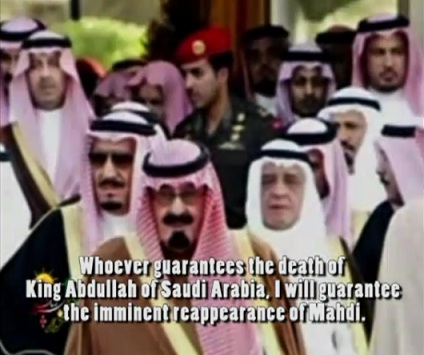
Okay, I’d say things are heating up. Here’s a screen grab from what we are led to believe is a recent video from Iran, made with government backing as described below the fold.

death-of-abdullah-sign-of-mahdi.jpg

This does not bode well…

*

The Christian thriller novelist Joel Rosenberg (author of The Twelfth Imam) has a new blog post up, in which he cites a Christian Broadcasting Network story — which in turn refers to a video posted with some introductory materials on his blog by Reza Kahlili (author of A Time to Betray: The Astonishing Double Life of a CIA Agent Inside the Revolutionary Guards of Iran).

According to Kahlili, who has also posted the full video to YouTube, it is a half-hour long program sponsored by the Basij militia and the Office of the President of Iran, affirming the soon-return of the Mahdi.

And containing “inflammatory language” about King Abdullah of Saudi Arabia (see subtitle above)?  Can I say that?

For what it’s worth, the supposed “hadith” about the death of King Abdullah is discussed in some detail at The Wake-Up Project, so it’s definitely “in the air” — but I don’t recall seeing any references to it in Abbas Amanat, Abdulazziz Sachedina, or any of the lists of Signs of the Coming I’ve read, so my suspicion is that this is an opportunistic addition to the corpus rather than a reliable hadith.

Which brings me to my last point:

I am not posting these materials to encourage panic — that’s what terrorism strives for, and it is the very opposite of what I would wish to see.  If anything, these stirrings of Mahdist sentiment should make us more careful and attentive to the serious scholarly work that has been done in this area.  Jean-Pierre Filiu‘s book Apocalypse in Islam, which I reviewed for Jihadology, would be an excellent place to start.

*

There are plenty of other things going on that I would love to track, blog about or comment on these days, but for the next while I shall try to restrain myself and focus in on this particular issue and its ramifications:

  • Contemporary Shi’ite Mahdist expectation
  • The Iranian nuclear program in the light of Mahdist expectation
  • Iranian attempts to use Mahdism to unite Sunni and Shi’a
  • Mahdism and jihad
  • The role of Khorasan in Mahdist rhetoric
  • Christian apocalyptic responses to Mahdist stirrings
  • Joel Rosenberg‘s book, The Twelfth Imam
  • Joel Richardson‘s book, The Islamic Antichrist
  • Glenn Beck‘s increasing focus on Iranian Mahdism
  • The increasing influence of Islamic and Christian apocalyptic on geopolitics

This is a pretty complex and potent mix of topics, and while I’ll post some individual pieces of the puzzle as I see it, I shall also try to put together a “bigger picture” piece with the whole mosaic laid out.

*

Apart from that, I remain deeply committed to questions of chivalry and peace-making, and will continue to monitor developments and write what I can on those topics as time allows…

Honor killings

Monday, March 7th, 2011

[ by Charles Cameron — cross-posted from ChicagoBoyz ]

*

I had occasion today to give myself a quick refresher course on honor killings, one form of which is already present in the Torah as of Leviticus 21.9:

And the daughter of any priest, if she profane herself by playing the whore, she profaneth her father: she shall be burnt with fire.

and found myself once again noting that there is a substantial swathe of regions of the world where honor killings are found, and that where it is found (including in immigrant communities from those parts of the world) the practice is not confined to any one religious group.

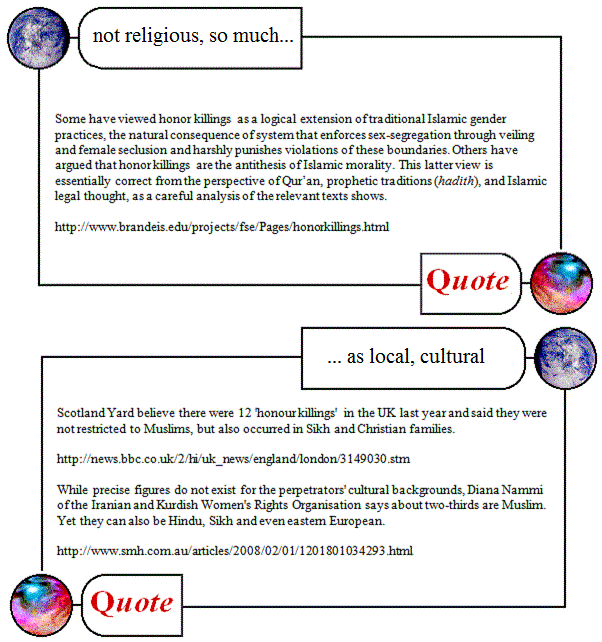
Hence this DoubleQuote:

I think it is appropriate to consider honor killing a form of religious violence when the claim is made by those who do the killing that they are acting in the name of their religion — but that it is also important to distinguish such acts committed in a cultural context in which they are practiced across religions from acts that are the exclusive province of one religious tradition.

There are examples of honor killings which are performed in the name of Islam, and/or advocated by Islamic scholars — and the same could no doubt be said of other religious traditions — but honor killing as a genre is fundamentally more cultural than religious.

Sources: Brandeis studyBBCSydney Morning Herald

The analytic point:

From my point of view as an analyst, it is important to note and compare both religious and cultural drivers — neither avoiding mention of the one out of “correctness” — nor overlooking the other for lack of comparative data.

A HipBone approach to analysis VI: from Cairo to Bach

Monday, February 28th, 2011

[ by Charles Cameron ]

*

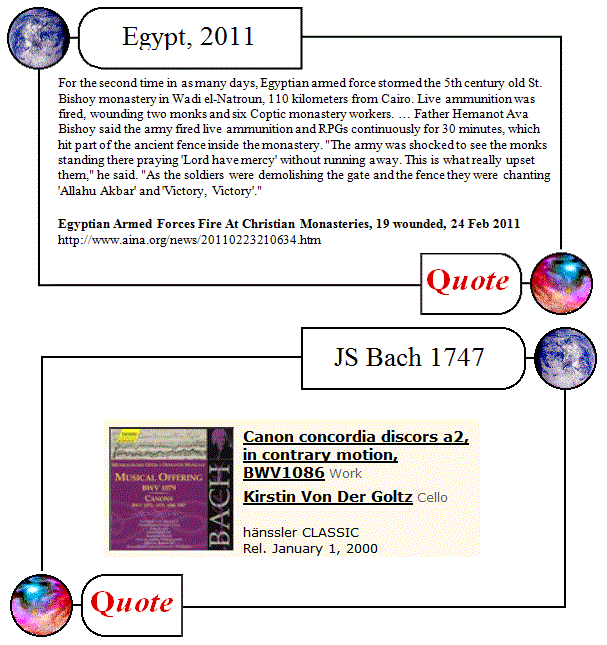
The description of Egyptian troops attacking a Christian monastery that forms the first quote in this DoubleQuote is horrifying in many ways.

quoprayer-counter-prayer.gif

Recent events in Egypt had featured mutual support between Muslims and their Coptic Christian neighbors, each group in turn acting as human shields to protect the other while they were praying. Here, by contrast, the army – which is effectively now “ruling” Egypt in the interregnum between the fall of Mubarak and the election of a new President and government – is attacking the humans it is supposed to protect.

But what does that have to do with Bach?

*

Part I: a monastery attacked in Egypt

This is vile.

Those who are being attacked happen to be Christians and monks, no less human on either account, and just as subject to bleeding as others – so they might ask, with Shakespeare‘s Shylock speaking for the Jews:

If you prick us do we not bleed? If you tickle us do we not laugh? If you poison us do we not die? And if you wrong us, shall we not revenge?

That last question of Shylock’s is an interesting one, and gets to the heart of what I want to discuss here, as we shall see.

Specifically, these human beings were monks. Muhammad had a higher opinion of monks than of many others. In the Qur’an, we find:

The nearest to the faithful are those who say “We are Christians.” That is because there are priests and monks among them and because they are free of pride.

*

Sigh.

These “followers” of Muhammad were attacking Christian monks with live ammunition and RPGs continuously for 30 minutes, wounding 19.

They felt superior to their compatriots the monks, they cried “God is Great” and “Victory, Victory” as they did it.

In this they resemble GEN Boykin, who famously responded to a Somali warlord claiming that God would protect him, “Well, you know what? I knew that my God was bigger than his. I knew that my God was a real God and his was an idol.”

I could easily have made that my second quote here, pairing it with the description of the Egyptian army attack on the monastery, for between the two of them they raise the question of whether weaponry is stronger than belief – and while some Christians might agree with General Boykin, some Muslims might agree no less strongly with the members of the Egyptian military shouting “Allahu Akbar”.

*

I believe that taking sides here misses the point.

Which I am happy to say, Abraham Lincoln made with considerable eloquence in his Second Inaugural Address in 1865, almost a century and a half ago:

The prayers of both could not be answered. That of neither has been answered fully. The Almighty has His own purposes.

That point is one which HaShem made to his angels, according to rabbinic teaching:

The Talmud teaches us that on the night that the Egyptian army drowned in the Red Sea, the first true moment of freedom for the Jews fleeing Egypt, God refused to hear the angels sing their prayers, and said “my creations are drowning in the sea, and you will sing songs?”

So, no — revenge is not the way to go…

*

But please note that the point I am making is not one of moral equivalence.

That God which created “both sides” in any human conflict and loves each and every one of his own creations, might indeed find one creed superior to another, as he might find one scientific law more accurately describing the workings of, say, gravitational attraction than another – or the night sky at Saint-Rémy portrayed by Van Gogh more or less moving than the thunderous sky over Toledo of El Greco.

In the view I am proposing, the “God who takes neither side” in fact takes both, but with this distinction: he sides with the wounded more than with those who inflict wounds – not because one side has a better creed than the other, but because he made us to learn not to unmercifully maim and destroy one another…

…one of whose names is The Merciful, in whose scriptures it is written:

If thou dost stretch thy hand against me, to slay me, it is not for me to stretch my hand against thee to slay thee: for I do fear Allah, the cherisher of the worlds.

…one of whose names is The Lord is Peace, in whose scriptures it is written:

Love your enemies and pray for those who persecute you.

*

Part II: Bach and contrapuntal analysis

All of which brings me to the second “quote” in my DoubleQuote above: JS Bach‘s “concordia discors” canon in two voices, BWV 1086 – which you can hear or purchase here.

Bach’s mastery was in counterpoint, the play of one musical idea against another, and in this particular work, the two ideas are exact opposite: in musical terms, the melody is played here against its inversion. And the point of counterpoint, if I may put it that way, is not to provide “harmony” but to show how discord can become harmonious and concordant — or to put that in the geopolitical terms that interest me, how conflict and opposition can be resolved…

Not, you understand, that this state of affairs then leads necessarily to the singing of Kumbaya or the kind of ending in which “they all lived happily ever after”.

Concordia discors: the resolution of the present conflict, in a continuing overall “music” of great power and beauty, in which further conflicts will inevitably arise and find resolution.

*

Here’s the essence: Bach takes contrasting and at times conflicting melodic ideas and makes music.

He teaches us to hear distinct and differing voices, to allow ourselves to hear and feel both the discomfort that their disagreements raise in us, and the satisfaction that comes as those disagreements are worked out. He does this by teaching us to hear them as voices within a choir, ribbons in a complex braid, making together a greater music that any of them alone could give rise to. And in this process, their differences are neither denied nor lost, but resolved and transcended.

Edward Said, whose politics my readers may dislike or like or even perhaps be unaware of, was for years the music critic for The Nation, wrote three books (and an opus posthumous) on music, and with his friend the pianist and conductor Daniel Barenboim co-founded the West-Eastern Divan Orchestra, named for the West-östlicher Diwan, Goethe’s collection of lyric poems.

Barenboim (the Israeli) wrote of Said (the Palestinian):

In addition to being well versed in music, literature, philosophy, and the understanding of politics, he was one of those rare people who sought and recognized the connections between different and seemingly disparate disciplines. His unusual understanding of the human spirit and of the human being was perhaps a consequence of his revelatory construct that parallels between ideas, topics, and cultures can be of a paradoxical nature, not contradicting but enriching one another.

And there we have it again: Bach’s insight, this time transposed by an accomplished musician into the key of thoughts and ideas…

*

Said talks quite a bit about counterpoint, both musically:

Musically, I’m very interested in contrapuntal writing, and contrapuntal forms. The kind of complexity that is available, aesthetically, to the whole range from consonant to dissonant, the tying together of multiple voices in a kind of disciplined whole, is something that I find tremendously appealing.

.

[Said, Power, Politics and Culture, p. 99.]

and politically:

When you think about it, when you think about Jew and Palestinian not separately, but as part of a symphony, there is something magnificently imposing about it. A very rich, also very tragic, also in many ways desperate history of extremes — opposites in the Hegelian sense — that is yet to receive its due. So what you are faced with is a kind of sublime grandeur of a series of tragedies, of losses, of sacrifices, of pain that would take the brain of a Bach to figure out. It would require the imagination of someone like Edmund Burke to fathom.

.

[Said, Power, Politics and Culture, p. 447.]

*

As I commented in an earlier post that ties in with this one, the great pianist Glenn Gould was also preoccupied with counterpoint, both in Bach’s music and in conversations overheard at a truck-stop cafe or on long train journeys — he too was “working” the parallel between melodic and verbal forms of counterpoint.

And JRR Tolkien made the reconciliation of discordant musics in a greater concord the central to his creation myth in The Silmarillion, “The Music of the Ainur”, which can now be read online at the Random House site.

*

Part III: invitation

May I strongly commend to your attention the movie, Of Gods and Men, which just opened in limited release, having won the grand jury prize at Cannes…

A HipBone approach to analysis V: DARPA and storytelling

Sunday, February 27th, 2011

[ by Charles Cameron — cross posted from DIME/PMESII ]

I seem to be writing some mini-essays that braid together more of the various strands of my interests and thinking than usual – geopolitics and poetics, games and reality, warfare and peacemaking.

Here’s one that I posted yesterday, on a list devoted to modeling and simulation, in a topic discussing DARPA’s STORyNET briefing tomorrow.

*

DARPA and Storytelling:

One

Sophocles, pushing the human mind to its limit, genius, wrote the Oedipus trilogy. His plays, which turn on the parallel guilt and innocence of a man who – unknowingly, the fated plaything of cruel gods — kills his father and sleeps with his own mother, were performed by the great actors of his day in the great amphitheater of Epidaurus, the sanctuary of Aesculapius to which the Greeks went for healing.

Freud, also brilliant, also concerned with the human mind and healing, reduced Sophocles’ plot to his own “Oedipus Complex” – which he would then painstakingly find in the murkiest regions of his patients’ mental processing.

Further reduced, the concept becomes a word of abuse so radical it takes two letters, one hyphen and ten asterisks to print it – and finally, it slides into song and speech as mofo, all meaning leached from the two words, let alone the complex insights of Sophocles or Freud.

Two

Story, you might say, has a trunk, limbs, branches, lesser branches, twigs…

Trees and ferns, we now know, are fractal. The mathematical “story” of a tree is arguably just one story: branching. Different trees branch differently, the yucca pushing out its limbs in 90 degree rotation, oaks and birches, beeches and cottonwoods, poplars and ferns each having their own mathematical characteristics, and each individual of each species answering to certain specifics of context – water, sunlight, wind forming clusters of trees into copses.

For the purposes of lumber, the “trunk” of a story may be enough, or trunk and limbs, mofo or m*****-f***** an adequate telling of Sophocles tale. For a winter wood supply, cords of sawn branches, for a camp fire, some branches some twigs — for Sophocles, for Ansel Adams, the one pushing the human mind to its limit, genius, only the full tree, root, stem, branch, and leaf, rich in all its detail and context, will suffice.

Three

So there are six stories, there is only one, the stories in the ocean of stories are infinite, as Salman Rushdie, another of those who pushes the human mind to its limit tells us:

… the Water Genie told Haroun about the Ocean of the Streams of Story, and even though he was full of a sense of hopelessness and failure the magic of the Ocean began to have an effect on Haroun. He looked into the water and saw that it was made up of a thousand thousand thousand and one different currents, each one a different color, weaving in and out of one another like a liquid tapestry of breathtaking complexity; and [the Water Genie] explained that these were the Streams of Story, that each colored strand represented and contained a single tale. Different parts of the Ocean contained different sorts of stories, and as all stories that had ever been told and many that were still in the process of being invented could be found here, the Ocean of the Streams of Story was in fact the biggest library in the universe. And because the stories were held here in fluid form, they retained the ability to change, to become new versions of themselves, to join up with other stories and so become yet other stories …

— and as Edward Tufte, another of the pushers of the mind, illustrates for us in his beautiful book, Visual Explanations, in a page or two of which this snapshot gives only a poor glimpse.

Four

So there is utility in the single equation, the single story line, and there is use for the outlines of the major branchings and knowing the main varieties of trees, and there is beauty and insight and pushing the mind to its limit in the whole tree, individual and splendid in all its detail, the great story, magnificently branching from its seed-story under the influence of a Shakespeare, a Kafka, a Dostoyevsky, a Borges, a Rushdie…

The full spectrum of understanding that narrative might bring us will be found when the full spectrum from “one story” through “six” or “sixteen” to Rushdie’s “infinity” is taken into account, when we weigh the insights of the great novelists and poets of all cultures – Rumi, Shakespeare, Kalidasa, the anonymous singers of the Navajo Beautyway – alongside those of the critic, the psychoanalyst, the guy who puts together the Cliff’s Notes, and the editor with a headache’s headline version of the tale.

We need the forester and the lumber baron, the watercolorist and the fellow who identifies the habitats of the Lepidopterae

Narrative goes all the way from the obvious platitude to the work of genius. Somewhere along that scale, each one of us will have our area of interest, the place where our skill set fits and perhaps stretches. Numbers of board feet and likely return on investment can be assessed by quantitative means: the beauty of a particular oak tree in the eye of the novelist John Fowles is entirely qualitative, as is the language he must use to describe it.

Five

I suspect DARPA may be stuck at the quantitative end of the spectrum. The mind of a Musab al-Suri demands a finer level of interpretation.


Switch to our mobile site