zenpundit.com » framing

Archive for the ‘framing’ Category

Iconic: compare and contrast III

Saturday, December 24th, 2011

[ by Charles Cameron – Iraq war, beginning and ending, analytic power of similarity ]

.

I’ve thanked Zen for his Iconic Compare and Contrast post already, but I’d like to run with his juxtaposition of images from the end of the Iraq war, and book-end it with an early DoubleQuote of mine from the beginning, thus:

That’s the beginning of the war, as I saw it “binocularly” — and here’s its ending, as Zen captured it:

Different though they are — one verbal, one visual — I think they go well together. I think they belong together.

But that’s essentially an aesthetic intuition.

*

And — apart from thanking Zen — that’s the thing I want to talk about.

The two quotes, eighty-six years apart, about an (anglophone) army in Baghdad coming there to liberate, not to conquer, are similar enough that they should give us pause for thought. They challenge us to think long and hard about the similarities between the two situations — and they challenge us to think no less hard and long about their differences.

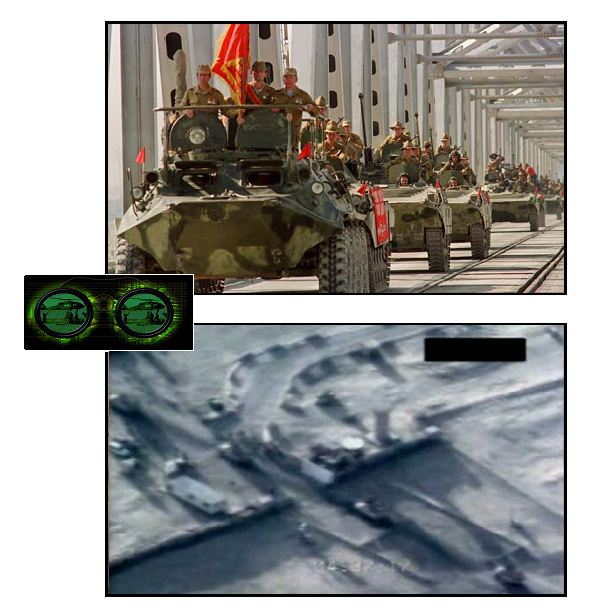
Likewise, it’s the similarities between the two images Zen chose — of the Soviet withdrawal from Afghanistan and the US exit from Iraq — that give that juxtaposition its power.  And Zen has chosen very carefully:

Not only are there two lines of vehicles stretching back from the foreground away into the distance in each image, but the angle from which the two columns are seen is about the same — and there are even two “tracks” in each photo reinforcing the vanishing point — two tracks to the right of the vehicles in the Afghan photo, the edge of the road and a what looks like the shadow of an overhead cable in the photo from Iraq.

*

But let’s take this a bit further. The following juxtaposition is every bit as much a juxtaposition of the Soviet and American withdrawals as the pair of images Zen picked, but this time we have an aerial view of the US convoy — so the visual “rhyme” between the two images is no longer there — and even though the aerial shot is an intriguing one, what a difference that makes!

There’s nothing in that juxtaposition to make you go, yes!

On the level of what’s being referred to, the troop withdrawals from Afghanistan and Iraq,  this pair of images has the same properties as the two images that Zen selected.  But it doesn’t capture our attention in nearly the same way.

And the same would have been true if I’d picked a different sentence from Rumsfeld‘s speech to juxtapose with General Maude‘s “not as conquerors or enemies but as liberators” — such as, “You’ve unleashed events that will unquestionably shape the course of this country, the fate of the people, and very likely affect the future of this entire region.” I’d still be comparing and contrasting two speeches from the beginnings of two occupations of Baghdad.  But there’d be no oomph to the comparison.

*

Because — and this is what I am trying to get at, the basic principle of HipBone analysis and what distinguishes it from otherwise similar modes of brainstorming and mind-mapping — the recognition of pattern, of salient sameness, of close parallelism or opposition is the criterion for success or failure in a HipBone-style juxtaposition.

Zen’s graphic example has that closeness — even down to those two parallel tracks beside and to the right of the vehicles.  My two quotes from Maude and Rumsfeld have that.  And it’s that closeness of match that makes a juxtaposition powerful.

Analogy works this way, rhyme works this way, fugue works this way, graphic match (in cinematography) works this way — it’s basic to the arts, basic to rhetoric, and basic to the way our analogically-disposed minds think.

It is not a method for arriving at conclusions, it’s a method for posing questions. And it sits right at the juncture where analysis admits it is not a science but an art.

A question for the readership

Saturday, December 10th, 2011

[ by Charles Cameron — terminology of war ]
.
I have a question:

Do we have or need a term for the kind of situation where one nation, while ostensibly at peace with another, fights them by means that are plausibly deniable –- I’m thinking a campaign of sabotage, computer viruses, assassinations -– whose leaders when asked if they would care to deny them, smile like so many Cheshire Cats?

This certainly seems to be one mode of the continuation of politics by other means — and once war is declared, it would fold itself into war itself as covert and info ops — but I was wondering: is there a name for this, or do we perhaps need a name for it, in “peacetime”, as one of the forms of warfare?

I pinged Mark on this, since he’d know better than I, and he replied:

There is no legal term for such a state.

Individually, these actions either constitute “violations of sovereignty” or “criminal acts” depending on how the state chooses to interpret them, until they consider them “an act of war” (i.e. mining harbors, sabotage, assassination) and act diplomatically. Until then it is a state of “peace” under International Law.

Which leaves me wondering: is it about time we had a name for this kind of war, which the United States and / or Israel may plausibly – and deniably – be waging at against Iran as we speak?

Would it be useful to have a term for, and a legal doctrine about, campaigns of this sort?

On bananas, cucumbers, tomatos and piano legs: an aside

Saturday, December 10th, 2011

[ by Charles Cameron, h/t Mike Few — bananas, cucumbers, tomatos and piano legs as sexual objects, reading the world as a book, Iraq recently, Shakespeare a while back, Robert Hooke ]
.

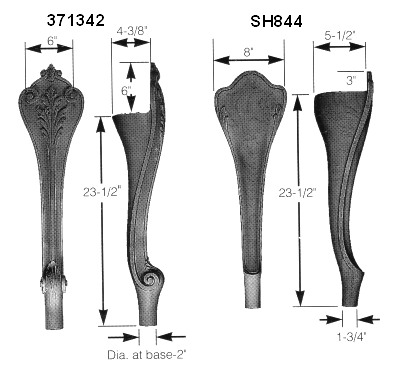
Louis XV grand piano legs, hard maple. Image credit: http://www.balaams-ass.com/grandlegs.htm

MikeF in a comment on my post, Let me put my banana in your fruitbasket, pointed us to his Small Wars Journal article The Break Point: AQIZ Establishes the ISI in Zaganiayh, in which he reports that the Mujahedeen Shura Council in Iraq passed out propaganda pamphlets providing “instruction on the proper actions of good Muslims” in preparation for the establishment of an Islamic State of Iraq. One example of “proper actions” given was as follows:

One cannot eat tomatoes and cucumbers together because one is male and the other is female. This action is immoral. Failure to comply will result in death.

Think long and hard on that one!

*

By way of light relief:

Frederick Marryat‘s 1839 book A Diary in America, in which he describes (as his title stipulates) American, not British, customs, seems to be the source of the idea that the (British, the urban legend having undergone a transatlantic metamorphosis here) Victorians covered the Legs (think: ankles, see diagram above) of their pianos for modesty’s sake.

Marryat, a credulous fellow as Matthew Sweet describes him in his Inventing the Victorians (p. xiii.), may well have been being teased when told this tale by his American friends. In any case, he reported that in an American girl’s school he visited, the head mistress “to preserve in their utmost purity the ideas of the young ladies under her charge” had “dressed all four limbs” of the school piano “in modest little trousers, with frills at the bottom of them!”

“Was this practice ever pursued, even in America?” Sweet asks sweetly, and answers himself: “Probably not.” And further, “whatever the case, the synecdochic relationship that now exists between Victorian sensibilities and the clothed piano leg is wholly fraudulent.”

Sweet is marvelous on this whole business, going on about it for pages. Most useful for my own purposes is his quotation from Richard Sennett‘s (1986) The Fall of Public Man, which argues:

that cultural change, leading to the covering of the piano legs, has its roots in the very notion that all phenomena speak, that human meanings are immanent in all phenomena.

*

And a tad more seriously…

Interestingly enough, that very notion is indeed to be found in Islam, where the Qur’an asserts that nature is to be read like a scripture. In the words of Seyyed Hossein Nasr:

The Quran refers constantly to the world of nature as well as to the human order. The sky and the mountains, the trees and animals in a sense participate in the Islamic revelation, through which the sacred quality of the cosmos and the natural order is reaffirmed. The sacred scripture of Islam refers to the phenomena of nature as ayat (“signs” or “portents”), the same term used for its verses and the signs that appear within the soul of human beings according to the famous verse: “We shall show our portents (ayat) upon the horizons and within themselves, until it be manifest unto them that it is the Truth” (41:53). Natural phenomena are not only phenomena in the current understanding of the term. They are signs that reveal a meaning beyond themselves. Nature is a book whose ayat are to be read like the ayat of the Quran; in fact, they can only be read thanks to the latter, for only revelation can unveil for fallen man the inner meaning of the cosmic text. Certain Muslim thinkers have referred to the cosmos as the “Quran of creation” or the “cosmic Quran” (al-Qur’an al-takwini), whereas the Quran that is read every day by Muslims is called the “recorded Quran” (al-Qur’an al-tadwini). The cosmos is the primordial revelation whose message is still written on the face of every mountain and tree leaf and is reflected through the light that shines from the sun, the moon, and the stars. But as far as Muslims are concerned, this message can only be read by virtue of the message revealed by “the recorded Quran.”

*

This view is not solely an Islamic one: Duke Senior, exiled to the Forest of Arden in Shakespeare‘s As You Like It (Act II Scene 1) declares:

And this our life: exempt from public haunt,
Finds tongues in trees, books in running brooks,
Sermons in stones, and good in everything.

And if Shakespeare be considered too worldly a source, here is Hugh of St. Victor (twelfth century):

For this whole visible world is a book written by the finger of God, that is, created by divine power … But just as some illiterate man who sees an open book looks at the figures but does not recognize the letters: just so the foolish natural man who does not perceive the things of God outwardly in these visible creatures the appearances but does not inwardly understand the reason. But he who is spiritual and can judge all things, while he considers outwardly the beauty of the work inwardly conceives how marvellous is the wisdom of the Creator.

More recently and less theologically, the scientist Robert Hooke (1635 – 1703), friend of Robert Boyle and discoverer of Hooke’s Law, wrote that in the interests of science it was:

much to be wisht for and indeavored that there might be made and kept in some Repository as full and compleat a Collection of all varieties of Natural Bodies as could be obtain’d, where an Inquirer might be able to have recourse, where he might peruse, and turn over, and spell, and read the Book of Nature, and observe the Orthography, Etymologia, Syntaxis, and Prosodia of Natures Grammar, and by which, as with a Dictionary, he might readily turn to and find the true Figures, Composition, Derivation, and Use of the Characters, Words, Phrases and Sentences of nature written with indelible, and most exact, and most expressive Letters, without which Books it will be very difficult to be thoroughly a Literatus in the Language and Sense of Nature.

*

All of which is to say that it may be unwise to read spiritual texts in too literal a manner.

Lex Talionis I: the matter of Subramaniam Swamy and Harvard

Friday, December 9th, 2011

[ by Charles Cameron — Harvard controversy, free speech vs hate speech, Hindutva, moral high ground & sanctions for and against violence ]

.

I am grateful to various members of the New Religious Movements list for pointing me to the recent events in Harvard, where a group of scholars led by the formidable Diana Eck (her book on Banaras is a masterpiece and greatly treasured) have persuaded the Faculty of Arts and Sciences to omit two courses in economics usually taught by Subramaniam Swamy from their Summer School offerings next year, on the ground that an op-ed he published in Daily News and Analysis titled “How to Wipe Out Islamic Terror” fell under the category of hate-speech (as opposed to free speech).

The article in question is no longer available on the DNA site, but can be found on Pamela Geller‘s Atlas Shrugged blog.  An account of the controversy can be found on Inside Higher Ed, and Harvard Faculty’s debate was reported in the Harvard Magazine.

Subramaniam Swamy is President of what remains of the once powerful Janata Party and former Union Cabinet Minister.

With that as background, I would like to address the issue of the varying principles and rule-sets invoked as offering a moral high ground – or a necessary safeguard – in various religious and other traditions.

*

I have read Dr Subramaniam Swamy’s article, and while the various quotes in it recommending specific actions — such as “Remove the masjid in Kashi Vishwanath temple complex, and 300 others in other sites as a tit-for-tat” and “Enact a national law prohibiting conversion from Hindu religion to any other religion” – give western readers a sense of Swamy’s overall mindset and intentions, it was another quote that held my attention:

This is Kaliyug, and hence there is no room for sattvic responses to evil people. Hindu religion has a concept of apat dharma and we should invoke it. This is the moment of truth for us.

I suspect the reason this quote has not been featured in the reports I’ve read of the debate have to do with the number of words in it that are unfamiliar to the western reader.

I’m acquainted with Kaliyug (the Age of Darkness) and with the concept of the sattvic (“Sattva is a state of mind in which the mind is steady, calm and peaceful” to quote the sacred Wiki), but had to dig a bit to discover that apat dharma is essentially “righteousness in emergencies”:

There are special Dharmas during critical and dangerous circumstances. They are called Apat-Dharma.

Swami Sivananda

Apat Dharma: They are duties that come to one under extraordinary circumstances, in crisis or in emergencies (apatmulakah). In such circumstances, even that which under normal circumstance is deemed wrong becomes dharma (tatra adharmo’pi dharmah). Here the righteous motives guide our actions (bhava-suddhimattvat). Normally a doctor gives anaesthesia before operating the patient but an emergency operation performed on the battlefield to save the life or limb of a soldier on the battlefield may be done without anaesthesia and with the instruments available, be they sterilized or not. When emergency is declared in the country, the elected parliament can be dismissed, the Constitution suspended and the ruler assumes extra-ordinary powers to deal with the situation. When peace prevails, the youth of a country should get education and work, but during war, the country may call upon its youth to sacrifice their education and fight in defence of the country, sometimes with hardly any training.

Sanjeev Nayyar

So that quote – “This is Kaliyug, and hence there is no room for sattvic responses to evil people. Hindu religion has a concept of apat dharma and we should invoke it. This is the moment of truth for us” – is essentially the abstract principle on which Swamy’s various proposals are based, and thus corresponds to the principles articulated by PM Netanyahu in his recent opening of the Knesset as underlying his government’s policies with regard to national security:

Our policy is guided by two main principles: the first is “if someone comes to kill you, rise up and kill him first,” and the second is “if anyone harms us, his blood is on his own hands.”

If you want a sense of how important that quote about apat dharma is to a Hindu (and a fortiori, a Hindutva) reader, see the way it is singled out and quoted with an illustration of Krishna driving Arjuna‘s chariot into battle by “Sanchithere (I’ve used the same illustration at the head of this post):

*

What am I after here?

It seems to me that we could use a brief yet definitive scholarly account of what the guiding principles of the various religions and secular worldviews allow their adherents, in terms of justice, forgiveness, pre-emption, retribution and retaliation.

This would need to include, compare and contrast such principles as:

  • The Judaic notions of pre-emptive killing (Netanyahu’s first principle, found in the Talmud and commonly quoted as ‘ha’Ba Lehorgecha, Hashkem Lehorgo, If someone tries to kill you, rise up and kill him first) and the injunction, in fighting the Amalekites, “Now go and smite Amalek, and utterly destroy all that they have, and spare them not; but slay both man and woman, infant and suckling, ox and sheep, camel and ass” (1 Samuel 15:3).
  • Christ’s “But I say unto you which hear, Love your enemies, do good to them which hate you.” (Luke 6.27)
  • Christian “just war” theology.
  • The western / UN “norm” that some actions are simply beyond the pale, unacceptable under any circumstances (essentially the basis for war crimes tribunals)
  • Game theory’s “tit for tat” strategy in an iterated Prisoners’ Dilemma as proposed by Anatol Rapaport and articulated by Robert Axelrod in his book, The Evolution of Cooperation.
  • The Islamic tradition’s notion of response in kind (Qur’an: 2.194, “and so for all things prohibited, — there is the Law of Equality. If then anyone transgresses the prohibition against you, transgress ye likewise against him but fear Allah, and know that Allah is with those who restrain themselves”) – which would appear to imply that actions that would not normally be acceptable may be appropriate in response to an enemy that has already “transgressed” in that specific manner
  • Gandhi’s ahimsa, together with his corollaries, “An eye for an eye makes the whole world blind” (attributed) and “It is better to be violent, if there is violence in our hearts, than to put on the cloak of nonviolence to cover impotence.”
  • Swamy’s own “This is Kaliyug, and hence there is no room for sattvic responses to evil people” and “the nation must retaliate — not by measured and ‘sober’ responses but by massive retaliation.”
  • Buddha’s “Victory breeds hatred. The defeated live in pain. Happily the peaceful live giving up victory and defeat” (Dhammapada15,5)…

… and so forth.

*

I am grateful for further pointers and comments you may care to offer.

I hope to follow this post up with another, Lex Talionis II, which will address the use of private rewards for revenge killings in the Israeli / Palestinian matter.

The Haqqani come to high Dunsinane

Wednesday, November 23rd, 2011

[ by Charles Cameron — why is non-actionable (useless) intelligence sometimes the most intelligent (useful)? – importance of multiple frames for complex vision ]
.

spec-taliban-to-high-dunsinane.png

I have fun choosing my data points, I’ll admit, and I enjoy the art of juxtaposition for its own sake — but the particular juxtaposition above is frankly useless.

Readers of the Chuang-Tzu, however, will be familiar with the idea that the useless is not without its uses

Here, then, is the method to this madness.

What I want to establish in myself – and in others who choose to follow me – is a rich supply of frames, of analogies, of patterns that can be seen at a glance. And the ways to do this are (a) to read widely in those arts and sciences which make frequent use of symmetry, analogy, metaphor, and pattern, and (b) to practice, oneself, the techne of analogy-, metaphor-, symmetry-, and pattern-making.

1.

In the two image-frames above, the lower image shows a still from a Haqqani network training video from SITE — which could be viewed as the fulfillment (albeit in Afghanistan, and waking reality) of a prophecy made earlier (about Scotland, a not-entirely-dissimilar country, mountainous, clannish, proud), in suitably oracular fashion, in Shakespeare’s Macbeth Act IV Scene 1 (shown in the upper frame, from the First Folio edition).

Here, you might say, the Taliban come to high Dunsinane Hill.

But…

This is not actionable intelligence.

The injunction to “keep a lookout for people on the move pretending to be trees” is not a useful addition to tradecraft.

It is, however, vivid. And it’s an instance of “the leap” from one idea to another that’s at the heart of the process of insight and discovery. It is an example of a specific skill of considerable analytic importance.

2.

Karl Weick and Kathleen Sutcliffe, in Managing the Unexpected: Assuring High Performance in an Age of Complexity, p. 42, [quoted in Fishbein and Treverton and Jeffrey Cooper ] define mindfulness thus:

By mindfulness we mean the combination of ongoing scrutiny of existing expectations, continuous refinement and differentiation of expectations based on new experiences, willingness and capability to invent new expectations that make sense of unprecedented events, a more nuanced appreciation of context and ways to deal with it, and identification of new dimensions of context that improve foresight and current functioning.

How’s that for a prose version of the basic OODA insight?

3.

Obviously, I am not talking about the kind of tactical intelligence that is concerned with materiel and logistics here, but with mindset and morale.

This may get overlooked, since…

Emphasizing current intelligence for actionable exploitation may have created an unintended mind-set that undervalues the immense importance of knowing and understanding the adversary’s intentions throughout the course of the confrontation, even at cost of foregoing exploitation of these sources for temporary advantage on the battlefield or in the diplomatic conference room.

[Cooper, Curing Analytic Pathologies: Pathways to Improved Intelligence Analysis, p.30]

4.

What I am talking about here is that “willingness and capability to invent new expectations that make sense of unprecedented events, a more nuanced appreciation of context and ways to deal with it, and identification of new dimensions of context that improve foresight and current functioning mentioned above.

New dimensions of context? What this boils down to is multiple frames of vision… which the IC understands very well, as expressed in the often-repeated chess master analogy — good for strategic thinkers of all stripes. Here’s Robert Sinclair‘s version, in Thinking and Writing: Cognitive Science and Intelligence Analysis, p. 13:

Simon estimates that a first-class player will have 50,000 of these patterns to call on — by no means a small number, but orders of magnitude less than the theoretical possibilities that flow from any given position. The expert can use them to drastically reduce the number of choices he must consider at any point in a game, with the result that he often hits on an effective move with such speed that the observer attributes it to pure intuition.

Enter Neustadt and May, whose book Thinking in Time Zen reviewed here just the other day — enter, in fact, history, as a store of stories.

Richards Heuer explains [Psychology of Intelligence Analysis, p. 38]:

An analyst seeks understanding of current events by comparing them with historical precedents in the same country, or with similar events in other countries. Analogy is one form of comparison. When an historical situation is deemed comparable to current circumstances, analysts use their understanding of the historical precedent to fill gaps in their understanding of the current situation. Unknown elements of the present are assumed to be the same as known elements of the historical precedent. Thus, analysts reason that the same forces are at work, that the outcome of the present situation is likely to be similar to the outcome of the historical situation, or that a certain policy is required in order to avoid the same outcome as in the past.

And the analogies and insights can come from fiction as well as history, as Charles Hill is quoted here as saying:

That is why Alexander the Great carried the Iliad with him on his conquests, and why Queen Elizabeth studied Cicero in the evenings. It is why Abraham Lincoln read, and was profoundly influenced by, Walt Whitman’s “Leaves of Grass,” and why Paul Nitze paged through Shakespeare on his flights to Moscow as America’s chief arms negotiator.

Further, the appropriate insights and possible framings can come from future and/or speculative histories — hence the meetings between IC members and various science fiction authors and thriller screenwriters which then DDI Jami Miscik arranged in an attempt “to see beyond the intelligence report and into a world of plot development”.

As I noted a few days back, I’m particularly impressed by Frank Herbert‘s ability to recognize the importance of the oil / desert / ecology / major powers / jihad / Mahdi complex – back between 1957 and 1965, while writing Dune.

5.

But all this takes me back to a comment I made a while back on Mark Stout‘s On War and Words blog, on “the notion of the kinship of spycraft and literature.” I wrote there:

I think that idea has a lot of merit. Chaucer was a spy, as was Kit Marlowe, and Wordsworth, and Basil Bunting. Somerset Maugham and Graham Greene spied, and John le Carre – and if I’m not mistaken, much of the early OSS was recruited from the Yale literature department by the likes of Archibald MacLeish…

My own suggestion would be that this is because the literary mind is well suited to understanding and expressing complex relationships, just as (it has been suggested) the engineering mind is suited to seeing things in black and white – you’ve probably seen Diego Gambetta and Steffen Hertog’s paper on Engineers of Jihad, in which they determine that “engineers, in particular, were three to four times more likely to become violent terrorists than their peers in finance, medicine or the sciences”.

I don’t know whether that allegation is accurate, or just an artifact of their research methods – but if it’s true that literature offers a different (and in some ways more subtle) means of modeling the kinds of complex situation we’re all facing these days, maybe we need to increase the intake of lit and humanities majors into the IC, and stop being so tech-centric about our analytic methods. The human mind might just be better at selecting and connecting the right dots than our datamining programs.

Keith Oatley‘s paper Shakeapeare’s invention of theatre as simulation that runs on minds might give us a hint or two.

And we’re back to Shakespeare.

6.

Why?

Because what’s important in all this is the quality of imagination expressed. And the core insight is that the greatest poets, dramatists, science fiction writers and historians create pocket universes — worlds invented or perceived in which the logics of the many binary oppositions, tides, undertows, tipping points and emergent patternings of our profoundly complex world are found in miniature.

The mind in a nutshell, the world in a grain of sand…

Perhaps clearest statement of this perspective comes from the great scientist Gregory Bateson, who writes about poetry in these terms:

One reason why poetry is important for finding out about the world is because in poetry a set of relationships get mapped onto a level of diversity in us that we don’t ordinarily have access to. We bring it out in poetry. We can give to each other in poetry the access to a set of relationships in the other person and in the world that we are not usually conscious of in ourselves. So we need poetry as knowledge about the world and about ourselves, because of this mapping from complexity to complexity.

7.

If it is great imaginative power that provides the deepest insights into a complex world, great minds and hearts will be those you need to follow — not minds cowed by the pressures of bureacracy and success.

“You want some new ideas? Read some old books” Marine Gen. James Mattis told his audience at the 14th annual American Veterans Center conference the other day, in a speech which “recommended books by and about leaders like Nelson Mandela, Martin Luther King Jr., George Washington and Abraham Lincoln.”

Great hearts, great minds. And not always well-tolerated by those around them.

8.

Jami Miscik again, at a conference discussing “The Power of Impossible Thinking: A Prerequisite for Profitable Growth“:

Embrace the maverick.

Miscik is clear that the purpose isn’t only to be widely read, but to be independently and courageously thoughtful.  Bureaucracies are not by nature the most friendly places for independent thinking, stove-piping and soloing, seniority and comfort all militate against it — hence the need to embrace the maverick, to develop (in fact) a culture that embraces the maverick.

Miscik addresses that issue, too: “She also warned the audience that a single spate of change is not enough; an organization will always have to change again.”

Or as Sinclair has it in Thinking and Writing (op. cit., p. 9):

I do believe diversifying the workforce in this way would require a cultural shift at least comparable to that involved in a shift to online substantive collaboration. Without such a shift, the directorate, like any organism under threat, would identify people who failed to fit the dominant pattern as foreign bodies and extrude them.

9.

I am thinking, in all this, of those whose task it is to provide the richest, highest level analysis of “the adversary’s intentions” — the readers of minds by which history is about to be written.

Those whose job it is to be concerned about the threats that face us, from the Haqqani, from the Chinese, from Pakistan, from wherever, will do their job better, with greater insight – with greater critical doubt and critical confidence – if their minds are richly sown with myths and histories, matter for analogies pattern languages, than if they have focused down along the scope of a single silo…

As Mattis, Hill, Miscik, Sinclair, Bateson, Oatley, Heuer and company, each in their own way, suggest…

10.

When you come right down to it, audacious, insightful thinking is its own form of special ops.

Switch to our mobile site