Mancala games in culture & nature
Tuesday, May 17th, 2016[ by Charles Cameron — I would rather play with the woodpeckers than with the humans ]
.
Mancala a game with complex history: Diff versions due to fracturing of communities by transatlantic slave trade. pic.twitter.com/bzulFTGGgq
— Sacha Coward (@sacha_coward) March 26, 2016
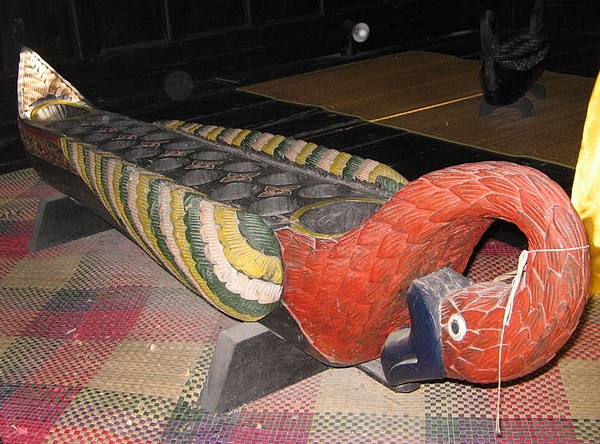
Mancala games are games in which “seeds” are places in a series of “holes” in a board, often a carved wooden board, according to mathematical principles of play and capture. Wikipedia:
Most mancala games share a common general game play. Players begin by placing a certain number of seeds, prescribed for the particular game, in each of the pits on the game board. A player may count their stones to plot the game. A turn consists of removing all seeds from a pit, “sowing” the seeds (placing one in each of the following pits in sequence) and capturing based on the state of board. This leads to the English phrase “count and capture” sometimes used to describe the gameplay. Although the details differ greatly, this general sequence applies to all games.
¶¶
Equipment is typically a board, constructed of various materials, with a series of holes arranged in rows, usually two or four. The materials include clay and other shape-able materials. Some games are more often played with holes dug in the earth, or carved in stone. The holes may be referred to as “depressions”, “pits”, or “houses”. Sometimes, large holes on the ends of the board, called stores, are used for holding the pieces.
Playing pieces are seeds, beans, stones, cowry shells, half-marbles or other small undifferentiated counters that are placed in and transferred about the holes during play.
¶¶
Among the earliest evidence of the game are fragments of a pottery board and several rock cuts found in Aksumite areas in Matara (in Eritrea) and Yeha (in Ethiopia), which are dated by archaeologists to between the 6th and 7th century AD; the game may have been mentioned by Giyorgis of Segla in his 14th century Ge’ez text Mysteries of Heaven and Earth, where he refers to a game called qarqis, a term used in Ge’ez to refer to both Gebet’a (mancala) and Sant’araz (modern sent’erazh, Ethiopian chess).
Nota Bene:
Even when played with glass beads, mancala games are not even close to the Glass Bead Game as Hermann Hesse describes it, since their moves have nothing to do with cultural citation or meanings, let along their contrapuntal connections and correspondences, but are indifferent markers, inherently fungible.
**
Cool photos of acorn woodpecker storing its bounty for winter @SequoiaKingsNPS #nature pic.twitter.com/lQLaWOAXBd
— US Dept of Interior (@Interior) October 23, 2014
It was 3 Quarks Daily that introduced me to the avian version of mancala games in a post that read:
Acorn woodpeckers drill into trees not in order to find acorns, but in order to make holes in which they can store acorns for later use, especially during the winter.
As the acorn dries out, it decreases in size, and the woodpecker moves it to a smaller hole. The birds spend an awful lot of time tending to their granaries in this way, transferring acorns from hole to hole as if engaged in some complicated game of solitaire.
Multiple acorn woodpeckers work together to maintain a single granary, which may be located in a man-made structure – a fence or a wooden building – as well as in a tree trunk. And whereas most woodpecker species are monogamous, acorn woodpeckers take a communal approach to family life. In the bird world, this is called cooperative breeding. Acorn woodpeckers live in groups of up to seven breeding males and three breeding females, plus as many as ten non-breeding helpers. Helpers are young birds who stick around to help their parents raise future broods; only about five per cent of bird species operate in this way.
**
Conclusion:
For myself, I would rather play with the woodpeckers than with the humans.
Even so, a humanly-wrought board can be very lovely: