zenpundit.com » new yorker

Archive for the ‘new yorker’ Category

This I must watch on Netflix

Monday, August 28th, 2017

[ by Charles Cameron — continuing in the pesky socratic tradition ]
.

**

Here’s the possible parallelism, d’you dare say it’s a moral equivalence, are the scales even close to equal, or isn’t that the moral point anyway?

Just a few years after the destruction of European Jewry, the soldier wonders, have we now become oppressors? Have the Arabs now been sent into exile?

Here’s the whole paragraph:

In 1949, Yizhar Smilansky, a young Israeli veteran, national legislator, and novelist writing under the pen name S. Yizhar, published “Khirbet Khizeh,” a novella about the destruction of a lightly fictionalized Palestinian village near Ashkelon, some thirty miles south of Tel Aviv. Writing from the point of view of a disillusioned Israeli soldier, Yizhar describes the Army’s capture of the village and the expulsion of its remaining inhabitants. The time is 1948, the moment of Israel’s independence and its subsequent victory over five invading Arab armies that had hoped to erase the fledgling Jewish state from the map. It would be forty years before the New Historians—Benny Morris, Avi Shlaim, and Simha Flapan among them—marshalled the nerve and the documentary evidence required to shatter the myth that hundreds of thousands of Palestinian Arabs had all voluntarily “abandoned” their cities and villages. Yizhar was there to bear witness in real time. He wrote from personal experience; he had been an intelligence officer in the war. In “Khirbet Khizeh,” Yizhar’s protagonist is sickened as he comes across an Arab woman who watches as her home is levelled: “She had suddenly understood, it seemed, that it wasn’t just about waiting under the sycamore tree to hear what the Jews wanted and then to go home, but that her home and her world had come to a full stop, and everything had turned dark and was collapsing; suddenly she had grasped something inconceivable, terrible, incredible, standing directly before her, real and cruel, body to body, and there was no going back.” Just a few years after the destruction of European Jewry, the soldier wonders, have we now become oppressors? Have the Arabs now been sent into exile? And why can’t I bring myself to protest? “Khirbet Khizeh” eventually became part of the Israeli public-school curriculum.

**

Source & resource:

  • David Remnick, How Do You Make a TV Show Set in the West Bank?
  • Netflix, Fauda
  • **

    With any luck, I’ll report back at some point. It seems to me that a love of the individual Palestinian should nest within a love of the State of Israel as the circles in the tai chih symbol rest within the swirls of the opposite colors. But what a charged topic!

    A koan!
    Matryoshka Trump

    Thursday, July 20th, 2017

    [ by Charles Cameron — NYorker invokes the nested dolls archetype — not kind to Trump ]
    .

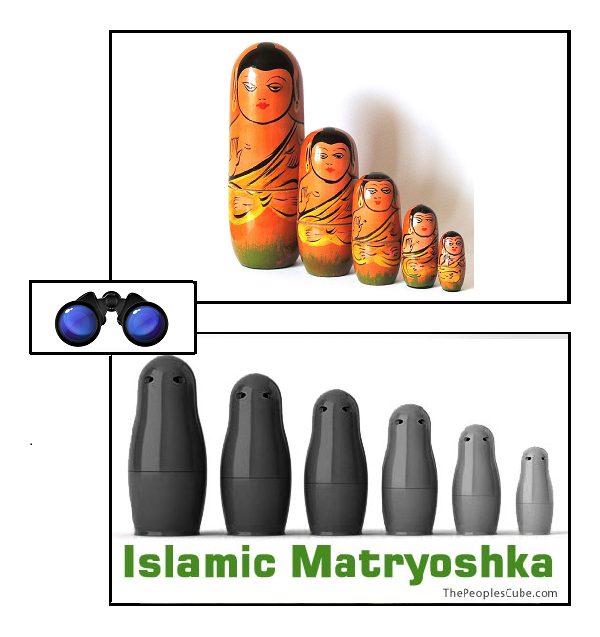
    You already know that I sit up and take special notice when certain forms (symmetries, helices, ouroboroi, etc) show up — because forms are a particularly powerful way in which the mind orders its world, or because the world teaches the mind that it is ordered in formal ways, take your pick — well, one of those forms is the nested form called Matryoshka, which I’ve discussed before:

  • Nesting Buddhas and insubstantiality
  • ISIS goes Matryoshka
  • **

    Imagine, then, my interest to read today’s New Yorker post, Valley of the Russian Dolls: A Hollow, Repetitive Form Proves Perfect for Trump.

    **

    I invite you to read the article yourself to learn about Halina Danchenko. who sells Matryoshka dolls. Shoppers are asked not to open the dolls on display in her stone themselves — however “If you want to see what’s inside the leader of the free world, Danchenko will open him for you.”

    The article is witty, if you share her perspective:

    Trump, who is as matronly as a big bullying man can be, already has the de-facto physique of a nesting doll (and something very like the shellac)

    The dolls are witty too, or should I say catty? Read about the two Trump sets that the article describes in detail..

    **

    If you think Trump is father to a host of lies, as the NYT does, why then this article will amuse you, and conversely, if you see him as a straight-shooting man of truth, not so much.

    The writer, Kathryn Schulz, is clearly in the first category:

    Never has a President seemed so entirely hollow as Trump, so intellectually and morally vacant. Nor has any Administration, so early in its tenure, concealed such a lengthy series of deceptions, or grown so bizarrely, fatally fractal: its lawyers have lawyers, its scandals have sub-scandals, its lies have little lie-lets. It’s easy to imagine, given this prevailing opacity and the incompetence of those nominally in charge, that there is another Trump Russian doll out there, this one filled up with actual Russians.

    And her conclusion:

    That might or might not prove to be the truth about what’s going on inside Donald Trump politically. What’s going on psychologically is a different story. All of us are largely hidden from one another, our most important attributes by definition invisible: minds, hearts, psyches, consciences, souls. Even for ourselves, we can access these aspects only through sustained introspection, a habit anathema to Trump; other people, meanwhile, reveal their innermost selves to us chiefly through their actions. On that evidence, the most accurate Trump doll is the one made of Donalds all the way down: utterly full of himself, in all other ways utterly empty.

    US and Israel, a double ouroboros

    Saturday, January 21st, 2017

    [ by Charles Cameron — Netanyahu, Trump, and their interchangeable ambassadorships? — also fake news and truth ]
    .

    Two versions of two serpents biting each others’ tails to form a loop

    On the left, we have a western, alchemical version of the two-serpent ourobouros, and on the right an “Infinite Wealth Sacred Buang Nak Bat Amulet” from Thailand. The accompanying text on the Billionmore Rare Thai Buddhist amulets and Talismans site reads:

    Naga is the great snake of wealth in Buddhist belief when two Naga connect into a circle, it means wealth will never end..

    That’s right, infinite wealth is yours for only $26.90.

    **

    In today’s New Yorker, we see the same secondary form of the ouroboros: two serpents, biting each others’ tails, to form a loop:

    In recent years, ascendant political currents in America and Israel had already begun to merge. We have now reached the point where envoys from one country to the other could almost switch places: the Israeli Ambassador in Washington, Ron Dermer, who grew up in Florida, could just as easily be the U.S. Ambassador to Israel, while Donald Trump’s Ambassador-designate to Israel, David Friedman, who has intimate ties to the Israeli settler movement, would make a fine Ambassador in Washington for the pro-settler government of Benjamin Netanyahu.

    As you may know, I’m generally disinclined to support one side in a conflict when it appears to me that conflict itself is the basic conundrum we should be examining. Accordingly, it’s the form here — the two serpents, the two ambassadorships working together as an integrated system, that I’d call your attention to.

    **

    While we’re on the subject of twin serpents…

    Sometime back in the last century I suggested the utility of a Tarot-like pack of cards showing the great archetypal images that have populated the imaginations of so many cuotures across the globe and centuries.

    Thus both the caduceus of western medicine and the kundalini of eastern yoga show twinned serpents spiraling up a central pole – and if Linus Pauling had seen that double serpent image when he was chasing the structure of DNA, he might have spent less time on the triple and more time on the double helix, and beaten Crick and Watson to the punch.


    Left, an image of the kundalini; right, the caduceus or rod of Aesculapius — see also the two linked wikipedia pages for a flaw in this portion of my argument

    A similar case can be made for Kekule’s realization that the form of the benzene molecule was a ring, supposedly triggered by a reverie of the ouroboros or serpent biting it’s tail.


    diagram of ouroboros and benzene molecule from ChemDoodle

    It’s worth noting, however, that this appears to be an old wives’ tale, perhaps fashioned by Kekule himself, as detailed by JH Wotiz and S Rudofsky in Kekulé’s dream: Fact or fiction?” Chemistry in Britain, 20, 720–723 (1954).

    Now, are the debunking stories better stories than their respective archetypal insight stories? And what’s the truth in story, in any case? In the psyche, story and fact are both story, tiny molecular weavings of the imagination.

    And how does this tie in with “news” — fake and true?

    Three self-references already, and its only 8am

    Tuesday, October 4th, 2016

    [ by Charles Cameron — with an eye for form, paradox, self-reference ]
    .

    I’ve found three self-references already today, and its only 8am.

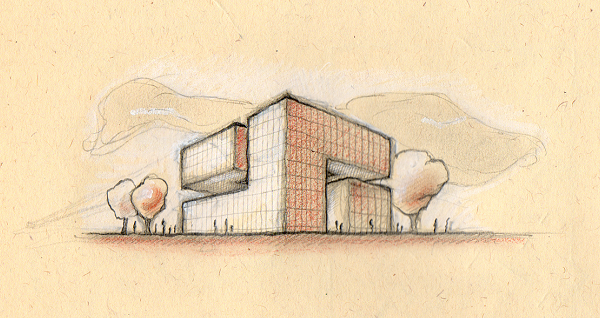
    Unless of course you count architect Matteo Pericoli‘s building design to illustrate the structure of Friedrich Dürrenmatt’s mystery novel The Judge and His Hangman:

    perspective

    — in which case, I’ve found four. Pericoli comments:

    As in the novel — with its surprise ending that flips everything upside down, transforming the structure we had taken for granted into a profound moral and existential dilemma — in the building, what seemed to obscure now illuminates, what once concealed now is hidden, what seemed to give support is now nothing but a weight to bear and understand.

    Now tell me, is that self-referential and ouroboric, or merely boustrophedonic or enantiodromic?

    For Greek fun, wait till the end of this post*.

    **

    On firmer self-referential ground, my first self-referential account has to do with a Nobel Prize, just awarded. Gina Kolata and Seawell Chan in the New York Times explain:

    Yoshinori Ohsumi, a Japanese cell biologist, was awarded the Nobel Prize in Physiology or Medicine on Monday for his discoveries on how cells recycle their content, a process known as autophagy, a Greek term for “self-eating.” It is a crucial process.

    Self-eating: even the ouroboros can’t say it plainer than that.

    **

    The second comes from an article on artist Jennifer Trask titled Death and Decay Lurks Within These Stunning Works of Art in the Smithsonian magazine. The description of Jennifer and her work begins:

    Those who encounter a piece by Jennifer Trask are likely first struck by its elegance: a baroque gold-coated necklace or an intricate floral broach. But a closer look reveals much more happening below the gilt surface: antlers woven into the necklace; snake vertebrae used as the “petals” of the broach’s flower, giraffe femurs…

    Death, here, as in earlier artistic tradition, is a reminder of the fickleness of life. The article gives us the self-referential paradox as it explains:

    Trask draws on the tradition of vanitas — moralistic paintings that were popular in 16th- and 17th-century Netherlands. She says her interest is now focused on the “symbolism and the ironic nature” of the paintings, and “how the vanitas itself ultimately became another of the luxurious objects they were meant to warn against.”

    **

    And the third might even count as two recursions — one analogous to the other.

    You may have read the New Yorker‘s profile, Sam Altman’s Manifest Destiny: Is the head of Y Combinator fixing the world, or trying to take over Silicon Valley?, and you may just be cooler than I, and either way you may already know that the Y Combinator is the startup starter-upper par excellence.

    Here’s the self-ref, from their FAQ:

    Why did you choose the name “Y Combinator?”

    The Y combinator is one of the coolest ideas in computer science. It’s also a metaphor for what we do. It’s a program that runs programs; we’re a company that helps start companies.

    A hat-tip here to Steven H. Cullinane, whose Log 24 blog today pointed me to this particular quote.

    **

    *It’s all Greek to me:

  • ouroboros, a snake or dragon devouring its tail, standing for infinity or wholeness
  • boustrophedon, written from right to left then left to right, as in ploughing with oxen
  • enantiodromia, tendency of things to change into their opposites, as a natural principle
  • **

    Well, it’s past 9am now, but I haven’t been scouting around for further examples since I began this post.

    Polishing the heart: full circle

    Sunday, February 14th, 2016

    [ by Charles Cameron — happy daze! from Joan Halifax via Henry Corbin to Hui Neng & David Remnick ]
    .

    From Roshi Joan Halifax:

    **

    Steven Nouriani, The Meeting of Two Rivers, in Copenhagen 2013 – 100 Years On:

    As Corbin (1969) indicated, the heart is thought to be like a mirror in which every moment the various manifestations of the Divine Forms can be reflected on a microcosmic level. The more we polish the heart, the more we develop the Himma (aptitude) to experience Divine epiphanies out of Mundus Imaginalis.

    Henry Corbin, Creative Imagination in the Sufism of Ibn Arabi, p 222.

    In its unveiled state, the heart of the gnostic is like a mirror in which the microcosm from of the Divine Being is reflected

    **

    Sachiko Murata, Chinese Gleams of Sufi Light, p. 225, n. 8:

    The Sufi path is rather to empty oneself of all causes, to “polish the heart” by cleansing it of the rust of things, and to find God’s light in the heart.

    **

    Luang Pu Thuat, quoted in Dharma Legacy of Ajaan Dune Atulo:

    To make yourself a good-looking wandering monk isn’t proper at all. It goes against the purpose of going out to wander. Each of you should reflect a great deal on this. The purpose of wandering in meditation is only one thing: to train and polish the heart so that it’s free of defilements. To go wandering in meditation only in body, but without taking along the heart, is nothing excellent at all.

    **

    Morihei Ueshiba, founder of Aikido:

    The only cure for materialism is the cleansing of the six senses (eyes, ears, nose, tongue, body, and mind). If the senses are clogged, one’s perception is stifled. The more it is stifled, the more contaminated the senses become. This creates disorder in the world, and that is the greatest evil of all. Polish the heart, free the six senses and let them function without obstruction, and your entire body and soul will glow.

    **

    Shen-hsiu, in The Platform Sutra: The Zen Teaching of Hui-neng, Red Pine, tr.:

    The venerable Shen-hsiu held up a lantern and wrote his gatha on the middle of the south corridor wall at midnight, and no one saw him. His gatha went:

    The body is a bodhi tree
    the mind is like a standing mirror
    always try to keep it clean
    don’t let it gather dust.

    to which Hui Neng‘s responds, from the same source:

    Unless you know your own mind, studying the Dharma is useless. But once you know your mind and see your nature, you understand what is truly important. My gatha went:

    Bodhi doesn’t have any trees
    this mirror doesn’t have a stand
    our buddha nature is forever pure
    where do you get this dust?

    Then I composed another one:

    The mind is the bodhi tree
    the body is the mirror’s stand
    the mirror itself is so clean
    dust has no place to land.

    **

    BBC, Valentine’s Day: Countries that don’t love February romance

    Last year, there were clashes at a university in Peshawar over Valentine’s Day.
    Liberal students were celebrating with red balloons and cake while another group felt such a show was un-Islamic.
    Dozens of students threw rocks in the scuffle, leading to gunshots being fired by both sides and rooms in a student dormitory being set on fire.

    **

    David Remnick, Dangerous Liaisons:

    Love is wonderful; Valentine’s Day, less so. Often, it’s cheesy and boring. Here’s your antidote: a collection of stories about dangerous love, doomed love, and other forms of bad romance. … Consider these pieces a Valentine from us.

    **

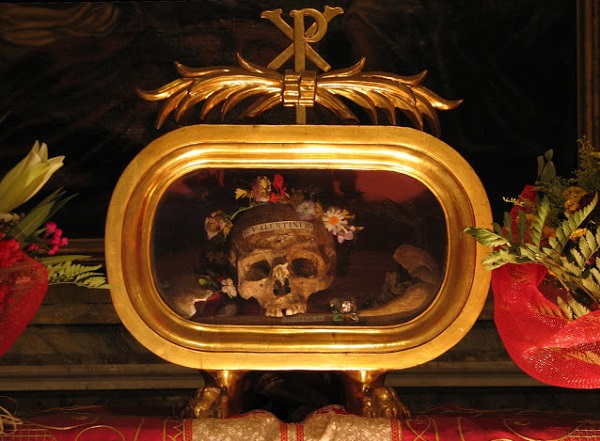
    Veneration of relics:

    2262875989_948afb24d8_b
    Relics of St. Valentine, Santa Maria in Cosmedin, Rome, photo by Fr Lawrence Lew OP


    Switch to our mobile site