[ by Charles Cameron — Blake, Britain, and Blake again — among the angels ]
.
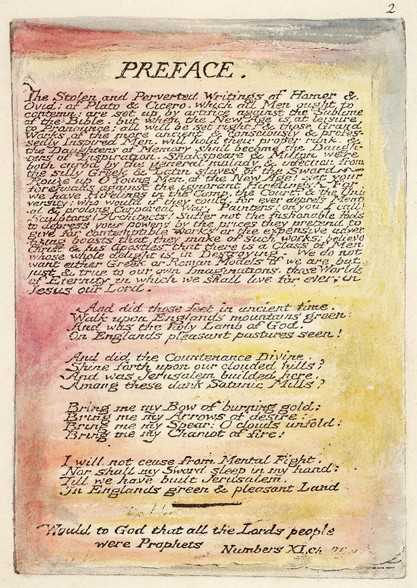
The irrepressible William Blake can’t keep himself from coloring outside the words:
**
Okay, here’s the poem as poem — a very curious poem celebrating “arrows of desire” to have made its way into the hymnary of England, its royalty, and the Proms:
And did those feet in ancient time.
Walk upon Englands mountains green:
And was the holy Lamb of God,
On Englands pleasant pastures seen!
And did the Countenance Divine,
Shine forth upon our clouded hills?
And was Jerusalem builded here,
Among these dark Satanic Mills?
Bring me my Bow of burning gold;
Bring me my Arrows of desire:
Bring me my Spear: O clouds unfold!
Bring me my Chariot of fire!
I will not cease from Mental Fight,
Nor shall my Sword sleep in my hand:
Till we have built Jerusalem,
In Englands green & pleasant Land
Happily the United States — whose birthday is tomorrow — didn’t exactly lose ye olde English tradition, as is readily apparent in this rendition — this one by the West Point Cadet Glee Club:
**
Oops, but England, my England — see what has become of it!
Like every generation since Ahab begat Behab right in the beginning, I fear for our young, even those now middle-aged, I fear for their young.. I fear for the future so fast spiraling out of our past.
**
Blake himself had a high esteem of his work and purpose. He wrote:
I am more famed in Heaven for my works than I could well conceive. In my Brain are studies & Chambers filled with books & pictures of old, which I wrote & painted in ages of Eternity before my mortal life; & those works are the delight & Study of Archangels.
And he could paint the archangels’ likenesses by memory, too, with angelic felicity:
**
A tip-of-the-hat here to David Auerbach.
And a shout-out to Michael Horovitz, who published my first poems in book form in his richly Blake-influenced 1969 Penguin anthology, Children of Albion.
— however, a polarization of youth against the elderly is hardly an improvement. There’s something intangible the Leavers are loving, and perhaps Blake‘s Jerusalem, sung at the wedding of Kate Middleton and Prince William, captures that love without the hateful rhetoric that has accompanied Farrage‘s side of the exit campaign:
**
Speaking of which, I’m no great admirer of Bill Maher, who is too snide to be considered much of a wit in my book — but this little jewel of an aphorism may be the best haiku-like summation of Remainer’s regret I’ve seen.
Bill Maher line last night: Pride and Prejudice beat out Sense and Sensibility in #Brexit
Civilization requires civility — and polarization seems to encourage incivility on both sides of many, many issues. Sorry, folks.
**
My friend Michael Robinson posted this elegaic comment the other day:
Flabbergasted | “The fearmongering and outright lies of Boris Johnson, Michael Gove, Nigel Farage, The Sun and the Daily Mail have won. The UK, Europe, the west and the world are damaged. The UK is diminished and seems likely soon to be divided. Europe has lost its second-biggest and most outward-looking power. The hinge between the EU and the English-speaking powers has been snapped. This is probably the most disastrous single event in British history since the second world war. …
The UK’s decision to join the EU was taken for sound reasons. Its decision to leave was not. It is a choice to turn its back on the great effort to heal Europe’s historical divisions. This is, for me, among the saddest of hours. ” (Martin Wolf FT)
[ by Charles Cameron — religions taking other religions apart, stone by stone, image by image, song by song ]
.
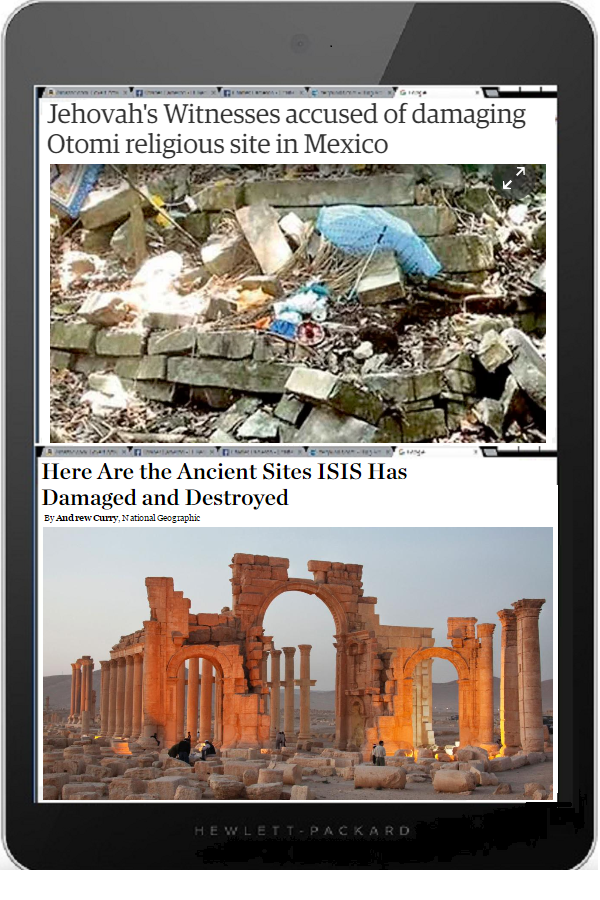
Some recently converted Jehovah’s Witnesses appear to have destroyed the altars of indigenous Otomi people in Mexico, an anthopologist has stated:
Assailants have damaged an ancient Otomi Indian religious site in Mexico, toppling stone structures used as altars, breaking carved stones and scattering offerings of flowers, fruit and paintings at the remote mountain shrine known as Mayonihka or Mexico Chiquito. [ .. ]
“I don’t know what religion they belong to, but they destroyed several images that were there,” said Daniel Garcia, the municipal secretary of the nearby township of San Bartolo Tutotepec. “The thing is, there are some religions that don’t believe in using idols.”
Luis Perez Lugo, a professor at the University of Chapingo, visited the site in May and talked to residents of a nearby hamlet, El Pinal, whose residents said they had carried out the attack.
“I was there, and the Jehovah’s Witnesses said they had done it,” Perez Lugo said, noting some were recent converts to the religion who used to go to the site for Otomi ceremonies.
See upper panel, below:
In the lower panel, above, we see a detail from a National Geographic listing of sites attacked by the Islamic State. Three quick notes:
the JWs, if they were JWs, were recent converts; converts often have a zeal all their own
the IS, like the Taliban at Bamiyan, destroys ancient religious sites even if no longer in use
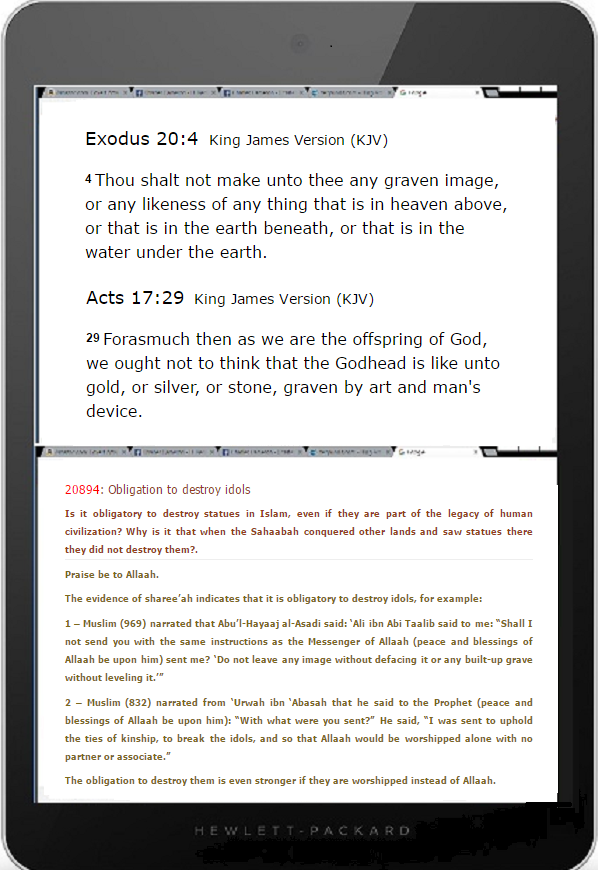
You already know this, but for the record — because Scripture:
In the upper panel, Jewish and Christian scriptures — from the Jewish Ten Commandments in Exodus, and St Paul‘s address to the Athenians, as recounted in the Acts of the Apostles.
In the lower panel — a hard-line contemporary Islamic commentary, citing two ahadith.
**
So it’s Jehovah’s Witnesses and hard-line Muslim literalists who approve of the destruction of monuments to false gods, is that what this means?
They are not alone. In the upper panel, below, recent news of the Chinese — avowed atheists — continuing their attacks on Tibetan Buddhism, this time by mandating the dismantling of Buddhism’s largest monastic university at Larung Gar:
In the lower panel, above, we see some of what remains of the great Abbey of Glastonbury, torn down during the Dissolution of the Monasteries under King Henry VIII.
Glastonbury has strong associations with Arthurian and Christian traditions:
William Blake’s dramatic poem ‘Jerusalem’ familiar nowadays as an inspirational hymn, draws on the myth that Christ himself may have visited Glastonbury with Joseph of Arimathea and ‘walked on England’s mountains green’.
The Gospels record that Joseph of Arimathea was a wealthy follower of Christ who buried Christ’s body in his own tomb after the Crucifixion.
In the Middle Ages Joseph became connected with the Arthurian romances of Britain. He first features in Robert de Boron’s Joseph d’Arimathie, written in the twelfth century, as the Keeper of the Holy Grail. He receives the Grail (the cup used by Christ at the Last Supper) from an apparition of Jesus and sends it with his followers to Britain.
Later Arthurian legends elaborated this story and introduced the idea that Joseph himself travelled to Britain, bringing the Holy Grail with him and then burying it in a secret place, said to have been just below the Tor at the entrance to the underworld. The spring at what is known as Chalice Well is believed to flow from there. In their quests King Arthur and the Knights of the Round Table searched for the Grail.
Glastonbury retains its place in English hearts to this day, albeit in contemporary guise — it is the Yasgur’s Farm of England’s ongoing Woodstock — mud, sex, drugs, rock and all — the yearly Glastonbury Festival —
It is also — in the form of Blake‘s hymn “And did those feet in ancient time” — a part of such ceremonial events as the Last Night of the Proms — and Royal Weddings:
But more on Blake’s poem — known as Jerusalem, and taken from his preface to Milton a Poem — in an upcoming post, Creek willing.
**
Finally, what an exceptionally lovely early DoubleQUote is this, returning us to the topic of sacred places and images and their destruction:
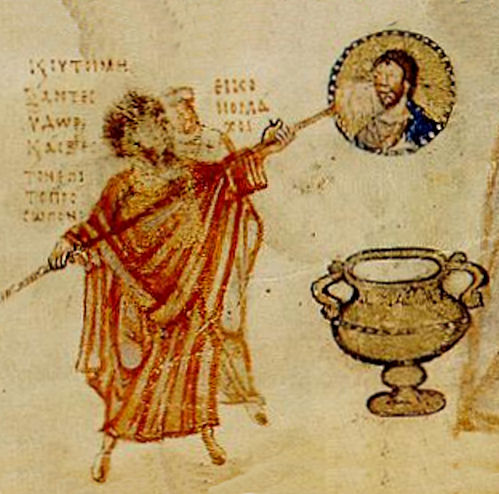
What we have here is a page from the Chludov Psalter — ask Wikipedia for that what means, I only just ran across it in the course of writing this piece — but it’s a 9th century Byzantine prayer book, illuminated with illustrations attacking the iconoclasts — those Christians who wanted to destroy icons and other Christian images for reasons not dissimilar ton those of the Taliban.
In the illustration to the right, the miniaturist illustrated the line “They gave me gall to eat; and when I was thirsty they gave me vinegar to drink” with a picture of a soldier offering Christ vinegar on a sponge attached to a pole. Below is a picture of the last Iconoclast Patriarch of Constantinople, John the Grammarian rubbing out a painting of Christ with a similar sponge attached to a pole.
Let’s take a closer look:
Both verbally and visually, then, we have a direct comparison of the Roman soldier mocking the dying Christ, and the icon-hating Patriarch erasing Christ’s image from a wall.. And they call him the Grammarian!
But let’s proceed:
John is caricatured, here as on other pages, with untidy straight hair sticking out in all directions, which was considered ridiculous by the elegant Byzantines.
No punks, apparently, these Byzantines!
And the coup de grâce? House the sacred book in a state museum..
Nikodim Kondakov hypothesized that the psalter was created in the famous monastery of St John the Studite in Constantinople. Other scholars believe that the liturgical responses it contains were only used in Hagia Sophia, and that it was therefore a product of the Imperial workshops in Constantinople, soon after the return of the Iconophiles to power in 843.
It was kept at Mount Athos until 1847, when a Russian scholar brought it to Moscow. The psalter was then acquired by Aleksey Khludov, whose name it bears today. It passed as part of the Khludov bequest to the Nikolsky Old Believer Monastery and then to the State Historical Museum.
[ by Charles Cameron — in using the word apocalyptic to describe mundane (or zombied) disturbances such as Brexit, we lose sight of the beauty and mystery it conceals & reveals ]
.
In fact, not so much as a whiff of fresh napalm in the morning.
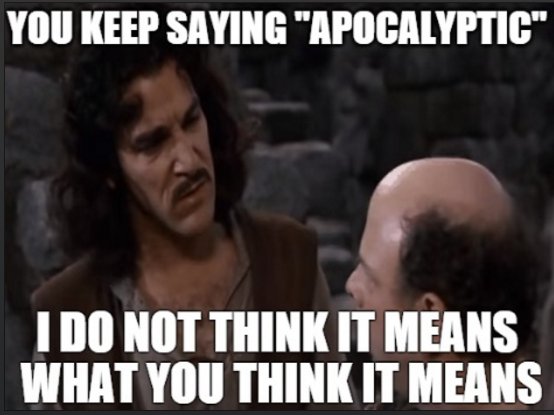
Tim Furnish has been on a mini-crusade recently against the misuse of the word apocalypse, tweeting examples along with this meme-image:
**
Here are two examples of the genre. which Tim featured last night because each comments on Brexit in apocalyptic terms:
The word apocalypse properly refers the vision John, the seer of Patmos, had, tearing away of the veil which so often hides the divine glory from mortal eyes: the Greek word apokalypsis is appropriately translated revelation, and the first verse of the book called The Apocalypse by Catholics and The Revelation of John in the King James Version runs as follows:
The Revelation of Jesus Christ, which God gave unto him, to shew unto his servants things which must shortly come to pass; and he sent and signified it by his angel unto his servant John.
**
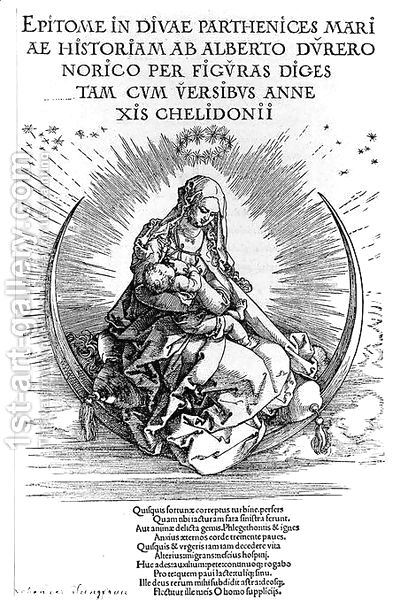
Consider the beauty — and the otherworldiness — of this image from Albrecht Durer. illustrating the “woman clothed with the sun, and the moon under her feet, and upon her head a crown of twelve stars” of Revelation 12.1
:
**
The imagery of this final book of the Bible does not show us the usual world of our senses, but a realm of great symbolic beauty, far beyond the reach of unaided eye or camera — as the great literary critic Northrop Frye notes, when he calls the book “a fairy tale about a damsel in distress, a hero killing dragons, a wicked witch, and a wonderful city glittering with jewels” in his Anatomy of Criticism, p 108.
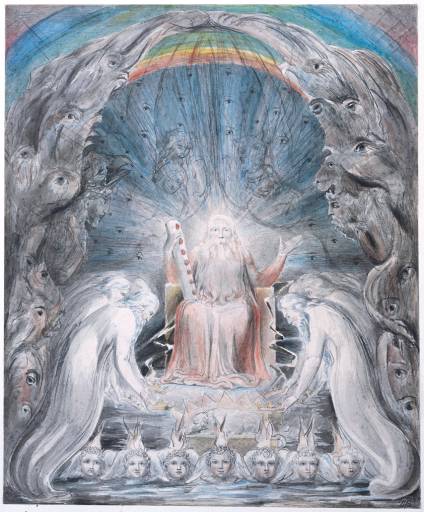
Like the works of the English visionary William Blake, Revelation is more poetic than literal, visionary in the best sense — and it is hardly surprising that Blake is among its foremost illustrators:
Blake, Four and Twenty Elders Casting their Crowns before the Divine Throne, The Tate Gallery
Brexit simply cannot match the darkness of Revelation’s Babylon in its final throes, nor the “new heaven and new earth” that succeed it — “for the first heaven and the first earth had passed away”.
[ by Charles Cameron — on creativity at the intersection of the fleeting and the eternal ]
.
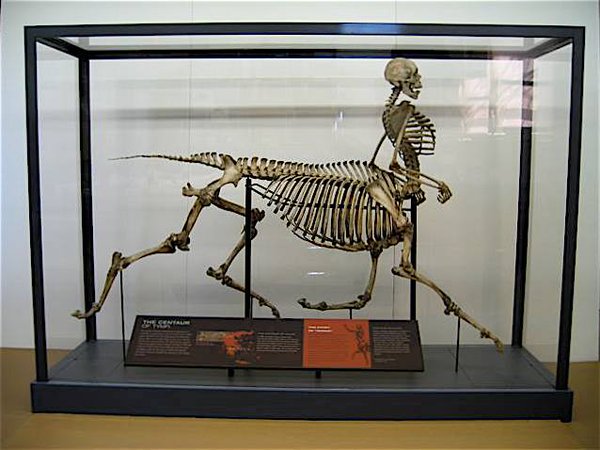
Centaur, displayed in the International Wildlife Museum, Tucson, AZ
**
You know Lao Tzu’s “uncarved wood” (pu) — and Spencer Brown’s “Mark” or “first distinction? It is hard to speak of “the one and the many” without language itself favoring the many, the one being “one” and the many “another”. The Greek phrase “Before Abraham was, I am” attributed to Christ may be as close as we get.
The “uncarved wood” is not some definite -– named and thus defined -– “one” -– it is also “raw silk” (su), the simple -– the natural way or stream, from which things have not yet been separated out by naming.
There is delight, however, both in one becoming two and thus many, in the making of distinctions and naming of names, and no less in two (or the many) becoming one, in the resolution of paradox, the release of tension, peace after strife. In human terms, there is joy in both solo and collaborative achievement.
What better, then, than the perfect fit between disparate entities?
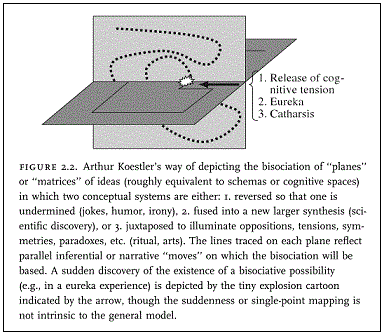
I have written often enough about Arthur Koestler and the place where two disparate spheres of thought link up — the centaur links horse and man in an indissoluble unity — there’s no question here of dismounting after a ride, giving the horse a rub down and some feed, then retiring to the verandah for a whiskey…
The mythological aha! we get from the centaur displayed in the museum hinges on the fit of horse and human skeletons, the perfection with which disparates are joined.
**
Thus far, whenever I’ve discussed Koestler‘s notion of bisociation, I’ve focused on the sense that it liea at the heart of creativity. Koestler himself takes it deeper. Here’s Nicholas Vajifdar, in a review titled Summing Up Arthur Koestler’s Janus: A Summing Up:
Koestler .. asserts that there are two planes of existence, the trivial and the tragic. The trivial plane is the stage for paying bills, shopping, working. Most of life takes place on the trivial plane. But sometimes we’re swept up into the tragic plane, usually due to some catastrophe, and everything becomes glazed with an awful significance. From the point of view of the tragic plane, the trivial plane is empty and frivolous; from the point of view of the trivial plane, the tragic plane is embarrassing and overwrought. Once we’ve moved from one plane to the other, we forget why we could have felt the way we used to.
That’s not just any old distinction between two realms, that’s the one Koestler himself prioritizes. And following his basic principle that a creative spark is lit when two disparate “planes of ideas” intersect, we shouldn’t be too surprised to find Vajifdar continuing:
“The highest form of human creativity,” Koestler writes, “is the endeavor to bridge the gap between the two planes. Both the artist and the scientist are gifted — or cursed — with the faculty of perceiving the trivial events of everyday experience sub specie aeternitatis, in the light of eternity…”
Finally, Vajifdar tells us why he finds Koestler’s definition of art maybe the best he’s ever read:
What I value in this definition of creativity is its emphasis on the subjective being of those who experience the work of art or scientific theory, a surer gauge than cataloguing formal properties or whether it’s “interesting.” Art has always seemed like a kind of sober drunkenness, or drunken sobriety. Most people probably have wondered whether the feelings they felt while drunk were more or less real than their sober feelings. Koestlerian art joins these seemingly irreconcilable feelings together.
This intense and perverse peace, superimposed on scenes of flesh-tearing and eardrum-splitting violence, is an archetype of war-experience. Grass never smells sweeter than in a dug-out during a bombardment when one’s face is buried in the earth. What soldier has not seen that caterpillar crawling along a crack in the bark of the tree behind which he took cover, and pursuing its climb undisturbed by the spattering of his tommy-gun? This intersecting of the tragic and the trivial planes of existence has always obsessed me in the Spanish Civil War, during the collapse of France, in the London blitz.
Zenpundit is a blog dedicated to exploring the intersections of foreign policy, history, military theory, national security,strategic thinking, futurism, cognition and a number of other esoteric pursuits.