zenpundit.com » book

Archive for the ‘book’ Category

REVIEW: Why Socrates Died by Waterfield

Sunday, May 21st, 2017

[ Mark Safranski / “zen“]

Image result for why socrates died

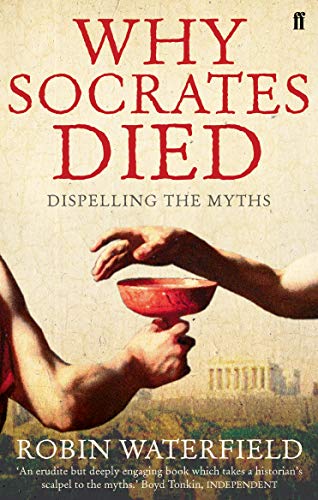
Why Socrates Died: Dispelling the Myths by Robin Waterfield

2400 years after his trial and execution at the hands of the restored Democracy, Socrates continues to exert a fascination over the Western mind. He is a seminal figure in the development of philosophy and was part of the cognitive revolution in classical Greece that saw a shift from archaic Homeric values to humanistic, rational and proto-scientific values. The death of Socrates, condemned for thought crimes, was the great contradiction of Athenian self-conception of Athens as  “the school of Hellas” and his execution remained an indictment leveled by the enemies of democracy ever since. While the importance of Socrates is universally acknowledged, the exact circumstances and motives for his death remain obscure; ironically, a philosopher who so deeply valued “truth” had prosecutors and apologists equally determined to conceal or distort it.

British scholar and translator Robin Waterfield has attempted, as did radical journalist I.F. Stone a generation earlier, to unearth the truth behind the myths about Socrates. Unlike Stone, Waterfield’s investigation, Why Socrates Died , rests on an extensive career translating and writing about the classics, including the major primary and secondary sources used for his book. This provides a firmer base for the inevitable speculation from limited evidence that is frequently required in historical reasoning about antiquity. Waterfield is also far less influenced by contemporary political and cultural conflicts than was Stone, whose turbulent career as an investigative journalist was intertwined with Cold War controversies and his activities on behalf of the intelligence services of the Soviet Union. Waterfield also understands far better the machinery of the Athenian state and the nature of Greek polytheistic religious life, which Stone erroneously believed had become thoroughly secularized by the time of the trial of Socrates.

Waterfield notes that while it is normal that most of the records of historical events during antiquity are fragmentary or have vanished, we two purported records for Socrates’ defense speech at his trial, one of the prosecution and numerous apologia. Socrates trial was obviously no ordinary law case for impiety, being still recalled by Athenians a half-century later. Nor did the disciples of Socrates who most ardently took up his cause, Plato and Xenophon, wish the case to be forgotten but rather endeavored to protect their master’s reputation for all posterity. Waterfield writes:

….Both Plato and Xenophon wanted to give their readers the impression that a high-minded philosopher was convicted by the stupidity of the mob, but this was an attempt to distract attention from the real reasons Socrates was killed.

The real reason posited by Waterfield was that Socrates  was the teacher of Alcibiades and Critias and thus bore some responsibility for the grave misfortunes suffered by Athens during the war and the crimes of the Thirty Tyrants afterwards. Moreover, as Waterfield argues, Socrates was not so much the victim of a political show trial in which Socrates deliberately provoked the democratic faction to kill him, as I.F. Stone argued but was a religious sacrifice or scapegoat for the transgressions of his students against democracy so that a fragile Athenian society could heal its wounds.

Much of the book is devoted to the career of the mercurial and highly charismatic Alcibiades, who entered politics young and as a disciple of Socrates. According to Wakefield, A scion of the greatest of Athenian houses, Alcibiades in his person was emblematic of all of the virtues and vices of the old Athenian aristocracy that had once ruled Athens from the grand council of the Aeropagus. Of the rising generation of young and clever men of good breeding who aimed to play a role in the politics of the radical democracy, Alcibiades had the greatest promise. Highly intelligent, wealthy, handsome and with a magnetic charm, Alcibiades had the natural arête and metis to romance the mob and bend it to his will. It was this that Waterfield argues attracted the attention of Socrates, who saw in Alcibiades and other young men of promising talent he took on as students the future of Athens.

Unfortunately, with Alcibiades, his numerous gifts could never be separated from his equally stupendous flaws – sexual libertinism, flamboyant profligacy, megalomaniacal ambition and reckless hubris – that were frequently his undoing. A psychological chameleon and demagogue, Waterfield argues that the Athenians, as much as they repeatedly forgave and embraced Alcibiades and his schemes, ultimately feared him as an aspiring tyrant. This feeling crystallized into blame for Socrates in the public mind when other students of his who lacked the charms of Alcibiades, notably Critias, sought revolution and oligarchy. Critias’ bloodthirsty pro-Spartan regime as well as the elite’s prior attempt at oligarchy are explained but not with the same space and attention to detail devoted to Alcibiades. One point that Waterfield takes further than most is arguing that Critias aspirations for a morally reformed and less populated Athens are very much in line with the teachings of Socrates. That far from an aberration for whom Socrates bears little responsibility, Critias represented the philosopher’s hopes for Athens and the Athenian democrats who had suffered at the hands of the Thirty Tyrants wanted someone held accountable. That someone was Socrates, whose teachings as it were, would imperil democracy again were he left at liberty.

Waterfield’s handling of the trial itself is less satisfying and includes a lengthy foray into fictive speculation of material prejudicial to Socrates that his notable apologists, Plato and Xenophon, have carefully omitted from their elegies to their beloved master and his trial. The parallels between Athenian religious ceremony and the results of Socrates trial – a trial for impiety held in defiance of the general amnesty that had been decreed for actions under previous regimes – are present. The Greeks did not as a rule go in for human sacrifices in the classical era (though it wasn’t quite as unknown as is commonly believed) but the symmetry is present if more metaphorical than perhaps explicitly religious. It is difficult as a modern to game out exactly where matters of state end and religion begin when the religion is pagan and intertwined in the mind of Athenians with the fate of the state. A debate more for classical scholars than the average layman.

What is difficult to dispute is the centrality of Socrates life in the evolution of Western philosophy and the contradiction he presents for admirers of self-government and free speech and thought as the core of a liberal society. Socrates elenchus is radically subversive; his Homeric tenets on rulership were arch-reactionary even by the standards of his day and Socrates devotion to his beliefs could not be dented even when they required the supreme sacrifice.

What would an American Socrates look and sound like today? How would “the herd” react to his immovable defiance of popular ideologies? Judging by the barometer of social media and the lynch mob mentalities and angry censoriousness that prevail in elite quarters of American life, I’d have to say: poorly. I see no evidence that Americans living in the bastion of civil liberty would prove more tolerant of dissent than did the Athenian democrats who put Socrates to death.

Waterfield has written a lively and informative explanation of a philosopher whose execution casts a long shadow even after two thousand years.  Recommended.


Robert Pirsig, RIP

Tuesday, April 25th, 2017

[ by Charles Cameron — obit as bead game ]
.

A meditation on Robert Pirsig‘s Zen and the Art of Motorcycle Maintenance:


Tryptich: zen speaks to zen, Suzuki to Suzuki, motorcycle to motorcycle

Pirsig died yesterday at his home in Maine, after 88 years hereabouts.

War Books, local version

Tuesday, April 25th, 2017

[ by Charles Cameron — saved from a slush pile]
.

A while back, I presumptuously submitted my effort for Modern War Institute‘s War Books Profile series, where it has languished on the slush pile for a few months now. No need to waste a decent post, though, so I’m posting it here, locally, on Zenpundit, for any who may be interested.

**

Name: Charles Cameron

Brief Biography:

Charles Cameron is the managing editor of the strategy blog Zenpundit, and a past Principal Researcher with the Center for Millennial Studies at BU and Senior Analyst at The Arlington Institute. He is a three time finalist in the Atlantic Council Brent Scowcroft Center’s Art of the Future challenges, and author of the essay “The Dark Sacred: The Significance of Sacramental Analysis” in Robert J Bunker, Blood Sacrifices (a Terrorism Research Center Book). He is the designer of the HipBone family of conceptual games, and is currently working on a book on religious sanctions for violence titled Landmines in the Garden.

Top Five Books:

Mustafa Hamid & Leah Farrall, The Arabs at War in Afghanistan. Respectful enemies – he, a friend of UBL and Mullah Omar, she, a counter-terrorism expert for the Australian Federal Police – debate and confer across battle lines to draw a detailed picture of AQ structure and history. A unique collaboration.

William McCants, The ISIS Apocalypse. The key to ISIS intensity has to do with what then-Chairman of the Joint Chiefs Dempsey called their “apocalyptic, end-of-days strategic vision.” McCants masterfully reveals that apocalyptic driver, and the somewhat obscure scriptures on which it is based.

SH Nasr, ed., The Study Quran. With enemies such as ISIS and AQ that are given to quoting scriptural texts, it is important to have a reputable, non-sectarian translation and scholarly commentary on the Quran. This is that book.

Hegghammer & Lacroix, The Meccan Rebellion: The Story of Juhayman al-‘Utaybi Revisited. A slim volume, a delight to hold in the hand, and packed with detailed scholarship on what is arguably the seed moment of contemporary Jihadism.

John Kiser, The Monks of Tibhirine. This book, and Christian de Chergé’s astonishing letter to the jihadists who would shortly martyr him, is an eloquent testament to values we should cherish in a time of brutality and hatred.

The One That Shaped Me The Most:

Hermann Hesse, The Glass Bead Game. The human mind, attuned to variety and complexity yet primed to understand complex matters in binary terms, tends to hold war and peace as poles apart. Musically speaking, war is equivalent to discord, peace to harmony. The musical technique of counterpoint, so central to Bach, plays “voices” against one another in a manner that recognizes their variety and individuality and allows for discord while constantly working to resolve it harmoniously. It thus offers us an analogy for the constant interplay of warlike and peaceable motivations, both within the individual human and among the world’s societies and cultures – an invaluable overview of the natural condition. Hesse’s novelistic Game shows analogy rather than linearity as the key to creative insight, and offers a contrapuntal play of ideas as the overarching architectural structure for comprehending a world of conflict and resolution. It won the Nobel.

**

**

Reworking my list today, I might well reckon the McCants book has served its brilliant purpose, illuminating in fine detail the apocalyptic nature of ISIS theology, and substitute a no less valuable but more wide-focus tome, Shahab Ahmed’s What is Islam, which broadens our understanding by offering a comprehensive exploration of “lived Islam” across the centuries and continents, going far beyond “scriptual” Islam as understood by the fundamentalists.

Ideally, of coure, there’d be room for both McCants and Ahmed, as there is in the tiny bookshelf on my desk..

Muslim does not equal Terrorist

Friday, April 21st, 2017

[ by Charles Cameron — witting or unwitting, there’s a blatant inability to make this simple distinction ]
.

The sane alternative:


Sheikh Ahmadou Bamba and His Holiness the Dalai
Lama are two role models for our century.

**

There’s an interesting conflation of Islam and Terrorism in a post titled 2 Faces of Islam: Why All Muslims Benefit from Terrorism from Freedom Outpost:

While many Muslims are just as horrified by terrorism as the rest of us are, all Muslims nevertheless benefit from Islam. This is because both peaceful and violent Muslims tend to share two important goals: (1) the conversion of non-Muslims to Islam, and (2) the silencing of critics of Islam. Since terrorism helps achieve these goals, all Muslims benefit from Islam.

This would make sense — I’m not saying I’d agree with it, merely that it would have a logical form to it that wouldn’t make me go cross-eyed — if it read [note: this paragraph edited in light of comment below]:

While many Muslims are just as horrified by terrorism as the rest of us are, all Muslims nevertheless benefit from terrorism. This is because both peaceful and violent Muslims tend to share two important goals: (1) the conversion of non-Muslims to Islam, and (2) the silencing of critics of Islam. Since terrorism helps achieve these goals, all Muslims benefit from terrorism.

But no: under a caption that tells us 2 Faces of Islam: Why All Muslims Benefit from Terrorism, it twice states all Muslims nevertheless benefit from Islam.

The conflation is evident, Islam and Terrorism are interchangeable in the writer’s mind, and that interoperability is liable to find an echo in — or seep diasastrously into — the reader’s mind, too.

**

The actual relation between Islam and contemporary Islamist terrorism is neither “Islam is a religion of no terrorism (aka peace)” nor “Islam is a religion of terrorism (aka war)”. To get at a couple of the major nuances here, the Meccan Cantos and the Medinan cantos of the Quran suggest very different readings of what the religion was originally all about, and how it adapted to violent hostility; and in terms of contemporary Islam, not all Muslims are Salafist, and not all Salafists are jihadist fighters, but some of them most definitely and ruthlessly are.

In addition, Islam needs to be considered both scripturally — the usual western critique — and culturally, by which I mean how Islamic belief plays out in cultural practice across time and space — a far subtler matter. SH Nasr‘s The Study Quran is a prime guide to the former, and Shahab Ahmed‘s What Is Islam?
The Importance of Being Islamic the towering work to digest in understanding the latter.

A useful corrective to the “Islam is a religion of war” perspective can be found in the lives and works of two proniment Muslim proponents and practitioners of nonviolence, Sheikh Amadou Bamba, founder of the Muridiyya or Mourides, and Badshah Khan, Gandhi‘s Muslim friend.

For context around the Mourides, and in constrast with the Wahhabis of the Levanty, see Why are there so few Islamists in West Africa? A dialogue between Shadi Hamid and Andrew Lebovich.

The inability to distinguish Muslim from Terrorist, and the violence that follows it, can truly be described as Islamophobia.

**

Image:

  • Sheikh Aly N’Daw, Choice, Liberty and Love: Consciousness in Action
  • A Backlog of Books for the Antilibrary

    Tuesday, March 28th, 2017

    [Mark Safranski / “zen“]

    Image result for sapiens harrari book  Image result for Tolkien and the great War: the threshold of middle earth   Image result for soldiers & Ghosts book  Image result for the grand strategy of the roman empire

    Image result for intellectuals and society book sowell   Image result for Dynasty book Tom Holland   Image result for psychology of military incompetence book dixon   Image result for Xenophon's Retreat book waterfield

    Image result for the young hitler i knew   Image result for You belong to the universe Keats    Image result for Assholes a theory       Image result for Hitler's Private Library

    I have an intimidating backlog of new and newish books to review here. I have an even longer queue of not so new books for my Antilibrary. I’m not sure when I will get to some of these, given my schedule, but they are nice to have on hand for research purposes.

    Here’s why I picked these up:

    Sapiens: A Brief History of Humankind by Yuval Noah Harari

    Buzz mainly. Saw a few reviews and some chatter on Twitter. I also like evolutionary and cultural evolutionary themes, “Big History” and the like. OTOH I have also read folks bashing  Harari for a poor grasp of economics, so we shall just have to see.

    Tolkien and the Great War: The Threshold of Middle-earth by John Garth

    This is a natural follow-up to The Fellowship: The Literary Lives of the Inklings which I reviewed the other day, but in truth I’ve been looking for a copy of this book for a while in used bookstores. I didn’t buy the hardback when it was new and regretted it. This one I will start reading now.

    Soldiers & Ghosts: A History of Battle in Classical Antiquity by J. E. Lendon

    The ancient world is a topical area where I have been trying to build my Antilibrary for some years now and this book is a twofer being also military history. I am also, in some ways, hoping to make up for the subpar education of my youth by reading the classics and ancient histories.

    The Grand Strategy of the Roman Empire by Edward Luttwak

    Edward Luttwak is one of our more creative – some might say weird – strategic thinkers who is known for putting forth provocative positions embedded with offbeat tangents. Luttwak is also, after a fashion, not an “operator” , or so it is bruited about – and not just an armchair theorist. I liked his The Grand Strategy of the Byzantine Empire even though he gave Byzantine purists fits.

    Intellectuals and Society by Thomas Sowell

    Sowell was in the news that day for retiring as a columnist and I was in a bookstore.

    Dynasty: The Rise and Fall of the House of Caesar by Tom Holland

    I have read some of Holland’s other books, most notably Rubicon. He’s an engaging writer and popular historian with a knack for keeping the narrative moving.

    The Psychology of Military Incompetence by Norman Dixon

    While I’m sure a book like this could write itself, Dixon did it and I’m interested in his systemic conclusions, if any, off organizational incompetence.

    Xenophon’s Retreat by Robin Waterfield

    Xenophon, the student of Socrates, historian and mercenary always struck me as interesting, which probably led me to organize the Xenophon Roundtable years ago on the Wayne Ambler edition of The Anabasis of Cyrus. I also need to pick up Leo Strauss’ On Tyranny again; so little time. So many books.

    The Young Hitler I Knew by August Kubizek

    A source in almost every major bio or history of Adolf Hitler ever written other than Konrad Heiden’s Der Fuhrer and Trevor-Roper’s  The Last Days of Hitler. Most likely, you have already seen the most reliable or noteworthy parts of Kubizek’s memoir reproduced elsewhere more than once in print and documentaries. This is another topical area for Antilibrary building.

    You Belong to the Universe: Buckminster Fuller and the Future by Jonathan Keats

    Buckeyballs. That’s why.

    Assholes: A Theory by Aaron James

    Partially finished with this one. It is a reasonable argument  built upon recognizable observations but being a philosopher, Dr. James is a bit of a pedant and circles back frequently in the text to reiterate his line of reasoning. This may be standard philo practice  but it makes the book slower going than it might have been for a popular format.

    Hitler’s Private Library: The Books that Shaped his Life by Timothy Ryback

    A side of Hitler that neither the German public during the Reich nor the generations of students of history after WWII have normally seen. A useful source for research.

    That’s it!


    Switch to our mobile site