zenpundit.com » media

Archive for the ‘media’ Category

Teju Cole on Nairobi: death and birdsong, death and poetry

Thursday, September 26th, 2013

[ by Charles Cameron — on the topic of Nairobi there’s the news — and then there’s Teju Cole ]
.

Teju Cole, left, Kofi Awoonor, right -- photo credits Teju Cole & Peace FM Online respectively

**

We’re interested in creativity as well as natsec issues here at Zenpundit, so i thought it might be appropriate to see what a fine writer had to say about the hideous attack and siege of the Westgate mall in Nairobi — and perhaps more importantly, how he chooses to say it.

Teju Cole is a writer (“award winning” and rightly so) whose insightful and skilfully deployed tweets caught my attention some while back, and have only increased my admiration for him over time. I followed his twitterstream along with others while the events in Nairobi were playing out, and today read his New Yorker blog post covering much the same ground in greater detail.

What is striking to me about Cole’s approach — the approach of a fine writer, in Nairobi at the time, a friend and admirer of the Ghanaian poet Kofi Awoonor who died at the mall — is the care he takes to balance death with birdsong, death with poetry. In treating matters this way — and we can be sure he is every bit as deliberate in his use of 140 characters as he is in longer-form writings — he both gives a world of context to the small world of the mall event itself, and offers us hope to balance our despair and disgust.

Cole is reading from his novel Open City at the National Museum at the time the attack on the mall begins:

During the reading, as word of the attack filtered in, people answered their phones and checked their messages, but, onstage and oblivious, I continued taking questions from the audience

**

Here, then, I have pulled together most of the tweets Cole posted in recent days for your consideration, in the order in which he posted them… Together, they offer us a very different way to encounter tragic events from those presented by journalists or analysts.

.
Nature has entered the picture: next up will be death — the death of his poet colleague and friend, described first obliquely in the poet’s own words:

.
Then comes the first of two tweets in which Cole judiciously balances the tragically human and blithely natural worlds, including in his tweet a short soundscape in which those voices are woven together in counterpoint:

.

This one is grim — suitable, or a bit overstated, with its echo of the Holocaust? — a question best left to individual taste, perhaps:

.
And then his second polyphonic melding of sounds natural and human-made, joyous and terrifying:

.
He returns to his friend’s death…

.
And then again to birdsong, to the natural world, to the world in which the events of the past days are framed…

**

There is something powerfully moving about Cole’s tweeted reflections, and I believe they take their impact from the precision with which Cole himself frames and balances the horror with beauty.

Just today, my friend Jessie Daniels posted a tweet that caught my eye:

Teju Cole has gone from a tweet to a blog post on the New Yorker site in a matter of days. Here’s just a brief taster:

The massacre did not end neatly. It became a siege. In my hotel room, about half a mile from the mall, I was woken in the mornings that followed by the sounds of gunfire, heavy artillery, attack helicopters, and military planes. In counterpoint to these frightening sounds were others: incessant birdsong outside my window, the laughter of children from the daycare next door. I read Awoonor’s poems, and watched a column of black smoke rise from the mall in the distance. The poems’ uncanny prophetic force became inescapable. A section of “Hymn to My Dumb Earth” reads:

What has not happened before?
An animal has caught me,
it has me in its claws
Someone, someone, save
Save me, someone,
for I die.

.
But you should really read the whole thing: Letter from Nairobi: “I will say it before death comes”.

Pope Francis and the artists who move him

Thursday, September 19th, 2013

[ by Charles Cameron — Dostoevsky, Hopkins, Caravaggio, Mozart, Bach, Fellini, Cervantes — that’s who! ]
.

For context and contrast, first read this:

Pope Francis decided at the last minute not to attend a Beethoven concert last evening, Fox News and others reported. Fox News comments, “Unlike his predecessor Benedict, who was well-known as a music lover, Francis has shown scant interest in music, liturgical or otherwise.” The concert, an event long planned for the Year of Faith, included Beethoven’s 9th symphony with choir and orchestra.

Pope Francis supposedly said “I am not a Renaissance prince who listens to music instead of working,” Vatican Insider first reported, later softening its report to preserve the general sense without quoting the pope directly.

— then this, from the first extended interview of Pope Francis, which has just been released.

While I’m sure plenty of others will mull over other aspects of what he has to say for himself, I’m taking my own insights into his character from the artists in whose work he finds inspiration:

I have really loved a diverse array of authors. I love very much Dostoevsky and Hölderlin. I remember Hölderlin for that poem written for the birthday of his grandmother that is very beautiful and was spiritually very enriching for me. The poem ends with the verse, ‘May the man hold fast to what the child has promised.’ I was also impressed because I loved my grandmother Rosa, and in that poem Hölderlin compares his grandmother to the Virgin Mary, who gave birth to Jesus, the friend of the earth who did not consider anybody a foreigner.

I have read The Betrothed, by Alessandro Manzoni, three times, and I have it now on my table because I want to read it again. Manzoni gave me so much. When I was a child, my grandmother taught me by heart the beginning of The Betrothed: ‘That branch of Lake Como that turns off to the south between two unbroken chains of mountains….’ I also liked Gerard Manley Hopkins very much.

Among the great painters, I admire Caravaggio; his paintings speak to me. But also Chagall, with his ‘White Crucifixion.’ Among musicians I love Mozart, of course. The ‘Et incarnatus est’ from his Mass in C minor is matchless; it lifts you to God! I love Mozart performed by Clara Haskil. Mozart fulfils me. But I cannot think about his music; I have to listen to it. I like listening to Beethoven, but in a Promethean way, and the most Promethean interpreter for me is Furtwängler. And then Bach’s Passions. The piece by Bach that I love so much is the ‘Erbarme Dich,’ the tears of Peter in the ‘St. Matthew Passion.’ Sublime. Then, at a different level, not intimate in the same way, I love Wagner. I like to listen to him, but not all the time. The performance of Wagner’s ‘Ring’ by Furtwängler at La Scala in Milan in 1950 is for me the best. But also the ‘Parsifal’ by Knappertsbusch in 1962.

We should also talk about the cinema. ‘La Strada,’ by Fellini, is the movie that perhaps I loved the most. I identify with this movie, in which there is an implicit reference to St. Francis. I also believe that I watched all of the Italian movies with Anna Magnani and Aldo Fabrizi when I was between 10 and 12 years old. Another film that I loved is ‘Rome, Open City.’ I owe my film culture especially to my parents who used to take us to the movies quite often.

Anyway, in general I love tragic artists, especially classical ones. There is a nice definition that Cervantes puts on the lips of the bachelor Carrasco to praise the story of Don Quixote: ‘Children have it in their hands, young people read it, adults understand it, the elderly praise it.’ For me this can be a good definition of the classics.

**

Mozart, Et incarnatus est:

Mozart, played by Clara Haskil:

Bach, Erbarme dich, from the Matthew Passion:

Fellini, La Strada, innocence:

Fellini, La Strada, despair:

No wonder, then, that he loves the poetry of his fellow Jesuit, the poet Gerard Manley Hopkins:

No worst, there is none. Pitched past pitch of grief,
More pangs will, schooled at forepangs, wilder wring.
Comforter, where, where is your comforting?
Mary, mother of us, where is your relief?
My cries heave, herds-long; huddle in a main, a chief
Woe, wórld-sorrow; on an áge-old anvil wince and sing —
Then lull, then leave off. Fury had shrieked ‘No ling-
ering! Let me be fell: force I must be brief.”‘

O the mind, mind has mountains; cliffs of fall
Frightful, sheer, no-man-fathomed. Hold them cheap
May who ne’er hung there. Nor does long our small
Durance deal with that steep or deep. Here! creep,
Wretch, under a comfort serves in a whirlwind: all
Life death does end and each day dies with sleep.

— nor the works of Caravaggio, whose rap sheet was impressive to say the least:

Arriving in Rome in 1595 at the age of 25, the hot-headed painter’s police dossier — hand-written in Latin and vernacular Italian and bound in great volumes that were stored in the archives until now — makes Caravaggio come across as almost compulsive in his lawlessness. For instance, the man was weapon-obsessed, sporting a sword, dagger, and pistol at various times. He was twice thrown in the clink for carrying arms without a permit, and known for beating strangers in late-night fights and pelting police with rocks.

The documents add fresh color to well-known parts of the Caravaggio legend. Regarding the 1606 brawl during which the artist killed one Ranuccio Tommassoni, leading the artist to flee Rome and causing Pope Paul V to issue a death warrant, the documents reveal that the fight was over a gambling debt, and not a woman, as some accounts have suggested.

It is all the more appropriate, then, to close this post with Caravaggio’s own meditation on the martyrdom by crucifixion of the first Pope, St Peter, whose chair Francis now holds:

_______________________________________________________________________________

.

h/t Damian Thompson, who tweeted “I never thought I’d hear a Pope rave about Haskil’s Mozart, Furtwängler’s Beethoven and Knappertsbusch’s legendary 62 Parsifal.”

Serpentine logic: enantiodromia, or a sudden turn of events

Saturday, September 14th, 2013

[ by Charles Cameron — an intriguing example of enantiodromia aka reversal or the hairpin bend ]
.

Let’s start with this tweet from Glenn Greenwald on September 11th 2013, a dozen years on from that tragic day:

Click on Greenwald’s link, and you’ll find it leads to an article by Mike Riggs, and refers specifically to this image of an ad in a DC metro station:

Riggs, who had written his article Oath Keepers Group Places Massive Pro-Snowden Ad Inside Pentagon Metro Station a couple of months eariler on July 24 2013, clearly thought that OathKeepers’ ad was strange enough to comment:

Last Thursday as I was rolling into the Pentagon Metro station I noticed from the train window a giant sign that read, “Snowden Honored His Oath. Honor Yours! Stop Big Brother!”

Before I could snap a picture or see who’d sponsored the sign, the train was rolling out. For the rest of the weekend I wondered who had the chutzpah (and the inventiveness) to praise Snowden at the Pentagon stop, where it’s far more common to see ads from lobbyists praising the merits of some piece of military tech.

Turns out it was the Oath Keepers, “a coalition of current and former military, police, and other public officials [who] have pledged not to obey unconstitutional commands.”

Following hot on the heels of Greenwald’s tweet of September 11, Charles Johnson wrote a piece on LGF titled Why Is Glenn Greenwald Promoting an Extreme Right Wing Militia?

And that in turn led to friend JM Berger’s tweet, also on Sept 11th:

And the enantiodromia here, the sudden switcheroo? That’s to do with Greenwald suddenly tweeting an appreciation of the OathKeepers — not his usual allies by any stretch of the imagination. So this one might equally be filed under “strange bedfellows”.

Or a “one two combo” perhaps? Left jab right cross, to be specific?

**
So where does the word come from? Carl Jung more or less borrowed the word from Heraclitus, as quoted by Diogenes Laërtius (ix. 7) in a passage that defies easy translation. Fortunately, as Wikipedia helpfully notes:

Plato in the Phaedo will articulate the principle clearly: “Everything arises in this way, opposites from their opposites.” (sect. 71a).

Jung explains Heraclitus’ meaning as he understands it:

In the philosophy of Heraclitus it is used to designate the play of opposites in the course of events — the view that everything that exists turns into its opposite…

and as he himself uses the term:

I use the term enantiodromia for the emergence of the unconscious opposite in the course of time.

Would you prefer a more contemporary reference? John Perry Barlow even gave a TED talk about it:

**

Enantiodromia turns out to be one of the classic forms of paradox in history — t’s a form I’ve written about before on Zenpundit, in my post Jung in Tehran, aka “enantiodromia”, and also referred to in a comment on Pamela Geller.

Here are two notable examples. The first comes from Reinhold Niebuhr‘s The Irony of American History:

Everybody understands the obvious meaning of the world struggle in which we are engaged. We are defending freedom against tyranny and are trying to preserve justice against a system which has, demonically, distilled injustice and cruelty out of its original promise of a higher justice.

The second is from UK’s Labour MP, Sir Gerald Kaufman, who once said:

My grandmother was ill in bed when the Nazis came to her home town a German soldier shot her dead in her bed. … My grandmother did not die to provide cover for Israeli soldiers murdering Palestinian grandmothers in Gaza.

Right or wrong, Kaufman was in effect asserting the danger of enantiodromia

**

Note well that enantiodromia is mostly used to refer to a single switchback: iterative enantiodromia would be a form of boustropehdon.

Note also that David Myatt, whose comment on enantiodromia in Heraclitus I linked to above, is an interesting fellow in his own right, having been a leading UK neonazi for decades, then converting to Islam and preaching jihad and praise of bin Laden — now finally settling into his (hopefully, final) role as an English country gentleman and proponent of moderation in all things — an ex-twice-extremist anti-extremist, itself quite an enantiodromic turn of events…

Hurrumph! Enough for one post…

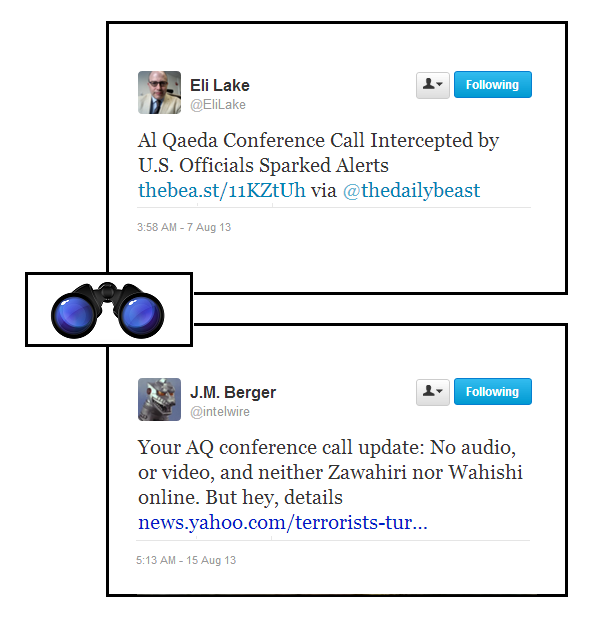
AQ Conference Call, 2: what a difference a week makes

Thursday, August 15th, 2013

[ by Charles Cameron — all the AQ leaders teleported into this one cave for their annual conference, see, and spoke to reporters as they were leaving for “near” and “far” – no wardrobe malfunctions, though ]
.

Following up on my post, AQ Conference Call, 1

.

When Eli Lake and Josh Rogin broke the story it was huge, wardrobe-malfunction huge, although AQ doesn’t really do wardrobe malfunctions the way we do at the Superbowl:

It wasn’t just any terrorist message that triggered U.S. terror alerts and embassy closures—but a conference call of more than 20 far-flung al Qaeda operatives, Eli Lake and Josh Rogin report.

Okay, conference call, I’ve been on some of those. Phones, right?

Ah — Skype, maybe, or Google+?

Nope.

Semantic? Okay… but anyway, “The crucial intercept that prompted the U.S. government to close embassies in 22 countries was a conference call between al Qaeda’s senior leaders and representatives of several of the group’s affiliates throughout the region” — right?

Um, no.

Here’s the more recent piece by Lara Jakes and Adam Goldman for AP to which JM Berger’s quote (lower panel, above) was pointing:

Al-Qaida fighters have been using secretive chat rooms and encrypted Internet message boards for planning and coordinating attacks — including the threatened if vague plot that U.S. officials say closed 19 diplomatic posts across Africa and the Middle East for more than a week.

It’s highly unlikely that al-Qaida’s top leader, Ayman al-Zawahri, or his chief lieutenant in Yemen, Nasser al-Wahishi, were personally part of the Internet chatter or, given the intense manhunt for both by U.S. spy agencies, that they ever go online or pick up the phone to discuss terror plots, experts say.

More specifically:

A U.S. intelligence official said the unspecified threat was discussed in an online forum joined by so many jihadist groups that it included a representative from Boko Haram, the Nigerian insurgency that has loose and informal ties to al-Qaida. Two other intelligence officials characterized the threat as more of an alert to get ready to launch potential attacks than a discussion of specific targets.

One of the officials said the threat began with a message from al-Wahishi, head of the Yemen-based al-Qaida in the Arabian Peninsula, to al-Zawahri, who replaced Osama bin Laden as the core al-Qaida leader. The message essentially sought out al-Zawahri’s blessing to launch attacks. Al-Zawahri, in turn, sent out a response that was shared on the secretive online jihadi forum.

So the jihadis have a web-forum, and messages from Zawahiri get quoted there?

A stunning new development!

**

DoubleTweet Sources:

  • Eli Lake
  • JM Berger
  • Articles pointed to:

  • Eli Lake
  • JM Berger
  • **

    Edited to add:

    FYI, there’s an extended treatment of the whole affair by Ken Silverstein now up at Harper’s, Anatomy of an Al Qaeda “Conference Call” — h/t Joshua Foust.

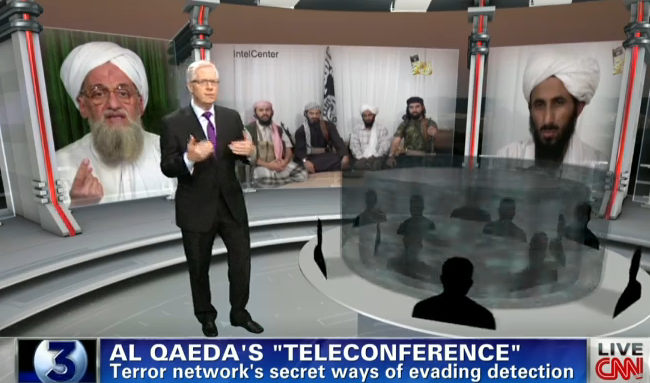
    AQ Conference Call, 1: a picture worth a thousand words

    Thursday, August 15th, 2013

    [ by Charles Cameron – if the media presentation is sufficiently shiny, it will surely impress enough people that making sense becomes senseless ]
    .

    From CNN comes this picture — the one that opened my eyes to what AQ is really up to these days:

    **

    So…

    If one picture
    is worth a thousand words, what’s
    a bunch of Wordsworth?

    **

    I apologize. In all fairness, you should be able to see the whole clip:

    **

    In a follow up post, how the story looked when it first broke, and how it looks now it’s clearly broken.


    Switch to our mobile site