zenpundit.com » china

Archive for the ‘china’ Category

Making Historical Analogies about 1914

Friday, January 10th, 2014

[by Mark Safranski, a.k.a. “zen“]

The Independent has a short, quasi-sensationalist, article featuring historian Margaret MacMillan discussing what is likely to become the first pop academic cottage industry of 2014….making historical analogies about 1914 and World War I! MacMillan is a senior scholar of international relations and administrator at Oxford ( where she is Warden of St Antony’s College)  with a wide range of research interests, including the First World War on which she has published two books.  I am just going to excerpt and comment on the historical analogies MacMillan made – or at least the ones filtered by the reporter and editor – she’s more eloquent in her own writing where each of these points are treated at greater length:

Is it 1914 all over again? We are in danger of repeating the mistakes that started WWI, says a leading historian 

Professor Margaret MacMillan, of the University of Cambridge, argues that the Middle East could be viewed as the modern-day equivalent of this turbulent region. A nuclear arms race that would be likely to start if Iran developed a bomb “would make for a very dangerous world indeed, which could lead to a recreation of the kind of tinderbox that exploded in the Balkans 100 years ago – only this time with mushroom clouds,”

…..While history does not repeat itself precisely, the Middle East today bears a worrying resemblance to the Balkans then,” she says. “A similar mix of toxic nationalisms threatens to draw in outside powers as the US, Turkey, Russia, and Iran look to protect their interests and clients. 

Several comments here. There is a similarity in that like the unstable Balkan states of the early 20th century, many of the Mideastern countries are young, autocratic, states with ancient cultures that are relatively weak  and measure their full independence from imperial rule only in decades.  The Mideast is also like the Balkans, divided internally along ethnic, tribal, religious, sectarian and linguistic lines.

The differences though, are substantial. The world may be more polycentric now than in 1954 or 1994 but the relative and absolute preponderance of American power versus all possible rivals, even while war-weary and economically dolorous, is not comparable to Great Britain’s position in 1914.  The outside great powers MacMillan points to are far from co-equal and there is no alliance system today that would guarantee escalation of a local conflict to a general war. Unlike Russia facing Austria-Hungary over Serbia there is no chance that Iran or Russia would court a full-scale war with the United States over Syria.

On the negative side of the ledger, the real problem  is not possible imperial conquest but the danger of regional collapse. “Toxic nationalism” is less the problem than the fact that the scale of a Mideastern Sunni-Shia sectarian conflict is so enormous, as are the implications . Nothing in the Balkans after the turn of the century compares to Syria, then Iraq and then other states sliding into a Muslim version of the Thirty Year’s War. An arc of failed states from Beirut to Islamabad is likelier than, say, a new Persian empire run by Tehran’s mullahs.

Modern-day Islamist terrorists mirror the revolutionary communists and anarchists who carried out a string of assassinations in the name of a philosophy that sanctioned murder to achieve their vision of a better world

Agree here. The analogy between 21st revolutionary Islamists and the 19th century revolutionary anarchists is sound.

And in 1914, Germany was a rising force that sought to challenge the pre-eminent power of the time, the UK. Today, the growing power of China is perceived as a threat by some in the US.

Transitions from one world power to another are always seen as dangerous times. In the late 1920s, the US drew up plans for a war with the British Empire that would have seen the invasion of Canada, partly because it was assumed conflict would break out as America took over as the world’s main superpower.

Imperial Germany’s growing power was less troublesome to Edwardian British statesmen than the strategic error of the Kaiser and von Tirpitz to pursue a naval arms race with Great Britain that did not give Germany’even the ability to break a naval blockade but needlessly antagonized the British with an existential threat that pushed London into the French camp.

As to military plans for invading Canada (or anywhere else), the job of military planning staffs are to create war plans to cover hypothetical contingencies so that if a crisis breaks out, there is at least a feasible starting point on the drawing board from which to begin organizing a campaign. This is what staff officers do be they American, French, Russian, German, Chinese and even British. This is not to be taken as serious evidence that the Coolidge or Hoover administrations were hatching schemes to occupy Quebec.

More importantly, nuclear weapons create an impediment to Sino-American rivalry ending in an “August 1914” moment ( though not, arguably, an accidental or peripheral clash at sea or a nasty proxy conflict). Even bullying Japan ultimately carries a risk that at a certain point, the Japanese will get fed-up with Beijing, decide they need parity with China, and become a nuclear weapons state.

Professor MacMillan, whose book The War That Ended Peace was published last year, said right-wing and nationalist sentiments were rising across the world and had also been a factor before the First World War

In China and Japan, patriotic passions have been inflamed by the dispute over a string of islands in the East China Sea, known as the Senkakus in Japan and Diaoyus in China. “Increased Chinese military spending and the build-up of its naval capacity suggest to many American strategists that China intends to challenge the US as a Pacific power, and we are now seeing an arms race between the two countries in that region,” she writes in her essay. “The Wall Street Journal has authoritative reports that the Pentagon is preparing war plans against China – just in case.” 

“It is tempting – and sobering –to compare today’s relationship between China and the US with that between Germany and England a century ago,” Professor MacMillan writes. She points to the growing disquiet in the US over Chinese investment in America while “the Chinese complain that the US treats them as a second-rate power”.

The “dispute” of the Senkakus has been intentionally and wholly created by Beijing in much the same way Chinese leaders had PLA troops provocatively infringe on Indian territory, claim the South China Sea as sovereign territory and bully ships of all nearby nations other than Russia in international or foreign national waters. This is, as Edward Luttwak recently pointed out, not an especially smart execution of strategy. China’s recent burst of nationalistic bluffing, intimidation and paranoia about encirclement are working along the path of self-fulfilling prophecy.

Another similarity highlighted by the historian is the belief that a full-scale war between the major powers is unthinkable after such a prolonged period of peace. “Now, as then, the march of globalisation has lulled us into a false sense of safety,” she says. “The 100th anniversary of 1914 should make us reflect anew on our vulnerability to human error, sudden catastrophes, and sheer accident.

Agree that globalization is no guarantee against human folly, ambition or the caprice of chance.

What are your thoughts?
Zen at War on the Rocks on China and Avoiding War

Thursday, November 14th, 2013
Chinese Navy

Chinese Navy

[by Mark Safranski, a.k. a. “zen“]

The editors of the excellent War of the Rocks invited me to post a short rebuttal to the op-ed “How Not to Go to War With China”, by Scott Cheney-Peters, which appears in their “Hasty Ambush” section:

UNDERSTANDING CHINA: THE REAL KEY TO AVOIDING WAR

….A place to begin our efforts in avoiding war with China might be avoiding engagement in some of the same incorrect mirror-imaging assumptions we once made about the Soviet Union, not least of which was MAD.  As a doctrine, Soviet leaders never accepted MAD and the Red Army general staff ignored it in drafting war plans to fight and prevail in any nuclear war. While the Soviets had no choice but to tackle the logic of deterrence as we did, the operative Soviet assumptions were predicated on a different strategic calculus, a different force structure and above all, different policy goals from their American counterparts.  A dangerous gap between American assumptions of Soviet intentions and the reality of these intentions came to light when in 1983 the Reagan administrationdiscovered to their alarm that Soviet leaders had interpreted the NATO exercise Abel Archer 83 as preparations for a real, imminent nuclear first strike on the USSR and ordered Soviet nuclear forces on high alert.

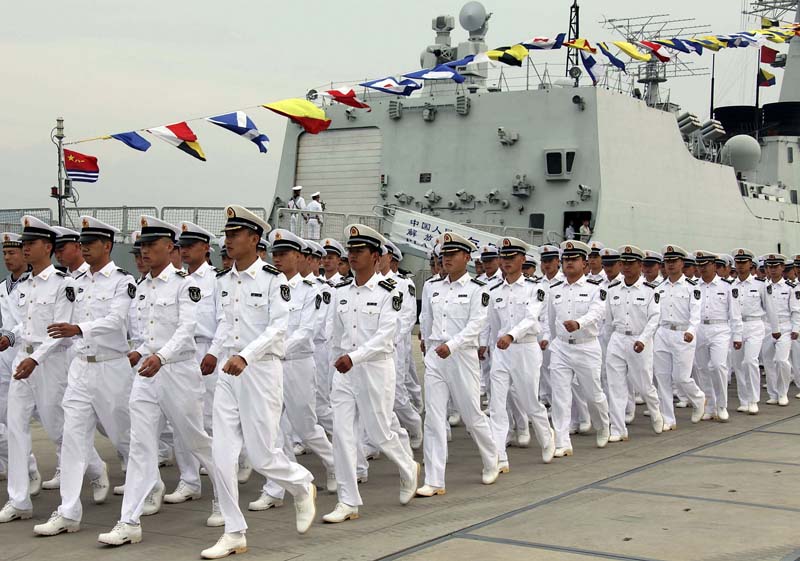
The military-to-military confidence-building initiatives outlined by Cheney-Peters intended to construct “habits of cooperation” are not entirely useless. There is some value in ensuring that high-ranking American military officers have personal and limited operational familiarity with their Chinese counterparts in the People’s Liberation Army (PLA), but as potential game-changers, they need to be taken with a grain of salt. Such a policy misses the essential strategic and political centers of gravity in the Sino-American relationship.  Namely that for the first time in 600 years, China is building a blue water Navy that will foster power projection as far away as the Indian ocean and Australia.  Secondly, this naval expansion, coupled with a new Chinese foreign policy, aggressively presses grandiose territorial demands on nearly all of its neighbors, including India and Japan.  These are fundamental conflicts with American interests that cannot be explained away or papered over by banquet toasts with visiting delegations of Chinese admirals. […]

Read the rest here.

Also read another WotR  China piece “99 Red Balloons: How War with China would Start” by Matthew Hipple

On China vs India — and the Hungry Ghosts

Tuesday, August 27th, 2013

[ by Charles Cameron — I’d have put these two “quotes” in my DoubleQuotes format, but wanted to quote quite a gobbit of each, and the print would have been too small ]
.

Offering us a fresh angle on two great nations as we (maybe) pivot to Asia

Excerpted from Hungry Ghost Festival 2013 Begins In China As Spirits Descend On Homes, Wander Streets:

The gates of hell have opened. Its ghosts have been let loose to roam on earth and visit the homes of their relatives.

According to traditional Chinese beliefs this happens every year during the seventh month of the lunar year, resulting in a raucous, feast-and-music filled celebration known as the Hungry Ghost Festival. But not all ghosts are good. There are some spirits who wander the streets, ravenous and envious because they died without descendants or were ignored by their kin while alive.

To appease the hungry spirits, ethnic Chinese step up prayers, aided by giant colorful joss sticks shaped like dragons. They also burn mock currency and miniature paper television sets, mobile phones and furniture as offering to the ancestors for their use in the other world.

For 15 days, neighborhoods hold nightly shows of shrill Chinese operas and pop concerts to entertain the dead.

Excerpted from Indian state outlaws profiting on miracles, summoning ‘ghosts’:

New Delhi – A new law against superstition and black magic in India’s Maharashtra state has triggered a debate between religious groups who say that the state is interfering in personal faith, and rationalists who say religious malpractices violate human rights. [ … ]

“We will challenge the law as it is ambiguous and interferes with personal faith,” says Abhay Vartak of the Santan Sanstha, a Hindu organization. “The law does not define much of what it outlaws – ghosts, for instance. The government itself is not clear whether ghosts exist! And if belief in ghosts is to be outlawed, then what about the Hindu Scripture the Atharva Veda, which says a lot about how to get rid of ghosts who come to inhabit a body?” he asks.

The law specifically outlaws 12 practices, making them punishable by a jail term of seven months to seven years. Of the 12 clauses, two relate to belief in ghosts. The first one forbids recommending violent and sexual practices for purging ghosts from the body – including drinking urine or stool, being tied with a rope or chain, and touching heated objects. It also outlaws creating fear by threatening to invite ghosts.

**

For a glimpse of how the notion of “hungry ghosts” might be interpreted in terms of Tibetan Buddhist philosophy — as embodied in the Chöd rite — see Tai Situ Rinpoche‘s Introduction to Chod.

A Sign of the Times – in today’s Post

Tuesday, August 6th, 2013

[ by Charles Cameron — on skilled design, and on choosing to purchase influence, elegance or beauty ]
.

There’s something very neat about this front page:

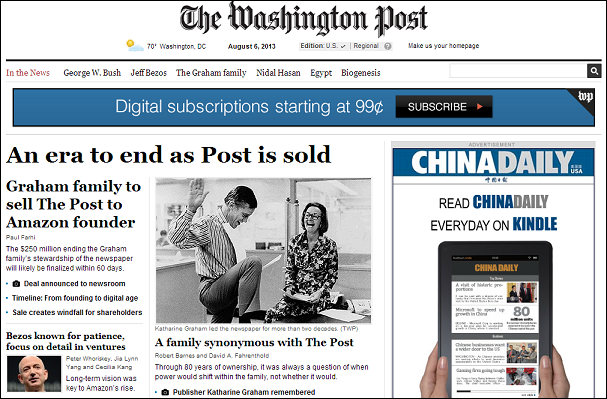
Okay, okay, Jeff Bezos has bought the Washington Post. But what intrigues me about this front page of today’s digital edition as it appeared on my screen this morning was the way a color photo of Bezos sneaks in (left) below a larger black and while photo of Katharine Graham (center) — while an ad for the China Daily (right) takes up a third of the real estate (right), to be read, mark you, on Bezos’ own Kindle.

So we have today’s future, to coin a phrase, with the “pivot to Asia” and the “pivot to Bezos” right there together — and the “pivot to digital” pretty much a done deal.

**

The price of the Post was $250 million, and plenty of people have talked about what Bezos could have bought instead — and while we’re on the topic of neat design, I couldn’t help but notice that there’s a $250 million penthouse under construction in Monaco, described by HiConsumption as The World’s Most Expensive Penthouse, and that one of the numerous architectural illustrations provided also features a striking lesson on graphics:

What catches my eye here is the parallelism between the window with its center divider and balcony rail (left) with the geometry of the painting on the wall (right) — that’s a brilliant design choice, as the photographer well knows.

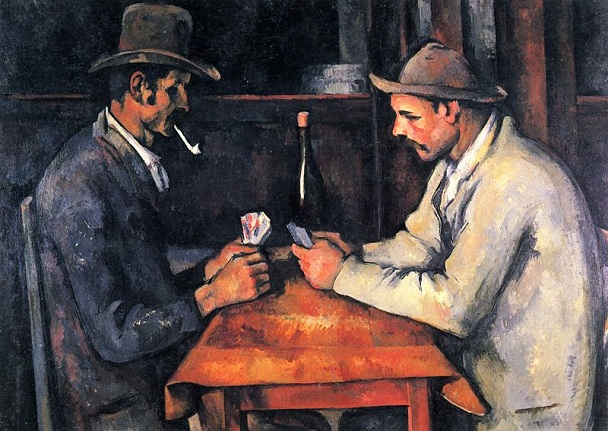
In my dreams I’d prefer my own choice of art-work, frankly — and if I only had $250 million to play with, I’d go for a small craftsman cottage in Pasadena, perhaps — with that luminous $250 million Cezanne to grace one of my walls…

**

That — and the digital Post on Kindle, I suppose.

Of images and likenesses

Thursday, May 30th, 2013

[ by Charles Cameron — a storm in a tea-kettle, various resemblances to Hitler, how Pudovkin perceived and practiced montage, what happened when the talkies came along, and four faces of Christ ]
.

It begins with something as innocent ad a tea kettle:

Does this otherwise innocuous tea kettle resemble Hitler? Does it look enough like Hitler to merit JC Penney withdrawing it from sale?

**

Let’s take a look at a couple of other “resemblances to Hitler”:

Who most resembles Hitler — Chaplin, or Stalin?

On the face of it, that’s an easy question. If I were to just ask you the question “who is most like Hitler” in words, you might very well say Stalin, or Pol Pot perhaps — or, I suppose, if you were very focused on World War II and the Axis leaders, Mussolini.

And if I asked you “who looks most like Hitler?” you might well say Charlie Chaplin — but you’d be “thinking visually” in terms of appearances, rather than “verbally” in terms of meanings.

So there are at least two different ways someone can resemble Hitler — in terms of appearance, and in terms of behavior.

**

We don’t notice our own noses most of the time, even though they’re within our field of vision — and it’s a bit like that with likeness. We don’t have a grammar of resemblance, and that’s part of what I want to explore here, in drawing your attention to these two ways (at least) in which we can think of someone resembling Hitler.

Placing two pictures side by side — Charlie Chaplin and Hitler, Hitler and Joseph Stalin — gets us to think a bit about the parallelisms and oppositions. And that’s a large part of what my DoubleQuotes format is good for. I am interested in what the mind does with juxtapositions, and I’m interested in getting us able to hold two contrasting thoughts in mind at the same time. As F Scott Fitzgerald said:

The test of a first-rate intelligence is the ability to hold two opposed ideas in mind at the same time and still retain the ability to function.

I’m in two minds as to whether he’s right, of course.

**

So montage. So the beginnings of Russian cinema, and the great directors of the silent era in film, Vsevolod Pudovkin and Sergei Eisenstein.

Pudovkin wrote quite a bit about montage, about what he called relational editing, telling us:

editing is not merely a method of the junction of separate scenes or pieces, but is a method that controls the “psychological guidance” of the spectator.

He talked about five modes of editing, getting close to the foundations of a grammar of resemblance of the kind I mentioned above — contrast, paralleliem, symbolism, simultaneity and leit-motif. He said, for instance:

Suppose it be our task to tell of the miserable situation of a starving man; the story will impress the more vividly if associated with mention of the senseless gluttony of a well-to-do man.

and went on:

it is possible not only to relate the starving sequence to the gluttony sequence, but also to relate separate scenes and even separate shots of the scenes to one another, thus, as it were, forcing the spectator to compare the two actions all the time, one strengthening the other.

Under the heading of Symbolism, he noted:

In the final scenes of the film Strike the shooting down of workmen is punctuated by shots of the slaughter of a bull in a stockyard. The scenarist, as it were, desires to say: just as a butcher fells a bull with the swing of a pole-axe, so, cruelly and in cold blood, were shot down the workers.

I don’t suppose I’m alone in thinking here of the ending of Coppola‘s Apocalypse Now — and I doubt Coppola would have been unaware of the tribute he was paying to one of the early masters of cinematography, either. And what doe Pudovkin say about the symbolic editing together of the shooting of workmen punctuated by the slaughter of a bull?

This method is especially interesting because, by means of editing, it introduces an abstract concept into the consciousness of the spectator without use of a title.

**

All this, of course, during the silent era. And when the talkies begin…

After the advent of the talking pictures, Eisenstein, Pudovkin, Alexandrov and Vertov issue a statement, attempting to salvage the emotional impact of montage which is in danger of being capsized by the oh so new and glittery charm of verbals — of people talking:

Only a contrapuntal use of sound in relation to the visual montage piece will afford a new potentiality of montage development and perfection.

The first experimental work with sound must be directed along the line of its distinct nonsynchronization with the visual images. And only such an attack will give the necessary palpability which will later lead to the creation- of an orchestral counterpoint of visual and aural images

You see what’s going on here? Eisenstein, Pudovkin, Vertov want the mind to be working on two tracks of ideation at once — a visual track, full of emotional impact, and a verbal track, in counterpoint to the visual.

They want us to be able “to hold two opposed ideas in mind at the same time” — not in synchrony but in counterpoint.

So this business of juxtaposition, of contrapuntal thinking, goes quite deep, and it’s my contention that it’s a skill we need both to develop and to understand — hence my interest in building a grammar of resemblance, of rhyme, of fugue, of graphic match, of equation.

**

One final example. If the “likeness of Hitler” example confronted us with the “nature of likeness” as between facial resemblance and similarities of behavior, this next instance will deal more with “evidence of likeness”:

Here’s the question: are these “real” likenesses?

**

The two likenesses above are both of interest as possible “likenesses of Christ” — the top one taken from the Shroud of Turin, the lower one allegedly photographed in the snow, perhaps in China. The image on the Shroud might be a sort of “photographic negative” of the actual face of man a crucified two thousand years ago — and scientific techniques may or may not offer us evidence as to that likelihood. The other image — supposedly of the face of the same Christ, this time seen and recognized by a photographer in shadows on snow — how does one check the provenance of an image like that?

We don’t have a photographic record of what Christ looked like to compare our own images with — unless the Shroud turns out to offer us just that — so it’s likely we’re back at the distinction first drawn by theologians over a century ago, between “the Jesus of History” and “the Christ of Faith”.

Consider the two images below, neither one perhaps what a camera might have seen if a photographer could time-travel back two thousand years, but each suited to the people for whom it was produced — in China, in Africa:

The Christs these two images evoke come from a different mode of seeing to the images captured in biometric scans and on ID cards — yet they are well-suited for devotion and inspiration…


Switch to our mobile site