zenpundit.com » china

Archive for the ‘china’ Category

Of games IV: the apocalyptic touch

Tuesday, June 19th, 2012

[ by Charles Cameron — some recent game references with seriously playful intent ]
.

Two things, really.

If you read the Jerusalem Post, you’ll likely have seen that:

Iran, Russia, China and Syria will hold the Middle East’s largest ever war game, Iranian news outlets reported quoting unnamed sources.

According to the report, 90,000 troops, 400 warplanes and 1,000 tanks from the four countries will take part in land and sea exercises. The war games will feature Russian atomic submarines, according to Iranian media, as well as warships, aircraft carriers and mine-clearing destroyers. Semi-official Iranian FARS news agency stated that the exercise was being planned in coordination with Egypt, which recently acceded to grant the passage of 12 Chinese warships through the Suez Canal. The report stated that the Chinese naval convoy is due to dock in Syrian harbors within the next two weeks.

That’s pretty much on the materiel side of things, IMO.

*

On the other hand, if you read Joel Rosenberg, you’ll have seen all that and more — and then this:

The story is particularly intriguing — and disturbing — in light of Bible prophecies in Ezekiel 38-39 that indicate a Russian-Iranian military alliance will develop in the “last days” to attack the nation of Israel. In my first nonfiction book, Epicenter, and in my novel, The Ezekiel Option, I describe these prophecies in detail. While it remains too early to know for certain if the “War of Gog and Magog” prophecies are going to be fulfilled in the near future, geopolitical trends in recent years and even in recent months have been curiously consistent with the ancient Biblical text. A militaristic Czar — Vladimir Putin — has risen to power in Russia. Putin is the only Russian leader in history to visit Israel (7 years ago), and is preparing to visit again on June 25, trying to make the Israelis feel comfortable with him. Yet Russia has been selling billions of dollars in arms to Iran and other nations described in the prophecies. Russia is currently sending naval ships and forces to Syria. Israelis are living more securely in the land, and are more prosperous, than ever in their modern history, also consistent with the prophecies.

Followed without a paragraph break by:

To learn more about the prophecies of Ezekiel 38-39, please click here.

And the headline?

That’s more morale than materiel, I’d say!

*

So that’s Thing One, as Dr Seuss might put it. But what about Thing Two?

The big, apocalyptic war games are for big fellows like Gog, Magog and Putin, guys who can afford to wear the big-boy pants.

What about the little guys and gals?

That, YNet tells us, is where a spot tourism might come in handy…

Gush Etzion has become a hot destination in recent months for tourists seeking an Israeli experience like no other: The opportunity to pretend-shoot a terror operative. Residents of the nearby settlements, who run the site, offer day-trippers a chance to hear stories from the battleground, watch a simulated assassination of terrorists by guards, and fire weapons at the range.

The fact that the tourist attraction is located beyond the Green Line only intensifies the thrill for the visitors, who often appear disappointed when told by their guides that they are not in any danger.

That strikes me as just a tad messianic, too… in a very post-modern sort of way.

Cute pic from that YNet article, photo credit Alex Kolomoisky:

To judge by the surrounding text, that young lady’s from Miami. She’s five.

Carlos Fuentes (1928 – 2012)

Wednesday, May 16th, 2012

[ by Charles Cameron — in memory of Carlos Fuentes, requiescat in pace ]
.


.

Carlos Fuentes‘ great novel, Terra Nostra, opens with these words:

Incredible the first animal that dreamed of another animal.

It’s a sentence to stop you in your tracks, a sentence to give pause to time itself, circling back on itself like the serpent that eats its own tail, a dream of a sentence, a dream sentence.

Fuentes continues:

Monstrous the first vertebrate that succeeded in standing on two feet and thus spread terror among the beasts still normally and happily crawling close to the ground through the slime of creation. Astounding the first telephone call, the first boiling water, the first song, the first loincloth.

How does a mind move so agilely among these many and diverse firsts — the sleeping, the archeo-anthropological, the technical, the musical, the shameful or sinful or perhaps decorative, even erotic? In a single paragraph — the first in a book that will run 890 pages and not tire?

And Fuentes continues:

About four o’clock in the morning one fourteenth of July, Pollo Phoibee, asleep in his high garret room, door and windows flung wide, dreamed these things, and prepared to answer them himself.

Pollo Phoibee dreamed these things, Carlos Fuentes dreamed Pollo Phoibee…

And we are in Paris, Paris of the artists, of the garret, and yet a Paris where the Seine is boiling, where the Louvre has become crystalline, the black eyes of the gargoyles of Notre Dame see “a much vaster panorama”…

*

Carlos Fuentes died today, and I am saddened — remembering him signing my short, fat British Penguin paperback of Terra Nostra (its fondly remembered cover image above) and commenting that it was his preferred English edition, since one could slip it into one’s pocket…

And Terra Nostra was special to me, both as a great and tumultuous fiction, and as a fiction that quoted Norman Cohn‘s In Pursuit of the Millenniun, the book that back in my Oxford days introduced me to the history of apocalyptic thought… a fiction also familiar with Frances Yates, another scholar I greatly admire, and her writings on the Memory Theater

Carlos Fuentes, the imagination that conceived Terra Nostra, is no longer with us.

*

He had been a diplomat, this great imagination. Born into a diplo family, he had served as Mexican ambassador to Paris — Paris of the diplomatic banquets, but also of the artist’s garret, of this New World imagination spanning continents and centuries as though they were a playground, the playground of a single, multiple, cosmopolitan and erudite mind.

The poet Paul Claudel, French ambassador to Japan, was reproved by the Surrealists in 1925 with the words:

One cannot be both ambassador for France and poet!

The poet Saint-John Perse was secretary to the French Embassy in Peking, and later General Secretary of the French Foreign Office. The poet Giorgos Seferis was Royal Greek Ambassador to the United Kingdom. The poet Pablo Neruda was Chilean ambassador to France… The poet Octavio Paz, Mexico’s ambassador to India.

Among novelists, it was Lawrence Durrell — an Englishman born in India with what he described as “a Tibetan mentality” — one who found life in England itself “like an autopsy … so, so dreary” — who was British press attaché in Alexandria, Egypt, during World War II, where as they say:

Ostensibly working, Durrell was in reality closely observing the assortment of sights, sensations, and people that wartime Alexandria, a crossroads of the East and West, had to offer.

The result was his masterpiece, The Alexandria Quartet.

*

Fuentes is heir to many lineages: of Mexico, of the world, of literature, of diplomacy, of the imagination.

In honoring him today, my researches turned up this apposite quote from Aldo Matteucci at the Reflections on Diplomacy blog:

To survive, a diplomat needs poetry. Filed amidst the many layers of the brief, the short poem will refresh the bleary mind. Poetry brings distance – hence perspective and insight. Poetry reminds the diplomat that the best professional is the amateur.

Most deeply – poetry is truth.

Carlos Fuentes survives us all.

The Strategic Dilemma of Bitter-Enders

Sunday, April 8th, 2012

Berlin 1945

I have been reading The End by Ian Kershaw and it struck me that the story therein of Hitler’s Reich going down to total destruction is really a recurrent phenomena.

It is interesting that Kershaw, who began his earlier 2 volume biography of Adolf Hitler with the hypothesis that the Fuhrer was more the opportunistic vehicle of grand historical forces, in this study of the Nazi Gotterdammerung has accepted that the pull of Hitler’s inexorable authority over  Nazi and traditional German elites was charismatic, personalized and beyond challenge, even when Hitler was encircled by Soviet forces in his subterranean bunker and hours from suicide. Kershaw details how Hitler and his die-hard Gauleiter apparatchiks repeatedly demanded not only the militarily impossible, but the nonsensically insane, from the Wehrmacht, the Waffen-SS and the German people themselves. Virtually everyone struggled to comply.

This story is far from unique.

The Imperial Japanese, it must be said, surpassed even their Nazi allies in stubborn refusal to accept empirical reality and determination to fight to uttermost ruin. After the destruction of their Navy, loss of 100,000 men in Okinawa (their entire army there, minus a handful, fought to the death), the ruin of their cities, approaching famine, exhaustion of aviation fuel and gasoline stocks, the declaration of war on Japan by the Soviet Union and the atomic bombing of Hiroshima – Imperial Japan’s war cabinet deadlocked on a vote to surrender. The Kamikaze enthusiasts among the flag officers proposed a battle plan for their home islands to the war cabinet picturesquely titled “Honorable Death of 100 Million”, with gruesome implications for Japan’s civilian population.

Emperor Hirohito inspects Hiroshima after the atomic bombing

Many years later, Prime Minister Nakasone, who had been conscripted as a mere boy to meet invading American soldiers and Marines on the beach with a sharpened bamboo stake, credited the two atomic bombs with having saved his life. Without them, Japan’s warlords, with the tacit approval of their Emperor, would have coerced the Japanese nation into a gloriously genocidal defeat. A policy that while irrational,  faithfully followed the cultural spirit of Bushido and Japan’s mythic 47 Ronin.

Then there was the ancient example of Masada, the defiance of Titus by the Jewish Sicarii in 73 AD, as described by Josephus:

…. Miserable men indeed were they, whose distress forced them to slay their own wives and children with their own hands, as the lightest of those evils that were before them.  So they being not able to bear the grief they were under for what they had done any longer, and esteeming it an injury to those they had slain to live even the shortest space of time after them,-they presently laid all they had in a heap, and set fire to it.  They then chose ten men by lot out of them, to slay all the rest; every one of whom laid himself down by his wife and children on the ground, and threw his arms about them, and they offered their necks to the stroke of those who by lot executed that melancholy office;  and when these ten had, without fear, slain them all, they made the same rule for casting lots for themselves, that he whose lot it was should first kill the other nine, and after all, should kill himself. Accordingly, all these had courage sufficient to be no way behind one another in doing or suffering;  so, for a conclusion, the nine offered their necks to the executioner, and he who was the last of all took a view of all the other bodies, lest perchance some or other among so many that were slain should want his assistance to be quite dispatched; and when he perceived that they were all slain, he set fire to the palace, and with the great force of his hands ran his sword entirely through himself, and fell down dead near to his own relations. So these people died with this intention, that they would leave not so much as one soul among them all alive to be subject to the Romans.

….Now for the Romans, they expected that they should be fought in the morning, when accordingly they put on their armor, and laid bridges of planks upon their ladders from their banks, to make an assault upon the fortress, which they did,  but saw nobody as an enemy, but a terrible solitude on every side, with a fire within the place as well as a perfect silence So they were at a loss to guess at what had happened. At length they made a shout, as if it had been at a blow given by the battering-ram, to try whether they could bring anyone out that was within;  the women heard this noise, and came out of their underground cavern, and informed the Romans what had been done, as it was done, and the second of them clearly described all both what was said and what was done, and the manner of it:  yet they did not easily give their attention to such a desperate undertaking, and did not believe it could be as they said; they also attempted to put the fire out, and quickly cutting themselves a way through it, they came within the palace,  and so met with the multitude of the slain, but could take no pleasure in the fact, though it were done to their enemies. Nor could they do other than wonder at the courage of their resolution and the immovable contempt of death, which so great a number of them had shown, when they went through with such an action as that was.

What does the phenomenon of bitter-end political leadership mean in terms of strategy?

To the extent that war is a contest of wills or a form of bargaining between two political communities, the fanaticism of bitter-enders simplifies strategy while often complicating the warfare necessary to execute it.  Strategy is simplified because, to borrow a term from labor relations, the “last, best offer” has been refused. No bargaining is taking place – one or more sides refuses peace at any price short of total victory (“unconditional surrender”) or complete defeat. This represents movement away from a limited war for limited ends closer toward Clausewitz ‘s theoretical “Absolute War” by becoming, for the losing party, an existential conflict. The implicit threat to fight to the bitter end in any war – assuming the resources and will to make good on the threat exist – is really a primitive form of psychological deterrence; most states seeking limited objectives will avoid getting trapped in this dynamic.

This means the strategic calculus is altered by such a stance. The war itself and the driving need to wage it to it’s ultimate conclusion may have come to outweigh the value of the original “End” over which the conflict began; perhaps a policy concession or bit of territory or admission by a state’s rulers of a subordinate place in the diplomatic pecking order. While adopting a “bitter-end” position logically seems disadvantageous to the weaker party, it presents the enemy with a new set of problems. The “Means” or costs required to wage a war of conquest and lengthy occupation may be economically or attritionally prohibitive, or even physically impossible. Israel has a fine military and nuclear weapons but the Jewish state is too small to subdue and rule over the Arab states; Imperial Japan, for all it’s martial ferocity and cruelty, could not swallow the vastness of China, divided by civil war and fighting without allies, even before Pearl Harbor. Reach can exceed grasp.

Likewise, the moral burden and diplomatic friction of waging war not only against the opposing army, but the enemy population as well – of bombing or blockading into starvation women, children and the elderly – may be more than a political community or it’s leadership are able to bear and remain unified. As callous and narcissistic leaders of great countries usually are, few of them (fortunately) aspire to follow in the footsteps of Hitler, Stalin or Mao and openly spill an ocean of blood.  The impressive firepower of the bombing campaigns of Lyndon Johnson and Richard Nixon did not break Hanoi’s will to fight the Vietnam War, they broke the Eastern Establishment’s will to pursue anticommunist Containment by force in Vietnam or elsewhere. The brutal counterinsurgency tactics of the French Army in the Algerian War destroyed the Algerian rebels militarily, but it shattered the Fourth Republic politically.

Insurgency, the “war of the weak”, is powerful because it inherently contains elements of bitter-endism. To rise up against one’s own society usually is an act of politically burning your boats and wearing, so far as the state is concerned, the mantle of treason and all that it entails. A desperate act by desperate men and conversely,  many of the leaders of states, being tyrants, are in no better position. Tyrants are widely despised; the Gaddafis or Mussolinis know that their power is their only guarantee of safety and their fate, if they fall into the hands of their people, would be terrible, so any rebellion must be crushed immediately, lest it gain traction. The Shah by contrast, was a congenital coward but a realist. He knew what might happen if he and his family fell into the hands of his political opponents, so the Pahlavi dynasty preemptively fled at the first sign of trouble (twice).

Finally, a word must be said about the position of a people under the leadership of  bitter-ender rulers in a war. Caught between a rock and a hard place, they essentially have three choices, none of them attractive:

1. Make a supreme effort to win the war.

2. Make a supreme effort to overthrow the government and sue for peace.

3.  Desert the cause as quietly as they can on an individual basis and hope for the best.

The best almost never happens. Kershaw’s history of the fate of the Germans in 1945 would have been well understood by Thucydides, even if the Melians were as blameless as the Germans were deserving of their fate:

….About the same time the Melians again took another part of the Athenian lines which were but feebly garrisoned. Reinforcements afterwards arriving from Athens in consequence, under the command of Philocrates, son of Demeas, the siege was now pressed vigorously; and some treachery taking place inside, the Melians surrendered at discretion to the Athenians, who put to death all the grown men whom they took, and sold the women and children for slaves, and subsequently sent out five hundred colonists and inhabited the place themselves.

If you want the bitter end, be prepared to drink the last drop.

One quick illustrated quote from Secretary Clinton

Wednesday, March 14th, 2012

[ by Charles Cameron — sometimes i post things so obvious they might actually be useful ]
.

One quick annotated quote from Sec. Clinton‘s speech at the U.S. Institute of Peace China Conference, March 7th:

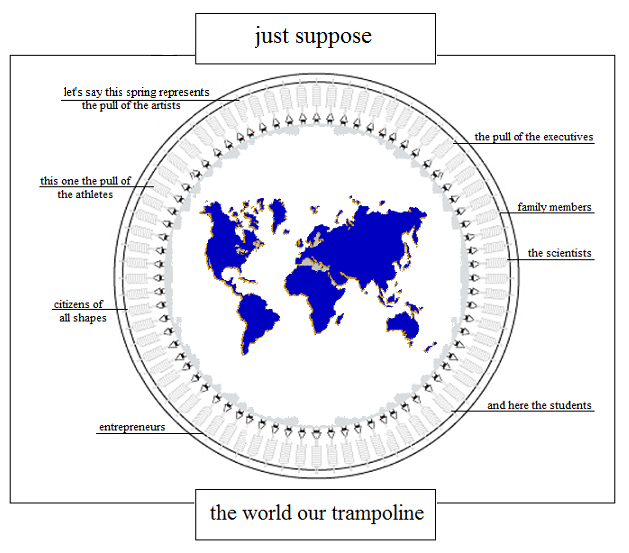
Now when I say “we,” I do not mean only our governments, as important as they are. Every day, across both of our countries, executives and entrepreneurs, scientists and scholars, artists and athletes, students and teachers, family members and citizens of all kinds shape and pull and add to this relationship. Together, they represent a vast range of priorities, concerns, and points of view. And they are all stakeholders in how we build toward a shared future.

It’s really that list I’m after…

There are seven billion individuals bouncing up and down on our trampoline, some of them holding hands, some of them in gangs that want to trip up rival gangs, or make a clearing for themselves and themselves alone, some too weak to bounce much at all…

and each time each one of us lands, we impact the trampoline from a different angle, stretch it a different way – tugging it to the will of the artist, the entrepreneur, the child, the retiree, the curious, the aggressive, the meek…

As we know, the earth is round, which is to say three-dimensional – but the tugs on it, the tensions, are more complicated than that, in fact they’re complex, n-dimensional – and constantly shifting.

Hilary Clinton wants to wake up in the morning, have coffee – and model that! – along with, and in balance with, her counterpart in another huge mass of population, half a globe and at least six philosophies away…

The coffee’s good, but it’s not enough — what we all could use is a new mode of thinking.

*

Maps courtesy of www.theodora.com/maps used with permission

On fire: issues in theology and politics – i

Sunday, February 26th, 2012

[ by Charles Cameron — suicide, protest, martyrdom, the self-immolation of Buddhist monastics ]
.
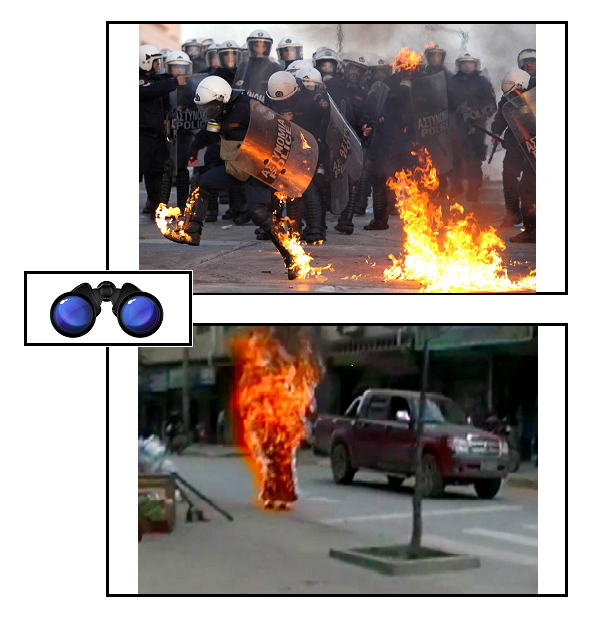
You can set your enemies on fire, you can set yourself on fire, you can blow yourself and your enemies up…

Protest, mayhem, suicide, martyrdom?

*

As usual, my interest is in the theological sanctions and constraints involved — in this case, by Buddhist self-immolation — so this excerpt from a Q&A with Lobsang Sangay, the prime minister of the Tibetan government-in-exile caught my eye:

Q: Does Buddhism allow self-immolation?

A: It’s a complex issue. One could refer to Jataka tales, which concern the previous births of the Buddha. In one story, the Buddha, in a previous incarnation, gives up his body to feed a starving tigress and her four cubs. Some other stories also talk about self-sacrifice by the Buddha.

Although suicide is violent and prohibited in Buddhism, some Buddhists believe it depends on the motivation. If you do it out of hatred and anger, then it is negative. But if you do it for a pure cause … it’s such a complex theological issue. You can’t go either way or have a definitive answer. But the action is tragic, so painful.

That’s a start: it’s a theologically complex issue…

The young Karmapa Lama, second in influence only to the Dalai Lama himself, is quoted in a Guardian report as discouraging this form of protest:

These desperate acts … are a cry against the injustice and repression under which they live. But I request the people of Tibet to preserve their lives and find other, constructive ways to work for the cause of Tibet.

In Buddhist teaching life is precious. To achieve anything worthwhile we need to preserve our lives.

It should be noted, however, that a number of monks in exile from China are depicted in the same article, bearing posters that call the self-immolators “burning martyrs”.

Robert Thurman, Je Tsongkhapa Professor of Indo-Tibetan Buddhist Studies at Columbia and president of New York’s Tibet House, provides his own justification for such acts:

When you destroy your body, you violate your own life, the lives of what Buddhists call “the 84,000 cells” that constitute it. This does seem violent. Yet in this case, the individual sacrifices herself to appeal to her enemy, to convey the perhaps all-too-subliminal message that they have nothing to fear from her, that she will resist their relationship of fear and harm by removing herself from being the target of their ultimately self-destructive, evil behavior. That is true non-harming—perfect resistance by complete surrender. If your victim prevents you from harming her by harming herself and taking herself out of your reach, then why were you afraid of her and wanting to harm her in the first place? Since she won’t harm you, she must love you. She wants you to stop fearing and hating; she wants you to be happy! Indeed, she cries out to you with her very life to wake up and behold the power of love—how it does not fear death, how it gives itself away to reality, how it overwhelms hatred.

And we should remember that even within Buddhism, self-immolation is not an exclusively Tibetan phenomenon. Here’s the celebrated Vietnamese zen monk and poet Thich Nhat Nanh, hearkening back to the days of the Vietnam War in his open letter “In Search of the Enemy of Man” (addressed to Martin Luther King):

The self-burning of Vietnamese Buddhist monks in 1963 is somehow difficult for the Western Christian conscience to understand. The Press spoke then of suicide, but in the essence, it is not. It is not even a protest. What the monks said in the letters they left before burning themselves aimed only at alarming, at moving the hearts of the oppressors and at calling the attention of the world to the suffering endured then by the Vietnamese. To burn oneself by fire is to prove that what one is saying is of the utmost importance. There is nothing more painful than burning oneself. To say something while experiencing this kind of pain is to say it with the utmost of courage, frankness, determination and sincerity. During the ceremony of ordination, as practiced in the Mahayana tradition, the monk-candidate is required to burn one, or more, small spots on his body in taking the vow to observe the 250 rules of a bhikshu, to live the life of a monk, to attain enlightenment and to devote his life to the salvation of all beings. One can, of course, say these things while sitting in a comfortable armchair; but when the words are uttered while kneeling before the community of sangha and experiencing this kind of pain, they will express all the seriousness of one’s heart and mind, and carry much greater weight.

The Vietnamese monk, by burning himself, says with all his strength and determination that he can endure the greatest of suffering to protect his people. What he really aims at is the expression of his will and determination, not death. To express will by burning oneself, therefore, is not to commit an act of destruction but to perform an act of construction, that is to suffer and to die for the sake of one’s people.

In a later post, I’ll return to Nhat Hanh‘s comment about monastic ordination, comparing it with the symbolism of the “red” given to cardinals on their elevation to that dignity.

*

Someone who is neither a monk or nun, nor a Tibetan, nor even a Buddhist — a Tunisian street vendor named Mohamed Bouazizi — set himself on fire in Sidi Bouzid not so long ago, and the rippling wave of events triggered by that act have included the toppling of long-entrenched dictators — is it so remarkable that an 18 year old nun, Tenzin Choedon, and other Tibetans too might hope that an act of self-immolation would galvanize the population around them and the world, resulting in the toppling of the hated Han regime in their part of the world?

I am not sure whether Prof. Thurman’s attempt to tie the Buddhist monastics’ mode of self-sacrifice to the notion, “see, we’re no threat” really works, but it is surely worth considering when it comes from a man who often speaks as a western mouthpiece for the Dalai Lama…

There are of course differences between monastics and laypeople.

Bouazizi’s self immolation was an act of despair, Tenzin Choedon’s an act of courage — as the photos of her standing there, ablaze and unflinching, while another woman offers a silk scarf into the flames in the traditional gesture of respect clearly show.

And when Prof. Thurman declares that the nun wanted her people to be happy, he surely doesn’t mean that she wanted them to be pleased at the sight of her standing there in the middle of the street ablaze — but that she wanted her people to be liberated from the repressive yoke they were and are under, and to feel the joy that comes with liberation from dictatorship.

But Bouzazi’s act, too, must have required considerable courage, while Tenzin Choedon’s act was surely also born of desperation. We humans, as individuals, are by our very nature blended beings.

***

As an Addendum:

Khenpo Karthar Rinpoche in his book, Dharma Paths, tells the Jataka tale of the Buddha giving his body to feed some tiger cubs as follows:

In one of his previous lives, the Buddha was born as the youngest of three princes. When he was only five years old, the three princes were in a forest playing together at hide-and-seek and other games. As they were walking in the forest, they came to a cave where they saw a wounded female tiger with five cubs. The mother tiger was very weak and was unable to provide food for the baby tigers. The Buddha’s older brothers went to search for some food, and they asked the young prince to stay near the cave to take care of the mother tiger and the five cubs.

While the Buddha was taking care of the wounded tiger and her five cubs, he began to think that it was not proper to kill other beings and give their flesh to the tiger. He found some large thorns and pressed them into neck, and as the blood came out, he let the cubs and their mother suck the blood. In fact, he gave his whole body to the five cubs and their mother as an act of generosity. As he did this, the Buddha prayed, “Right now I am only able to give temporary help to these starving beings, just removing their hunger. May these tigers who are enjoying my flesh, blood, and bones be reborn to a higher realm, and may I be able to teach them and lead them out of cyclic existence.”

We are naturally entitled to take the Jataka tales as scriptures, morality tales, or legends, fairy-tales — but the Rinpoche makes it clear in his telling that the bodhisattva who would later become Gautama Buddha “gave his whole body”.

In the Chod ritual of Tibetan Buddhism, practitioners symbolically give their own flesh to sate the hungry demons…



Switch to our mobile site