zenpundit.com » china

Archive for the ‘china’ Category

US Defense Budget, Fear and Interest

Wednesday, March 23rd, 2011


Major Chris, a ZP reader, wrote in today to draw my attention to an item at NRO and I promised a comment:

From Reihan Salam at The Agenda:

Matt Frost and Jim Manzi on US Military Expenditures

Matt Frost (you can find him on Twitter: @mattfrost) copied me on an email earlier today, and he’s kindly given me permission to share his thoughts with all of you:

Comparing the US’s military expenditures against the next three or five potential competitors doesn’t have much analytical value as such, because there are thresholds of capability that you can only cross at some absolute level of cost. Let $x be how much the US spends on the military.

Let $y be how much China spends. The difference between $xand $y, whether in terms of ratio or absolute dollars, doesn’t tell you much, because what matters is value $z, which is how much it costs to field a carrier battle group and maintain bases for air tankers and launch a constellation of GPS satellites and have all your planes be all-weather capable etc etc. Once you get to point $z+1, your capabilities are categorically different from those of a country at $z-1.

Sure, the US spends over $600 billion while the Chinese only spend $98 billion. That difference looks absurd in comparative terms. But between $98 billion and $600 billion there’s a threshold below which you just can’t project power globally. If we think that #winning means global power projection, then cutting to $200 billion won’t work, since it’s not a matter of keeping a 100% lead over the Chinese, or 150% or whatever. Superpower status does not depend on a proportional lead over our competitors; our place at the head of the pack requires staying above that magic increment while everyone else stays below it.

I don’t know what the magic number really is. If it’s $599 billion, then we’re spending the exact amount that our global strategy insists we spend. If it’s $300 billion, then we’re wasting half of every dollar. My hunch is that the real value is closer to the top than the bottom of this range. [Emphasis added]

Hmmm. My two cents:

Comparing the ostensible dollar figures of the Chinese and US defense budgets is a relatively meaningless exercise.

First, like the old Soviet Union, you are not dealing with honest budget figures in regard to Chinese military power. Many military expenditures in China are subsumed by other state agencies, such as for internal security paramilitary troops which even China admits to being slightly over 100% of the PLA budget. This alone would make China’s defense budget twice as large as admitted and we can reckon these figures as being a) underestimates and b) not comprehensive, failing to count military expenditures billed to scientific, industrial, intelligence, nuclear and space related entities. The official published statistics for these items could also be outright lies. Their system is as opaque as it chooses to be. If China’s real national security and defense budget is a cent under $ 300 billion I’d be very surprised.

Then there are the technical economic questions of converting their currency into dollars and whether that accurately reflects the purchasing power of the Chinese government on national security items. Hint: It doesn’t.

It turned out during the Cold War our best analytical efforts grossly overestimated the true size of the GDP of the USSR while vastly underestimating the astronomical percentage of GDP the Soviets devoted to national security and defense. What makes anyone think we are any more accurate today with China when so few of our analysts are expert Sinologists compared to the large number of Soviet specialists during the Cold War?

If you want to understand Chinese power projection capabilities, you have to count the verifiable assets and boots that give them the ability to project power and estimate the degree to which their known logistical capability can support “x” forces at “y” distance for “z” period of time. That will be about as accurate a guess as can be made, along with qualitative assessments of Chinese personnel and equipment and the most probable areas of operation for them. I don’t expect a Chinese Armada off the coast of Uruguay any time soon.

Chinese military power is growing, just ask India or Vietnam, but we need to be realistic about where the PLA is in terms of military power vis-a-vis the United States. We can put an enormously powerful military force on their front porch at will. If it was a contest today of the entire nation of China vs. just PACOM, my money is on PACOM.

That will change in time but how fast and to what degree of adversariality between our two countries depends on far more than just military spending.
Dr. Barnett Responds on Sino-American Grand Strategy

Tuesday, January 4th, 2011

In response to my previous post A Short Analysis on The Whyte-Barnett Sino-American Grand Strategy Proposal, Dr. Thomas P.M. Barnett wrote in late this morning and I am giving him the floor:

You’re fundamentally right in your analysis.

What we heard from a senior quasi-official (and I’ll leave the description there) was that we should not present the compromises in the form of annexes but to make it a singular sign-it-or-no agreement.  Why? That path would suffer the deaths of a thousand-edits and ruin the desired dynamic. 

I agreed with the notion for this reason:  The American approach to such a document is to carve it up into pieces and to give the Iran piece to the Iran desk and the Taiwan piece to the Taiwan desk and so on, and everybody comes back saying the same thing: “American could never do this one thing!”  But, of course, the whole point of the process is to encourage the horse-trading mindset.

Do you, America, want a different path with China?

Do you, America, want the money to flow from China back into the US economy in a useful manner for all?  Do you want the trade imbalance balanced?

If you want these things, and see the wisdom of the deepened economic connectivity, then what transparency and strategic trust must be created–minimum list?

Once you see all these “demands” expressed from the Chinese side, do you see a path forward or are these things too much for Beijing to ask for?

Me personally, I want Kim’s regime collapsed–pronto.  But I cannot make that argument stand up right now, given the larger tasks at hand and the relationship to be maintained.  I hear the Chinese on that subject and I think their offer of a slow soft-kill path makes sense.  So I accept the bargain because I see a lot of negative pathways curtailed by it and profoundly positive ones created by it.

But I’m not a China expert who’s incredibly vested in the complexity and opacity of this relationship.  It gets better and I still have plenty of opportunity to pursue.  I’m also not a regional expert well versed in telling you how something is “impossible!”  I approach the issue from the long-range perspective, with more of a businessman’s tendency to look for the deal rather than wait on the perfect architecture or all the policy boxes to get checked.  I want progress, and asked the Chinese what it would cost.

I believe that if you put this package in front of the American people, they will not find the costs high at all.  But that would take seriously visionary leadership on our side (like Brzezinski’s suggestion in the NYT yesterday).  The Chinese have enough of it on their side to move forward.  I fear we do not.  We are now the muddle-through people, looking frighteningly like Brezhnevian Russia.  Nobody is creating any Deng or Gorbachev-like clarity about the path ahead.  Where is our 21st-century Alexander Hamilton?  

We argue amongst ourselves over piddling things, fighting each conversation to the death. And we lower ourselves in the eyes of others.

John Milligan-Whyte is convinced Obama is a transformational figure–a lawyer’s mind who will understand the terms and act on it.  I am less optimistic but felt it was crucial to try.

The Chinese response was–to me–stunning in its openness and flexibility of imagination.  Yes, they have their demands and when you look at it from their perspective, they are fairly reasonable, even as I, in my American mindset, find some of them too slow in unfolding.  But they took this thing with immense seriousness–even an eagerness.  They were like somebody who had long waited to eat a decent meal and were determined to gobble it up with relish, and I found all that sad, because it made me realize what a dead dialogue the SED must be, with its 1-2% improvement goal every year.

But Obama’s crew has no real strategists.  They have handlers and politicos and experts, but no strategists or deal-makers.  They are too satisfied with the “keeping all balls in the air” bit, ecstatic when China does the littlest effort to rein NorKo in for some SouKo artillery ex–like that’s some great victory!  It’s really sad, because the moment is so ripe for imaginative approaches.

We knew the package had to start from the Chinese side and I firmly expected the US side to blow it off, for its lack of proper channels.  But it does not stop there–from the Chinese perspective.  So our work continues.

Ark attack

Tuesday, January 4th, 2011

[ by Charles Cameron ]

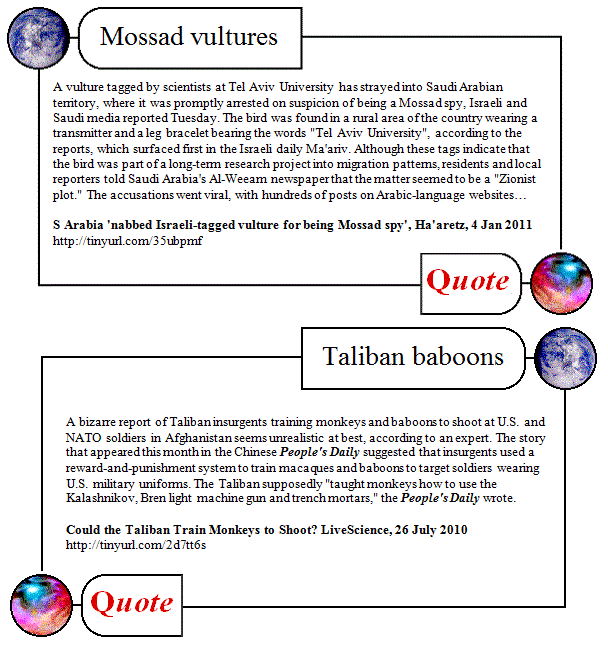
Every article I’ve read about the Mossad vulture makes some mention of another recent story, that of the Shark ‘sent to Egypt by Mossad’ of December — hence my choice to link instead to the Chinese allegation of Taliban-trained baboon platoons…

Links for this piece: vulturesbaboons

For your further edification, here’s LiveScience’s delightful illustrated compendium of the Top 10 Animal Recruits in War.

A Short Analysis on The Whyte-Barnett Sino-American Grand Strategy Proposal

Tuesday, January 4th, 2011


A few comments on the proposed Whyte-Min-Barnett Grand Strategy Executive Agreement for a Sino-American partnership that Dr. Barnett has been deeply engaged with the past few months.

First, a caveat: while Tom has involved me in aa few of his past projects, I was not involved in this one and know only what I have read recently. Secondly, while I know a bit about China in an academic sense, it is not an area of research for me nor am I up to speed on the  current politics of China’s generational transfer of power/power struggle. Those readers who are avid China watchers should chime in with comments.

As an overview, I think the proposal’s specific terms should be viewed less seriously individually than the gesture itself, which represents in my view a very significant trial balloon signal from China’s leadership that they see a need to negotiate a successor to the long outgrown cornerstone of Chinese-American relations, the Shanghai Communique, signed during Nixon’s historic summit with Mao. A new agreement would provide some updated “rules of the road” that would defuse potential and existing tensions and allow the US and China to tackle some urgent problems in the global economy. By using a semi-official independent set of pundits ( Whyte and Min) and a maverick private sector American geostrategist ( Tom) with close ties to the Pentagon, China can advance it’s talking points and interest in negotiating without any loss of face that an official inquiry risks as a result of America’s fractious domestic partisan politics.

Read up on the secret diplomatic minuet that ensued between the US and China 1969-1972.

China’s leadership seems to have invested a sizable heavyweight participation in this proposal, Tom cites:

– Former Minister of Foreign Affairs;
  – Former UN ambassador,
  – Former U.S. ambassador,
  – Former Deputy Chief of the General Staff of the PLA,
  – Former Military Attaché to North Korea and Israel,
  – Former Vice Minister of Commerce,
  – President of Shanghai Institutes of International Studies,
  – China’s Central Party School Institute of International Strategic Studies,
  – Chinese People’s Institute of Foreign Affairs,
  – China Center for International Economic Exchanges,
  – China Institute For International Strategic Studies,
  – China Foundation for International & Strategic Studies,
  – Boao Forum,
  – China Institutes of Contemporary International Relations.

This has resulted in a document that unsurprisingly leans strongly towards China’s interpretation of a good Sino-American partnership but this proposal is not holy writ, it is a red flag ( pun intended) for bargaining to begin. A plea, really by a leadership craving greater certainty, medium term security and “recognition” ( i.e. “face” or “respect” – this is very much like Brezhnev and Kosygin deeply desiring that the USSR be seen as an equal to the US, except unlike the Soviets, China actually has a productive economy) Imagine a US doc shepherded by a comparable set of former and current powerbrokers, the Council of Foreign Relations, CNAS, Carnegie, CNA, SSI, Brookings, AEI, Hoover, the chairmen of the Republican and Democratic Parties and the president of Harvard. Would that catch the attention of foreign observers?

I am not sure if it is being received that way over here. My perception – and I freely admit to having large gaps of knowledge – is that US policy toward China is determined below the NSC level and not in a strategic fashion by a) Treasury b) the Fed c) PACOM in that order , pursuing contradictory policy goals and without proper coordination while State, which should be taking a lead role, is a quiet secondary voice relegated to managing lower level, day to day, routine problems in ad hoc fashion. Some carping and special pleading from Congress is erratically inserted into the mix. If someone in the Obama administration is the China policy “czar” it is obscure to me. It must be obscure to Beijing as well or they would be having their ambassador or foreign minister pushing these proposals to their American counterparts in a normal fashion instead of Tom.

Barnett, Whyte and Min devote a great deal of space to bilateral and global economics relationships. They should. The magnitude of the Sino-American monetary and trade relationship and it’s evolved distortions between two nations that are radically dissimilar, understand one another poorly and are not allied are actually scary. Immense quanties of locked up capital – and we are talking epic figures  that dwarf the interwar period European “dollar gap” or even that of the postwar era remedied by the Marshall Plan – ultimately create money scarcity elsewhere in the global economy until trade breaks down in political reaction or the ebb of a medium of mutual exchange.  That money needs to begin circulating via productive investment and Chinese policies creating this structural imbalance need to be phased out. How exactly this should be done is beyond my ken, but that something needs to be done is obvious.

Dr. Barnett, as I understand his strategic thinking, takes the long view and is willing to concede in the short term what would be impossible to sustain in the long term anyway (“locking in tomorrow’s China at today’s prices” ) and is concerned about defense contractors eager to make China the justification for hyperexpensive weapons mega-platforms ultimately inculcating over time thinking that carelessly slides the United States toward a needless great power war with China. A position mirrored by China’s own ambitious self-dealing military asshats.

Is Tom’s view the last word? No. but it is disturbing to me that a strategic relationship as we have with China is not being handled by American officials with the same attention and degree long term focus we give to Europe.

What do the Sinologists out there say?

Maxwell on North Korean Regime Collapse and Irregular Conflict

Thursday, December 2nd, 2010

Colonel David Maxwell, who has probably forgotten more about North Korea than I ever knew in the first place, has an insightful analytical piece up at SWJ Blog:

Irregular Warfare on the Korean Peninsula

….This paper is written with the concepts of “military misfortune” in mind. In Eliot Cohen and John Gooch’s seminal work on military failures, they determined that militaries are generally unsuccessful for three reasons: the failure to

learn, the failure to adapt, and the failure to anticipate. This paper will recommend that the ROK-US alliance learn from operations in Afghanistan and Iraq, adapt Irregular Warfare concepts to the security challenges on the Korean Peninsula and anticipate the collapse of the Kim Family Regime and the complex, irregular threats that collapse will bring.

The conventional wisdom would postulate that the worse case situation would be an attack by the north Korean military because surely the devastation and widespread humanitarian suffering as well as global economic impact would be on a scale that would far exceed any crisis that has occurred since the end of World War II. While that could very well be the case, there is little doubt about the military outcome of an attack by the north on the South and its allies and that would be the destruction of the north Korean People’s Army and the Kim Family Regime. Victory will surely be in the South’s favor; however, this paper will argue that the real worse case scenario comes from dealing with the aftermath; either post-regime collapse or post-conflict.

Maxwell’s operative assumptions are particularly good. I especially like:

….The fifth and final assumption is that while some planning has taken place to deal with north Korean instability and the effects of Kim Family Regime collapse, there has been insufficient preparation for collapse. Furthermore, in addition to planning for collapse, actiocan and should be taken prior to collapse in order to mitigate the conditions and deal with the effects of collapse of the Kim Family Regime. Unfortunately, despite some planning efforts tocounter specific irregular threats, the ROK, and the US in particular, has been distracted by the very real and dangerous threat of north Korean nuclear weapons and delivery capabilitiesproliferation of same while at the same time ensuring deterrence of an attack by the north. Deterrence is paramount and the nuclear problem is a critical international problem; however, successful deterrence over time will likely result in the eventual collapse of the regime and the associated security and humanitarian crises that it will bring.

In other words, not only are US and ROK policy makers not preparing for the most probable second and third order effects of a North Korean collapse scenario, but the status quo on the Korean penninsula represents a wicked problem that is essentially a trajectory toward a worst case scenario collapse.


Switch to our mobile site

