The Xenophon Roundtable
Tuesday, September 15th, 2009
The Anabasis of Cyrus
Translation by Wayne Ambler.
The long awaited Xenophon Roundtable begins today at Chicago Boyz with an introductory post by our host and moderator, Lexington Green, which I reproduce in full, followed by a few comments.
Xenophon Roundtable: List of Contributors
Our Xenophon Roundtable begins this week.
Xenophon‘s Anabasis of Cyrus was written roughly 2,400 years ago. Yet it is still of interest and value today, for many reasons. It is an exciting tale of adventure. It is the first war memoir. It is a firsthand account of a military campaign that goes badly wrong, and of a man taking command and saving himself and his army from destruction. It is a travel book about exotic locales and natives. It depicts leadership under life and death circumstances. It contains remarkable examples of oratory and persuasion, where Xenophon had to convince because he could not compel. It is a portrait of conditions in the era following the victory of Sparta in the Peloponessian War. It is a comparison between the Greek way of political and military organization, and that of the Persians and other “barbarians”.
There is a lot in this very old book. I and the other participants will be putting up several posts in the next three weeks about it. I look forward to what the others will have to say.
Our distinguished roundtable participants are the following:
Disraeli1867 is a graduate of the College and the Business School at the University of Chicago. He works in venture capital and equity research.
“josephfouche” is a software engineer and system administrator slaving away for a technology startup somewhere in flyover country. He’s been reading military history since age nine and talking about it since his fourth grade teacher, asking a pro forma question, inquired if any student in the class knew anything about the Crimean War. (She got more than she bargained for.) He blogs at The Committee of Public Safety, a group blog dedicated to understanding the subtle interplay of human nature, culture, war, and power.
Fringe is a University of Chicago Alum, and is employed as an academic. He has been a student of military history and military affairs since his childhood. He knows strategists, and understands the difference between a strategist and a student of strategy. He has published on many topics and in many venues, including articles about modern warfare.
Lexington Green is a lawyer in Chicago. His common core humanities class freshman year at the University of Chicago was Greek Thought and Literature. It was the only A he got that year. Hblogs at ChicagoBoyz.
HistoryGuy99 is a historian, and U.S. Army veteran of the war in Vietnam. After having a 30 year career in global logistics, he earned an advanced degree in history and began to teach. Currently he is an adjunct history professor with the University of Phoenix and Axia College. He blogs as historyguy99 and hosts HG’s World, a blog devoted to history, connectivity, and commentary. He is a co-author of soon to be published, Activist Women of the American West and contributing author to The John Boyd Roundtable.
Steve Pressfield is the author of “Legend of Bagger Vance,” “Gates of Fire,” “The Afghan Campaign” and other historical fiction set in the Greco-Macedonian era-but nothing about Xenophon! Currently blogging about mil/pol issues in Afghanistan on It’s the Tribes, Stupid
Purpleslog is a Milwaukee-area blogger looking to enjoy and learn from an ancient true-life adventure story. He blogs at PurpleSlog.
Mark Safranski was the editor of The John Boyd Roundtable: Debating Science, Strategy, and War, and a contribution author to Threats in the Age of Obama, both published by Nimble Books. Mark blogs at Zenpundit. Mark can also be found at several well-regarded group blogs including, ChicagoBoyz, Progressive Historians and at a U.K. academic site, The Complex Terrain Laboratory. Mark is a free-lance contributor to Pajamas Media.
Seydlitz89 He is a former Marine Corps officer and US Army intelligence officer who served in a civilian capacity in Berlin during the last decade of the Cold War. He was involved as both an intelligence operations specialist and an operations officer in strategic overt humint collection. This experience sparked his serious interest in strategic theory. He is now involved in education. He participated in the Clausewitz Roundtable on ChicagoBoyz.
Dr Helen Szamuely is a political researcher and writer. She edits the Conservative History Journal and writes its blog. She also blogs on EUReferendum and Your Freedom and Ours, as well as writing occasionally for Chicagoboyz
The list of contributors may not quite be complete as of this writing. Likewise, it is not unknown in previous roundtables for a participant or two to get cold feet once the first stellar post emerges. Two previous roundtables were of a quality where a publisher decided that they merited being turned into books. I can say that I learned a great deal from everyone else who decided to go “into the arena”.
By training my specialty is 20th century diplomatic and economic history, not classical antiquity. I do not have ancient Greek under my belt or a working knowledge of that subfield’s historiography. I have it on authority that Dr. Ambler produced a first rate translation, but I am incapable of evaluating his linguistic skill. In recent years, I have taken to reading ancient history, classic texts as well as secondary sources. This is not the same thing as professional reading or evenreading the classics in the original languages, but it is far more enjoyable a pastime because when I pick up a book I am learning something new – as opposed to re-treading the same well-worn ground from a slightly different angle or sifting it for minutia and minor errors. To an extent, I also can look at The Anabasis of Cyrus with “fresh eyes” because I am not well informed regarding the controversies and implicit dogmas of classicists and historians of antiquity.
Over the summer, I read The Anabasis of Cyrus and enjoyed it, though it struck me as different from the first time, when I read a popular translation entitled “The Persian Expedition”. Ambler’s Xenophon seemed to me to be far more “present” to the reader, perhaps omnipresent, and less a creature of a distant, disinterested, narrator. I took that to be to Ambler’s credit, reconstructing Xenophon’s voice across the gap of twenty four centuries.
The discussion will be good. I hope that the readers, some of whom know a great deal about the Greek world, will join in the comment section at Chicago Boyz.
 ,
,  and
and  ( I would pair the first with W.Bruce Lincoln’s
  to see the differences between the
  way eminent historians and political scientists handle the same topic). Dr. Pipes has written an op-ed for WSJ.com and it was reviewed by his former student,
  they’ve never really had any experience picking their own leaders over the past 1,000 years. That fend-for-yourself mentality pervades the political system and its foreign policy. All citizens want from the state is order, and what they miss most about the Soviet past was that it preserved Russia’s contiguous empire beyond that of any in Europe or Asia.
 by Steven Johnson
 the reader to an understanding how bottom-up, “blind”, systems work and the principles behind them. Highly readable and next to no jargon. Probably due soon for an updated edition though, given the scientific advances in research in network and complexity studies.
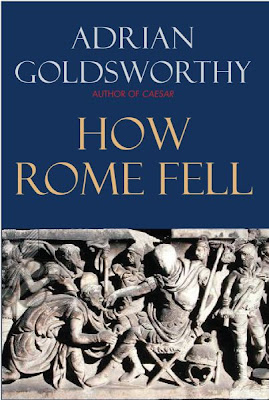
 by Adrian Goldsworthy
 centuries as it was during the golden age of philosopher-warrior-emperor Marcus Aurelius. Or that there was no fall of the empire at all, just a gentle “transformation” into something new. Goldsworthy discusses the likelihood of Late antquity “paper legions” of Roman armies which, in any event, scarcely resembled in elan, tactics or fighting strength the ones that Julius Caesar wielded in Gaul. A tour de force marred only by a weird epilogue that ranges from pedestrian to ( in it’s last sentences) truly awful – was it it tacked on as an afterthought? Did the editor of the rest of the book die before it was completed? Regardless, How Rome Fell is a worthy addition to an collection of popular ancient histories.
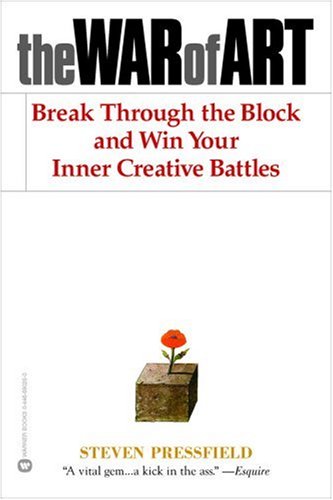
 by Steven Pressfield
 is brilliant but because it is profound. Utilizing select personal vignettes and other anecdotes, Pressfield distills in everyday language the essence of what creative people need to understand if they are to succeed – concepts of “resistance”, which seductively undermine your efforts, and being a “professional”, which is the mindset that will get you there.
 . Where Goldsworthy was more closely tied to his primary sources in his earlier work, How Rome Fell gives him greater scope for both synthesis and analysis as Goldsworthy draws on his knowledge of the subject to evaluate theories of causation as well as to entertain and inform the reader.

