zenpundit.com » geopolitics

Archive for the ‘geopolitics’ Category

Book Review: Grand Strategies by Charles Hill

Monday, March 21st, 2011

Grand Strategies by Charles Hill

Charles Hill, senior Cold War diplomat, Hoover Institution fellow and a co-founder of Yale’s popular Grand Strategy Program that amounts to a crash course in the kind of classical liberal education that universities once imparted to undergraduates but today pride themselves in doing so no longer. The popularity of Hill’s program,  therefore, is with the students moreso than campus activists or the faculty:

…Despite whispers of words like “elitist,” “conservative,” and “cult”-words considered synonyms by many at Yale-The Grand Strategy seminar, only a few years old, has become one of the university’s marquee classes. Grand Strategy, like Professor Hill, has its own myth. The liberals on campus call the class Grand Fascism. They are kidding, but only in part. Many Yale students and faculty are suspicious of the program. Students awed or repelled by Grand Strategy are the same ones who are awed or repelled by Professor Hill, and for the same reasons: the aura of power, the whiff of elitism, the promise of an answer to life’s messiest questions.

If the Grand strategy Course at Yale is a distillation of classical liberal education, Grand Strategies: Literature, Statecraft and World Order is Hill’s reification of the course as an education for the reader on how the evolution of the Western civilizational worldview makes possible grand strategy. The book is an intellectual tour de force by Hill, at some times an idiosyncratic one and at all times an interesting one. I have read many, though very far from all, of the classic texts that Hill critiques and uses to shape his argument but having a large library under your belt is not a prerequisite from understanding Grand Strategies. Far from it, one suspects Hill wrote the book with his seminar students in mind.

Hill examines the protean and mythopoetic relationship between cultural foundations and expressions of power and political wills in conflict represented by diplomacy and war, both navigated by grand strategy constructed from cultural vision. A recurring theme in Grand Strategies is the heroic structure of the epic tale, with the descent into the Underworld and revelation of the heroic destiny by the shades and an ascent (not always successful or as ideally envisioned) to a creative, transformative new order. The reader meets Achilles in many guises, marches upcountry with Xenophon, is cast out of Heaven by Milton, confronts Hobbes‘ Leviathan, defies Rosseau’s general will and exorcises the evil represented in Dostoyevskii’s The Possessed. And this only is a tenth of the narrative.

While I frequently found myself in agreement with Hill’s discernments of the texts, some of them struck me as strained or highly debatable, such as Hill’s reading of Plato as a wry ironist ( Hill borrows from Leo Strauss here but goes further, if I recall correctly, than Strauss did), something that Carroll Quigley, Karl Popper or many classicists would have disputed. Hill’s final chapter, “The Writer and the State” is entertaining and contains a laudatory anecdote about Hill’s former boss, the impressive SECSTATE George Schultz , but it lacked some of the gravity of earlier chapters.

Erudite and visionary, Grand Strategies is a grand synthesis by Charles Hill with lessons to learn on every page.

(Special hat tip to J. Scott Shipman who pushed me to read and review this book)

Honor killings

Monday, March 7th, 2011

[ by Charles Cameron — cross-posted from ChicagoBoyz ]

*

I had occasion today to give myself a quick refresher course on honor killings, one form of which is already present in the Torah as of Leviticus 21.9:

And the daughter of any priest, if she profane herself by playing the whore, she profaneth her father: she shall be burnt with fire.

and found myself once again noting that there is a substantial swathe of regions of the world where honor killings are found, and that where it is found (including in immigrant communities from those parts of the world) the practice is not confined to any one religious group.

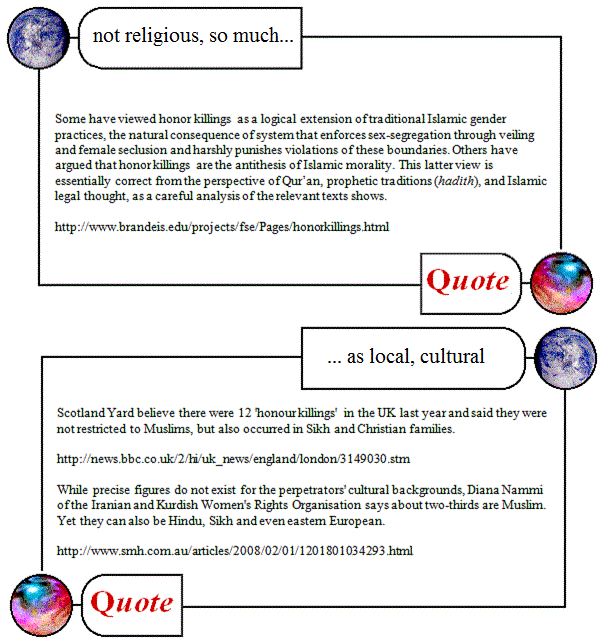
Hence this DoubleQuote:

I think it is appropriate to consider honor killing a form of religious violence when the claim is made by those who do the killing that they are acting in the name of their religion — but that it is also important to distinguish such acts committed in a cultural context in which they are practiced across religions from acts that are the exclusive province of one religious tradition.

There are examples of honor killings which are performed in the name of Islam, and/or advocated by Islamic scholars — and the same could no doubt be said of other religious traditions — but honor killing as a genre is fundamentally more cultural than religious.

Sources: Brandeis studyBBCSydney Morning Herald

The analytic point:

From my point of view as an analyst, it is important to note and compare both religious and cultural drivers — neither avoiding mention of the one out of “correctness” — nor overlooking the other for lack of comparative data.

The terminal occultation of Muammar Gaddafi

Wednesday, March 2nd, 2011

[by Charles Cameron ]

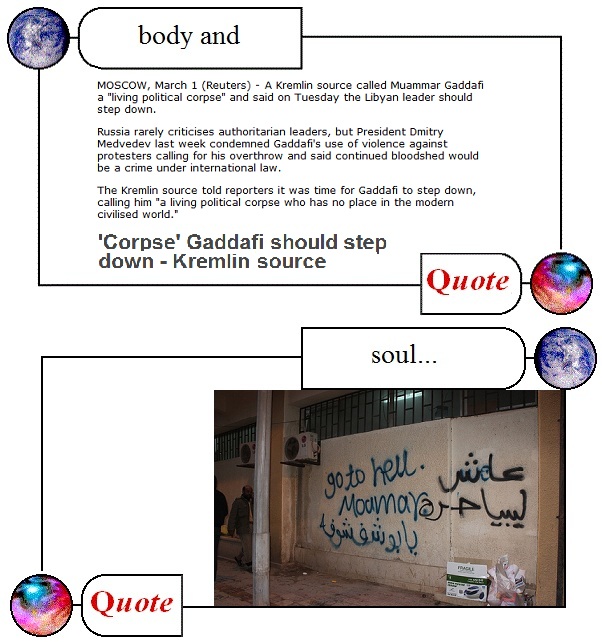
quo-gaddafi.jpg

People want the man out of there — body and soul, it seems.

Sources: body and soul

A HipBone approach to analysis VI: from Cairo to Bach

Monday, February 28th, 2011

[ by Charles Cameron ]

*

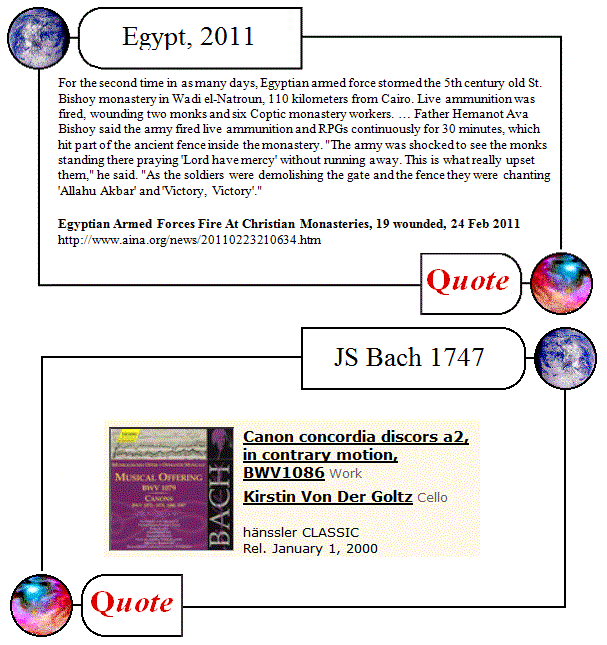
The description of Egyptian troops attacking a Christian monastery that forms the first quote in this DoubleQuote is horrifying in many ways.
quoprayer-counter-prayer.gif

Recent events in Egypt had featured mutual support between Muslims and their Coptic Christian neighbors, each group in turn acting as human shields to protect the other while they were praying. Here, by contrast, the army – which is effectively now “ruling” Egypt in the interregnum between the fall of Mubarak and the election of a new President and government – is attacking the humans it is supposed to protect.

But what does that have to do with Bach?

*

Part I: a monastery attacked in Egypt

This is vile.

Those who are being attacked happen to be Christians and monks, no less human on either account, and just as subject to bleeding as others – so they might ask, with Shakespeare‘s Shylock speaking for the Jews:

If you prick us do we not bleed? If you tickle us do we not laugh? If you poison us do we not die? And if you wrong us, shall we not revenge?

That last question of Shylock’s is an interesting one, and gets to the heart of what I want to discuss here, as we shall see.

Specifically, these human beings were monks. Muhammad had a higher opinion of monks than of many others. In the Qur’an, we find:

The nearest to the faithful are those who say “We are Christians.” That is because there are priests and monks among them and because they are free of pride.

*

Sigh.

These “followers” of Muhammad were attacking Christian monks with live ammunition and RPGs continuously for 30 minutes, wounding 19.

They felt superior to their compatriots the monks, they cried “God is Great” and “Victory, Victory” as they did it.

In this they resemble GEN Boykin, who famously responded to a Somali warlord claiming that God would protect him, “Well, you know what? I knew that my God was bigger than his. I knew that my God was a real God and his was an idol.”

I could easily have made that my second quote here, pairing it with the description of the Egyptian army attack on the monastery, for between the two of them they raise the question of whether weaponry is stronger than belief – and while some Christians might agree with General Boykin, some Muslims might agree no less strongly with the members of the Egyptian military shouting “Allahu Akbar”.

*

I believe that taking sides here misses the point.

Which I am happy to say, Abraham Lincoln made with considerable eloquence in his Second Inaugural Address in 1865, almost a century and a half ago:

The prayers of both could not be answered. That of neither has been answered fully. The Almighty has His own purposes.

That point is one which HaShem made to his angels, according to rabbinic teaching:

The Talmud teaches us that on the night that the Egyptian army drowned in the Red Sea, the first true moment of freedom for the Jews fleeing Egypt, God refused to hear the angels sing their prayers, and said “my creations are drowning in the sea, and you will sing songs?”

So, no — revenge is not the way to go…

*

But please note that the point I am making is not one of moral equivalence.

That God which created “both sides” in any human conflict and loves each and every one of his own creations, might indeed find one creed superior to another, as he might find one scientific law more accurately describing the workings of, say, gravitational attraction than another – or the night sky at Saint-Rémy portrayed by Van Gogh more or less moving than the thunderous sky over Toledo of El Greco.

In the view I am proposing, the “God who takes neither side” in fact takes both, but with this distinction: he sides with the wounded more than with those who inflict wounds – not because one side has a better creed than the other, but because he made us to learn not to unmercifully maim and destroy one another…

…one of whose names is The Merciful, in whose scriptures it is written:

If thou dost stretch thy hand against me, to slay me, it is not for me to stretch my hand against thee to slay thee: for I do fear Allah, the cherisher of the worlds.

…one of whose names is The Lord is Peace, in whose scriptures it is written:

Love your enemies and pray for those who persecute you.

*

Part II: Bach and contrapuntal analysis

All of which brings me to the second “quote” in my DoubleQuote above: JS Bach‘s “concordia discors” canon in two voices, BWV 1086 – which you can hear or purchase here.

Bach’s mastery was in counterpoint, the play of one musical idea against another, and in this particular work, the two ideas are exact opposite: in musical terms, the melody is played here against its inversion. And the point of counterpoint, if I may put it that way, is not to provide “harmony” but to show how discord can become harmonious and concordant — or to put that in the geopolitical terms that interest me, how conflict and opposition can be resolved…

Not, you understand, that this state of affairs then leads necessarily to the singing of Kumbaya or the kind of ending in which “they all lived happily ever after”.

Concordia discors: the resolution of the present conflict, in a continuing overall “music” of great power and beauty, in which further conflicts will inevitably arise and find resolution.

*

Here’s the essence: Bach takes contrasting and at times conflicting melodic ideas and makes music.

He teaches us to hear distinct and differing voices, to allow ourselves to hear and feel both the discomfort that their disagreements raise in us, and the satisfaction that comes as those disagreements are worked out. He does this by teaching us to hear them as voices within a choir, ribbons in a complex braid, making together a greater music that any of them alone could give rise to. And in this process, their differences are neither denied nor lost, but resolved and transcended.

Edward Said, whose politics my readers may dislike or like or even perhaps be unaware of, was for years the music critic for The Nation, wrote three books (and an opus posthumous) on music, and with his friend the pianist and conductor Daniel Barenboim co-founded the West-Eastern Divan Orchestra, named for the West-östlicher Diwan, Goethe’s collection of lyric poems.

Barenboim (the Israeli) wrote of Said (the Palestinian):

In addition to being well versed in music, literature, philosophy, and the understanding of politics, he was one of those rare people who sought and recognized the connections between different and seemingly disparate disciplines. His unusual understanding of the human spirit and of the human being was perhaps a consequence of his revelatory construct that parallels between ideas, topics, and cultures can be of a paradoxical nature, not contradicting but enriching one another.

And there we have it again: Bach’s insight, this time transposed by an accomplished musician into the key of thoughts and ideas…

*

Said talks quite a bit about counterpoint, both musically:

Musically, I’m very interested in contrapuntal writing, and contrapuntal forms. The kind of complexity that is available, aesthetically, to the whole range from consonant to dissonant, the tying together of multiple voices in a kind of disciplined whole, is something that I find tremendously appealing.

.

[Said, Power, Politics and Culture, p. 99.]

and politically:

When you think about it, when you think about Jew and Palestinian not separately, but as part of a symphony, there is something magnificently imposing about it. A very rich, also very tragic, also in many ways desperate history of extremes — opposites in the Hegelian sense — that is yet to receive its due. So what you are faced with is a kind of sublime grandeur of a series of tragedies, of losses, of sacrifices, of pain that would take the brain of a Bach to figure out. It would require the imagination of someone like Edmund Burke to fathom.

.

[Said, Power, Politics and Culture, p. 447.]

*

As I commented in an earlier post that ties in with this one, the great pianist Glenn Gould was also preoccupied with counterpoint, both in Bach’s music and in conversations overheard at a truck-stop cafe or on long train journeys — he too was “working” the parallel between melodic and verbal forms of counterpoint.

And JRR Tolkien made the reconciliation of discordant musics in a greater concord the central to his creation myth in The Silmarillion, “The Music of the Ainur”, which can now be read online at the Random House site.

*

Part III: invitation

May I strongly commend to your attention the movie, Of Gods and Men, which just opened in limited release, having won the grand jury prize at Cannes…

A HipBone approach to analysis V: DARPA and storytelling

Sunday, February 27th, 2011

[ by Charles Cameron — cross posted from DIME/PMESII ]

I seem to be writing some mini-essays that braid together more of the various strands of my interests and thinking than usual – geopolitics and poetics, games and reality, warfare and peacemaking.

Here’s one that I posted yesterday, on a list devoted to modeling and simulation, in a topic discussing DARPA’s STORyNET briefing tomorrow.

*

DARPA and Storytelling:

One

Sophocles, pushing the human mind to its limit, genius, wrote the Oedipus trilogy. His plays, which turn on the parallel guilt and innocence of a man who – unknowingly, the fated plaything of cruel gods — kills his father and sleeps with his own mother, were performed by the great actors of his day in the great amphitheater of Epidaurus, the sanctuary of Aesculapius to which the Greeks went for healing.

Freud, also brilliant, also concerned with the human mind and healing, reduced Sophocles’ plot to his own “Oedipus Complex” – which he would then painstakingly find in the murkiest regions of his patients’ mental processing.

Further reduced, the concept becomes a word of abuse so radical it takes two letters, one hyphen and ten asterisks to print it – and finally, it slides into song and speech as mofo, all meaning leached from the two words, let alone the complex insights of Sophocles or Freud.

Two

Story, you might say, has a trunk, limbs, branches, lesser branches, twigs…

Trees and ferns, we now know, are fractal. The mathematical “story” of a tree is arguably just one story: branching. Different trees branch differently, the yucca pushing out its limbs in 90 degree rotation, oaks and birches, beeches and cottonwoods, poplars and ferns each having their own mathematical characteristics, and each individual of each species answering to certain specifics of context – water, sunlight, wind forming clusters of trees into copses.

For the purposes of lumber, the “trunk” of a story may be enough, or trunk and limbs, mofo or m*****-f***** an adequate telling of Sophocles tale. For a winter wood supply, cords of sawn branches, for a camp fire, some branches some twigs — for Sophocles, for Ansel Adams, the one pushing the human mind to its limit, genius, only the full tree, root, stem, branch, and leaf, rich in all its detail and context, will suffice.

Three

So there are six stories, there is only one, the stories in the ocean of stories are infinite, as Salman Rushdie, another of those who pushes the human mind to its limit tells us:

… the Water Genie told Haroun about the Ocean of the Streams of Story, and even though he was full of a sense of hopelessness and failure the magic of the Ocean began to have an effect on Haroun. He looked into the water and saw that it was made up of a thousand thousand thousand and one different currents, each one a different color, weaving in and out of one another like a liquid tapestry of breathtaking complexity; and [the Water Genie] explained that these were the Streams of Story, that each colored strand represented and contained a single tale. Different parts of the Ocean contained different sorts of stories, and as all stories that had ever been told and many that were still in the process of being invented could be found here, the Ocean of the Streams of Story was in fact the biggest library in the universe. And because the stories were held here in fluid form, they retained the ability to change, to become new versions of themselves, to join up with other stories and so become yet other stories …

— and as Edward Tufte, another of the pushers of the mind, illustrates for us in his beautiful book, Visual Explanations, in a page or two of which this snapshot gives only a poor glimpse.

Four

So there is utility in the single equation, the single story line, and there is use for the outlines of the major branchings and knowing the main varieties of trees, and there is beauty and insight and pushing the mind to its limit in the whole tree, individual and splendid in all its detail, the great story, magnificently branching from its seed-story under the influence of a Shakespeare, a Kafka, a Dostoyevsky, a Borges, a Rushdie…

The full spectrum of understanding that narrative might bring us will be found when the full spectrum from “one story” through “six” or “sixteen” to Rushdie’s “infinity” is taken into account, when we weigh the insights of the great novelists and poets of all cultures – Rumi, Shakespeare, Kalidasa, the anonymous singers of the Navajo Beautyway – alongside those of the critic, the psychoanalyst, the guy who puts together the Cliff’s Notes, and the editor with a headache’s headline version of the tale.

We need the forester and the lumber baron, the watercolorist and the fellow who identifies the habitats of the Lepidopterae

Narrative goes all the way from the obvious platitude to the work of genius. Somewhere along that scale, each one of us will have our area of interest, the place where our skill set fits and perhaps stretches. Numbers of board feet and likely return on investment can be assessed by quantitative means: the beauty of a particular oak tree in the eye of the novelist John Fowles is entirely qualitative, as is the language he must use to describe it.

Five

I suspect DARPA may be stuck at the quantitative end of the spectrum. The mind of a Musab al-Suri demands a finer level of interpretation.


Switch to our mobile site