zenpundit.com » war

Archive for the ‘war’ Category

Sent to Coventry and much else besides

Monday, September 2nd, 2013

[ by Charles Cameron — shall we say, not a great enthusiast for war? ]
.


.

This image of Winston Churchill in the bombed out ruins of Coventry Cathedral is almost a self-referential paradox in itself, if you still believe the canard that he knew the Germans were going to bomb Coventry that night, and did nothing about it to avoid divulging allied knowledge of the German ENIGMA code.

It it walks like a canard and quacks like a canard…

For a rebuttal of the suggestion that Churchill knew Coventry would be the target that night, see Sir Martin Gilbert, Coventry: What Really Happened [pdf, pp. 32-3] — the post-literate can listen to this Angry History podcast instead.

**

As an aside, I wonder what Churchill had in mind when he coined his celebrated mot about Russia:

It is a riddle wrapped in a mystery inside an enigma; but perhaps there is a key.

According to Wikipedia, the Poles had delivered their early Enigma-breaking theories, tools and sample cryptologic bombs to British military intelligence in Warsaw on 25 July 1939. Churchill’s broadcast, The Russian Enigma, was given on 1st October 1939.

*

And another aside, while we’re here — just to note that conspiracy theories are often among the gaseous components of a fog of war…

On the other hand, conspiracy theories can often be revealing of popular and or archetypal hopes and fears. In the present case, the anxiety revolves around situations such as that invoked by Caiaphas’ claim “It is expedient for us, that one man should die for the people“.

**

Coming at the destruction of Coventry Cathedral from another angle…

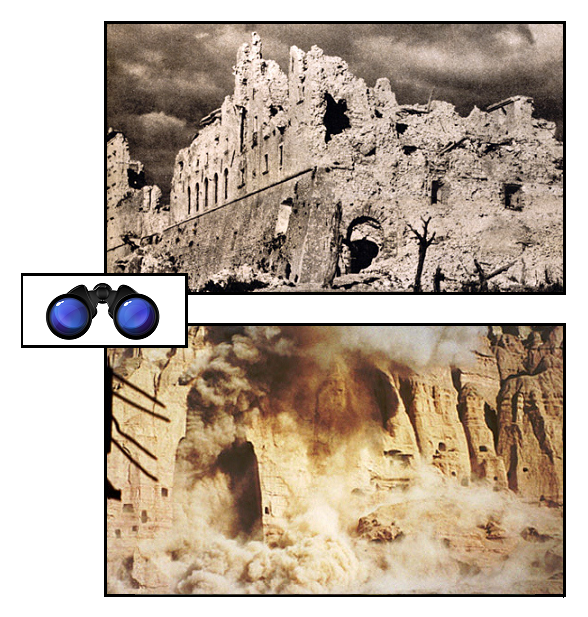
I have mourned before the losses at Bamiyan and Monte Cassino:

Here’s what’s happened to the Green Mosque or Mazjid Sabz, famous for its dome (upper panel only, lower panel h/t Bilal Sarwary), in the course of fighting in Afghanistan — the country whose oldest mosque it is:

**

And yet prayer continues:

FWIW, the lower panel image (above) is from a Christian Science Monitor article titled Israeli settlers respond to mosque burning allegations — the caption reads in part:

Palestinian men pray Monday near a burnt part of the carpet in a mosque that was damaged in the West Bank village of Beit Fajjar near Bethlehem. Palestinians accused Jewish settlers of setting fire to the West Bank mosque on Monday

The upper panel image, as far as I can determine, shows the continuing celebration of Mass in a German church after Allied bombardment in World War II.

**

It is at least worth pondering the words of these Trappist sisters in Azeir, Syria…

They came to Azeir to continue in spirit the work of the monks of Tibhirine, about whom I wrote, giving extensive background and the entire text of Fr. de Chergé‘s great, final testament here. The sisters write:

Today we have no words, except those of the Psalms that the liturgical prayer puts onto our lips in these days:

Rebuke the Beast of the Reeds, that herd of bulls, that people of calves…oh God, scatter the people who delight in war…Yahweh has leaned down from the heights of his sanctuary, has looked down from heaven to earth to listen to the sighing of the captive, and set free those condemned to death…Listen, God, to my voice as I plead, protect my life from fear of the enemy; hide me from the league of the wicked, from the gang of evil-doers. They sharpen their tongues like a sword, aim their arrow of poisonous abuse…They support each other in their evil designs, they discuss how to lay their snares. “Who will see us?” they say. He will do that, he who penetrates human nature to its depths, the depths of the heart…Break into song for my God, to the tambourine, sing in honor of the Lord, to the cymbal, let psalm and canticle mingle for him, extol his name, invoke it…For the Lord is a God who breaks battle-lines! … Lord, you are great, you are glorious, wonderfully strong, unconquerable.

We look at the people around us, our day workers who are all here as if suspended, stunned: “They’ve decided to attack us.” Today we went to Tartous…we felt the anger, the helplessness, the inability to formulate a sense to all this: the people trying their best to work and to live normally. You see the farmers watering their land, parents buying notebooks for the schools that are about to begin, unknowing children asking for a toy or an ice cream…you see the poor, so many of them, trying to scrape together a few coins. The streets are full of the “inner” refugees of Syria, who have come from all over to the only area left that is still relatively liveable…. You see the beauty of these hills, the smile on people’s faces, the good-natured gaze of a boy who is about to join the army and gives us the two or three peanuts he has in his pocket as a token of “togetherness”…. And then you remember that they have decided to bomb us tomorrow. … Just like that. Because “it’s time to do something,” as it is worded in the statements of the important men, who will be sipping their tea tomorrow as they watch TV to see how effective their humanitarian intervention will be….

Octavian Manea Interviews General David Petraeus

Monday, September 2nd, 2013

[by Mark Safranski a.k.a. “zen“]

Octavian Manea has had an excellent series of COIN  interviews at SWJ and this is one of the more important ones:

Reflections on the “Counterinsurgency Decade”: Small Wars Journal Interview with General David H. Petraeus

SWJ: In his recent op-ed published in the New York Times, “The Pipe Dream of Easy War”, General H.R. McMaster warned against the fantasy of “a new era of war”, and especially about the dangers in the blind faith in the transformative effects that technology promises to have on war. He argued that over the past counterinsurgency (COIN) decade we relearned a few lessons that we really should keep in mind as we head into the future: “American forces must cope with the political and human dynamics of war in complex, uncertain environments”. His warning reminds me of an article you wrote in 1986 with General John Galvin about “uncomfortable wars”. You warned to take into consideration “the societal dimension of warfare”. To what extent do you see that prophecy still holding true post Iraq and post Afghanistan?

General Petraeus: I think the essence of the article back in 1986 with General Galvin was frankly the importance of the human terrain in each particular situation, and the importance of understanding the terrain, having a very nuanced, detailed feel for the context of each situation, not just nationally, but sub-nationally and literally all the way down to each valley and each village. That kind of knowledge was achieved in Iraq and helped us enormously during the Surge. We had a greater understanding there, earlier than we did in Afghanistan, just because we had so many more forces on the ground, 165,000 American military alone at the height of the surge. In Afghanistan at the height of our deployment, we had 100,000 US troopers and about 50,000 coalitional forces, and we maintained that level for a relatively brief period of time. As I noted on a number of occasions, we never really got the inputs close to right in Afghanistan until late 2010.

So, noting the importance of human terrain, I believe, is a fundamental aspect of crafting a counterinsurgency campaign. In fact, it was the biggest of the big ideas when we launched the Surge in Iraq, and we knew that since the human terrain was the decisive terrain, we would had to secure it as our principal focus – and to do so by living with the people, locating forward operating bases/joint security stations in the neighborhoods and villages, and specifically right on the sectarian fault-lines across which the heaviest fighting was ongoing in the capital. We ultimately established 77 additional locations just in the Baghdad area of operations alone, and many dozens more elsewhere throughout the country. There were other big ideas to be sure:  e.g., that you can’t kill or capture your way out of an industrial strength insurgency, such as we faced, therefore you need to reconcile with as many of the insurgents as was possible, seeking to maximize the number of the reconcilables; correspondingly, we also needed to intensify our campaign of targeted operations against the irreconcilables. But I think, fundamentally, it comes back to this issue, that it is all about people, counterinsurgency operations are wars in, among, and, in essence, for the people. And the first task of any counterinsurgency campaign has to be to secure those people.

Read the rest here.

Bomb Syria?

Thursday, August 29th, 2013


[by Mark Safranski a.k.a. “zen“]

There is much ado about a prospective Western (i.e. American) aerial campaign to bomb the Iranian allied Alawite-Baathist dictatorship Syria over use of chemical weapons against primarily al Qaida allied Sunni Islamist extremist rebels.

To what end or how that end will be brought about by a surgical use of American air power, aided by token French and British contributions, well, no one is quite sure.

The driving insider force behind this astrategic call to arms are Susan Rice, Samantha Power and Anne-Marie Slaughter, the three Furies of R2P.  Slaughter writes on military intervention in Syria with her usual combination of moral certainty and operational magical thinking here. Rice angrily pontificates here while an unusually muted UN Ambassador Samantha Power just tweeted about it while on vacation from the emergency UN Security Council meeting on, uh, Syria.

The strategic argument about Syria is not about the normative qualities of the Assad regime, which is anti-American, brutal, terrorist supporting and fascistic. Or that the regime is committing atrocities. It is. It is about what political objective, if any, the use of military force against Syria can accomplish at what cost and with what probable outcomes. At a grand strategic level, there are also questions about how military intervention in Syria will impact great power relations and the shaping of international law.

I suspect many R2P advocates like Slaughter, Rice and Power are attracted to the idea of bombing Syria partly to garner a precedent to support doing similar things in the future, whether or not it has any positive effect on the Syrian civil war. That however, if true, is an extremely poor reason for military intervention anywhere. If bombing had some hope of changing the behavior of the Syrian regime or replacing it with something better, I would warm to the prospect but where is the evidence that is a likely outcome? Consider:

The Syrian rebels include armed groups as violent, lawless and squalid as the Assad regime. You know, the Beheading community of the third jihad international, with fringe support from the occasional cannibal commandos. If these Islamist lunatics come to power in Damascus they will cheerfully engage in ghastly pogroms of mass murder and torture that will make Assad’s goons look like the British Raj at tea time.

The Assad regime and the Alawite minority from whence it originates have their backs to the wall in a conflict that determines if they continue to rule Syria or are exterminated. Having no margin for maneuver or concession, America bombing them is irrelevant to whether in their calculus they can stop fighting their local enemies. The whole point of combining the threat of force with diplomacy – allegedly the reason given for bombing Syria – is to be able to make Assad an offer that he can’t refuse and not a threat that the Alawites can’t accept. Then, while blustering loudly and ominously we undercut our own bellicose posturing and announce that regime change was off the table. WTF?  Really?

The President should fire this unholy crew of incompetents and intellectual poseurs and hire some real foreign policy advisers with at least an undergraduate level grasp of how diplomacy, strategy and war have worked for the past 2000 years.

Failing that, a few poker players who can bluff without showing the entire table their cards.

War on Speed

Monday, August 26th, 2013

[ by Mark Safranski a.k.a. “zen”]

“When a man is lying in a shell hole, if he just stays there all day, a Boche will get him eventually. The hell with that. My men don’t dig foxholes. Foxholes only slow up an offensive. Keep moving.”

                                                                                                      – General George Patton

“In large-scale strategy, when the enemy starts to collapse, you must pursue him without letting the chance go. If you fail to take advantage of your enemies’ collapse, they may recover.”

“Speed is not part of the true Way of strategy. Speed implies that things seem fast or slow, according to whether or not they are in rhythm. Whatever the Way, the master of strategy does not appear fast”

                                                                                                          – Miyamoto Musashi 

“Two basic principles . . . underlie all strategic planning. . . .The second principle is:  act with the utmost speed”

                                                                                                             – Carl von Clausewitz

Soldiers of the 1st Cavalry Division charge [ Photo credit: U.S. Army photo by Sgt. Travis Zielinski]

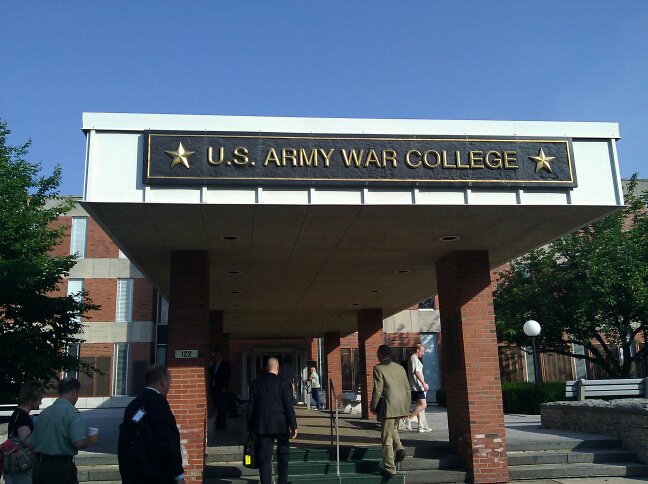
SWJ Blog published a link to  2013-14 Key Strategic Issues List put out by the Strategic Studies Institute to US Army War College students and researchers regarding the critical questions that the Chief of Staff believes need to be answered for the US Army to adapt to changing circumstances. It’s a good institutional practice and an interesting document to peruse. My attention was drawn to the subset entitled “Chief of Staff of the Army Special Interest Topics”. General Odierno’s second topic begins with an appropriately broad question:

                                       “How important is speed—both in terms of maneuver and information?”
We should look at the question first in a general sense and then in the light of the U.S. Army and the circumstances in which it is likely to find itself in the next few decades.

Common sense tells us that in any conflict, the ability of a single combatant, an armed group or an army corps to move and fight with speed is generally an advantage. This applies in other forms of conflict aside from warfare; for example, the boxing legend Muhammed Ali was great in his early career not merely because he was a big man and a gifted boxer but because he was also incredibly fast compared to his opponents, running rings around them in a match, taunting and humiliating them. When age removed the edge of speed, a slower Ali was forced to change his tactics and absorb a great deal of punishment that he had formerly escaped. Slow moving armies are like Muhammed Ali past his prime -they make for good targets.

In the history of warfare, many great fighting forces were also fast moving ones. Stonewall Jackson’s Confederates averaged close to fifteen miles per day in the Shenandoah Valley campaign; Roman legions frequently marched twenty miles in five hours while the armies of Alexander the Great and Napoleon Bonaparte drew closer to thirty a day. The fierce and elusive Apache topped them all, reputedly covering an astonishing seventy miles a day on foot in harsh desert terrain. Nor are the advantages of great speed limited to land armies, speed at sea and in the air is a tremendous equalizer for numerically inferior forces. It is good to move fast. The US Army, or at least parts of it, should be able to move fast, but this comes with a few caveats:

  • First, speed is always relative advantage. Being the fastest army in the world is a great thing but it is not quite so great if you are fighting the second fastest army in the world and the difference between the two is marginal.
  • .
  • Secondly, really optimizing speed for an entire army (vice specific units) is likely to come with trade-offs in terms of force structure and operational costs. Fast is fine, but fast with firepower is better, unless you think Operation Market Garden is the model to emulate.
  • .
  • Third, distance is often antagonistic to speed (i.e. imposes greater friction costs).  The ability to sustain a campaign in Afghanistan from the Western hemisphere does not mean it will be cheap to run your strykers and helicopters on imported fuel.  Zipping your panzers across France is not the same as slogging them through the vast and roadless expanse of Russia.
  • .
  • Fourth, speed and agility are not the same thing.  Maneuver in battle depends on other things aside from linear speed; the ability to execute fast transients by rapidly shifting what your force is doing on the fly is unlike simply moving them from point A to point B at a high rate of speed. 
  • .
  • Fifth, moving at one easily predictable speed and operational tempo, even at a high rate, is not as good as purposefully changing up both to throw the enemy off of their game. Sometimes employing a slow or erratic tempo is useful for imposing costs on enemy forces, deceiving them or constraining their freedom of action. 

Speed of information is not at all the same as the speed of material things, in part because the qualitative value of the information determines the utility of receiving it faster. An army that could move information and communicate more effectively – by having mastered writing, messenger systems, secret codes, the telegraph, shortwave radio or the internet – usually has a comparative advantage, but only up to a point. Much like medicine, the right dose of information can cure what ails you but too much or the wrong kind at the wrong time can kill you.

Even valuable information – much like Robert E. Lee’s battle plans for Antietam wrapped around some cigars – is simply unconnected data unless it is received by someone (Observation), who unlike General McClellan, is competent to discern the importance, put the information into context (Orientation), plan (Decide)and take appropriate action (Act).  Knowledge is contextual and actionable ( or it is a prerequisite for effective action) while information is isolated, raw and could easily be irrelevant trivia or distracting “noise”.

Quantity of information and the velocity with which it circulates through an organization can undermine the comparative advantage of having greater informational speed. Communication often expands to fill the bandwith allotted to the detriment of organizational effectiveness.  What is useful intel for a squad leader entering a seemingly abandoned village becomes a drowning sea of minutia for a battalion, brigade or theater commander who can only grasp coup d’oeil by focusing on essential components of operational or strategic problems as they are expressed on the battlefield.

Every transmitted message is a form of transaction requiring time, attention and energy from a commander and his subordinates, taxing their ability to prioritize effectively and inevitably creating “fog” by increasing the ratio of useless, incorrect or irrelevant data to crucial information. Improvement comes both from becoming increasingly effective at distilling knowledge from masses of data and from paring back the traffic in informational garbage and “busywork” and legalistic “CYA” communication. Greater informational speed shows it’s true value when an organization (military, business, political etc) can systematically move critical knowledge to the person who needs it at the moment it is required.

How Should the US Army think about Speed?

The US Army, in my view, faces some probabilities in the next few decades in terms of thinking about speed, force structure, potential conflicts and other questions:

  • Barring a resumption of conscription, austerity and domestic politics will mean a smaller active duty peacetime force that will have to formally shed some of the Cold War legacy missions it is no longer capable of executing  or willing to fund. 
  • .
  • Any major land conflict the US enters is likely to be expeditionary against a much more numerous opponent ( North Korea, Iran, Pakistan,  China or a proxy war – likely in Africa) while our technological edge over near-peer and second to third tier adversaries, while remaining, will be less than in previous decades.
  • .
  • The US may face more than one “small war” at a time with an allied or friendly state requesting FID/COIN help against an insurgency of some kind. 
  • .
  • The US may face an insurgency at home from Mexican narco-cartels that may begin as a law enforcement matter and be escalated by cartels into a serious paramilitary insurrection and terrorism problem before political authorities are willing to acknowledge the gravity of the threat (i.e. American politicians will behave much like their Mexican counterparts did in the 2000’s. Indeed they are already doing so in regard to massive cartel infiltration of American cities)
  • .
  • The US will retain sufficient nuclear deterrent, Naval and strategic air capability to make a conventional or nuclear attack on the American homeland extremely unlikely.

The US Army, even in a reduced size,  will probably retain the role of “mailed fist” land force with a core of  armor, motorized infantry, artillery units along with infantry that could conceivably be scaled up to much larger levels of personnel in a grave crisis. But the reality is the politicians will always try to fight foreign wars with peacetime forces, so to be of real use, the Army must be able to go to war “as is” and win it very quickly.  It is unlikely that a serious opponent like Iran, if it’s leaders believe the US intends regime change, will permit America a leisurely 6-12 month build-up of an invading host in a neighboring state the way that Saddam did [ can you imagine PLA generals sitting on their hands as the US Army put, say, 10-15 divisions of American and coalition troops on their border with Vietnam?]

So if the US Army is to be operationally relevant by virtue of speed, there must be a deep all-services investment in the unsexy air and sealift capacity to move a substantial amount of troops and their heavy equipment in days or weeks instead of months ( most likely combined with even greater efforts at pre-positioning ). Speed and maneuver in operations depends on getting there in the first place.

Assuming we have many divisions or brigades (if we stay “modular’) arriving somewhere, increasing operational speed is partly a work of the Army’s leaders spending years changing  the organizational culture to give subordinates real room to take initiative within their commander’s intent. This will help improve both physical maneuver as well as information flow by reducing the institutional incentives to create paralysis by micromanagement.

Accepting loose reins may mean more American casualties, far more enemy combatant casualties and consequent civilian collateral damage as field grade and junior officers take greater responsibility and the tempo of operations accelerates. ROE will have to be simpler and hew closer to what is permitted under the Laws of War vice what overly complex guidance prevailed at certain times in Afghanistan. This will require ruffling the feathers of international law professors, lefty NGO activists, anti-American journalists and some members of Congress.

On the other hand, we might start winning wars again.

War in miniature?

Friday, August 23rd, 2013

[ by Charles Cameron — as the Washington Post points out, this has indeed been a busy week for military justice ]
.

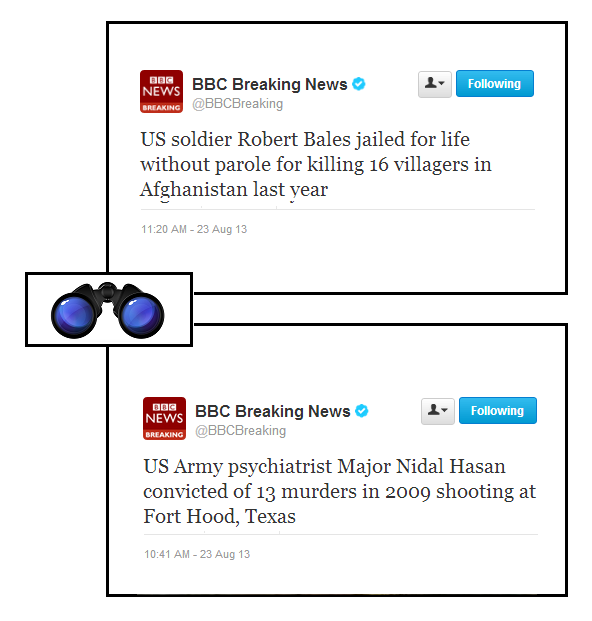
To take just two examples:

**

I have pulled these two news-tweets from the BBC out and juxtaposed them, because the charges in both cases had to do with murder, although Hasan was also found guilty of multiple additional attempted murders — but we should not forget the just-concluded trial of Bradley / Chelsey Manning, nor the pretrial hearings now under way for Khalid Sheikh Mohammed and his alleged 9/11 co-conspirators — nor for that matter the USS Cole case, which has just while I was writing this post been postponed till October.

Workplace violence? Treason? Torture? Dishonor? Death Sentence? Jihad? Martyrdom?

Comparing and contrasting these different yet related situations, we have before us what seems to me to be a war in microcosm…


Switch to our mobile site