zenpundit.com » war

Archive for the ‘war’ Category

Guest Post: Sean Meade Reviews The Illiad

Saturday, September 11th, 2010
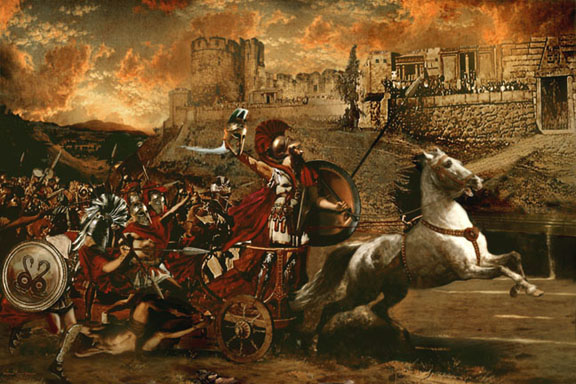
The Illiad by Homer

Sean Meade, in addition to being my good friend, is the Web Editor for Aviation Week’s defense and space content and is the former longtime webmaster/editorial assistant/right-hand of Dr. Thomas P.M. Barnett. Sean blogs at ARES for Aviation Week and at his personal blog, Interact:

ON THE ILLIAD

by Sean Meade

What makes ‘The Iliad’ a classic? Why is it classic?

I think the primary answer is simple: it’s the characters. If you can hang tough through all of the idiosyncratic flourishes and ornaments and repetitions, the characters are compelling: Achilleus, his anger and character; the comparative nobility of Hektor and Patroklos (both of whom we know are doomed); the vagaries of the gods and their adolescent machinations; the supporting cast of Agamemnon, Menelaos the wronged, two very different men named Aias (Ajax), Diomedes, Aeneas, Odysseus, Nestor, Paris, Helen and Priam. Take these characters and others and mix them with an interesting story and you have a classic that reaches out to us from about the eighth century BC (when it was likely ‘composed’ (with heavy use of previous, oral sources) by Homer), maybe from as far back as the 12th century BC (maybe the original setting of what has come down to us as The Trojan War). ‘The Iliad’ still resonates with us today.

One reason ‘The Iliad’ can still move us is that Homer has done a masterful job of relating the ‘accidents’ of life. ‘Time and chance happen to all men’, and people who lived 3000 year ago couldn’t deceive themselves about their ability to control life the way we ‘modern’ people do. Human experience and emotions are often inscrutable. ‘Love’ (baldly called ‘lust’ by Homer) can easily destroy. When it occurs in the most influential levels of society, it can draw whole nations into its whirling vortex. Even the love between men in ‘The Iliad’ can seem illogical (no matter where you come down on the homosexuality question): why does noble Patroklos honor Achilleus literally to the death?

‘The Iliad’, of course, focuses a lot on war in ways that have become shockingly remote for most of us. Nothing is so susceptible to ‘luck’ as war. One ‘good’ soldier gets hit by stray friendly fire and dies instantly. Another ‘bad’ soldier comes through the whole war unscathed. Consider the hazards of love, life and war in ‘The Iliad’. Consider them in our own experience. It makes more sense than many theories to conclude that arbitrary and capricious gods can powerfully affect us.

My final guess (for the purposes of this mini-review) at why ‘The Iliad’ is a classic is that the poetry is timeless. This is, of course, nearly impossible to take in from one read-through in translation. My friend, Jason, listened to the abridged version and talked about its power. The commentators discuss it quite a bit, from what I can tell. Most of us (who aren’t going to pay the price to really test it) are going to have to take this on faith and rate it as we will. Poetry is a dying art, and poetry appreciation is probably in an even worse state.

I wonder what role foreknowledge plays in ‘The Iliad’. Many of us know the broad outline of the story going in. If we don’t, Homer spills it in short order. Does knowing Achilleus dies shortly after this episode in The Trojan War change our view of him? Do we cut him more slack? How does  knowing that Hektor and Patroklos die within the bounds of this story affect us? Or that Odysseus lives? Or that Agamemnon will be murdered in his bath by his wife (he had it coming ;-)?

Something else that stands out about ‘The Iliad’ is the graphic war imagery. Homer’s descriptions almost seem gratuitous when he goes into detail about how one soldier killed another, where the spear penetrated and where it came out, what muscles were severed, what happened to the bowels, teeth or brain. It’s probably distasteful to many of us in the 21st century, but I think we can just chalk that up to cultural differences.

My second big question is: what does ‘The Iliad’ mean? I’m very snobbish about exegesis, especially concerning the Bible (my training, as a former pastor), but including any suitably worthy literature (with concomitant training in British Lit and Analytic Philosophy). Exegesis, in principle, is simple: what was the author trying to communicate to the audience? (So why is good exegesis so hard to find? 😉 If we are to make any meaningful connection to the original work, this is where we have to begin. You can deploy your Reader Response Theory on ‘Twilight’ or some such drivel, but keep it off my Homer (I told you I’m a snob ;-).

We come to ‘The Iliad’ at a loss because Homer’s values are very different from ours. His presuppositions are vastly different from ours. I have touched on some of these already. The gods can show up at any time and throw any wrench in the works for almost any imaginable reason. We have to take the role of the gods seriously to take Homer seriously. What did their role say about the responsibility of people? Humans retain some responsibility, almost paradoxically. Helen isn’t completely off the hook for running away with Paris. Achilleus does not get a complete pass for his anger that causes the deaths of so many Achaean comrades. Agamemnon is not excused for his overbearing pride that contributed to the disagreement with Achilleus. And even noble Hektor faces bouts of inaction and cowardice for which he is not wholly exonerated.

Another value we find hard to understand is the ancient Greek concept of nobility. It’s just born there. If you’re a shepherd who’s not the natural-born son of King Priam and Queen Hekabe, that’s all you’ll ever be: a shepherd. The main characters are noble; many are first-generation half-deities and most (all?) have divinity in their bloodline somewhere. From our standpoint, Achilleus behaves like a monster, especially in his repeated attempted-desecration of Hektor’s body (the gods protect Hektor’s body and Achilleus’ ultimate honor by preserving Hektor’s corpse inviolate in almost the perfect proverbial deus ex machina). He’s sacrificed any claim to nobility as far as we’re concerned. Not so for Homer and the ancient Greeks; Achilleus retains his nobility, though it is clouded by sins. He receives partial pardons and rationalizations. From our perspective, we view him as maybe the original anti-hero. Homer’s view is much less ambivalent, and Achilleus gets away with things for which lesser men would go straight to Tartaros without passing ‘Go’. It’s a far cry from our 21st century Western concept of nobility and our love of ‘rags to riches’ fables. It’s only riches to riches here (though maybe no one knew through the rags that you were really rich).

So what is Homer’s message? The conclusion of my barely-better-than-cursory reading is: Given that nobility and greatness are natural, almost literally gifts of fate (the Fates); and that humans are subject to the whims of the gods; it is best to be brave and seek glory (within reason–with a glance forward to Aristotle’s middle-way ethic). How’s that going to help you with your job or family? Not much. It’s fodder for thinking about societal values and a long way from whether or not to stick it out in your mediocre, going-nowhere job. (It might possibly apply to whether or not you should run away with your neighbor’s spouse.)

For most of us, ‘The Iliad’ is probably a test in proper exegesis more than someplace we should or will go to look for meaning. But maybe that’s just my soap box 😉

Narcos Copycat Global Guerrilla Playbook

Wednesday, September 8th, 2010

The Cartels are following in the footsteps of Nigerian delta rebels and Iraqi insurgents.

Though to my mind, this attack was more of a demonstration than a determination to bring the state to it’s knees. Narco business would be impinged by a true state collapse in Mexico which would activate the USG in unhelpful ways. The cartels would rather someone else mind the store while they get on with making money unhindered.

John’s next book should just be titled “See, I told you so”

Summer Series 2010: WAR by Sebastian Junger

Wednesday, September 8th, 2010

Summer Series 2010: Reviewing the Books! has begun. This review was originally posted in June, 2010 and is being re-posted as part of Summer Series:

WAR by Sebastian Junger

I just finished reading my courtesy review copy of WAR by journalist and author Sebastian Junger, on his firsthand observation of the war against the Taliban in the Korengal Valley, waged by the soldiers of the 2nd Platoon of Battle Company. I cannot say that I found WAR to be an enjoyable read – though Junger is a polished writer – a more accurate description is that WAR is powerful, thought-provoking, at times moving and, ultimately, a very disturbing account of the war in Afghanistan.

Junger, whose previous works include The Perfect Storm: A True Story of Men Against the Sea and Fire, was embedded along with photojournalist Tim Hetherington, with 2nd Platoon during their COIN campaign in Korengal, a mission that resulted in some of the bloodiest firefights and highest American casualties of the Afghan war and withdrawal from a rugged valley sometimes known as “Afghanistan’s Afghanistan”. The Korengalis, related to the people of Nuristan, are noted for their xenophobic hostility to outsiders, which was directed at times toward the Taliban as well as Americans. Junger reports that the US only succeeded in controling a quarter of Korengal and contesting roughly half of the six mile by six mile valley with the Taliban and local “accidental guerrillas”motivated by money, excitement, religious zeal or revenge to attack the Americans.

WAR is not an especially “political” or “policy” book discussing the war from some remove. Junger’s primary interest are the men of second platoon at Restrepo, an outpost dedicated to the memory of a valorous medic who had been killed. O’Byrne, Anderson, Stitcher (who has “INFIDEL” tattooed across his chest), Jones, Moreno, Bobby to name just a few soldiers Junger interviewed and witnessed how they lived in the moment. That moment could comprise the adrenaline high of combat, agonies of grief, anticipatory tension before the next ambush, the angst of boredome behind the wire and especially the iron bonds of brotherhood in a small unit tempered by fire.

What comes through in War, aside from the extremity of the terrain and the uncertainty of ever-present danger, men being shot without warning by the enemy, even in Restrepo, is how very few men are actually involved in combat. Battle Company is the vaunted “tip of the spear” but when only a few hundred men were taking a wildly disproportionate percentage of all combat contacts in a nation the size of Afghanistan ( Junger cites 20 %) the spear begins to look more like a tiny sewing needle connected to a Leviathan-like noncombatant-administrative tail, surreally outfitted with fast food courts.

There’s a peculairly granular quality to Junger’s WAR, the grittiness of the squalid conditions in which soldiers live, the depths of their physical sufferings and mental exhaustion, their primal fear of letting their comrades down in battle and being responsible for getting friends killed. There are also epiphanies of bravery and carrying the day against the odds, men living who but for chance would have died on some rock strewn hill and lusty celebration after the deaths of their enemies. The sort of politically incorrect, atavistic, jubilation that is culturally frowned upon by people who are comfortably safe and far away.

What disturbed me most about WAR was not just how few Americans are carrying the burden of the combat in Afghanistan but how disconnected these few soldiers and their sacrifices are from the rest of the military itself. Junger’s epilogue with O’Byrne, a fine soldier who is a major figure in the book, and his inability to readjust and shift from the battlefield to garrison or civilian life is deeply depressing. “The Army’s trying to kill me” O’Byrne declared, finding a momentary refuge in alcohol, but little help from the military bureaucracy.

Junger attempted to show the war in Korengal as seen from the perspective of the privates, NCO’s and junior officers of Battle Company who lived and died there, from his interviews and his own participation in their patrols as they came under fire or as they gingerly parleyed with Korengali elders in isolated villages. Eschewing theory or a historian’s search for causation, Junger attempts to let the soldiers words and actions drive the narrative.

Sebastian Junger’s WAR is raw and undecorated by sentiment.

Grand Strategy and Morality

Saturday, August 21st, 2010

Adam Elkus had two brief but thoughtful posts on grand strategy at Rethinking Security that I woulld like to highlight and use as a foil to promote further discussion. I encourage you to read both in full:

Basil Liddell-Hart, Grand Strategy, and Modern Grand Strategy

….This, however, is not the understanding of “grand strategy” we have today. Starting with Edward Luttwak’s Grand Strategy of the Roman Empire (Luttwak has written a new book about the Byzantine Empire), grand strategy has been used in books to refer to the overall method of a state for producing security for itself or making itself powerful. Paul Kennedy’s edited compilation Grand Strategies in War and Peace and Rise and Fall of the Great Powers explicitly uses this framework. The William Murray and MacGregor Knox edited compilation The Making of Strategy: Rulers, States, and War also pioneered it. And the Clausewitzian Colin S. Gray has written a great deal on grand strategy as well.

So, what to say? First, the better works on the subject do not treat grand strategies as linear plans but a coherent or at least related set of practices over a long period of time. This is a good approach to take, as it emphasizes that rulers did not instinctively seek to craft a Seldon Foundation-esque master plan for eternity but discovered, through trial and error, a set of practices, ideas, and concepts of operations that worked for a given period of time. Perhaps a very important question (and one that has been alluded to) is what kinds of political cultures tend to produce these sets of practices, and whether they are imposed top-down, generated in a mixed fashion, or come emergently from below

and:

Strategy and “Strategy”

Diplomatic historian Walter McDougall recently wrote this:

The most a wise statesman can do is imagine his ship of state on an infinite sea, with no port behind and no destination ahead, his sole responsibility being to weather the storms certain to come, and keep the ship on an even keel so long as he has the bridge.

I write this after an interesting Twitter conversation with Gunslinger of Ink Spots, which he later excerpted in his own reflections on strategy in America. Gunslinger points out a recurring dynamic. The upper layer of policy and strategy is thin and operational art, the solid bottom foundation, is filling in the void. The problem, however, is that operational art provides a narrow viewpoint to see the world. It is good as a cognitive ordering device for some things, but poor for others. When we try to use it as a strategic device, it magnifies our confusion because the blurs outside of our finely tuned vision are all the more distressing, frightening, and alien to us

Adam is right. Operational excellence is strongly desirable but by itself, insufficient. It is a sword, not a map. Still less is it a crystal ball or moral code. 

Grand strategy is not, in my view, simply just “strategy” on a larger scale and with a longer time line. Strategy is an instrumental activity that unifies ends, ways and means. While grand strategy subsumes that aspect, it also provides ordinary strategy with a moral purpose, perhaps even in some instances, an identity.  Grand strategy explains not just “how” and “for what”, but “why we fight” and imparts to a society the supreme confidence in itself to sustain the will to prevail, even in the face of horrific sacrifice. Grand strategy brings into harmony our complex military and political objectives with the cherished, mythic narrative of a “good society” we conceive ourselves to be, reducing “friction”, “pumping up” our resolve and demoralizing our enemies. Grand strategy is constructive and energizing.

A simple but profound moral argument is a critical element of a grand strategy, to a great extent, it frames the subsequent political and military objectives for which war is waged. Here is one example:

….We hold these truths to be self-evident, that all men are created equal, that they are endowed by their Creator with certain unalienable Rights, that among these are Life, Liberty and the pursuit of Happiness. – That to secure these rights, Governments are instituted among Men, deriving their just powers from the consent of the governed, – That whenever any Form of Government becomes destructive of these ends, it is the Right of the People to alter or to abolish it, and to institute new Government, laying its foundation on such principles and organizing its powers in such form, as to them shall seem most likely to effect their Safety and Happiness. Prudence, indeed, will dictate that Governments long established should not be changed for light and transient causes; and accordingly all experience hath shewn that mankind are more disposed to suffer, while evils are sufferable than to right themselves by abolishing the forms to which they are accustomed. But when a long train of abuses and usurpations, pursuing invariably the same Object evinces a design to reduce them under absolute Despotism, it is their right, it is their duty, to throw off such Government, and to provide new Guards for their future security

Or another:

….I would say to the House, as I said to those who have joined this government: “I have nothing to offer but blood, toil, tears and sweat.”

We have before us an ordeal of the most grievous kind. We have before us many, many long months of struggle and of suffering. You ask, what is our policy? I can say: It is to wage war, by sea, land and air, with all our might and with all the strength that God can give us; to wage war against a monstrous tyranny, never surpassed in the dark, lamentable catalogue of human crime. That is our policy. You ask, what is our aim?

I can answer in one word: It is victory, victory at all costs, victory in spite of all terror, victory, however long and hard the road may be; for without victory, there is no survival. Let that be realised; no survival for the British Empire, no survival for all that the British Empire has stood for, no survival for the urge and impulse of the ages, that mankind will move forward towards its goal. But I take up my task with buoyancy and hope. I feel sure that our cause will not be suffered to fail among men. At this time I feel entitled to claim the aid of all, and I say, “come then, let us go forward together with our united strength.”

War is not a game of chess. Without a moral purpose – an Atlantic Charter, a Gettysburg Address, Pope Urban II’s sermon, the Funeral Oration of Pericles – to lend sanction to strategy, a war effort is hamstrung and civil society is left unengaged, perhaps indifferent or even hostile to military action. In the American Civil War, there was a world of difference between the morale and determination of Union states of 1861-1862 and that of late 1864-1865. This turnaround was not solely due to Generals Grant and Sherman, the former of whom was being castigated in the newspapers as a “butcher” up almost until the moment where he was deified in victory, the change pivoted on the Emancipation Proclamation and the Gettysburg Address which welded battlefield sacrifice to a higher cause.

Naturally, actions that violate the moral purpose – of the grand strategy or a society’s sense of self – are incredibly, incredibly, damaging. This is why Abu Ghraib was utterly devastating to the American war effort in Iraq. Or why accusations or evidence of high treason are bitterly divisive. They contradict the entire raison d’etre for having a strategy and paralyze a society politically, energizing competing centers of gravity while giving heart to the enemy.

Oddly, highly sophisticated American leaders seem to be blind to this but Osama bin Laden, fanatical and ignorant in his half-baked, obscurantist understanding of Salafi Islam, is keenly aware. His entire “fatwa” declaring al Qaida’s jihad on America, despite being riddled with lies, is a painstaking plea to his fellow Muslims as to the righteousness of his cause, the worthiness of his objectives and the iniquity of the American infidels. Osama may be an evil barbarian, but Bin Laden has far more clarity of purpose and moral certitude  than many USG senior leaders who cannot bring themselves to say who the enemies are that United States is fighting and why ( other than “9/11” – which is like saying we fought Nazi Germany because of Pearl Harbor). Too often they have an indecent haste to cut checks to governments who are allied to our enemies

They are halfhearted and timid in America’s cause while our foes brandish their convictions like they were AK-47’s.

The Strategist as Demiurge

Saturday, August 7th, 2010

“Genius is above all rules” – Carl von Clausewitz

“Creativity is the ability to introduce order into the randomness of nature.” – Eric Hoffer

An intriguing, thought-provoking and frequently on-target paper by Dr. Anna Simons of SSI  (hat tip to SWJ Blog). First the summary excerpt and then some comments:

Got Vision? Unity of Vision in Policy and Strategy: What It Is and Why We Need It (PDF)

….Moving beyond “unity of effort” and “unity of command,” this monograph identifies an overarching need for “unity of vision.” Without someone at the helm who has a certain kind–not turn, not frame, but kind–of mind, asymmetric confrontations will be hard (if not impossible) to win. If visionary generals can be said to possess “coup d’oeil,” then unity of vision is cross-cultural coup d’oeil. As with strategic insight, either individuals have the ability to take what they know of another society and turn this to strategic–and war-winning–effect, or they do not. While having prior knowledge of the enemy is essential, strategy will also only succeed if it fits “them” and fits “us.” This means that to convey unity of vision a leader must also have an intuitive feel for “us.”

[ For the readers for whom military strategic terminology is unfamiliar, “coup d’ oeil” is an instant, intuitive, situational understanding of the military dynamics in their geographic setting. The great commanders of history, Alexander, Caesar, Belisarius, Napoleon – had it]

The key concept  here is “visionary generals” creating a mutually shared “general vision” of policy and its strategic execution. While military figures who hold high command – Eisenhower, MacArthur, Petreaus – are obvious examples, technically, it doesn’t have to be a “general” in immediate combat command, so much as the final “decider”. A figure whose authority is part autocrat and part charsmatic auctoritas. Abraham Lincoln and Winston Churchill epitomized this role, as did George Marshall, the orgainizer and architect of the Allied victory in WWII. On a less exalted scale, we see Edward Lansdale (cited by Simons) or Thomas Mann, LBJ’s behind the scenes, Latin America “policy czar” during the Dominican Crisis of 1965

Simons is arguing for finding “great men” of strategy rather than explaining how to contruct a strategic vision per se. There is a very strong emphasis here of successful strategy as an act of great creativity, with the strategist as a master artist of force and coercion, imposing their will on allies and the enemy to shape the outcome of events. Colonel John Collins, wrote of this article by Dr. Simons at his Warlord Loop:

Be aware that the following article is NOT about unity of vision. It is about visionaries who convinced a majority that their vision was the best available policy at a given time and place in a certain set of circumstances. Implementing plans, programs, and operations follow. Most successful visionaries indeed must be supersalespersons, because priceless theories and concepts otherwise gather dust.  

I agree. There’s a combination of actions here – strategic thought, proselytizing the vision, competent execution, empirical assessment and strategic adjustment – that feeds back continuously (or at least, it should). While Simons argues her point well and draws on several case studies from India from which I learned new things, there is a flaw in one of her premises:

Take Andrew Krepinevich’s and Barry Watts’s recent assertion that it is “past time to recognize that not everyone has the cognitive abilities and insight to be a competent strategist.”4 As they note, “strategy is about insight, creativity, and synthesis.”5 According to Krepinevich and Watts, “it appears that by the time most individuals reach their early twenties, they either have developed the cognitive skills for strategy or they have not.”6 As they go on to write:

If this is correct, then professional education or training are unlikely to inculcate a capacity for genuine strategic insight into most individuals, regardless of their raw intelligence or prior experience. Instead, the best anyone can do is to try to identify those who appear to have developed this talent and then make sure that they are utilized in positions calling for the skills of a strategist.7

Mark Moyar concurs. The point he makes again and again in his new book, A Question of Command: Counterinsurgency from the Civil War to Iraq, is that “counter-insurgency is ‘leader-centric’ warfare, a contest between elites in which the elite with superiority in certain leadership attributes usually wins.”8

Watts and Krepinevich are statistically correct regarding the rarity of strategic thinking and are probably largely correct regarding the effects of professional military education and the career path of most military officers. They are most likely wrong on the causation of the lack of strategic thinking ability. It is not exclusively a matter of winning the genetic lottery or losing it at age thirty, cognitively we are what we frequently do. Discourage a large number of people by regulation or culture from taking the initiative and making consequential choices and you will ultimately have a group bereft of strategic thought. Or possibly, thought.

As with most professionals, military officers tend to be vertical thinkers, or what Howard Gardner in Extraordinary Minds calls “Masters” – as they rise in rank, they acquire ever greater expertise over a narrower and more refined and esoteric body of professional knowledge. This tendency toward insularity and specialization, analysis and reductionism is the norm in a 20th century, modern, hierarchical institutional culture of which the US military is but one example.


However, if you educate differently, force officers out of their field (presumably into something different from military science but still useful in an adjunctive sense), the conceptual novelty will promote horizontal thinking, synthesis and insight – cognitive building blocks for strategic thinking. While we should value and promote those with demonstrated talent for strategic thinking we can also do a great deal more to educate our people to be good strategists.


Switch to our mobile site