zenpundit.com » al qaida

Archive for the ‘al qaida’ Category

Barnett at Battleland: “Right out of John Boyd’s strategy…”

Monday, May 9th, 2011

Dr. Barnett is now a blogger for TIME Magazine’s Battleland

Right out of John Boyd’s strategy: disconnect, isolate & disempower your enemy

But Osama, looking far older than his 54 years, had none of that.  He was down to just a sad little entourage, and his comms were reduced to thumb drives smuggled in now and then. He is isolated, almost imprisoned, and he looks like a man sapped of all vitality.

…This is right out of American strategist John Boyd’s playbook:  you beat your enemy by isolating him, denying him allies, keeping him in the dark and – bit by bit – wearing down his energy: “Interaction permits vitality and growth, while isolation leads to decay and disintegration.” 

Read the rest here.

“Trust, but verify” and Pakistan: III

Sunday, May 8th, 2011

[ by Charles Cameron — third of three parts ]

*

.

David Ronfeldt said something in a recent comment here on strategy that to my mind maps very nicely — like one of those zooms in films from a very long view of a New York cityscape right in through the window of a brownstone onto a particular book on a certain someone’s bedside table or desk – onto this week’s questions about Pakistan:

as others have noted better than i, strategic relationships may involve competition in one area, collaboration in another, and a potential for serious conflict in yet another.

Bingo.

That seems to be pretty much the attitude of the ISI retiree Michael Wahid Hanna described on the Afpak channel two days ago:

“As for duplicity, I would say that diplomacy is not single tracked. We all follow many different tracks; sometimes, apparently, working against each other,” a retired senior official from Pakistan’s Inter-Services Intelligence Directorate (ISI) told me and my colleagues during a private gathering in Islamabad in July 2010 that was organized as part of The Century Foundation’s International Task Force on Afghanistan. “Double games or triple games are part of the big game.”

*

Time magazine gives the argument from both the “they must have known” and “honest, we didn’t” sides:

The most damaging accusation against the Pakistani military, of course, is that it must have known bin Laden’s was hiding in the small garrison town where army personnel at frequent checkpoints demand identification. “They knew. They knew he was there,” wrote Dawn columnist Cyril Almeida, echoing the suspicion of many Pakistanis. Kayani had driven past bin-Laden’s bolt-hole literally a week earlier, on his way to tell a gathering at the military academy that the “Pakistan army is fully aware of internal and external threats.”
.
Kayani was adamant that the Pakistanis had no idea that bin-Laden was hiding in Abottabad. “We had no clear, actionable information on Osama bin-Laden,” he told the journalists. “If we had it, we would have acted ourselves. No one would have questioned our performance for ten years. It would have raised our international prestige.”

That’s fair and balanced with, if you’ll excuse the pun, a great deal hanging in the balance…

*

Pat Lang at Sic Semper Tyrannis, accordingly, tries to weight the the US and Pakistan in terms of their respective affordances to each other…

Let’s see… What does Pakistan do for the US? … Pakistan’s military keeps it’s existing and future nuclear capability out of the larger world game. As has been discussed at SST many times, Pakistan either has or will soon have the real world CAPABILITY of ranging Israel’s target set. They have around 100 fully engineered and manufactured deliverable nuclear weapons. They have aircraft and missiles (Shahiin 2 improved) that would do the job. The missile launchers are fully mobile. The US has zero control over this nuclear strike force. Logically, the willingness of the Pakistan military to keep this “piece” off the chess board is a major boon to the US. We do not want to see that willingness change to something else.
.
On the other hand … The Pakistani security services support many of our worst opponents in Afghanistan. This is so well documented that I won’t bother to do so again.

*

Are you dizzy yet?

Lawrence Wright at the New Yorker – he wrote The Looming Tower, simply *the* book about AQ’s road to 9-11 – drops one of those tidbits that just might be the exact detail we need to pursue, in one of those long shot zooms in through the window I was talking about. He tells us:

Within the I.S.I., there is a secret organization known as the S Wing, which is largely composed of supposedly retired military and I.S.I. officers. “It doesn’t exist on paper,” a source close to the I.S.I. told me. The S Wing handles relations with radical elements. “If something happens, then they have deniability,” the source explained. If any group within the Pakistani military helped hide bin Laden, it was likely S Wing.

So.

Are we getting closer to that starkly phrased remark of Zen’s that I quoted at the outset of this three post series, “Osama bin Laden was caught and killed in an ISI safe house in Abbottabad” ?

I trust Lawrence Wright quite a bit — but I would like to verify

“Trust, but verify” and Pakistan: II

Sunday, May 8th, 2011

[ by Charles Cameron — second of three ]
*
.

Trust — or mistrust — but verify.

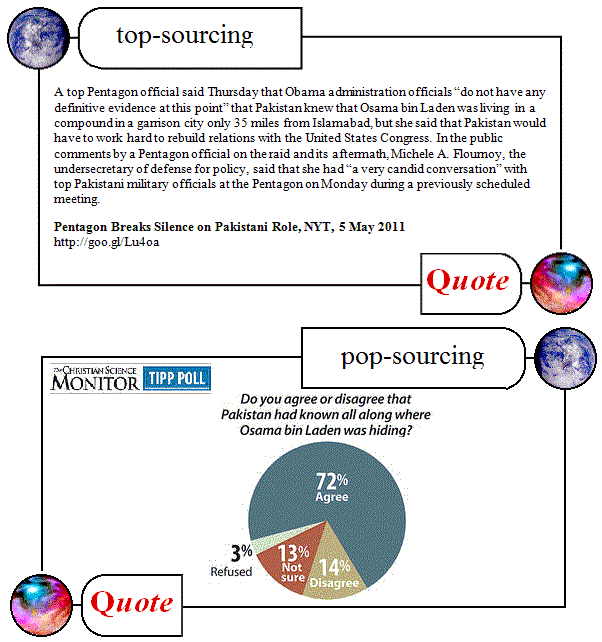
So: can you trust crowd-sourcing, can you trust officialdom?

quo-csm-poll-vs-flournoy.gif

Can you trust Pakistan?

“Trust, but verify” and Pakistan: I

Sunday, May 8th, 2011

[ by Charles Cameron ]
*
.

Ronald Reagan said “Trust, but verify.” Gorbachev said, “You repeat that at every meeting.” Reagan said, “I like it.”

*

Zen claimed a couple days ago that “Osama bin Laden was caught and killed in an ISI safe house in Abbottabad” — while over at ChicagoBoyz, Trent Telenko asserted:

We already knew Pakistan is what we feared a nuclear-armed Iran would be — a nuclear-armed, terrorist supporting, state. Just ask India about Mumbai and the Lashkar-e-Taiba. Now we know that Pakistan is attacking us too. Al Qaeda is the operational arm of Pakistani intelligence (ISI) attacking us just as Lashkar-e-Taiba is its operational arm attacking India.

Those are “strong” versions of claims that have been made in “weaker” forms for some time now.

*

Thus the NY Times refers to “the belief among administration officials that some elements of the ISI may have ties to Bin Laden and the Afghan Taliban” while according to the BBC, Adm. Mike Mullen recently claimed the ISI had a “long-standing relationship” with the Haqqani network. A Guardian report used the phrase “rogue elements” in discussing recently wikileaked documents from Guantanamo:

The documents show the varying interpretations by American officials of the apparent evidence of ISI involvement with insurgents in Afghanistan. There are repeated “analyst’s notes” in parentheses. Several in earlier documents stress that it is “rogue elements” of the ISI who actively support insurgents in Afghanistan.

So: is it “some elements of the ISI”—or “rogue elements of the ISI” — or simply “the ISI”?

*

The Pakistani Inter-Service Intelligence Directorate was included in the “list of terrorist and terrorist support entities identified as associate forces” in one of the leaked documents, the “JTF-GTMO Matrix of Threat Indicators for Enemy Combatants” with the notation:

This list is not all inclusive but provides the primary organizations encountered in the reporting from and about JTF-GTMO detainees. Through associations with these groups and organizations, a detainee may have provided support to al-Qaida or the Taliban, or engaged in hostilities against US or Coalition forces.

“Association with Pakistan ISID, especially in the late 1990s up to 2003” was listed in the same document as among the “the primary indicators for assessing a detainee’s membership or affiliation with the Taliban or ACM elements other than al-Qaida.”

BTW, what happened to the ISI in 2003?

*

And what of Pakistan itself? is it just the ISI that’s problematic, or the entire state of Pakistan? Time magazine reports:

CIA ruled out participating with its nominal South Asian ally early on because “it was decided that any effort to work with the Pakistanis could jeopardize the mission. They might alert the targets,” Panetta says.

Indeed, the problem may not be that there are rogue elements in ISI, nor that the ISI is a rogue element in Pakistan, but that Pakistan itself may be a rogue state, and a nuclear one at that.

How simple it is to write such a sentence – and how subtle the task of understanding – not leaping to conclusions but penetratingly understanding – just what the real situation is.

*

As Zen says in the same post:

It is long past time for a deep, strategic, rethink of what ends America wants to accomplish in Central Asia and some hardheaded realism about who our friends really are.

Intelligence needs to be intelligent, and to be seen to be intelligent.  Whether we trust or mistrust — we need to verify.

[ first of three, at least ]

Pakistan’s ISI On Trial….In Chicago

Friday, May 6th, 2011

As Pakistan’s corrupt military-feudal elite scramble to put out smoke after Osama bin Laden was caught and killed in an ISI safe house in Abbottabad and hire K Street lawyer-lobbyists like Mark Siegel at $ 75,000 a month, there are senior officials in Washington, inside and outside of the DoD, who doggedly championed Pakistan and defended the ISI behind closed doors.  These officials, as one DC correspondent in the know related to me, are now looking extremely foolish to their peers, even as they double-down and attempt to salvage a thoroughly discredited policy by spinning hard.

While attention is focused in Washington and Islamabad, Pakistan’s dreaded ISI is quietly going on trial. In Chicago.

An important post from Pundita:

U.S. government goes to lengths to shield Pakistan’s ISI at Rana trial in Chicago. Once again, keep your eye on the USG’s little cat feet.

This follows on my Tuesday post. The quotes I’ve pulled from ProPublica’s latest report on the upcoming trial of Tahawwur Hussain Rana will be upsetting to anyone who believes the U.S.-Pakistan relationship will change in significant fashion in light of the revelation that Osama bin Laden was quartered in a Pakistan garrison town.The ProPublica report presents clear evidence that all costs, including running roughshod over the American criminal justice system, the United States government will continue to cover for Pakistan’s military and intelligence services, as it’s done for decades. This is a point I emphasized in the Tuesday post so for anyone who thought I was being unduly pessimistic, read on. And be sure to read the rest of the report at the ProPublica site.Note from the report that the U.S. “intelligence community” still refuses to look at the Mumbai massacre in the context of the history of Pakistani military-sponsored terrorism and massacres going back decades. The community, at least according to the source ProPublica quotes, still insists that rogue officers, not the ISI institution, were responsible for the massacre in Mumbai.Before proceeding with the quotes I’ll note that ProPublica is an award-winning nonprofit American investigative journalism organization. It’s been keeping a close eye on Rana’s upcoming trial and other issues related to the 2008 massacre in Mumbai, India — to my knowledge the only U.S. media outlet that’s doing so despite the fact that six Americans were killed in the massacre. Here’s the link to earlier ProPublica reports on the issues.I’ve also included excerpts from a report posted at the Times of India news website that provide additional details about Rana and his trial.May 4, 2011, 5:11 p.m.

Pakistan’s Terror Ties at Center of Upcoming Chicago Trial
by Sebastian Rotella
ProPublica
It may be years, if ever, before the world learns whether Pakistan’s powerful Inter-Services Intelligence Directorate (ISI) helped hide Osama bin Laden. But detailed allegations of ISI involvement in terrorism will soon be made public in a federal courtroom in Chicago, where prosecutors last week quietly charged a suspected ISI major with helping to plot the murders of six Americans in the 2008 Mumbai attacks.The indictment has explosive implications because Washington and Islamabad are struggling to preserve their fragile relationship. The ISI has long been suspected of secretly aiding terrorist groups while serving as a U.S. ally in the fight against terror. The discovery that bin Laden spent years in a fortress-like compound surrounded by military facilities in Abbottabad has heightened those suspicions and reinforced the accusations that the ISI was involved in the Mumbai attacks that killed 166 people.“It’s very, very troubling,” said Congressman Frank Wolf, R-Va., chairman of the House Appropriations sub-committee that oversees funding of the Justice Department. Wolf has closely followed the Mumbai case and wants an independent study group to review South Asia policy top-to-bottom.“Keep in mind that we’ve given billions of dollars to the Pakistani government,” he said. “In light of what’s taken place with bin Laden, the whole issue raises serious problems and questions.”?

Read the rest here.

Read Propublica’s Mumbai Terror Attacks series.

If you have not heard about the Mumbai terrorism trial in Chicago, being carried out by Federal uber-prosecutor Peter Fitzgerald who is also prosecuting the high-profile, politically sensitive, retrial of former Illinois Governor Rod Blagojevic, it is no accident. In deference to State and the DoD, the Department of Justice is not exactly shouting about this terrorism case from the rooftops.

But somebody should.

There’s a lot of angst in this section of the blogosphere about the lack of strategy and the USG not looking at the larger picture. Well, the death of Bin Laden in the heartland of the military power structure that really rules Pakistan has been a wake up call that sent a normally somnambulent Congress into a state of anxiety. Good. Maybe if senators and congressmen hear from their constituents, they will less likely to be lulled to sleep again by Pakistan’s salaam alaikum‘ corner.

It is long past time for a deep, strategic, rethink of what ends America wants to accomplish in Central Asia and some hardheaded realism about who our friends really are.

UPDATE:

Pundita responds –U.S. and Pakistani damage control on Rawalpindi’s involvement in terrorism ignores much history

Christine Fair, an associate professor and Pakistan expert at Georgetown University in Washington DC, said Pakistan’s “record of helping us with al Qaeda is indisputable.”

Indisputable, huh? How about if you and I take a trip down memory lane, Professor Fair? Let’s link arms and skip back along a path piled high on either side with bodies of American dead.

The U.S. government paid their counterpart in Pakistan $25 million for Khalid Sheikh Mohammed. They paid $10 for another top al Qaeda operative, Abu Zubaydah.

Then Rawalpindi showed photographs of dead men with beards to the CIA, told them the corpses were al Qaeda operatives they’d killed, and got paid tens of millions of dollars in bounty. Some of those photographs cost the CIA one million dollars a pop.

I don’t think being skinned counts as receiving indisputable help, particularly when all signs point to top al Qaeda operatives such as KSM being ISI assets that the ISI sacrificed because they wanted the bounty money to keep themselves in business.

If you’d like to review the bounty program in detail, Professor Fair, you can read my November 2009 post, How the U.S. government built a perpetual-motion war machine in Afghanistan and sacrificed American values in the process

The upshot of the bounty program is that together the U.S. and Pakistan built a kind of perpetual motion machine:

At the end of every complex set of transactions between the CIA and the ISI, yet more enemy combatants materialize, to be rounded up or dispatched, leading to yet more enemy combatants to attack ISAF troops and nation-building efforts in Afghanistan, to be rounded up or dispatched, leading to — well, last night CNN reported that “Taliban” now control 80 percent of Afghanistan, even though only 7 percent of Afghanis support the Taliban.

The finding of Chicago-related terrorism plots on Osama bin Laden’s computer drives means that the trial takes on a new significance; Are Rana and Headley part of an operational cell designed to carry out attacks in the Windy City and not just a support team for Mumbai? 

Chicago TribuneTrial will probe alleged Chicago ties to Mumbai attack

While federal prosecutors link the alleged Mumbai plotters only to Lashkar, Headley has told investigators of a co-conspirator known only as “Major Iqbal,” who was working for Pakistan’s largest intelligence service, the Directorate for Inter-Services Intelligence, or ISI.

Further, Rana’s attorneys have also alleged in court documents that Rana believed Headley was working for ISI.


Switch to our mobile site
