zenpundit.com » terrorism

Archive for the ‘terrorism’ Category

The Hunt for KSM

Thursday, March 15th, 2012

The Hunt for KSM: Inside the Pursuit and Takedown of the Real 9/11 Mastermind by Terry McDermott and Josh Meyer

This courtesy review copy just arrived from Machette Book Group. The authors are investigative journalists, one of whom, Meyer, has extensive experience reporting on terrorism, while McDermott is also the author of the 9-11 highjackers book, Perfect Soldiers. Thumbing through the pages, I note the authors have little time and much contempt for the cherished DoD-State canard that the Pakistani government and the ISI are an ally of the United States, which has already given me a warm feeling.

The review copy index pages are blank, something I usually see only before a book has been finalized for mass printing. Odd.

I will be reading and reviewing this soon – Shlok advises that “it reads like a novel”

A note about nodes

Monday, March 5th, 2012

[ by Charles Cameron – places, people, neurons, ideas, with Kabul and Khost providing illustrations ]
.


[ illus: Starlight, from PNL ]

I was just reading Matthieu Aikins‘ GQ account of The Siege of September 13 in Kabul, when a couple of sentences caught my eye, not because of the attack itself, but because they reminded me of a point I want to make about the way we think these days about networks, nodes and linkages:

Salangi’s SUV was passing down the main road north of the embassy when the sound of gunshots and his police radio simultaneously erupted. He told his driver to turn around and head toward the sounds.

At Massoud Circle, the next roundabout down from Abdul Haq, they encountered a bottleneck of police vehicles, and so Salangi continued on foot, ducking as he heard the crack and whine of bullets passing close by…

What specifically caught and rerouted my attention was that phrase, “Massoud Circle, the next roundabout down from Abdul Haq” — Abdul Haq Circle, I’d read earlier in the article, “is a wide traffic roundabout named for a deceased mujahideen commander”, as presumably is the circle named for Massoud.

So we have two roundabouts connected by a road… and two deceased mujahideen commanders.

Or to put that another way, we have two nodes and a connection between them, twice over — in once case the nodes are places, and in the other the nodes are people.

*

Further into the article, I found a graphic showing the two places and the road connecting them — and an image of two people in Kabul that day, one extending an arm of care to the other. These two men weren’t Abdul Haq and Massoud, of course, but two people nonetheless. So in each graphic, we have two nodes and a connection:

A great deal of time and treasure goes into the analysis of networks of communication — cellphone to cellphone, person to person — or travel — place to place — (a) because the patterns can be revealing, and (b) because the data (what number called what number, e.g., how often Nidal Hassan emailed al-Awlaki, or what route bought Abu Dujanah from Amman to Khost) is unambiguous when obtained.

*

We’re also fond of neural nets, eh? — whether the “artificial” nets of AI or the “biological” nets of the brain — and again, these are unambiguous, scientists and technicians love them, and software developed with Congress-friendly budgeting implications is required to process them.

But what about ideas?

What about minds, what about the subjective side of persons and travels and communications and contacts and brains — what about thoughts, what about admiration?

That’s the node-link-node mapping that I find most interesting: it utilizes the most complex software (human intelligence), and demands the least complex support system (cappucino, napkin and pencil) — and some of its nodes and their linkages (beliefs, e.g., leading to actions) are among the richest features of the human behavioral landscape.

*

The idea that jihad is an individual obligation, for instance, is a staple of AQ-style theology. It is my contention, indeed, that acceptance of that idea is the religious foundation on which acts of jihadist suicide are based.

And by the same token, these suicide acts are then viewed in terms of martyrdom, since they were enacted in the cause of Allah, giving rise to such eulogies as this one, offered by AQ to Abu Dujanah after the Khost event:

May Allah have mercy on you, our dear Abu Dujanah, and may He raise your ranks in register of the inhabitants of Paradise. By the Lord of the Ka’bah, indeed you have succeeded, our dear Abu Lailah, Allah willing. You were truthful, and you became known. You set an example, and you were truthful in word and deed. You followed the speakers and writers before you. May Allah be pleased with you . Your patience, Jihad, and tolerance of hardships were in Allah’s Cause. Your prayers and insistency was for Allah, and was your solitude and secret conversation. Thus, your reward is with Allah. Allah is your Lord and Protector, and Allah willing, our next meeting will be in Al-Firdaws Al-A’la, our dear beloved brother.

Such logic, such rhetoric, and such devotion are of the essence of what we confront in the jihad…

*

And richest of all for us to come to terms with: the person to person transmission of such ideas…

Should I whisper, should I scream? – Abu Musab al-Suri redux, Pt 2

Thursday, March 1st, 2012

[ by Charles Cameron — typology of intelligence failures, analytic blind spot, millennial movements, prophecy as strategy, abu Musab’s end times chronology ]
.

To tie in with the first part of this double-post, let me quote Aaron Zelin again:

I’ll back that up with Jean-Pierre Filiu‘s observation that in Abu-Musab al-Suri’s reading of jihadist history, “events lead on from one another toward the appearance of the Mahdi” — and that in Abu-Musab’s own words, “We shall be alive, then, when Allah’s order comes.”

I’ll give a brief account of the chronology below. Let’s get on with this.

1.

I don’t believe that Richard Landes, my mentor at the Center for Millennial Studies, mentions Abu Musab al-Suri in his Heaven on Earth: The Varieties of the Millennial Experiences (again as with Furnish, I could be wrong) — but if there’s a single book that will convince you of the enormity of our blind spot when it comes to taking millennial movements seriously, it’s this masterwork — simply stunning.

The thrust of his book is that millennial movements have been quite deliberately overlooked twice by the grand narratives of western civilization — first by religious writers who were embarrassed by the repeated cycle of enthusiasm followed by failure of end times prophecies and retroactively marginalized the topic, and more recently by…

secular historians, determined to push religion into the background of their story, [who] were hardly interested in highlighting religious phenomena that even the ecclesiastical historians considered ridiculous.

It is to undo the damage that this two-fold blindedness has caused us that Landes writes his remarkable book, covering in extraordinarily wide-ranging scholarly detail and with insight and wit, that current in human fear and hope he terms “the most protean belief in human history: millennialism.”

2.

In other words, the “the most protean belief in human history” has been consistently disregarded for way too long by academics, pundits and experts.

Put that in the context of this trenchant paragraph from Richards Heuer‘s Psychology of Intelligence Analysis, just recently quoted and indeed highlighted by Clint Watts and John E. Brennan in their paper Capturing the Potential of Outlier Ideas in the Intelligence Community:

Major intelligence failures are usually caused by failures of analysis, not failures of collection. Relevant information is discounted, misinterpreted, ignored, rejected, or overlooked because it fails to fit a prevailing mental model or mind-set.

3.

Rejected and overlooked?

Even the Psalmist (118.22) knows the importance of what’s rejected:

The stone which the builders rejected has become the chief cornerstone.

And just in passing, I’d argue that two of the seven “outlandish, unthinkable, and wholly anomalous” outliers that Watts & Brennan offer as bulleted examples in their paper — the Khomeini and bin Laden events — would have shown up rather more prominently had a subset of analysts been tasked to keep an eye on millenialist and / or specifically mahdist movements.

4.

Very quickly, then, here are some of the recent reports regarding al-Suri from well-informed analysts which seem to pay little mind to the Mahdist strand in his strategic thinking:

  • Raff Pantucci‘s January 26, 2012 post Whither al Suri? focuses on the implications of al-Suri’s release and quotes Brynjar Lia — insightful, but no mention of Mahdism.
  • Aaron Zelin‘s February 3 Foreign Policy post on al-Suri’s release comes closest to mentioning an apocalyptic angle when he writes:

    Additionally, his lore will grow in light of an alleged vision he had this past August, which was relayed by online jihadist Jundi Dawlat al-Islam (“Soldier of the Islamic State”), a member of the important Shamukh al-Islam Arabic Forum. “I have been informed that the Shaykh [Suri] saw in the past days a vision that he will have an important role in Bilad al-Sham (Syria), we ask Allah that it becomes true,” the jihadist wrote. Suri’s release will be seen as a vindication of that vision by his supporters, and no doubt boost his influence.

    The significant role of Shams — “the apocalyptic theater par excellence” — in al-Suri’s narrative is something J-P Filiu emphasized (p. 189).

  • Bill Roggio‘s February 5 piece for Long War Journal is an excellent backgrounder as befits LWJ — but no mention of eschatological strategy there, either.
  • Jarret Brachman‘s February 6 Abu Musab al-Suri Still Matters Online at Chronus Global is a brief note, just a tip-off that al-Suri is still influential…
  • MEMRI‘s February 8, 2012 The Release of Top Al-Qaeda Military Strategist/Ideologue Abu Mus’ab Al-Suri from Syrian Prison – A Looming Threat makes no mention of al-Suri’s eschatological thinking, and neither does their more extensive report on al-Suri, Al-Qaeda Military Strategist Abu Mus’ab Al-Suri’s Teachings on Fourth-Generation Warfare (4GW), Individual Jihad and the Future of Al-Qaeda, to which their February 2012 post links.
  • And the Jamestown Foundation‘s Feb 10 piece by Murad Batal al-Shishani, Syria’s Surprising Release of Jihadi Strategist Abu Mus’ab al-Suri, in their Terrorism Monitor v 10 # 3 doesn’t mention the apocalyptic angle — and Jamestown is where I heard Ali A Allawi speak on Millenarianism, Mahdism and Terrorism: The Case of Iraq back in 2007!

    Curious…

  • Ah well, there’s always Zenpundit [vbg].

    5.

    Okay, it looks to me as though we’re still so focused on the “nizam la tanzim / system not organization” and “lone wolf / leaderless resistance” aspects of al-Suri’s work, significant as they are, that it’s easy to overlook that damned ridiculous “end times” stuff the fellow also considers important, strategically speaking.

    So for the record, here’s the chronology of future events as J-P Filiu recounts it:

    Events will unfold in the following manner: “The Arabian Peninsula will be preserved [from harm] until the destruction of Armenia, Egypt will be preserved until the destruction of the [Arabian] peninsula, Kufa will be preserved until the destruction of Egypt, the city of impiety [mad?nat al-kufr] will be conquered only after the great wars, and the Antichrist will appear only after this conquest.” The concentrically expanding path of apocalyptic devastation will then close in upon Palestine, the sanctuary of Judeo- Crusader “impiety,” where the ultimate confrontation with the Byzantines will take place in and around the city of Acre.

    Well, that’s part of it, but you should read Filiu’s pp 186-191 for a fuller account — and somebody, please send me a reliable translation of those last 100 pages of abu Musab’s Call if you have one!

    Sadly, I don’t read or speak Arabic.

    6.

    Okay, that’s it, I’ve shouted, or whispered or whatever.

    The books at the top of this post are:

    David Cook, Contemporary Muslim Apocalyptic Literature
    Timothy Furnish, Holiest Wars: Islamic Mahdis, Their Jihads, and Osama bin Laden
    Jean-Pierre Filiu, Apocalypse in Islam
    Richard Landes, Heaven on Earth: The Varieties of the Millennial Experience

    All four are worthy of your consideration.

    There Will Be Blood…..

    Thursday, January 19th, 2012

    All In: The Education of General David Petraeus by Paula Broadwell, with Vernon Loeb

    The official biography of CIA Director General David Petraeus, by Harvard researcher Paula Broadwell, has long been anticipated in the .mil/COIN/NatSec/Foreign Policy communities and blogosphere.  I can hear pencils scrawling furiously away in the margins even as I type this post. 🙂

    Broadwell,  herself a reserve Army officer, West Pointer, Harvard grad, doctoral student at King’s College War Studies Department , and by all accounts, an impressive up and coming individual,  had very extensive access to her subject – allegedly, far more than the official Army historian assigned to General Petraeus’ last command. Given the subject is General Petraeus, the precarious state of American policy in Afghanistan and 2012 as a circus of political excess, All In will be one of the few “must read” books this year.

    And, I must commend Miss Mrs. Broadwell highly here, she will be donating 20 % of her net proceeds to help wounded veterans.

    That said, in terms of reaction to this book, there will be blood.

    Reviews of All In will afford the opportunity to tear the scabs off of the well-worn COINdinista/COINtra debate and rub salt in the exposed wounds – I for one am especially looking forward to reading future back to back reviews by Carl Prine and Thomas Ricks and Abu Muqawama vs. Colonel Gian Gentile. In the mainstream press, the opportunity for newspaper columnists to get in gratuitous potshots against figures like Presidents Bush and Obama, Dick Cheney, Don Rumsfeld, Robert Gates, Joe Biden, Hillary Clinton, Stan McChrystal and numerous others or grind partisan axes will be too tempting to resist, regardless of how relevant these remarks are to Broadwell’s biography of Petraeus. The looming specter of draconian cuts to defense budgets will also add to the rancor of the discussion of the book within the defense community.

    Somewhere in that debate will be the book Broadwell actually wrote and within the book, perhaps, we will come to see David Petraeus. Or not.

    Get your popcorn ready!

    Right now, I am deep into reading the superb George Kennan biography by eminent diplomatic historian John Lewis Gaddis but All In is definitely next on my list.

    And it will be reviewed.

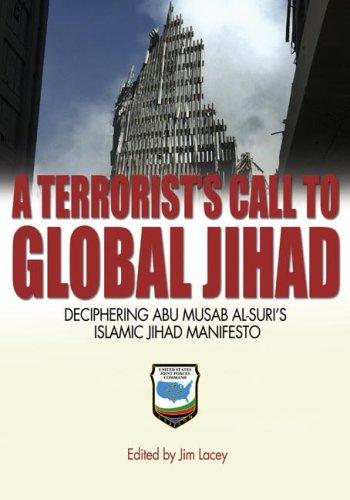
    Book Review: A Terrorist’s Call to Global Jihad

    Thursday, December 29th, 2011

    A Terrorist’s Call to Global Jihad: Deciphering Abu Musab al-Suri’s Islamic Jihad Manifesto by Jim Lacey (Ed.)

    Previously, I read and reviewed Brynjar Lia’s Architect of Global Jihad, about Islamist terrorist and strategist Abu Musab al-Suri. A sometime collaborator with Osama bin Laden and the AQ inner circle, a trainer of terrorists in military tactics in Afghanistan and an advocate of jihadi IO, al-Suri was one of the few minds produced by the radical Islamist movement who thought and wrote about conflict with the West on a strategic level. Before falling into the hands of Pakistani security and eventually, Syria, where al-Suri was wanted by the Assad regime, al-Suri produced a massive 1600 page tome on conducting a terror insurgency,  The Global Islamic Resistance Call, which al-Suri released on to the jihadi darknet.

    Jim Lacey has produced an English digest version of al-Suri’s influential magnum opus comprising approximately 10 % of the original  Arabic version, by focusing on the tactical and strategic subjects and excising the rhetorical/ritualistic redundancies common to Islamist discourse and the interminable theological disputation. There are advantages and disadvantages to this approach.

    First, Lacey has produced a concise and readable book from a large mass of sometimes convoluted and repetitive theorizing that al-Suri strung together piecemeal, sometimes on the run or in hiding. For those interested in getting to the heart of al-Suri’s nizam la tanzim strategic philosophy, A Terrorist’s Call to Global Jihad is an invaluable resource for strategists, counter-terrorism specialists, tactical operators,  law enforcement and laymen. Secondly, it is also a useful reference for policy people to see through al-Suri’s eyes the internal political and philosophical divisions within the radical jihadi community. al-Suri himself writes very ambivalently about 9/11 as a great blow against America and yet a complete calamity in it’s effects for the “jihadi current” that destroyed everything the Islamist revolutionaries had so painstakingly built, including the Taliban Emirate. Thus a climate was created by the American counter-attack where old methods of struggle were no longer useful and jihadis must adopt radically decentralized operations ( what John Robb terms Open-Source Warfare; indeed it is clear to an informed reader that al-Suri, a wide-ranging intellectual rather than a narrow religious ideologue, was influenced by Western literature on asymmetric warfare, 4GW, Three Block War  and COIN).

    The drawback to this approach is more for scholars looking at the deeper psychological and ideological drivers of jihadi policies, strategy and movement politics. The religious questions and obscure Quranic justifications cited by Islamist extremists that are so tedious and repetitive to the Western mind are to the jihadis themselves, of paramount importance in establishing both the credentials of the person making an argument but also the moral certainty of the course of action proposed. al-Suri himself had some exasperation with the degree to which primarily armchair ideologues, by virtue of clever religious rhetoric, could have more influence over the operational decisions of fighting jihadis than men with field experience like himself. By removing these citations, an important piece of the puzzle is missing.

    The Musab al-Suri whose voice appears in A Terrorist’s Call to Global Jihad is consistent with the one seen in Lia’s book, dry, sardonic, coldly hateful toward the West and highly critical of the jihadis own mistakes, laden with overtones of pessimism and gloom. al-Suri did not envision a quick victory over the West and wrote his manifesto as a legacy for future generations of Islamist radicals because the current one was nearly spent after the American onslaught and poorly educated in comparison with predecessors like the generation of Sayid Qutb.

    Strongly recommended.


    Switch to our mobile site