zenpundit.com » culture

Archive for the ‘culture’ Category

Guest Post: John R Hall: “Norway’s cultural Christian apocalyptic crusader?”

Monday, July 25th, 2011

Blog-friend John R. Hall is a Professor of Sociology at the University of California – Davis, and the author of such books as Gone from the Promised Land: Jonestown in American Cultural History; Apocalypse Observed: Religious Movements and Violence in North America, Europe, and Japan with Philip D. Schuyler and Sylvaine Trinh; and Apocalypse: From Antiquity to the Empire of Modernity. His current research involves deploying a social phenomenology to retheorize modernity in relation to contemporary society.

David Ronfeldt suggested that John’s long and detailed remarks taking off from my own post, 2083 Graphics – a first look, deserved to be a post in its own right and not be lost in the comments section, and with Zen’s approval, I am delighted to present it here as Dr Hall’s first Zenpundit guest-post. — Charles Cameron

___________________________________________________________________________________________

I have just completed a very preliminary examination of the Norwegian manifesto posted just before the Oslo bombings. It is an astonishing and significant document, far from the incoherent ravings of a mad person, as I would wish it to be. And it is incredibly chilling in its ruthless rationality and relative coherence. Here, I offer some initial reflections. I have concentrated on the portions from page 717 forward, where the author details ideology, revolutionary strategy, and utopian vision of a future, federated Europe. Beginning on p. 1388, the author offers an autobiography and c.v. of Breivik, which presumably will be checked out by investigators and the media, plus a quite detailed account of his actions over the past several years. A number of important comparisons already have been made – to al Qaida and the Oklahoma City bombing, for example. But in many ways, if the perpetrator indeed acted alone, he is something of a piece with the Unabomber, who similarly combined ruthless action with a carefully elaborated manifesto. There are important difference, to be sure. In particular, the Unabomber worked to conceal his identity so that he could carry out multiple actions, and he operated out of an environmental left ideology rather than a Christian nationalism.

The latter part of the document depicts its account of pre-emptive war as a new mode of writing, exploring scenarios rather than writing fiction or history, thereby claiming to eliminate its usefulness to authorities seeking to use it as evidence when bringing charges against the author or a perpetrator of the acts it describes.

As others already have commented, the label of ‘Christian fundamentalist’ seems wrong, at least in conventional use of the term today. Certainly the author represents himself as a nationalist/European federalist conservative opposed to ‘cultural genocide’ of the Enlightenment West, and seemingly he proposes reinstitution of monarchy as more representative of a nation than democracy can be. Only very late in the missive, p. 1134, does he embrace Europe’s return to the traditional Catholic Church, for its apostolic succession of authority and its capacity to guide believers in matters of scripture. This development is to be coupled with a re-initation of patriarchy, developed in substantial detail (p. 1141ff.), and concern about ‘the ongoing genocide of the Nordic tribes’ and a discussion of its genetic basis and the dangers of miscegenation and sexual promiscuity (including a discussion of ‘erotic capital,’ leading to a frank discussion of the possibility that the state could ‘play an essential role in national reproduction’ (p. 1157ff.; quote, p. 1185). The treatise goes on to mention future education, economic, pollution-control, population-control, crime, cultural/anti-multicultural, deportation, and youth policies, as well as discussing financing an organization, categories of traitors (A, B, and C). In short, it is a comprehensive (in Mannheim’s terms) ‘utopian’ vision, i.e., one that could never be realized in the world as it is presently institutionalized.

Yet there is certainly a basis for recognizing the claims of a ‘Christian’ basis for the ideology, and a religious fundamentalism as well. This latter claim, I make in relation to Martin Riesebrodt’s important comparative study of U.S. Protestantism at the dawn of the twentieth century and Iranian fundamentalism 70 years later or so – both of them strongly based in an ideology of patriarchy, as is the Oslo killer’s manifesto (A Pious Passion, U. California Press, 1993).

Yet this is not simply ideological quasi-religious fundamentalism/nationalism. Rather, the utopian program has all the markings of an apocalyptic crusader, and more generally, the apocalyptic warring sect that I described in Apocalypse (Polity, 2009). The lever by which the author makes contact with Christianity (beyond its status as the cultural basis of European civilization, is a modern-day ‘PCCTS, Knights Templar’ struggle to initiate a European ‘civil war’ against ‘enablers’ – cultural marxists and multiculturalists who are ‘aiding and abetting’ cultural genocide, most significantly in efforts to accommodate Islam within Europe. The challenge, as the author sees it, seems to be to eliminate Islamic migration to Europe, assimilate or force emigration of Muslims, and to excise all Islamist or Arab influenced culture, art, and architecture from European countries. The Knights Templar, described as an ‘ancient Christian European military order,’ is being re-founded not by Christians alone, but by 12 individuals, including a ‘Christian atheist’ and a ‘Christian agnostic.’ Eventually, p. 1309, the manifesto is clear that its appeal is to ‘cultural Christians,’ although it invokes the Bible and Church crusading history, especially the work of Bernard de Clairvaux, to justify the contemporary initiative. One of many elements is the crucial proposal to engage in asymmetric warfare – a vein that is classically that of the apocalyptic warring sect, using a ‘clandestine cell organization,’ combining the rhetoric of ultimate belief in a cause with the cold, rational logic of how to operate. In considerable detail, the manifesto outlines a mode of operations that foreshadows the actions in and near Oslo, including the chilling note, page 886, that it will take ‘the SWAT team 10 – 40 minutes to reach you,’ and therefore, it is worthwhile to divide up the components of a planned action accordingly.Similarly, the author mentions, p. 995, ‘announcing your operation’ ‘only seconds before you initiate’ it, and suggests, p. 927, ‘hide a knife behind a smile,’ a recommendation, along with subsequent ones, that foreshadows the killer’s use of a police uniform and a story about helping to ensure the safety of the island camp participants before beginning to slay them – a technique that he used twice, in different places on the island.

In a variety of passages, the document offers a detailed handbook of asymmetric operations of war, including attacks and sabotage, and evaluation of a variety of targets, accompanied by a detailed catalogue of equipment, weapons (including bombs made from fertilizer – see esp. p. 1015), and armor, where to buy materials, and how to create weapons, detailed discussions of chemical, biological assaults, and attacks on nuclear reactors, as well as dietary recommendations, and an outline of a training regimen, recommendations concerning alliances with certain criminal networks [a theme that reprises the analysis of Eric Hobsbawm that I cited several weeks ago].

The author also announces that the apprehension of a Knights Templar is not the end of the operation: it ‘will mark the initiation of the propaganda phase’ (p. 948), and afterward, the task will be one of ‘countering the misinformation campaign’ (p. 1073), and comments on the use of trial opening and concluding statements for propaganda purposes (p. 1108-14). Alternatively, if you die, you will live on as a martyr in the memory of those carrying on the cause.

The scope of the publication is almost encyclopedic. It also includes historical analysis of how the past millennium of European history lead to the present crisis and need for re-formation of the Knights Templar, as well as a sketch of the umbrella organization, membership, military uniforms for dress occasions, medals, appropriate tombstones, a proposal for subsequent compensation (upon victory) for people who contribute to the resistance movement (a sort of rational-choice approach to mobilizing supporters), and on and on.

In short, the document envisions apocalyptic war as the means to reach a new European conservative/nationalist/Christian utopia. Yet unlike many other visions of apocalyptic war, this manifesto goes far toward detailing what that utopian world would look like. Even if, as it seems, this action is that of a lone individual, it is a dangerous development that we ignore at our peril.

John Hall
2083 Graphics — a first look

Sunday, July 24th, 2011

[ by Charles Cameron — index of graphics, first 800 or so pages of the “2083 European Declaration of Independence”, with some analysis ]

.

A great deal of work needs to be done on the 2083 European Declaration of Independence, and I thought a useful place to start would be a catalog of images.

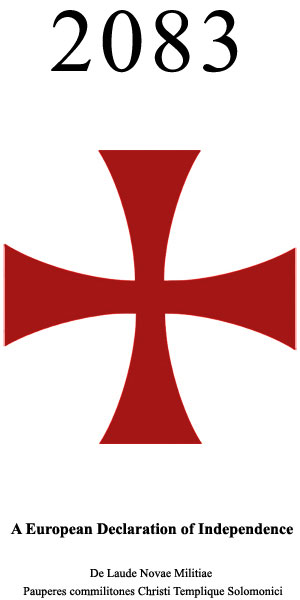
The document opens with a graphical title:

000-2083-cross-tp.jpg — title page —

That’s probably the largest single graphic in the entire work, and it puts the work squarely in the context of the Knights Templar — with e Templar cross and the full name of the order, “Pauperes commilitones Christi Templique Solomonic” or Poor Fellow-Soldiers of Christ and of the Temple of Solomon.  The Templars were a Western Christian chivalric order strongly associated with the Crusades — and the topic more recently of much historical, occult and fictional speculation.

The date 2083 is a date SFE (in the Science Fictional Era) as was 1984 before it — but it was almost certainly chosen for its echo of the 1683 Battle of Vienna, which is commonly taken to represent the turning back of the Ottomans by the Habsburgs, and thus the victory of Christendom over Islam.  Two maps show the Umayyad Conquests:

umayyad-conquests-p-228.jpg — p 228 —

and the Second Islamic Wave, turned back in Spain and at the gates of Vienna:

243-1683-second-islamic-wave-p-243.jpg — p 243 —

These can fruitfully be contrasted with a map of “tomorrow”:

demain-p-487.jpg — p 487 —

it being the author’s contention that France will be the first European country to fall to Islamic dhimmitude.  I suspect much the same is implied in this version of the French tricolore:

flag-face-p-781.jpg — p 781 —

There are some pointed attacks on leftist intellectuals:

033-academic-reform-p-33.jpg — p 33 —

and on media perceived as left-leaning, notably the BBC:

bbc-flag-w-crescent-p-384.jpg  — p 384

— that’s the Saudi flag mashed up with the BBC logo and star and crescent — and:

804-bbc-02-p-804.jpg  — p 804 —

giving both “ancient” and “modern” variants on the theme…

There are some strange items which I’ll drop in here for a breath of fresh air…

free-pluto-equal-gravity-for-all-planets-p-381.jpg  — p 381 —

which appears to be a commentary on the respective attractions of Venus and Mars, since it’s situated in a commentary on Feminism…

this really is a strangely mythic document… and…

global-warming-voidka-p-657.jpg

with its reference to “mind control agents” — and those whose minds have been controlled are clearly sheep:

wake-up-p-803.jpg — p 803 —

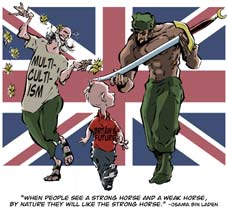
which may be the right moment to mention that the British, too, come in for a measure of contempt, via a quotation from none other than Osama bin Laden:

when-people-see-a-strong-horse-p-707.jpg  — p 707 —

“When people see a strong horse and a weak horse, by nature they will like the strong horse”.  Perhaps its unsurprising that the author is something of an admirer of bin Laden’s means, if not his ends.

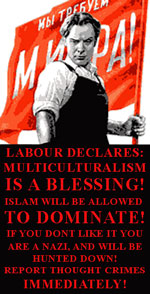
Of course, that’s largely the fault of the Labour party:

labour-declares-multiculturalism-is-a-blessing-p-373.jpg

But that’s probably enough for one post — in my next, I’ll consider how weak we are, what the jihadist strategy against us is, and how the new Templars hope to turn the tide

against:

worst-threats-to-mankind-p-674.jpg — p 674 —

the worst threats to mankind.

A Culture of Punitive Raiding

Saturday, July 9th, 2011


Robert Haddick agrees with me, albeit with greater eloquence and length ( hat tip to Colonel Dave).

From SWJ Blog:

This Week at War: Rumsfeld’s Revenge

….Rumsfeld’s and Schoomaker’s redesign of the Army into a lighter, more mobile, and more expeditionary force seems permanent. Gone is the Cold War and Desert Storm concept of the long buildup of armor as prelude to a massive decisive battle. Instead, globally mobile brigade combat teams will provide deterrence, respond to crises, and sustain expeditionary campaigns. Gen. Martin Dempsey, the current Army chief of staff (and soon to be chairman of the Joint Chiefs of Staff) recently described a sustainable brigade rotation system, an expeditionary adaptation that the Navy and Marine Corps have employed for decades. In addition, both the Army and Marine Corps have drawn up plans to shrink their headcounts back near the Rumsfeld-era levels. Rumsfeld’s concerns about personnel costs sapping modernization are now coming to pass.

There now seems to be a near-consensus inside Washington that the large open-ended ground campaigns that Rumsfeld resisted are no longer sustainable. The former defense secretary’s preference for special operations forces, air power, networked intelligence, and indigenous allies is now back in vogue. Even Gen. David Petraeus, who burnished his reputation by reversing Rumsfeld’s policies in Iraq, will now implement Rumsfeld’s doctrine in eastern Afghanistan. According to the New York Times, the U.S. will counter the deteriorating situation there not by shifting in conventional ground troops for pacification, but with “more special forces, intelligence, surveillance, air power … [and] substantially more Afghan boots on the ground.”

While we agree that this is “Rumsfeld’s revenge”, unlike Haddick, I would not choose “doctrine” to describe it. This is really about a “Community of Operators” across services , agencies and their White House superiors adopting a culture of punitive raiding for at least the medium term. A doctrine might come along later but there are downsides to institutionalizing punitive raiding that have already been very well expressed by others (see comments section at SWJ). I’d prefer punitive raiding remain a flexible tool rather than a reflexive response ( it might help if we created a “Community of Thinkers” before we get too comfortable as an international flying squad).

At this point, I will stop and recommend a fine piece by Adam Elkus on the subject of punitive raiding, From Roman Legions to Navy SEALs: Military Raiding and its Discontents. A good primer on the history, implications and drawbacks.

Why is this happening?  Economics and the subsequent electoral politics of a finance-sector driven global depression. The same thing that brought COIN to an end and then finally killed it as an operationally oriented policy.

Punitive raiding is relatively cheaper. It permits defense cuts in the size of the Army and Marine Corps that are badly desired by the administration and Congress. It preserves and justifies investments in naval and air striking power that will bring joy to the Lexington Institute and satisfy many MoC concerned about defense jobs for constituents. On a point of genuine importance, this also hedges against near peer competitors (ahem…cough…China).

Is it a done deal? Unless the economy roars back, yes.

ADDENDUM:

Check out these two directly related posts by Pundita and Joseph Fouche:

America’s Light Footprint Era (Revised) 

Unhappy Medium: The Perils of Annoyance as Your Strategic Default

A Library vs. a Collection

Thursday, June 30th, 2011

Recall the “antilibrary ” discussion some years back, prompted by Nassim Nicholas Taleb?

The other day, I was having a conversation in the comments section regarding ancient Chinese philosophers with my learned friend Lexington Green, when I had cause to quote Nassim Nicholas Taleb, from his most recent book The Black Swan: The Impact of the Highly Improbable:

The writer Umberto Eco belongs to that small class of scholars who are encyclopedic, insightful, and nondull. he is the owner of a large personal library ( containing thirty thousand books), and separates vistors into two categories: those who react with ‘Wow! Signore professore dottore Eco, what a library you have! How many of these books have you read?’ and others – a very small minority- who get the point that a private library is not an ego boosting appendage but a research tool. Read books are far less valuable than unread ones. The library should contain as much of what you do not know as your financial means, mortgage rates, and the currently tight real estate market allow you to put there. You wil accumulate more knowledge and more books as you grow older, and the growig number of unread books on the shelves will look at you menacingly. Indeed, the more you know, the larger the rows of unread books. Let us call the collection of unread books an antilibrary.

A passage that immediately made me feel better about having resigned myself to falling further and further behind in reading the books that I keep purchasing ( I’m now also periodically finding myself going to IKEA to buy shelf extensions. I’ve resigned myself to that too).

Taleb was advocating building a library – an organized assemblage of books on a wide range of topics, of which the unread portion was your antilibrary. Libraries, private or public, are wonderful things, functioning in an earlier time as the poor man’s university. Andrew Carnegie endowed public libraries for that purpose and in past ages, wealthy patrons opened the doors of their private libraries to their favored scholars, like King George III did for Samuel Johnson.

My library is sizable but disorderly and eclectic. There are books on Turkic kingdoms and network theory, art history and classical economics, political memoirs and diplomatic papers, the “great books” and sci fi. And of course a great deal of books on strategy and history. My friends Lexington Green and Dave Schuler have far larger personal libraries and Lex’s, I can say firsthand, seems to be much better organized than mine ( though, admittedly, that would not be hard).

Recently, one of my uncles, an academic, decided he wanted to make me the eventual recipient of a major portion of his library, along with the funds to transport and shelve the books. This generous offer came with a proviso – that his collection is to be kept intact and passeed on only to someone else who would agree to keep it so. And it is really a collection and not a library. Naturally, I agreed

The difference between a library and a collection is puposeful focus and quality. My uncle decided on the advice of one of his mentors to really become a collector and decided to target the Hanoverian period of British history and only read and collect books that related directly in some way to the book previously read. He also specifically wanted to acquire rare editions and copies with the marginalia of important people from the period for purchase. My uncle also made a habit of going to the best rare and used bookstores (when he visits Illinois, Bookman’s Alley is his faviorite) wherever he happened to be. The uncle has been doing this for at least thirty+ years and has read his way forward to the early 20th century and in recent years, developed an extensive sub-collection dedicated to T.E. Lawrence.

Interestingly enough, none of this has anything remotely to do with his area of academic expertise (he has two doctorates; in a hard science and another in a medical specialty) but he’s made himself into more of an expert on the historiography of this period of British history than are most professional historians.The reason is a tunnel-like focus, which is the primary distinguishing characteristic between a building a general library and building a collection. There’s a comprehensiveness to a collection that becomes an end in itself.

books.jpg

Sacred Things

Thursday, June 23rd, 2011

[ post  by William Benzon cross-posted from his New Savanna blog with Intro by Charles Cameron — nature, arts, the sacred ]

.

Intro

.

This strange category, the sacred, strikes me as important because it intensifies.

It gives rise to beauty, terror, repulsion, love.  It empowers whatever vision, ideology, mission, crusade, jihad, movement, or tendency it touches.  And our society has in some ways lost touch with it so completely that we think it is found in the outward forms of piety, and miss its secular manifestations, its manifestation in religions other than our own, and most significantly and disastrously the groundswell of feeling it gives rise to in unexpected places.

It is a haven for many in an unlovely or uncertain world, a dwelling-place for saints, idealists, artists and — who knows? — perhaps the mad. And it catches us up when we least expect it — when the lights go down low in a cinema or at the opera, the curtain parts, and we enter another world whose rules are not our own.

We need to understand this.

.

In my post on Sacred space and the imagination, I tried to give a feel for the sacred without focusing on places of official worship, where it may be so expected as to be missed elsewhere, and I headed that post “no mil/intel stuff” because “this blog is dedicated to exploring the intersections of foreign policy, history, military theory, national security,strategic thinking, futurism, cognition and a number of other esoteric pursuits” — and my post clearly fell under the “other esoteric pursuits” part of the rubric.

But pattern pervades all, and the arts are prime sources for an understanding, a grasp, an accurate intuition of patterns in general. So we are not so far from strategy after all…

William Benzon responded to that post of mine, which he’d cross-posted on his own blog, with a post of his own, which I am cross-posting here. By way of introducing Benzon himself, then —

Benzon is a scientist (he led the information systems group at NASA in 1981, developing strategic recommendations about NASA-wide computer use and acquisition, and in conjunction with David G. Hays, published a series of articles in the Journal of Social and Evolutionary Systems covering the development of cognition in the brain from primitive vertebrates through primates and in human culture from the preliterate world through the development of computing) with wide cross-disciplinary interests (he’s played concerts with the likes of Dizzy Gillespie and B.B. King), either the first or one of the very first independent scholars invited by the National Humanities Center to lead off a topic of his choice on their blog, the author of a brilliant book on music and the brain, Beethoven’s Anvil: Music In Mind And Culture, and my friend.

Here, then, is his response to my post. Take it away, Bill…
.

Sacred Things

.

IMGP0005rd

… that still roaring dell, of which I told;
The roaring dell, o’erwooded, narrow, deep,
And only speckled by the mid-day sun;
Where its slim trunk the ash from rock to rock
Flings arching like a bridge;–that branchless ash,
Unsunn’d and damp, whose few poor yellow leaves
Ne’er tremble in the gale, yet tremble still,
Fann’d by the water-fall! and there my friends
Behold the dark green file of long lank weeds,
That all at once (a most fantastic sight!)
Still nod and drip beneath the dripping edge
Of the blue clay-stone.

— Coleridge, This Lime-Tree Bower My Prison

This post began, I suppose, when, upon reading Charles Cameron’s post, Sacred space and the imagination, the “graffiti!” light went off in my brain. Not just any graffiti light, but this one:

westward ho.jpg

Well, not that exact one, but it was a photograph of that same arch, a different photograph. This one shows the graffiti a little more clearly, but it’s not the same graffiti, as graffiti often changes over time, in some places more rapidly than others.

If you look back over Cameron’s images, you’ll see that it’s of a piece with them. And I’ve got dozens of photos of that arch: different times of the day, different seasons, different years, different graffiti, different angles. And that’s not all.

Graffiti and the sacred is a natural, one that hadn’t quite hit me full-on until I’d read Cameron’s post. You see, my first post about graffiti (the images, alas, are gone) was about this piece, which I called the Shrine of the Triceratops:

dino_train_872

It’s not that I believe, mind you, that there’s a triceratops cult in Jersey City and that this is where they meet. Nothing like that. Rather, that that image seemed to embody of the spirit of the place, the Japanese word is kami. (That triceratops is now gone. First, eroded by the weather, then other writers went over it.)

I could go on and on about graffiti, but I won’t, because this post isn’t just about graffiti. But I’ll leave you with one last graffiti thought. Graffiti is often likened to cave art. Well, cave art, some of it, perhaps all of it, is sacred art. Not mere pictures, but spirits bodied forth on walls.

*

And then there’s my current film project, Apocalypse Now. And that is deeply intertwined with the sacred. Not that it presents itself as a sacred story, nothing so straight-forward, but that it deals with ultimate things in a secular way.

Ultimate things in a secular way! – now there’s a fine kettle of fish for you. Just what does that mean? I suppose, for example, that that physicist’s dream, the grand unified theory, is a secular run on ultimate things. But is that secular the same secular as is appropriate to Appocalypse Now? I think not. Are we then confronted with the varieties of secular experience, mingling next to the varieties of religious experience? And where’s the boundary?

But, no, the film doesn’t present itself as religious in the way that Tree of Life presents itself as religious. But the caribao sacrifice at the end, that’s a real sacred ritual, not an enactment. Coppola shot the real thing, not that you’d know that from watching the film, though you could see that the caribao was really hacked to death. And the final third of the film takes place in a liminal no man’s land. It’s sacred territory, for some (nontrivial) meaning of sacred.

Anyhow, it looks like I’m going to argue that Apocalypse Now is an ontological text. That it is about the moral structure of the world rather than conveying this or that moral (or immoral) action. It’s about how things are through the ends of time, not about how this or that person gets from here to there.

*

And that certainly seems to be what’s going on in Malick’s very different The Tree of Life. We have the trials of the O’Brian family, daddy’s something of a dick, though a music-loving dick, mommy’s kind but a flake, and one kid dies – whether by suicide or not, that’s not clear from the film itself (I’ve seen it only once — shouldn’t have to see it more than once on such a plot point). But god’s creation is magnificent. As if that had anything to do with the O’Brian’s afflictions. Well, it does. It doesn’t.

In any event, it seems that this film, that as a film must unfold in time, minute by minute by (often tedious) minute, blasts time to smithereens. It opens with a verse from Job and then a flickering shimmering light that’s supposed to be, I guess, a Supreme Something Or Other in the Universe, but isn’t this dew-flecked dandelion more elegant?

dandilion

And then, I think, some story in the more or less present. Yes, that’s it, she gets the telegram. The news is not good, not good at all. Things fall apart. A plane. At the airport. And somewhere in there not too far into the film we get this sequence in which the world and all the life in it gets created, ending with some dinosaur killing some other dinosaur. Live action and CGI special fx. Wonderful imagery. Wonderful.

And slices of that imagery get cut into the rest of the film as life goes on, backwards and forwards. It’s as though the world didn’t get created by once, but always and ever, created and recreated, recreating.

*

And behind it all there’s Uncle Walt. Uncle Walt’s the first one who gave us a vision of the creation of the world, a cinematic vision that is, one we can see with our own eyes and hear with our own ears. All in less than half an hour. And it’s got dinosaurs!

I’m talking, of course, of “The Rite of Spring” episode in Disney’s Fantasia. He got the science wrong, even then they knew that the T. Rex and the Stegosaurus never co-existed, but he showed us the whole solar system, and seismic activity, and crashing dashing oceans, then life originating in the ocean, coming on land. And dinosaurs!

pterodactyl.jpg

Disney’s the one who had the genius to visualize THE WHOLE THING. We who’ve grown up in the shadow of Disney now take it for granted that such things are seeable, but Disney was there first. If Disney hadn’t done it, Malick would have had to figure it out from scratch. As it is, Disney’s imagery has so permeated the culture than one can do (and see) a film like Tree of Life without once thinking of Fantasia.

In fact, the cultural coding against cartoons is so deep that I hesitate ever so little to put Fantasia in the same paragraph with Tree of Life. How could these films possibly have anything in common much less be the same thing: entertainment. Yikes! I mean, Tree of Life is so freakin’ serious. And Fantasia is so, well, gorgeous, and rather annoyingly cutesy at times.

And it ends in a forest glade:

ave maria

The music is a rather fruity arrangement of Schubert’s Ave Maria. The motion: slow, stately, rigorous, restrained, austere.

— Bill Benzon.


Switch to our mobile site