zenpundit.com » academia

Archive for the ‘academia’ Category

An Iridology of the Sciences?

Tuesday, January 4th, 2011

[ by Charles Cameron ]

I for one am delighted to know that we can now play around with the iridology of the sciences, using the software available on the Science-Metrix Ontology Explorer site to view which fields have journals which cross-link to journals in other fields…
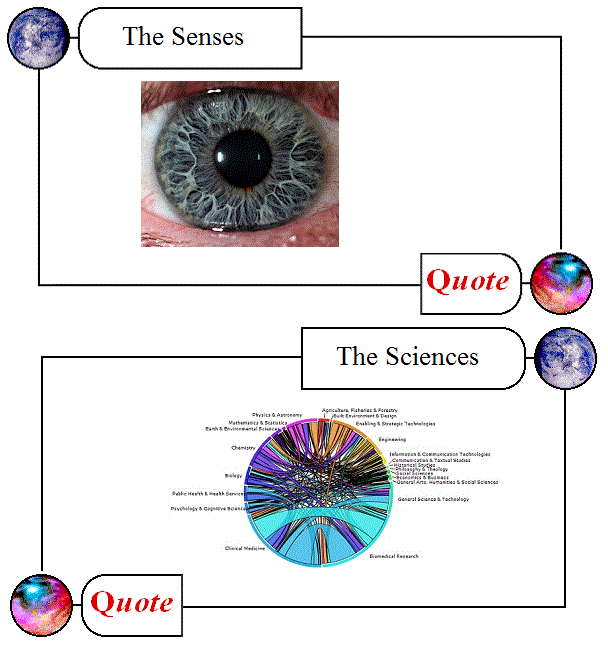
Seriously — that lower image is of the Field Citation Wheel that you can find, suitably enlarged for easy viewing, on that site.

*

And it’s heartening for me to know, for instance — taking a closer look at the segment of that image that’s roughly east north-east — that scientific journals do have some links on their pages to works of theology or philosophy:


Engineering
, you’ll notice, has more links than history, philosophy, theology, the social sciences (even counting them twice), economics, business, the arts and humanities combined.

My own field, theology, has to share its thin segment with philosophy, and you can guess how small the number of links to articles on Islamic apocalyptic probably are…

Which is, in part, why I wonder whether a project like the ETH’s Living Earth Simulator will really manage to map such things as, well, a possible outbreak of global jihadist Mahdism and its consequences.

*

But then I look at another gorgeous graphic from the same source, focusing in on a part of the network of knowledge that interests me, and I can just faintly make out, lower left, entirely isolated, the field of music

What splendid isolation! That’s all of Bach, mind you – and all the Beatles, too.

*

Seriously, though:

  • It’s fascinating to be able to see how the various branches of knowledge cross-reference each other.
  • Visual data representation is a gorgeous, fantastic, field.
  • Mapping the all-of-everything is an irresistable lure for keen minds
  • I’m betting the humanities will prove to be at least as good at it as the sciences.
  • And I recall, not without a pang of regret, the time when my beloved Theology was Queen of the Sciences, and one might converse with Abelard on the streets of Paris…

Best Book of 2010 ( that I read)

Monday, January 3rd, 2011

Saw a number of interesting posts on this “best book”  theme, starting with Cameron Schaefer and Lexington Green and Cameron challenged me to make a comment in this regard.

I am reading two excellent books right now, The Human Face of War by Col. Jim Storr and The Grand Strategy of the Byzantine Empire by Edward Luttwak, but as these are unfinished, they are out of the running. So are any books that are fiction, as I am poorly qualified to evaluate books purely upon their literary merit alone. I leave that to the English majors.

As my criteria for “best” will be the book with “most profound idea” then….the winner is…..The Collapse of Complex Societies by Joseph Tainter. As I wrote recently:

A superb academic book, previously featured and reviewed in the blogosphere by John Robb and Joseph Fouche, The Collapse of Complex Societies embarks upon a critical examination and partial de-bunking of theories that purport to explain the “sudden” fall of great empires, such as Rome or the vanishing of the Mayans. With caveats, Tainter settles on declining marginal returns from increasing societal investment in complexity as a rough proximate cause capable of subsuming a ” significant range of human behavior, and a number of social theories” under it’s rubric. Highly recommended.

What was your favorite book?

Ancient Days….

Wednesday, December 29th, 2010

Took the children, who had a fistful of gift cards, to Barnes & Noble’s yesterday and picked up a couple of books for myself:


The Spartacus War by Barry Stauss

Marcus Aurelius: A Life by Frank McLynn

The legendary slave rebellion of Spartacus has yielded a relatively thin book by Strauss but it is an opportunity for me to get a fresh interpretation of “Roman COIN” (as if Caesar were not clear enough about how Romans dealt with insurgency in his Commentaries). Marcus Aurelius too has acheived almost mythic status, the stoic philosopher-Emperor who is the gold standard to whom other rulers are compared, and frequently found wanting.

Not sure when I will get to these…into the antilibrary pile they go 🙂

Analogy as the Core of Cognition

Tuesday, December 28th, 2010

Now Reading Luttwak

Thursday, December 23rd, 2010

The Grand Strategy of the Byzantine Empire by Edward Luttwak

Just starting reading this magnum opus by eminent strategist Edward Luttwak and I am thoroughly enjoying it; particularly, the context-building historical digressions that enrich the text.  Highly recommended.


Switch to our mobile site