zenpundit.com » philosophy

Archive for the ‘philosophy’ Category

A difficulty with DoubleQuotes 2: Benzon

Sunday, August 9th, 2015

[ by Charles Cameron — following on from the AI dog / ostrich, this ]
.

No sooner had I posted my piece on the similarities and diffrerences between two humanly similar images — one of them identified as a dog by a neural net, the other as an ostrich — that I came across my friend Bill Benzon‘s piece, also posted today, Visual Resonance, in which he plays with Photoshop filters and a couple of his own images.

Synchronicity? Zeitgeist? GMTA?

**

Here is one of Bill’s photos, which he claims “no sensible photographer would shoot”..

Benzon 1

As Bill says:

The setting sun is low in the sky and reflecting strongly off a glass encased building, so strongly that the camera really can’t deal with it. Also, I’m shooting through the branches of a small tree or bush nearby and they show up as a mis-shaped dark area in the left half of the shot. I like to take such shots to see what I can pull out of them.

Here’s a second version, this one tweaked with a filter..

Benzon 2

Frosted?

I think there’s a fairly peasily perceptible family resemblance there, no?

**

But then we come to this one..

Benzon 3

in which a different filter has been applied to the same image..

To my eye. this is very different from the original — almost pure jazz in fact, and yes, Billplays jazz trumpet — though the palette “seems the same”..

And then there’s this..

Benzon 4

.. which seems to me discernibly similar to both the previous and the original images, and in fact consists, if I’m reading Bill right, of an overlay of the two of them.

**

All this leads me to tentatively revise my formulation that “likeness and unlikeness appear to me to find themselves on a spectrum which approximates closely to identity at one end .. and absolute distinction at the other“, renaming my spectrum “same-same, same-diff, diff-same, diff-diff“.

**

Sameness and Difference, One and Two, Three in One and One in Three — as the writer I referenced anonymously towards the end of my previous post said:

Even angels and the spirits of men were matter by Greek thinking. In a sense, there are only two substances in the universe. One is God — whatever the substance is that constitutes God — and the other is matter. Athenagoras, a Christian apologist writing in A.D. 168, tells us:

We employ language that makes a distinction between God and matter and the natures of both.

The question being asked at the Council of Nicea was …

  • Is Christ of the substance of God, or
  • is he made of matter like us and the angels?
  • Sameness and Difference, One and Two — we’re back in the heart of the Presocratics, of Pythagorean mathematics, of the Tao — the One and the Many.

    One Another.

    The paradox of the Repugnant Conclusion & more

    Saturday, August 8th, 2015

    [ by Charles Cameron — two data points, one impoverished, one rich — and a redemptive (maybe) quote from Twiggy ]
    .

    SPEC DQ The Repugnant Conclusion

    **

    As I quoted in my recent post Not everything that counts can be counted, “Effective altruism is based on a very simple idea: we should do the most good we can” — which in turn suggests that “good” can be quantified, an idea I resist.

    The Stanford Encyclopedia of Philosophy article The Repugnant Conclusion, from which I drew the Parfit quote [upper panel, above], doesn’t mention Wittgenstein , though I suspect his view that we cannot sum individual sufferings to a grand total would suggest a similarposition with regard to the summation of individual happinesses..

    And as I’ve pointed out before, both CS Lewis and Arne Naess agree with Wittgenstein on this point.

    **

    Walker Percy, Ludwig Wittngenstiein and Clive Staples Lewis all being Christians, it seems appropriate to recall here the tale of Mary and Martha from the New Testament, Luke 10:38-42 —

    Now it came to pass, as they went, that he entered into a certain village: and a certain woman named Martha received him into her house. And she had a sister called Mary, which also sat at Jesus’ feet, and heard his word. But Martha was cumbered about much serving, and came to him, and said, Lord, dost thou not care that my sister hath left me to serve alone? bid her therefore that she help me. And Jesus answered and said unto her, Martha, Martha, thou art careful and troubled about many things: But one thing is needful: and Mary hath chosen that good part, which shall not be taken away from her.

    I somewhat cavalierly refer to this story on occasion as the story of Mary Qualit and Martha Quant. Eh. Mary Quant, you may recall if you’re as old as I am, gave us the mini-skirt, the Dashing Daisy doll, and Twiggy .

    **

    The quote from Walker Percy’s second novel [lower panel, above] nicely illustrates high level abstraction, as we instantly see when we compare it with the personal insight (from the same novel) on which it is based [lower panel, below]:

    SPEC DQ Walker Percy x 2

    The first is philosophy, the second — if you’ll pardon my saying so — is humanity.

    Literature. Art.

    **

    All of which ties in neatly with a conversation I was having on Facebook with my long-time friend the game designer Mike Sellers. And in all of which, I am trying not to forget the heart’s reasons of which Pascal famously wrote —

    The heart has reasons Reason knows not of

    — because we need them in our gaming, in our analysis, and our understanding of what Mike Sellers describes as our world that is “far more interconnected and interactive than ever before.”:

    **

    Sources:

  • Julia Galef, The Repugnant Conclusion (a philosophy paradox)
  • Walter Isaacson, Walker Percy’s Theory of Hurricanes
  • **

    Hey, Twiggy — sweet — gets the main point:

    twiggy quote

    Multiculturalism in play?

    Wednesday, July 22nd, 2015

    [ by Charles Cameron — multiculturalism in play — or, what’s the name of the game? ]
    .

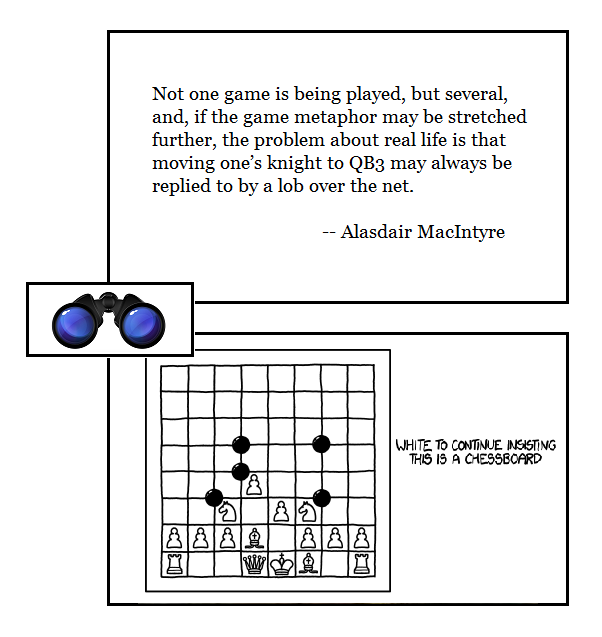
    It is getting to be quite a theme: When games collide.

    SPEC DQ MacIntyre xkcd

    I’ve used the MacIntyre quote before [1, 2, 3], but the wonderful xkcd visual presentation is new to me — many thanks to Tanner Greer for turning me onto it.

    **

    What’s the name of the game?

    Nomic?

    Not everything that counts can be counted

    Monday, July 20th, 2015

    [ by Charles Cameron — not Einstein but a fellow Cameron gave me my title ]
    .

    I’ll admit I was uneasy when I read about the “effective altruism” movement in Peter Singer‘s Boston Review piece, The Logic of Effective Altruism, but I didn’t quite see how to phrase my unease. Here’s Singer’s explanation of the concept:

    Effective altruism is based on a very simple idea: we should do the most good we can. Obeying the usual rules about not stealing, cheating, hurting, and killing is not enough, or at least not enough for those of us who have the good fortune to live in material comfort, who can feed, house, and clothe ourselves and our families and still have money or time to spare. Living a minimally acceptable ethical life involves using a substantial part of our spare resources to make the world a better place. Living a fully ethical life involves doing the most good we can.

    That’s the gist, but there’s a lot of what I can only term “moral cost-effectiveness” in there, as though goodness were a problem in engineering.

    Today I read Michael J. Lewis‘s Commentary piece, How Art Became Irrelevant, and think I found the “why” of my unease, in the writer’s description of the German idea (“ideal”) of an architectural Existenzminimum:

    This was the notion that in the design of housing, one must first precisely calculate the absolute minimum of necessary space (the acceptable clearance between sink and stove, between bed and dresser, etc.), derive a floor plan from those calculations, and then build as many units as possible. One could not add a single inch of grace room, for once that inch was multiplied through a thousand apartments, a family would be deprived of a decent dwelling. So went the moral logic.

    **

  • Not everything that can be counted counts, and not everything that counts can be counted.
  • The heart has reasons Reason knows not of.
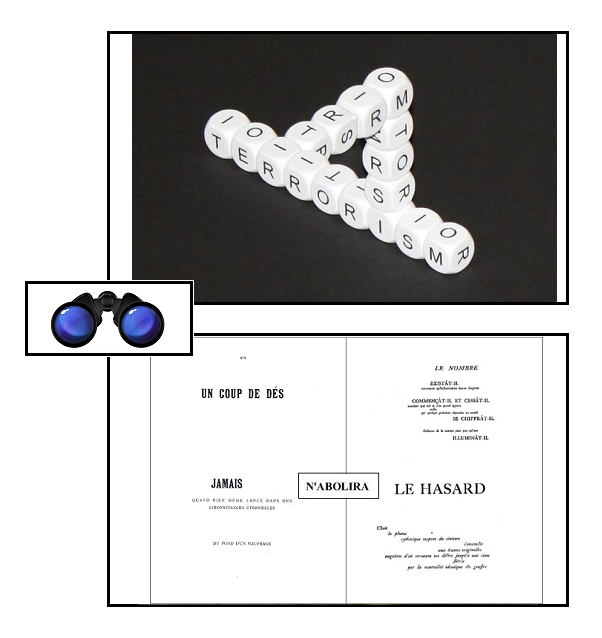
  • Terrorism, a ‘Pataphysical “definition”

    Thursday, June 25th, 2015

    [ by Charles Cameron — Escher, Mallarmé, Jarry, Macdonald, and Alex Schmid ]
    .

    SPEC DQ terrorism the 'pataphysical proof

    Sources:

  • Stuart Macdonald, entry in “Defining terrorism: an impossible puzzle” contest
  • Stéphane Mallarmé, Un Coup de Dés Jamais N’Abolira Le Hasard
  • The DoubleQuote format is mine own
  • Further refs:

  • Alex Schmid, The Revised Academic Consensus Definition of Terrorism
  • Alfred Jarry, Exploits and Opinions of Dr Faustroll Pataphysician

  • Switch to our mobile site