zenpundit.com » philosophy

Archive for the ‘philosophy’ Category

Across the great divide

Friday, April 8th, 2016

[ by Charles Cameron — philosophy during a bank heist — and its implications in terms of military doctrine ]
.

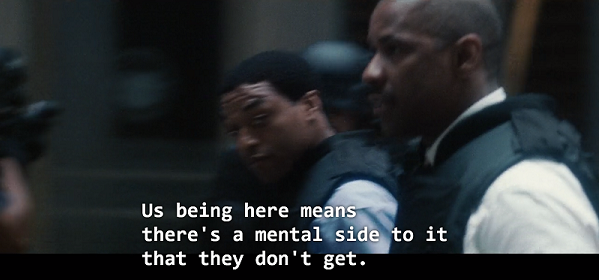
tactical

mental

Two screenshots in sequence from the Denzel Washington movie, Inside Man, bring me back to the philosophical fissures and fusions between mind and brain, subjective and objective, quantitative and qualitative, man half-angel and half-beast — in a law enforcement context.

**

When one side has reached the limits of its material strength, it can always add to its military efforts by mobilizing all possible moral strength.

I often need to talk about this. As material, for Clausewitz, is the counterpart to moral, what for TRADOC is the counterpart to Human Terrain?

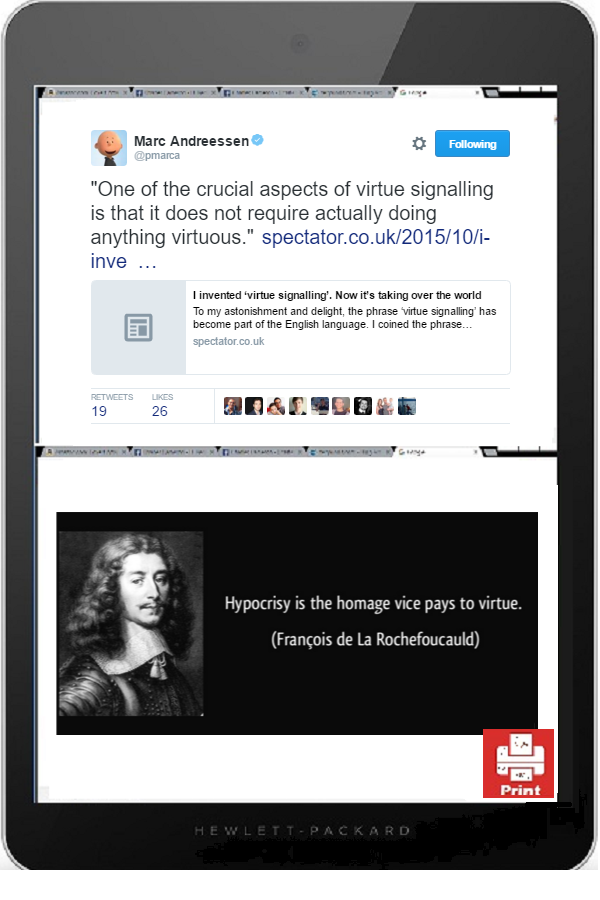
Vice, virtue & versa

Sunday, March 27th, 2016

[ by Charles Cameron — a pmarca tweet, a ducal quote DoubleQuoted ]
.

tablet dq andreessen rochefoucauld

Terror Is Glamour as War is Game

Friday, March 18th, 2016

[ by Charles Cameron — on the necessary simultaneity of temporal and eternal perspectives ]
.
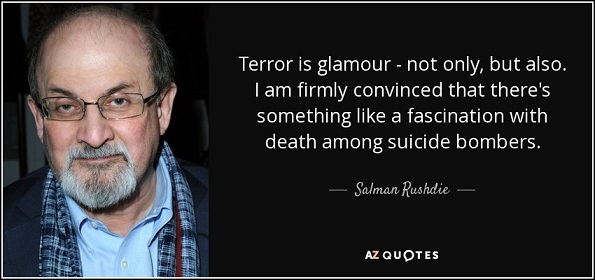
quote-terror-is-glamour-salman-rushdie

**

First as to glamour -– it may help to reflect that glamour, our word, comes not from Vogue but from the same origins as grammar (referring to languages) and grimoire (a book of spells, spelling also being a matter of language), and means something along the lines of “luminous illusion”. If we say terror is glamour, then, we mean that it “casts a spell” — and thus creates an appealing, indeed compelling, mirage. It lies, then, in the realm of magic, image, imagination, so ably delineated by Ioan Couliano in his great book, Eros and Magic in the Renaissance.

The best of contemporary advertising draws on precisely the same Renaissance principles of persuasion — principles of extraordinary power which we nowadays tend to dismiss as “magical thinking”.

**

Thus Virginia Postrel, in Terror Is Glamour:

Glamour can sell religious devotion or military glory as surely as it can pitch lipstick or island vacations. All promise a way to transcend our everyday circumstances, to experience more and become better than ordinary life allows. All invite us to imagine escape and transformation.

Postrel continues:

From Achilles and Alexander to “national greatness,” the glamour of battle is remarkably persistent. So is the glamour of martyrdom, as any trip through a Western museum or perusal of a Lives of the Saints (or its Protestant equivalent) will demonstrate. Nor is martyrdom’s appeal to Christians merely historical, as Eliza Griswold reported in this 2007 TNR piece.

Glamour appeals to our desires, whatever they may be, and Jihadi glamour offers something for everyone: from historical importance to union with God, not to mention riches and beautiful women.

Postrel then quotes Egyptian cleric Hazem Sallah Abu Isma’il, indicating that the “beautiful women” in question are “black-eyed virgins” from a world conceptually above our own:

If one of these virgins were to descend to this world, her light would extinguish the light of the sun and the moon. That’s how beautiful she is.

Yet as Postrel comments, “glamour proves perishable”:

As Rushdie suggests, of course, glamour always leaves something out, in this case the literally gory details of the act .. Either aspirations change, entropy and boredom set in, or the audience learns too much, destroying the mystery and grace on which glamour’s beautiful illusion depends.

She concludes with a significant question and preliminary response:

How do we puncture the glamour of Jihadi terrorism? The first step is recognizing that such glamour exists.

That may seem like CVE 101, but the deeper our understanding of magic, imagination, image — and hence the power of glamour — the deeper our understanding of the deep problem that CVE presents will become.

**

Next we turn to Richard Fernandez, writing in A Bellyful of War, picking up the themes of war’s attraction, and the carnage its glamour omits from mention, and tying both to the notions of war as game and war as brutal reality:

William Tecumseh Sherman understood what many modern theorists have forgotten: war can be attractive to young men for as long as long as it remains a game. War in small doses is supremely thrilling, even glamorous. It is peace which can be routine and boring.

And so it goes until war stops being a game and the going gets really rough. “Its glory is all moonshine,” said Sherman. “It is only those who have never heard a shot, never heard the shriek and groans of the wounded and lacerated … that cry aloud for more blood, more vengeance, more desolation.” To Sherman a “bellyful of war” was ironically the psychological foundation of generational peace.

Not only is that last sentence a profound statement worthy of the contemplation of all who love peace – it is also far more subtly convincing than the old Strategic Air Command motto, Peace is Our Profession, which sounds more like one of Rochefoucauld’s tributes that vice pays to virtue than anything, and yet is presumably intended to convey the same insight.

**

Finally we have Plotinus, for whom – in a manner richly echoed by Shakespeare — life itself is a dream, a play, a sport, a game:

Murders, death in all its guises, the reduction and sacking of cities, all must be to us just such a spectacle as the changing scenes of a play; all is but the varied incident of a plot, costume on and off, acted grief and lament. For on earth, in all the succession of life, it is not the Soul within but the Shadow outside of the authentic man, that grieves and complains and acts out the plot on this world stage which men have dotted with stages of their own constructing. All this is the doing of man knowing no more than to live the lower and outer life, and never perceiving that, in his weeping and in his graver doings alike, he is but at play; to handle austere matters austerely is reserved for the thoughtful: the other kind of man is himself a futility. Those incapable of thinking gravely read gravity into frivolities which correspond to their own frivolous Nature. Anyone that joins in their trifling and so comes to look on life with their eyes must understand that by lending himself to such idleness he has laid aside his own character. If Socrates himself takes part in the trifling, he trifles in the outer Socrates.

Plotinus is correct, I would suggest, sub specie aeternitatis, just as is Sherman sub specie incarnationis — and it is the role of the artist to hold both visions, trivial and eternal, as Koestler suggests.

**

I am again grateful to David Foster for his ChicagoBoyz post The Romance of Terrorism and War which triggered this exploration and the one on Getting Deeper into Koestler which preceded it.

Encryption, the mind and voice

Monday, February 29th, 2016

[ by Charles Cameron — paging birds and fishes, Chuang Tzu and Wm Blake ]
.

Dwight Furrow, Wine Tasting and Objectivity:

The question is whether flavors are “in the wine” or “in the mind”. On the one hand, there are objectively measurable chemical compounds in wine that reliably affect our taste and olfactory mechanisms—pyrazines cause bell pepper aromas in Cabernet Sauvignon, malic acid explains apple aromas in Chardonnay, tannins cause a puckering response, etc. But we know that human beings differ quite substantially in how they perceive wine flavors. Even trained and experienced wine critics disagree about what they are tasting and how to evaluate wine. This disagreement among experts leads many to claim that wine tasting is therefore purely subjective, just a matter of individual opinion. According to subjectivism, each person’s response is utterly unique and there is no reason to think that when I taste something, someone else ought to taste the same thing. Statements about wine flavor are statements about one’s subjective states, not about the wine. Thus, there are no standards for evaluating wine quality.

**

Is each mind inherently closed to every other, much as the bird’s mind is closed to ours in Blake‘s aphorism —

How do you know but every bird that cuts the airy way, is an immense world of delight, closed by your senses five?

— albeit not always so joyful?

In more contemporary terms — Is there encryption of the mind?

**

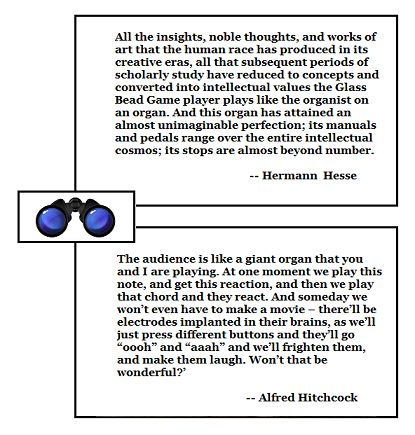
I ask this in light of the DoubleQuote I posted a few days ago comparing Hesse and Hitchcock in terms of their metaphoric uses of “organ” — in, I hasten to add, the Bach sense of the word:

SPEC-Hesse-Hitchcock-organs sm

Here’s what I’m thinking. Hesse’s game influences the mind, as does art, but it is non-invasive; Hitchcock applauds the potential for art to move in a more invasive direction, as if by force rather than by enticement.

“”

Humans — or at least the philosophers and philosopher tagalongs among them — can’t even tell if what one human sees as “red” is what another sees as “red” — let alone what a given Burgundy tastes like on another’s palate.

If this means, more generally, that minds are effectively encrypted by virtue of their differences in wiring acquired with parentage, age and experience, then our communications media -– language, the arts, literature, number — would appear to be the available decryption keys, selectively available to the minds in question.

**

Chuang-Tsu has this tale to tell:

Men claim that Mao-ch’iang and Lady Li were beautiful, but if fish saw them they would dive to the bottom of the stream, if birds saw them they would fly away, and if deer saw them they would break into a run. Of these four, which knows how to fix the standard of beauty for the world?

And this..

Chuang Tzu and Hui Tzu were strolling along the dam of the Hao River when Chuang Tzu said, “See how the minnows come out and dart around where they please! That’s what fish really enjoy!”

Hui Tzu said, “You’re not a fish – how do you know what fish enjoy?”

Chuang Tzu said, “You’re not I, so how do you know I don’t know what fish enjoy?”

Hui Tzu said, “I’m not you, so I certainly don’t know what you know. On the other hand, you’re certainly not a fish – so that still proves you don’t know what fish enjoy!”

Chuang Tzu said, “Let’s go back to your original question, please. You asked me how I know what fish enjoy – so you already knew I knew it when you asked the question. I know it by standing here beside the Hao.”

**

Chuang Tzu said, “You’re not I, so how do you know I don’t know what fish enjoy?”

Blake said, “How do you know but every bird that cuts the airy way, is an immense world of delight, closed by your senses five?”

On HipBone / Sembl moves and Wittgenstein’s PI

Friday, February 19th, 2016

[ by Charles Cameron — I have fond memories of the Anscombe household ]
.

ludwig-wittgenstein-swansea

**

In http://zenpundit.com/?p=47757 I said something that seems central to the way my HipBone mode of analysis works:

In each case, too, the associative process is the same, with some item perceived in the present calling up a past memory that is related to it — in a manner that can generally be articulated and annotated.

Such is the mechanism of a typical “move” in a DoubleQuote or HipBone game.

It’s so simple that it barely needs saying — one thing reminds us of another — and yet so basic that we can really benefit from paying attention to it.

Wittgenstein did, as I just discovered:

In his Philosophical Investigations, Part II, xl, he writes:

Two uses of the word “see”.
The one: “What do you see there?”—”I see this” (and then a description, a drawing, a copy). The other: “I see a likeness between these two faces” — let the man I tell this to be seeing the faces as clearly as I do myself.
The importance of this is the difference of category between the two ‘objects’ of sight.
The one man might make an accurate drawing of the two faces, and the other notice in the drawing the likeness which the former did not see.
I contemplate a face, and then suddenly notice its likeness to another.
I see that it has not changed; and yet I see it differently. I call this experience “noticing an aspect”.
Its causes are of interest to psychologists

So obvious. But it takes a Wittgenstein to see it, say it.


Switch to our mobile site