zenpundit.com » insight

Archive for the ‘insight’ Category

With Greco: two views of Toledo

Monday, June 6th, 2011

[ by Charles Cameron — perception, painting, pre-modern, modern, post-modern, heaven, sky, simulation, John Donne, El Greco ]

.

It is Sunday.

I find it powerfully interesting that the sky as perceived by painters (our “seers” par excellence) used to be filled with supernatural beings and is currently filled with natural ones — a clear sign that our culture has effectively moved from what one might call a theological vision of the world to a meteorological one (with astronomical trimmings under a clear sky)…

And I see that transition captured very precisely in four words, when John Donne writes:

At the round earths imagin’d corners, blow
Your trumpets, Angells, and arise, arise
From death, you numberlesse infinities
Of soules, and to your scattred bodies goe…

The “round earth” is that of modern science, the “imagin’d corners” those of pre-modern maps – and angelology.

*

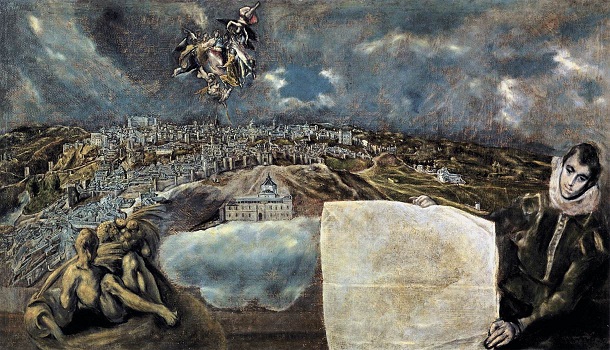
I have to admit, therefore, that I was surprised yesterday evening to come across an El Greco painting of Toledo that featured the blessed Virgin Mary over the city.

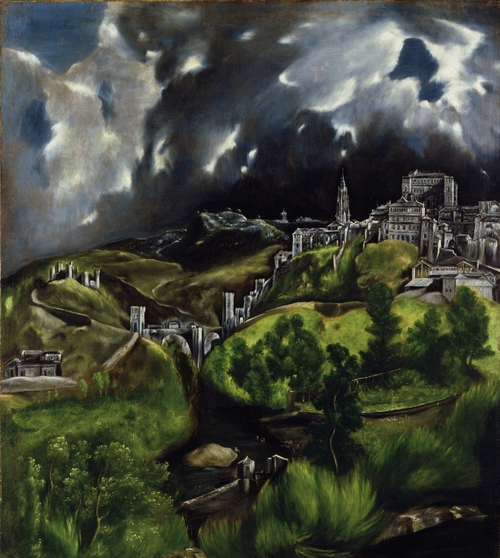
I have long been familiar with his better known View of Toledo, which is entirely naturalistic unless you want to consider storm-clouds as portents of a divine presence —
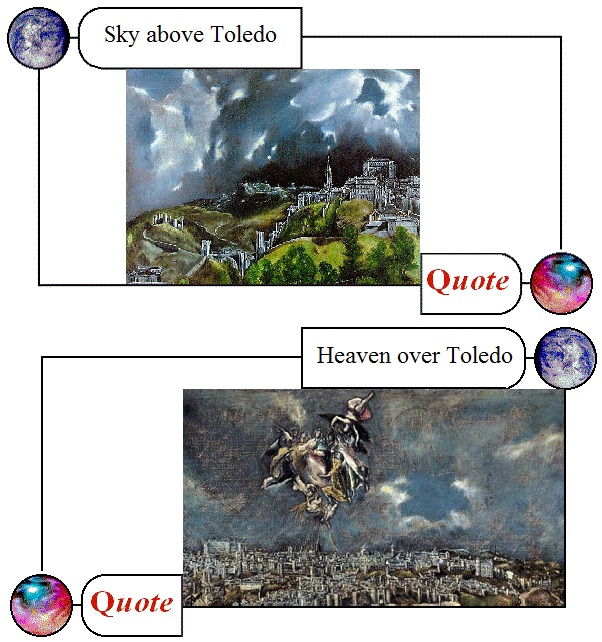
quo-sky-over-toledo.jpg

but the second of these images, from the View and Plan of Toledo, came as quite a surprise…

Here is a detail of the Virgin taken from it, to illustrate the point:
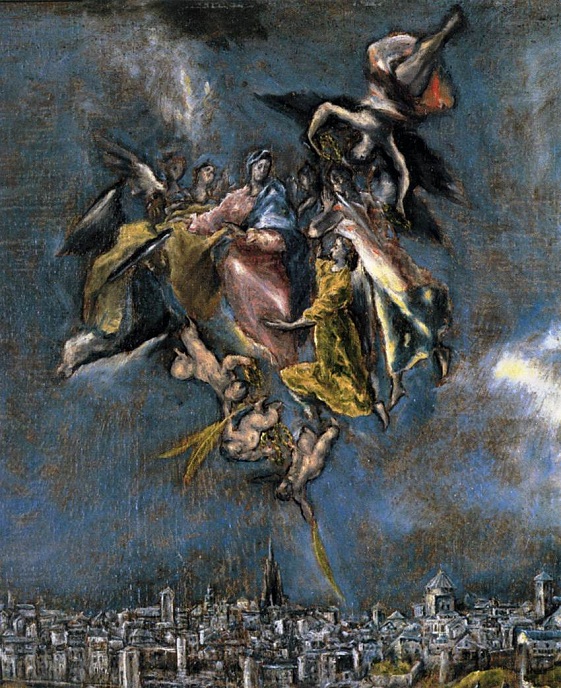
el-greco_view-and-plan-of-toledo_detalhe2_c1610.jpg

*

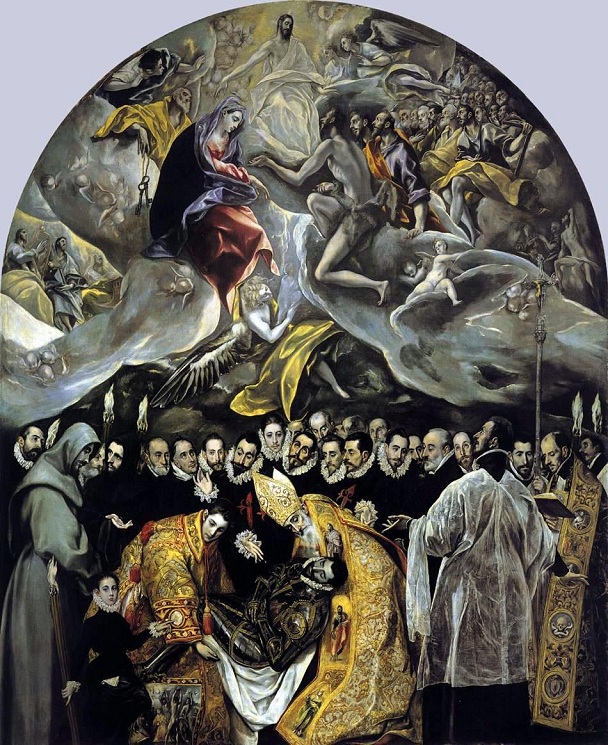
El Greco is famous for painting heaven-and-earth as a continuum – his great masterpiece, the Burial of Count Orgaz, catches the release of the soul from its bodily sheath as directly as Donne’s “to your scattred bodies goe” does to the return of those souls to corporeality at the General Resurrection:
entierro-del-conde-de-orgaz-sm.jpg

*

And yet El Greco, like Donne, sees both – Toledo under storm-clouds, Toledo under the shelter of the blessed Virgin…

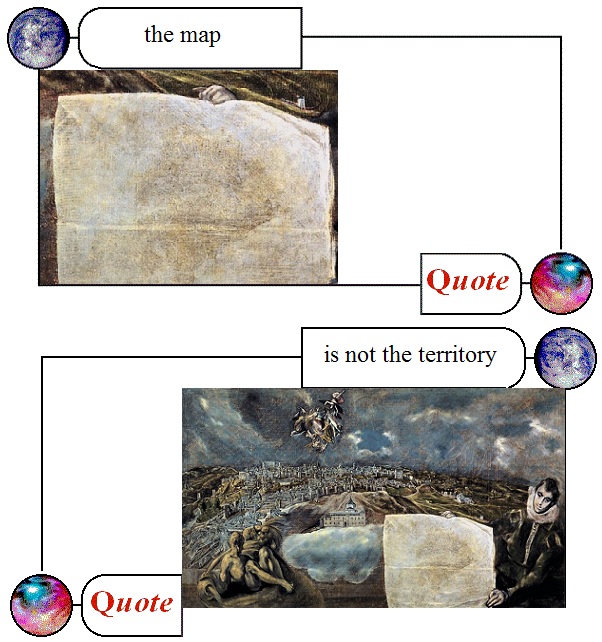
But there is more here, in this extraordinary painting. There is a map of the territory

quo-greco-toledo.jpg

*

If I could say in a nutshell what post-modern is, I would say it is recursive. It recognizes our perceived reality to be a simulation, and is thus always playing with maps and models, as Shakespeare was when he penned the words “All the world’s a stage” to be spoken in a theater whose sign and motto was “Totus mundus agit histrionem” – the whole world enacts a play.

Think of Hofstadter‘s Godel Escher Bach. Of Escher himself, and his image of himself holding his own small world in a glass sphere in his hand…

Think of Korzybski, and his dictum: the map is not the territory.

Think of Gregory Bateson, who wrote:

We say the map is different from the territory. But what is the territory? Operationally, somebody went out with a retina or a measuring stick and made representations which were then put on paper. What is on the paper map is a representation of what was in the retinal representation of the man who made the map; and as you push the question back, what you find is an infinite regress, an infinite series of maps. The territory never gets in at all. […] Always, the process of representation will filter it out so that the mental world is only maps of maps, ad infinitum.

Astoundingly, presciently – prophetically? – El Greco is already alluding to this, around 1610, in his View and Plan of Toledo.
11777-view-and-plan-of-toledo-el-greco-sm.jpg

*

El Greco’s Burial of Count Orgaz is in the Church of Santo Tomé in Toledo.

El Greco’s View and Plan of Toledo is in the Museo de El Greco, Toledo.

Here is the complete text of Donne’s sonnet:

At the round earths imagin’d corners, blow
Your trumpets, Angells, and arise, arise
From death, you numberlesse infinities
Of soules, and to your scattred bodies goe,
All whom the flood did, and fire shall o’erthrow,
All whom warre, dearth, age, agues, tyrannies,
Despaire, law, chance, hath slaine, and you whose eyes,
Shall behold God, and never tast deaths woe.
But let them sleepe, Lord, and mee mourne a space,
For, if above all these, my sinnes abound,
‘Tis late to aske abundance of thy grace,
When wee are there; here on this lowly ground,
Teach mee how to repent; for that’s as good
As if thou’hadst seal’d my pardon, with thy blood.

El Greco’s View of Toledo is in the Metropolitan Museum of Art in New York:
29_1006.jpg

Here we find no blessed Virgin, no angels with their final trumpets — and yet this painting can be viewed as analogous to his Vision of Saint John and the opening of the Fifth Seal — which owes its power to its “otherworldly stormy light” — and thus seen as yet another apocalyptic scene, one which “recalls St. John’s vision of the New Jerusalem in the Book of Revelations … a landscape of unearthly power and drama: a dialogue between heaven and earth conducted appropriately by the cathedral spire…”
Guest Post: David Ronfeldt on Dignity and Democracy

Thursday, May 26th, 2011

 ronfeldt_david.jpg

Blog-friend David Ronfeldt, until recently Senior Social Scientist with the RAND International Policy Dept., is author / co-author of such seminal works as Networks and Netwars; In Athena’s Camp; In Search of How Societies Work: Tribes — the First and Forever Form; and The Zapatista “Social Netwar” in Mexico. Today he offered a detailed comment on Zen‘s post, Skulls & Human Sacrifice — the central portion of which we felt deserved to stand as a post of its own, and attract its own body of discussion. We are accordingly delighted and honored to offer it here as David’s first guest-post on Zenpundit. –CC

______________________________________________________________________________________________

For months, many arab commentators have observed that the uprisings are mainly about “dignity”: e.g., identity and dignity, or dignity and freedom, or some other combination — but always dignity.

In contrast, American observers keep saying the uprisings are mainly about “democracy” — freedom and democracy in particular. some Arabs include a call for democracy with their call for dignity; but Americans only occasionally acknowledge their parallel pursuit of dignity. in fact, Americans rarely think about dignity; we’re raised to assume it. Language about dignity slides right through our modernized minds.

Yet, in many cultures, dignity is a more crucial concept than democracy. Dignity (along with its customary companions: respect, honor, pride) goes to the core of how people want to be treated. it’s an ancient tribal as well as personal principle. indeed, it’s central to the tribal form. tribal and clannish peoples think and talk about dignity far more than do americans and other westerners in advanced liberal democratic societies.

In the Arab spring, what many arabs seem concerned about is thus more primal than democracy. They’re fed up with the indignities inflicted by corrupt, rigged patronage systems, by rulers and functionaries who act in predatory contemptuous ways, by the endless abuse of personal rights and freedoms — in other words, by all the insults to their daily sense of dignity. Of course, many Arabs seek democracy too; and dignity and democracy (not to mention justice, equality, and other values) overlap and can reinforce each other. But dignity and democracy are not identical impulses, nor based on identical grievances. in some situations, the desire for dignity trumps the desire for democracy.

This interplay between “dignity” and “democracy” may have implications for US policy and strategy. I’m not exactly sure what they are, but it seems to me that we ought to be analyzing and operating as much in terms of dignity as democracy. I bring this up not only because americans tend to overlook the significance of the dignity principle, but also because I detect a dignity-democracy fault-line among the Arab-spring’s protagonists — a fault-line that may relate to whether the Arab spring ends up having democratic or re-authoritarian consequences.

My sense is that the younger modernizing protagonists of the Arab spring may well be pursuing democracy (along with dignity) as their strategic goal, but the older, more traditionalist elements operating alongside them are more interested in pursuing dignity, without necessarily favoring democracy. and the latter may be stronger than we have observed. if so, the quest for dignity may be satisfied by outcomes that have little to do with democracy: say, for example, a shift in tribal and clan balances, an enhanced appeal for islamic law (shariah), or a charismatic call for strong government devoid of foreign influence. It may be easier, and more popular, to gratify a quest for dignity than a quest for democracy.

*

I’m led to these observations via the TIMN framework about the four major forms of organization that lie behind social evolution: tribes + hierarchical institutions + markets + info-age networks. the young modernizing protagonists of the arab spring express the nascent +N part of TIMN, while the older traditionalist elements remain steeped in the ancient pro-T part — and therein lies the fault-line I mentioned earlier.

_______________________________________________________________________________________________

For further details of Dr. Ronfeldt’s published work, see his RAND portfolio.His current interests include in particular:

  • Development of a framework (TIMN) about the long-range evolution of societies, based on their capacity to use and combine four major forms of organization: tribes, hierarchical institutions, markets, and networks
  • Development of a framework (STA) for analyzing people’s mind-sets and cultural cosmologies in terms of basic beliefs about the nature of social space, social time, and social action

He blogs recent thinking on both frameworks at Visions from Two Theories.

2011, meet 1997 (and 1995, and 1943…)

Wednesday, May 25th, 2011

[ by Charles Cameron — creativity, IARPA, HipBone Games, h/t Hermann Hesse ]

.
Funny thing, that.

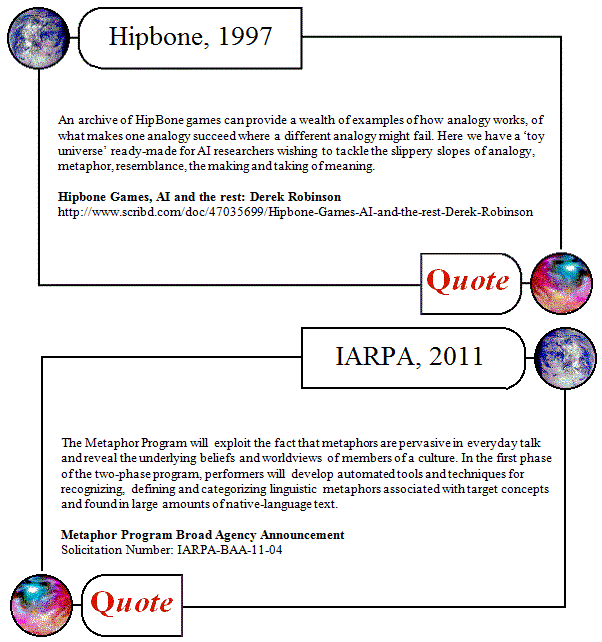
quo-iarpa.gif

In 1997, Derek Robinson wrote a short piece about my HipBone Games, indicating what they were good for. Read it – then read the IARPA solicitation that just came out.

My approach is to lure people into discovering analogies, metaphors, parallels and oppositions by playing a game which elicits them as game moves — a live process, and one that cuts to the very heart of creativity — IARPA wants an automated version, which will be clunky by comparison. And as Derek points out in his piece — pointed out, that is to say, fourteen years ago, quoting an even earlier (1995) comment from Douglas Hofstadter:

If, instead of using the real world, one carefully creates a simpler, artificial world in which to study the high-level processes of perception, the problems become more tractable.

That’s what my games are — “a simpler, artificial world in which to study the high-level processes of perception” — specifically, “of analogy, metaphor, resemblance, the making and taking of meaning”.

I’ve been working on this stuff for at least fifteen years… inspired by a book Hermann Hesse published in 1943.

*

And oh yes, there’s a “future of search engines” hiding in there, too.

What amazes me is the *speed* of the moral descent

Tuesday, May 24th, 2011

[ by Charles Cameron — the importance of undertows, archaisms, blind-spots ]
.
.
Zen writes, in a comment on his post, Skulls & Human Sacrifice:

What amazes me is the *speed* of the moral descent.

Yup. Bingo!  Yes!! Exactly…

That’s why I think it’s so important to track undertows as well as tides – the archaic rituals and myths, the archetypal dreams and nightmares of people like AQ, or La Familia, or even Harold Camping.

They’re below the surface, beneath our radar – until they “show”. And then they blow our minds.

*

That’s why I think apocalyptic movements are so significant.

By the time the Chinese Government found ten thousand or so qi gong practitioners protesting at Zhongnanhai in 1999, there were arguably as many practitioners (70 m) across China as there were members of the CPC (60+ m) – and any number of them might be listening to Li Hongzhi‘s Falun Dafa tapes while cultivating themselves in the park… The recognition that the Party might have a movement on its hands to compare with the Taiping rebellion (20 m lives lost) was what drove the fierce repression that followed…

It was as though Falun Gong came out of nowhere.

And who knew that Harold Camping’s prophecies broadcast out of a radio station in Oakland, CA could move “several thousand Hmong followers of a sub-Christian messianic cult” to gather for the end in Muong Nhe district, Dien Bien Province, Vietnam – conflating the prophecies of their own messiah figure, “a 25-year-old man named Zhong Ka Chang, now renamed Tu Jeng Cheng, meaning ‘the important one'” with Camping’s returning Christ, and expecting him to “appear and establish a pan-Hmong kingdom” (quotes from Compass Direct).

We laugh at Camping. But he touched a nerve.

*

Pretty much by definition, societies are and choose to remain unconscious of their unconscious contents until it’s too late, so they always surprise us.

They’re in our blind-spot, by definition.

Towards a Pattern Language for CT? III

Tuesday, May 17th, 2011

[ by Charles Cameron — all middle and no end ]

.

And while I’m at it, I might as well post one of the very first DoubleQuotes I put together when I was first experimenting with the format, sometime between October 2003 and June 2004

quo-pilots-divers.gif

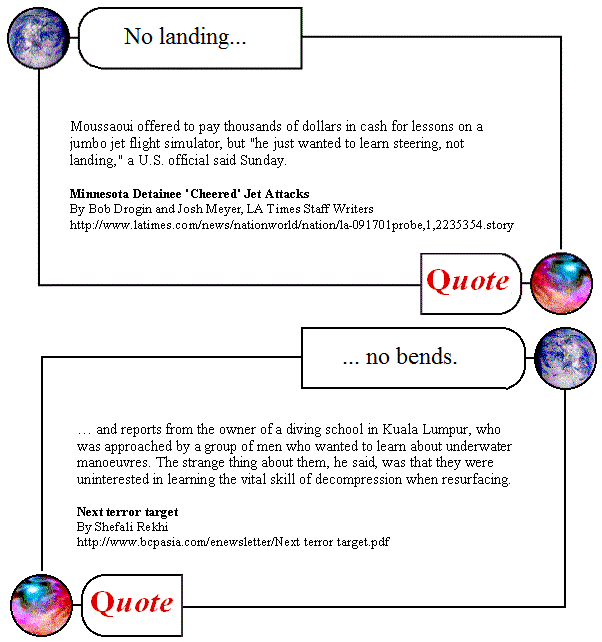
I thought then, and I think now, that a walkway lined with dozens of little plaques presenting odd snippets of fact like either one of those would be a marvelous device for triggering associations in ambulatory analysts…

And it is a recurring pattern, isn’t it?

Ominously, there have been cases of terrorist pirates hijacking tankers in order to practice steering them through straits and crowded sea-lanes-the maritime equivalent of the September 11 hijackers’ training in Florida flight schools. These apparent kamikazes-in-training have questioned crews on how to operate ships but have shown little interest in how to dock them. In March 2003, an Indonesian chemical tanker, the Dewi Madrim, was hijacked off Indonesia. The ten armed men who seized the vessel steered it for an hour through the busy Strait of Malacca and then left the ship with equipment and technical documents.
.
Gal Luft and Anne Korin, Terrorism Goes to Sea, Foreign Affairs, Nov/Dec 2004

It helps to be alert to rhyming between ideas


Switch to our mobile site