zenpundit.com » 20th century

Archive for the ‘20th century’ Category

“Our enemy is adaptable, we must be, too.” Adaptability & Simplicity, Random Thoughts

Saturday, March 17th, 2012

[by J. Scott Shipman]

This is cross-posted at http://tobeortodo.com

Earlier this week I had the privilege of speaking at the Navy Expeditionary Forces Conference (NAVEXFOR 2012) in Virginia Beach, VA. The theme for this year’s conference was “innovation in constrained environments.” In my talk, I focused on potential internal cultural constraints and deliberate actions to mitigate resulting threats. Not surprisingly, other speakers focused on our enemies and the constraints they place on our forces, and the fact those enemies impose constraints with innovative methods and weapons like roadside IEDs.  Yesterday, through a friend on Twitter, I learned that insurgents in Iraq had used cell phone geotags to destroy AH-64’s; innovation, indeed.

One speaker made the comment in this post’s title: “Our enemy is adaptable, we must be, too.” He went on to characterized their adaptations as “simple.”

Using this description, through simple adaptation, our enemies disrupt our activities, destroy our equipment, and kill or maim our service members using cheap, simple, but deadly tools. The resulting affect isn’t limited to physical casualties; their innovations also disrupt our ability to control the initiative, and perhaps just as importantly our sensemaking abilities. The ability to alter an opponent’s sensemaking will inform and increase the complexity of an already complex environment, so adaptability is essential.

In most situations we counter these simple adaptations by employing complex and expensive solutions. This has been accurately called, “adaptation at acquisition speed.” Those expensive and complex solutions must make it through byzantine acquisition processes rife with political maneuvering, operating in a culture of “no,” which results in increased costs, schedule, and ultimately our frequent inability to be responsive to troops in field. Institutional inertia in the defense bureaucracy prevents significant change in the short-run, so these facts must be considered an on-going constraint.

In spite of these constraints, our troops are thinking and acting—they are adapting, using simple tools, like remote control vehicles.  This “toy” was used to inspect vehicles and detect IEDs. Instead of an expensive long lead-time solution, they went to Radio Shack—and the vehicle lasted for several years—so they got another. According to the report, at least six lives were saved as a result. Not surprisingly, the folks closest to the problem produced an effective solution. No doubt there are other stories of ingenuity and adaptation, but this story exemplifies the possible. The underlying point is this soldier was thinking and acting—he was adapting in a way that allowed him and his colleagues to remain more safe.

Sun Tzu and the ultimate in adaptability

The speaker’s quote reminded me of this quote from Sun Tzu’s The Art of War, Chapter VI Weaknesses and Strengths (page 153 in the Samuel B. Griffith translation):

Now an army may be likened to water, for just as flowing water avoids the heights and hastens to the lowlands, so an army avoids strength and strikes weakness.

And as water shapes its flow in accordance with the ground, so an army manages its victory in accordance with the situation of the enemy.

And as water has no constant form, there are in war no constant condition.

Bear with me, as I like word pictures and synonyms and what follows is a bit like “plodding,” but I’ve found adjacencies in language illuminating (if I could draw this, I would). Water as a metaphor for adaptability presents any military force (or any other group) a daunting task. Considering the physical qualities of water several synonyms come to mind:

  • Water is transparent, so to be adaptable, we need to promote and practice clarity in internal communications and actions. Keeping ambiguity to a minimun is one method of promoting clarity, and practicing honesty is a good way to practice.
  • Water is physically cohesive, while being ultimately pliable. Think about it; put water in a jar, it conforms to the jar, pour it out, it follows gravity, and water surrounds whatever is submerged in it. Water moves as one, just as a group adaptability needs to be a key characteristic of any successful team. But in a larger sense, when one considers what I call the “bordering language” of synonyms, one discovers a greater depth to the concept of coherence, words like intelligence, comprehensibility, understandability, intelligibility, decipherability,  conncinity (my favorite),  unity, and harmony—just to name a few. Concinnity is a harmonious arrangement of things; where a culture is arranged and led in such a way as to promote and sustain harmony. My friend Ed H. has the best working definition for harmony that I’ve found. Ed derived his description from the novelist Douglas Adams and French impressionist painter Georges Seurat:

You don’t get harmony when everybody sings the same note. Harmony is the marriage of the contrary and of the similar; marrying discordant elements, regardless of tone, of color, of line, of thought and of purpose…

  • Water as described by Sun Tzu is fluid. Fluidity can be a blessing and a curse. On the one hand, fluidity implies adaptability, flexibility, fluency, smoothness, and ease. On the other, fluidity implies instability, unstableness, fickleness, inconstancy, changeableness, shifting, and flux. For cultures in a competitive environment, having the first form of fluidity is desired, while inflicting the second on the competitor. In addition, fluidity’s synonym fluency implies an eloquent and skillful use of language—or mediums of exchange. Fluency is possible only through practice, lots of practice. So much practice the skill becomes tacit knowledge, thus simple (effortless?)…even intuition.

Simplicity

Articulation in language and action are elements of simplicity. Simplicity implies tacit. As simple as the force of gravity directing water down a hill, going around and engulfing obstacles, thus is the potential of a group that has made their purpose/mission tacit and have the freedom to act. In fact, the sum of the skill sets may be so simple as to defy explanation—and more often than not in these cases, others learn by close association; watching, failing, learning, and making tacit those capabilities needed to cope and adapt. Boyd said as much in the abstract of Conceptual Spiral:

To flourish and grow in a many-sided, uncertain and ever-changing world that surrounds us, suggests that we have to make intuitive within ourselves those many practices we need to meet the exigencies of that world.

“To make intuitive within ourselves those many practices we need” implies the development and nurturing of habits that will enable us to adapt.That which is habitual becomes simple (and as mentioned above, yet another route to tacit).

Close

To the troops using the remote control vehicle mentioned above, the solution was obvious, and seemingly simple. Importantly, they were in a unit where they could act on their idea—and they did so outside the bureaucracy at little cost, and saved six lives (maybe more).

Taking a riff from the conference title, our leaders should be checking to make sure the rules of engagement (ROE) and other rigid rule sets aren’t implicitly making their folks hopelessly incapable of adaptability. As we increase adaptability, the more adaptability becomes a habit—and when it is a habit, it becomes simple. Just a thought.

Postscript:

The best short book I’ve read on tacit knowledge is Michael Polanyi’s The Tacit Dimension, the best long book on the same topic is Personal Knowledge by the same author.
The End and Ends

Tuesday, March 13th, 2012

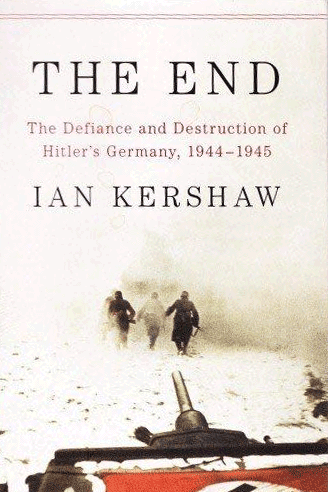
The End by Sir Ian Kershaw

I am currently reading The End, about the last year of the Third Reich and the Nazi death spiral toward Germany’s absolute destruction. It is a fascinating, mass suicidal, political dynamic that was mirrored to an even greater degree of fanaticism by Nazi Germany’s Axis partner, the Imperial Japanese. Facing the prospect of certain defeat, the Germans with very few exceptions, collectively refused every opportunity to shorten the agony or lighten the consequences of defeat and stubbornly followed their Fuhrer to the uttermost doom. It made no sense then and still does not now, seven decades later.

Adolf Hitler’s personal authority over the life and death of every soul in Germany did not end until his last breath. When surrounded by Soviet armies, trapped in his Fuhrerbunker in the ruin of Berlin, all it took for Hitler to depose his most powerful paladins, Hermann Goering and Heinrich Himmler was a word. They still commanded vast military and paramilitary security forces – Himmler had been put in charge of the Home Army as well as the SS, Gestapo and German police – but when Hitler withdrew his support and condemned them, their power crumbled. Goering, the glittering Nazi Reichsmarchal and second man in the state, was ignominiously arrested.

Even in Gotterdammerung, the Germans remained spellbound, like a man in a trance placing a noose around his own neck.

Currently, the chattering classes of the United States are uneasily working their way toward a possible war with Iran, or at least a confrontation with Teheran over their illegal nuclear weapons program (some people will object that, technically, we are not certain that Iran has a weapons program. This is true. It is also irrelevant to the diplomatic dynamic created by Iran’s nuclear activities which the regime uses to signal regularly to all observers that they could have one).  There is much debate over the rationality of Iran’s rulers and the likely consequences if Iran is permitted to become a nuclear weapons state. There is danger and risk in any potential course of action and predictions are being made, in my humble opinion, far too breezily.

In the run-up to war or negotiation, in dealing with the Iranians and making our strategic calculations, it might be useful to recall the behavior of the Germans.

A Wound That Does Not Cease to Bleed: The War in Vietnam

Wednesday, February 29th, 2012

Amigo of ZP blog, West Point military historian Colonel Gian Gentile, throws down the gauntlet in his review of Lewis Sorley’s new biography, Westmoreland: The General Who Lost Vietnam, in The National Interest:

The Better War That Never Was

DID GENERAL Westmoreland lose Vietnam? The answer is no. But he did lose the war over the memory of the Vietnam War. He lost it to military historian Lewis Sorley, among others. In his recent biography of William C. Westmoreland, Sorley posits what might be called “the better-war thesis”—that a better war leading to American victory was available to the United States if only the right general had been in charge. The problem, however, is that this so-called better war exists mostly in the minds of misguided historians and agenda-driven pundits.

In the battle over the memory of the Vietnam War, Sorley annihilates Westmoreland and leaves his character and reputation in smoldering ruins. Yet Sorley’s victory in the fight for the memory of Vietnam has not brought us a balanced historical biography of Westmoreland.  

 ….The better-war thesis argues that if only the U.S. Army had concentrated from the start on building up the South Vietnamese armed forces and winning the hearts and minds of the South Vietnamese people through limited applications of military force, we would have won the war. But the question remains: Precisely how could tactical adjustments early in the war have overpowered the political constraints placed on the army by the Johnson administration, which kept it from taking the fight to the North Vietnamese? Or the dysfunctional nature of the South Vietnamese government and military that precluded them from standing on their own? Or the declining popular support and political will in the United States as the war dragged on without a decent end in sight? Or, perhaps most importantly, how could tactical adjustments toward better methods of counterinsurgency have overpowered a communist enemy that fought the war totally while the United States fought it with limited means? In his Westmoreland biography, Sorley essentially ignores these questions.

Could the United States have prevailed in Vietnam? Yes, but it would have had to commit to staying there for generations, not a mere handful of years. The Vietnam War was an attempt at armed nation building for South Vietnam. Nations and their societies, however, are not built overnight, especially when they are violently contested by internal and external enemies. Thus, to prevail in Vietnam, the United States would have needed the collective will that it mustered to win World War II and would have had to be able to maintain it for generations. That kind of will—or staying power—was never a real possibility.

In war, political and societal will are calculations of strategy, and strategists in Vietnam should have discerned early on that the war was simply unwinnable based on what the American people were willing to pay. Once the war started and it became clear that to prevail meant staying for an unacceptable amount of time, American strategy should have moved to withdraw much earlier than it did. Ending wars fought under botched strategy and policy can be every bit as damaging as the wars themselves.

Well worth the read, not least for Gian’s model of how one historian carefully dismantles the thesis of another.

We are a mere three years from the fiftieth anniversary of Lyndon Johnson’s escalation of the Vietnam War, less than two years from the fiftieth anniversary of the assassination of John F. Kennedy that brought LBJ into power and a year from the fiftieth anniversary of the infamous coup d’etat against American client, President Ngo Dinh Diem, that JFK had approved. Finally,  fifty years ago, Kennedy drastically increased the American military advisory mission to South Vietnam to just under 10,000 men and signed off on clandestine operations against North Vietnam.

All those fiftieth anniversaries amount to a golden jubilee of rancor.

The bitterness sown by the lost war in Vietnam still burns in American politics like red hot coals. Less bright perhaps than the open flame of 1968, but if you scratch the surface, you will find with no less heat. The war spawned division and polarization that twisted our politics and poisoned public debate to this day, echoing now as farce as much as tragedy.

During the 1980’s, Vietnam historiography was virtually a cottage industry. It was the subject that ate the profession as a generation of academics who cut their academic teeth during the era of antiwar protest on campus acquired tenure, middle-aged paunches and lost hair while nursing their political grievances in their scholarship. I personally recall, as an  undergraduate, the war being referenced (usually along with vitriolic abuse of Ronald Reagan) in every humanities class, no matter how remote the course, with some professors being known for the quality of their off-topic rants.

While Westmoreland bears heavy responsibility for his part in a losing a war, even as theater commander in Saigon he was only an executor, not a maker, of strategy, much less national policy. Westmoreland did not lose Vietnam in a stunning battlefield capitulation, so Gentile is right to defend “Westy” from being scapegoated for the poor strategic reasoning hatched in the Oval Office. Where Westmoreland was at fault was in his inability to either intellectually comprehend the bigger strategic picture in which he found himself struggling (most likely) or if he did, to effectively articulate the strategic environment in Southeast Asia to a domineering President who was stubbornly determined to brook no contrary advice (possible). Had Westmoreland tried, he likely would have failed (Brute Krulak’s effort in this regard got him physically ejected from the Oval Office by the seat of his pants by Johnson himself. I am dubious that LBJ would have been any happier with contradiction of policy from Westmoreland).

Gentile, much like my professors of yore, is deeply interested in the congruence between events in his own time with those of the Vietnam era., in particular, the salience of counterinsurgency doctrine in the wars of Iraq and Afghanistan. There is, of course, some continuity between the Vietnam era and today present, a historical thread seized by the COINdinistas themselves in their veneration of Galula and slurping knife-blade portions of soup, but the continuity has limits. I suspect a Millennial generation vet of Kandahar or Fallujah, should they venture to become a historian, will frame and seek to explain their wars without much reference to the societal touchstone that is Vietnam.

Perhaps by then, for American society, Vietnam will have finally ceased to bleed.

America in Arms, John McAuley Palmer, a review

Tuesday, February 28th, 2012

[by J. Scott Shipman]

America in Arms, John McAuley Palmer (1870-1955)

Thanks to our blog friend Joseph Fouche, I discovered Brigadier General Palmer’s excellent history of how America has organized the army both in peacetime and in times of war. Fouche introduced Palmer in an excellent piece called, How Did We Get Here.

The Prologue to this excellent book begins:

When Washington became President, he had two main planks in his administration platform. His first plank called for a sound financial system; his second plank called for a sound national defense system.

Thanks to Alexander Hamilton, his Secretary of the Treasury, his first plank was installed before the end of his first administration. But it was not until 1920, more than one hundred and thirty years later, that Congress established a modern adaptation of his military organization. And it was not until 1940 that Congress completed the Washington structure by accepting the principle of compulsory military training and service in time of peace.

Thus begins one of the best written books I’ve read since Rear Admiral J.C. Wylie’s Military Strategy. While the authors cover different topics, both write in crisp, efficient prose and say what they mean the first time. One won’t find much fluff or nuance in either book; I like that.

Palmer traces the history of how America has organized to fight wars, and more often than not, the “how” is not pretty (we usually play catch-up in the early days of conflict). Palmer’s purpose in writing “this little book” was “to tell how Washington arrived at his military philosophy: how and why he was unable to persuade his countrymen to accept it; how their rejection of his advice affected their subsequent history; and finally how, after a century and a half their descendants have have been impelled to return to his guidance.” From the period of 1783 through 1911, Palmer’s book is history. Following 1911, Palmer provides “first-hand experience of the events described.”

Palmer begins with an early (pre-Constitution) inquiry to Washington by Congress on his views on a proper military policy for the new nation. Washington shopped the query around to Generals Steuben, Knox, Huntington, Pickering, Health, Hand and Rufus Putnam. Their responses were strikingly similar; “a well-regulated militia” would be sufficient for national defense. They agreed on a small regular army to patrol the Indian frontier and other “special duties” that could not be performed by citizen soldiers.

Palmer discovered Washington’s “Sentiment on a Peace Establishment” when researching his Washington, Lincoln, Wilson: Three War Statesmen. Washington’s treatise was pretty straightforward:

A Peace Establishment for the United States of America may in my opinion be classed under four different heads Vizt:

First. A regular and standing force, for Garrisoning West Point and such other Posts upon our Northern, Western, and Southern Frontiers, as shall be deemed necessary to awe the Indians, protect our Trade, prevent the encroachment of our Neighbours of Canada and the Florida’s, and guard us at least from surprizes; Also for security of our Magazines.

Secondly. A well organized Militia; upon a Plan that will pervade all the States, and introduce similarity in their Establishment Manoeuvres, Exercise and Arms.

Thirdly. Establishing Arsenals of all kinds of Military Stores.

Fourthly. Accademies, one or more for the Instruction of the Art Military; particularly those Branches of it which respect Engineering and Artillery, which are highly essential, and the knowledge of which, is most difficult to obtain. Also Manufactories of some kinds of Military Stores.

(Would highly recommend reading the entire piece.)

Palmer accounts for Washington’s seeming contradiction on the issue of militias, and points out that Washington was specific in his low opinion of an “ill-organized militia” (one based on short enlistments and political connections influencing the selection of leaders—a problem which endured in Lincoln’s Union Army). Washington favored a “well-organized militia” with the Swiss model ranking high in his esteem. Of the generals providing Washington with their thoughts, Palmer writes that Steuben and Knox were largely in agreement with Washington’s ideas. Both were in general agreement on the organization of small infantry divisions, or legions divided between New England, the Mid-Atlantic, and the South Atlantic. Under the direction of Congress, in 1786, General Knox (then Secretary of War) completed a Plan for a General Arrangement of the Militia of the United States.

The following plan is formed on these general principles.
1st.
That it is the indispensible duty of every nation to establish all necessary institutions for its own perfection and defence.
2’ndly,
That it is a capital security to a free State for the great body of the people to possess a competent knowledge of the military art.
3’dly,
That this knowledge cannot be attained in the present state of society but by establishing adequate institutions for the military education of youth— And that the knowledge acquired therein should be diffused throughout the community by the principles of rotation.
4’thly
That every man of the proper age, and ability of body is firmly bound by the social compact to perform personally his proportion of military duty for the defence of the State.
5’thly;
That all men of the legal military age should be armed, enrolled and held responsible for different degrees of military service.
And 6thly,
That agreeably to the Constitution the United States are to provide for organizing, arming and disciplining the Militia, and for governing such part of them as may be employed in the service of the United States, reserving to the States respectively the appointment of the officers, and the authority of training the Militia according to the discipline prescribed by Congress.

Congress did not enact the Knox plan as the United States, still under the Articles of Confederation was “insolvent” and unable to act. Palmer estimated that had Knox’s plan been adopted in 1786, “it is my estimate that the advanced corps would have numbered 60,000 men at the end of three years.” Those numbers would grow progressively as the population increased, so that at the outbreak of the Civil War, “the first line of the civilian army would have numbered about 500,000 men. ” By WWI in 1914, that number would have been about 1.8 million.

As president, Washington’s military policy was closely aligned to the Knox plan (Washington amended the original). The change involved a reduction in the required training for the advanced corp—then, as now, costs were the motivating factor for the reduction, but Washington wanted to get a national infrastructure approved. As mentioned previously, the Swiss model factored heavily among Washington and his general’s thinking—with the essential difference between the Swiss plan and Knox being the “distribution of training time.”

The first Congress was reluctant to embrace Washington’s ideas and instead passed the “notorius Militia Act of 1792.” Palmer said this Act made “our military system worse than before the bill was introduced. The old militia organization [the “ill-organized” that Washington deplored] with its phony regiments and divisions now had Federal sanction and was made uniformly bad throughout the nation.”

Washington was defeated in his efforts to develop and deploy a national militia. Washington in warning of foreign entanglements in his Farewell Adress also reminded us of the realities nations must shoulder:

If we remain one People, under an efficient government, the period is not far off, when we may defy material injury from external annoyance; when we may take such an attitude as will cause the neutrality we may at any time resolve upon to be scrupulously respected; when belligerent nations, under the impossibility of making acquisitions upon us, will not lightly hazard the giving us provocation; when we may choose peace or War, as our interest guided by justice shall Counsel…Taking care always to keep ourselves, by suitable establishments, on a respectably defensive posture, we may safely trust to temporary alliances for extraordinary emergencies.

Palmer covers the efforts of Jefferson, and then, Madison to develop a cogent national military organization. The War of 1812 illustrated the the dangers of “the ill-organized militia” as it was, as organized the militias were found wanting. A new force emerged from the War of 1812 and that new force was the regular army. Palmer concludes this chapter: “The history of our modern regular army really begins with the War of 1812. Since then it has never failed to give a good account of itself. It won the pride and gratitude of the American people just when the failure of the national militia had filled them with contempt and humiliation.”

“A new military gospel” was formed after the War of 1812, and the War Department became the new headquarters of the regular army. Madison’s successors had to start over as the archives (including Washington’s Sentiments) were destroyed when the British burned the capitol in 1814. John C. Calhoun, Secretary of War under Monroe, advocated an “expansible standing army”—the antithesis of Washington’s ideas. Palmer said, this “expansible-standing-army” plan hampered American plans for preparedness for more than a century…[through 1941] and…is not quite dead.” The problem was “how” to expand this force in time of war.

As Palmer traces the military policy from Florida to Mexico, and the Civil War, the same problems recurred: the standing army was stretched thin at the outset of conflict and ill-equipped to train recruits provided by the Several States. Added to this was the problems of short enlistments, that in some cases left commanders waiting to pursue the enemy while waiting for fresh troops (Battle of the City of Mexico).

After the Civil War Congress took action to attempt a solution to the broken military organization problem. The Burnside Commission was formed with veterans of the Civil War, but without Washington’s wisdom to guide them. Palmer recounts the accident of history where General Emory Upton had just finished reviewing Washington’s military writings—but missed Sentiments (referenced in a footnote). Upton missed the “key” to Washington’s thinking on an “efficient citizen army.” It appears Upton took the Washington he had read and connected to the expansible standing army idea—and missed Washington’s true intent.

Elihu Root became Secretary of War in 1899 and traced our military faults in the Spanish American war to “defective organization.” The defective organization, in Root’s estimation was this paragraph in Army regulations: “The military establishment is under orders of the Commanding General of the army in that which pertains to its discipline and control. The fiscal affairs of the army are conducted by the Secretary of War through the several Staff Departments”—dual control. While he was resisted, in 1903 the office of the chief of staff was created. Palmer calls this the first of Root’s “great reforms.” He followed by formalizing planning and organizing “the American war army.” A General Staff college was formed to educate those who would serve in the newly reorganized Army. Root and his use of Upton’s work made an indelible mark on the army, and in many ways made the army more professional and able. On the downside, I sense Root provided the shell of what is now the massive military bureaucracy.

I’ll conclude my chronological review here, as the author enters the narrative in first person while signed to Henry L. Stimson, Secretary of War. Suffice it to say, Palmer’s recounting of “how” we have traditionally organized our army is a very informative read. I have seen many “reading lists” of generals and leaders, but haven’t seen this old book on any of those lists—it should be. The “tribal” disconnect between the regular army and the National Guard is explained (not in so many words, mind you), and Palmer’s recounting of the dangerous power of doctrine and dogma is worth the read. The writer of the biblical book Ecclesiastes said, “There is nothing new under the sun.” In America in Arms, military personnel and general reader will find that many of today’s challenges have been challenges since our Founding.

This book has my highest recommendation—especially if you are a serving army officer or have interest in American military organization. This is a great old book. Get a copy; Palmer has much to teach us.

Postscript: Another friend of this blog, Lexington Green, recommended Citizen and Soldiers: The Dilemmas of Military Service, by Eliot Cohen, in the comments to the same post posted at chicagoboyz.net. On Lex’s recommendation, I ordered and have Cohen’s book, but have not yet read.

Second Postscript: I purchased America in Arms from a used book dealer on abe.com, and was fortunate to get a first edition hardback (ex-library book) in excellent condition. This particular title spent time on the shelves of The Catlin Memorial Free Library, Springfield Center, NY, and was placed there by the Arthur Larned Ryerson Memorial; Mr. Ryerson perished on the Titanic. In addition, this particular edition was also published by Yale by the Foundation established in the memory of Philip Hamilton McMillan (check the wife and children entry), Yale Class of 1894. Quite a pedigree for any book; a book that will remain safely in my collection. (the photo above is a snap-shot of my copy)

Syria, Iran and the Risks of Tactical Geopolitics

Monday, February 13th, 2012


Mr. Nyet 

World affairs are much more like spider’s web than the neat little drawers of an apothecary’s cabinet. In the latter,  the contents of each drawer are cleanly isolated and conveniently compartmentalized. What you do with the contents of one drawer today has no bearing on what you do next week with those of another. By contrast, with a spider’s web, when you touch a web at any point, not only do you find it to be sticky in a fragile sort of way, but your touch sends vibrations through every centimeter of the lattice.

Which alerts the spiders.

The great foreign policy panjandrums of the United States and the Western allies – with assorted Middle-Eastern clients who have real skin in the game-  are attempting to muddle through two overlapping but different crises with Syria and Iran through the medium of international diplomatic organizations. In the case of Syria, whose Baathist-Alawite dictatorship of Bashar Assad is trying to crush a widespread uprising by pacing the body count of their atrocities to what CNN viewers can tolerate, the effort by SECSTATE Clinton and Ambassador Rice to rally the UN Security Council to issue a forceful resolution against Syria was itself forcefully rebuffed by the double-veto of Russia and China. A highly predictable event that left Ambassador Rice “disgusted” but we hope, not surprised.

The case of Iran, which incidentally is one of Syria’s few allies, involves the long-running dispute over Iran’s complex and semi-clandestine nuclear activities which, in violation of the NPT and IAEA agreements, appear designed to pressure the West by giving Iran, at a minimum, a “breakout” capacity to make some nuclear weapons.  This decade long “crisis” has recently escalated, with the EU and United States applying punishing new economic sanctions while an unknown party that everyone knows to be Israel is engaging in a campaign of  sabotage and assassination against Iran’s IRGC-run nuclear establishment. Iran for it’s part has taken hostages, blustered about closing the straits of Hormuz and threatened unspecified new breakthroughs in nuclear activities.

To say that Russia and China have been less than helpful in halting Iranian nuclear weapons-related activity is like saying Pakistan’s ISI might be involved with assisting the Taliban.  Another situation the American foreign policy establishment consistently has trouble puzzling out.

The problem with current US policy or it’s advocates is not target selection. Syria, Iran, Libya and various other states have nasty, disruptive and anti-Western regimes. Giving them the heave-ho, in the abstract, makes sense if advancing American interests  (or basic decency in governance) is the objective. However, unlike the aforementioned apothecary cabinet drawers, states and their regimes do not exist in the abstract, moving according to arid principles of conduct, but in the real world with a society of states which constantly are evaluating and re-evaluating each other’s conduct in light of interest. Which means, as with many things, in foreign policy, timing matters.

The West recently dispatched over the objections of two great powers, Colonel Gaddafi, a ruler who was also an unpopular and violent lunatic with a long pedigree of terrorism and cruelty.  That in itself was tolerable and comprehensible, if not welcome, to Moscow and Beijing, but we rubbed salt in the wound in two ways. First, simply stomping on the Realpolitik economic interests of Russia and China in Libya, as Walter Russell Meade eloquently put it:

….Russia has some specific grievances connected to Libya.  What seems to really enrage the Russians is less the overthrow of the Great Loon than the cancellation of his many contracts with Russia and the refusal of the new government to give Russia a slice of the Libyan pie.  Russia always thought the west’s democratic agenda in Libya was a laugh — and the antics of the thuggish new regime and the array of torturers and thieves now running rampant in that country has done little to dispel that view. (Again, the Putin/KGB worldview would suggest that the hard realists at the core of Washington’s power structure released the ninnies to dance themselves into a frenzy of humanitarian and democratic ecstasy while the cold purposes of the DC machine were advanced.)

But what Russia thought it expected and deserved in return for its abstention on the Libya vote was due consideration for its commercial interests in Libya.  France, Britain and Qatar seem to be dividing that pie enthusiastically among themselves and nobody is thinking about Russia’s share and Russia’s price.

Secondly, was icing Gaddafi under the moral banner of R2P, which would seem – in theory of course – to be applicable to governments very much like those run by the allies of….Moscow and Beijing. To say nothing of , Moscow and Beijing themselves, which already see the “color revolutions” as subversive Western elite sock puppets with a democracy stage show kit.  To be frank, Russian and Chinese leaders see R2P as a doctrine or policy that potentially can be used not only against their nation’s interests, but their own hold on power, which they view, accurately, as a violation of sovereignty.

So it can hardly be reassuring to Moscow or Beijing that when the dust has yet to settle in Libya, that the United States and it’s NATO allies are now pressing for new UN resolutions designed to justify military intervention in Syria to overthrow Bashar Assad. Like the late and unlamented Colonel Gaddafi, Bashar Assad is a cold-blooded murderer, but unlike the crazy Colonel, Assad is a client of Russia and close Syrian ties to Moscow go way back to the earliest days of his father’s dictatorship. There’s no way, in such a short amount of time, that an American effort to topple Assad – however justified morally – that Vladimir Putin and to be truthful, many ordinary Russians, would not view that as a Western attempt to humiliate Russia. And R2P would indicate still more humiliations to come! As Dan Trombly wrote:

….that is precisely why the United States should drop even lip service to the Responsibility to Protect. Honestly stayed, the doctrine requires intervention after intervention, and its strategic advantage to the United States relies on consistency, because without consistency the supposed normative benefits it creates quickly evaporates. Yet R2P, far from strengthening the international order, actually demands continually more resources and, each time it is employed or contemplated, calls into question the rest of the international order the United States promulgates. If the goal is to “expand and strengthen an effective international order,” why would increasing the visibility of Responsibility to Protect, a doctrine that divides the United States and Western Europe from Central Europe, the rising democracies of Brazil, South Africa, and India – not to mention, of course, the major powers China and Russia and exhausts an already overburdened and shrinking Western military capability? 

In that context, the idea that Russia and China would support a UNSC resolution to intervene in Syria and depose Assad borders on the bizarre.  Advocates of R2P, like Anne-Marie Slaughter, would counter here, arguing that both Russia and China previously accepted R2P, so their cooperation in support of a UNSC resolution on Syria should have been a manageable enterprise. It wasn’t, largely because the Russians do not seem to give R2P much weight as a part of international law, the Russian Defense Ministry being even more blunt than their diplomatic counterparts:

….Russia’s Defense Ministry on Thursday reiterated its position stated earlier by the Foreign Ministry: Russia will do its best to avoid military intervention in Syria.

 “As for Syria, we see that harsh discussions are going on in New York and we are just giving backup to our colleagues from the Foreign Ministry who are tackling these problems. Of course, we think it is necessary to prevent military intervention in Syria,” Deputy Defense Minister Anatoly Antonov told Vesti 24 TV channel.

 Russia has firmly supported Syrian President Bashar al-Assad during the uprising against his regime. Russia and China vetoed a UN Security Council resolution on Syria, backed by the Arab League and Western nations, to prevent a repetition of “the Libyan scenario.

Joshua Foust, writing in The Atlantic, addressed the situation with admirable clarity:

….A big reason for Russia and China’s intransigence is the NATO coalition that led the intervention, which badly overstepped the range of permissible actions stipulated in the UN Security Council Resolution that authorized intervention. Russia was an early critic of such actions as France’s weapons shipments to the rebels — criticism that could have been accounted for (Moscow never made any secret of its concerns) but which seemed to be ignored in the rush to intervene. President Obama made a rapid transition from saying “regime change is not on the table” last March (part of the bargain to get Russian abstention from the UNSC vote) to publicly calling for his ouster. France and the UK used similar language, ignoring the politics of getting UN approval for intervention.

….Many states, none of whom are free, worry that the West’s renewed love of intervention might one day be focused upon them. This is a critical consequence of rejecting sovereignty and declaring governments unfit to rule through a mixture of expediency and opportunity. Powerful states with poor human rights records — Russia and China included — look at what happened in Libya and see disaster, not freedom. And they are taking steps to avoid it.

The problem is not  intervention per se but an otherworldly posture of Western policy makers that embraces tactical geopolitics – i.e.  each intervention (Libya, Syria, Afghanistan, Iraq), undertaken whenever chance arises somehow exists on it’s own terms, in splendid isolation. It doesn’t, except in NATO capitols. Any nation not seeing itself as safe and impregnable is constantly calculating their opportunities and dangers based on our actions. If we continue to pursue intervention at the current tempo, blind to the perspectives and interests of others, we will get pushback on a more strategic level. And we will rue it.

NATO has been around so long, it is so enshrouded in hazy nostalgia and circumlocational love of diplomatic process, that we forget it was originally a radical departure for Americans and Europeans alike. Soviet postwar behavior under Stalin was so menacing, so intransigent, so relentlessly pressuring that the US set aside it’s traditional isolationism and the French and British their justified loathing of the defeated Germans, to make common cause against Soviet Communism. The West, on the defensive and backed into corner after corner in one tactical scenario after another by Moscow – Poland, Czechoslovakia, Greece, Iran, Berlin – took the conflict with the Kremlin to the next level by forming an enduring supranational, nuclear-armed, military alliance that ensured the next war in Europe meant WWIII.

That turned out to be more conflict than Uncle Joe Stalin was eager to buy.

We are now the ones backing others into corners. Iran, North Korea, Syria, Zimbabwe and other states ruled by kleptocrats and monsters act as buffers for China and Russia. Aside from the benefits these failed states can bring as customers for military hardware or sellers of raw materials, the attention of Western statesmen and human rights activists are diverted by the cause du jour in these hellholes, rather than being focused on what Beijing and Moscow might be up to at home or abroad.  Every dismantling of an anti-Western dictatorship, from their perspective, is a step closer to their direct confrontation with the West’s hyperactive, erratic, morally hypocritical, meddling, ruling elite who will be no more able to ignore “grave injustices” in Wuhai or Kazan than they could in Aleppo or Benghazi.

This is not an argument that we should not press our claims, or not try to keep nukes out of the hands of religious fanatics or refrain from crushing states that attack us with terrorist proxies; we can and should do all of these things with vigor. But when possible, much is to be gained by pursuing our interests in a manner that permits other great powers to at least save face. Destroying Iran’s government because of it’s nuclear activities, for example, is not a strategic “win” if  the way we do it convinces China and Russia to form a military alliance against the United States.

There is no need to forge ahead stupidly just because it is faster not to think matters through to their logical conclusions. America is heading down a road, led by an insular foreign policy clique of lawyers, activists and ex-academics, that eschews the need for maps because all that matters is that we drive well enough to take every short-cut.


Switch to our mobile site

