zenpundit.com » 20th century

Archive for the ‘20th century’ Category

Carl Prine’s Rebuttal to “Be honest: Who actually read FM 3-24?”

Wednesday, July 13th, 2011

My amigo and SWJ News co-columinst Crispin Burke recently put forth a very interesting and provocative jeremiad “Be honest: Who actually read FM 3-24?” and one of his targets, journalist and Iraq war veteran Carl Prine, has been duly provoked, Prine has responded in great detail yesterday at Line of Departure:

Starbuck is wrong

Starbuck is wrong.

And in his drive to keep getting it wrong, he’s trying to rewrite FM 3-24, the military’s chief doctrinal publication on counterinsurgency.

But that just makes him more wrong.

He’s wrong about me.  He’s wrong about what I believe.  He’s wrong about the literature that informs FM 3-24.  He’s wrong about what the manual says and he’s wrong about what it left out.  He’s wrong about historiography.  He’s wrong about how a caste of top officers and diplomats came to understand “strategy” in the wake of the occupation of Iraq.

Let’s help get him right.  Or, at least, less wrong.  He’s a good man.  We need to turn him and ensure he quits taking shots at me I don’t deserve!

….The problem to anyone who studies Malaya, however, is that since the publication of the memoirs of exiled communist leader Chin Peng a dozen years ago, we now know that the civic, military and political policies under the British “hearts and minds” approach didn’t defeat the revolution.

Instead, the revolt was irreparably broken by brutal operations against the guerrillas, then a most coercive “screwing down the people” phase that dispossessed or killed thousands of Chinese, followed by draconian “population control” measures that, as Peng put it, starved the guerrillas in the bush because they snapped their rat lines and cut off their rice.

The “hearts and minds” initiatives designed to bring medical care, education, social welfare and other aid to the resettled Chinese and woo them to the colonial government’s side from 1952 – 1954 didn’t crack the back of the insurgency, a point now pretty much beyond dispute.

Why?  Because the previous “hearts and minds” claptrap as the cause of pacification in Malaya was contradicted by the Malayan Chinese, most especially those guerrillas who took up arms against the British regime!

You know, the people targeted by a population-centric counterinsurgency.  The people most counter-insurgents in their pop-centric fantasies almost never discuss except as abstractions, the human yarn wefted and warped by their long needles of war.

One finds “Hearts and Minds” prominently mentioned 11 times in Dr John Nagl’s valentine to Templer and colonial Malaya, Eating Soup with a Knife; to Nagl it’s the stuff of police services and economic development and whatnot with the psychology of the people being the center of gravity those reforms are meant to snatch.

And Nagl would like the best burglar of hearts and minds to be a learning, nimble and evolving military-political institution such as the U.S. Army.  It’s no small wonder, then, that Nagl became a dominant voice in FM 3-24 and that many of this thoughts in Eating Soup came to dominate the manual, too.

Or, as the introduction to FM 3-24 echoes soupily, “by focusing on efforts to secure the safety and support of the local populace, and through a concerted effort to truly function as learning organizations, the Army and Marine Corps can defeat their insurgent enemies.”

This is mere euphemism and wasn’t worth the ink that it cost taxpayers to print it.  But it sets the stage for the rest of FM 3-24, which follows a hearts and minds template that Starbuck doesn’t apparently realize is borrowed from mid-century….

Ouch. Note to self: if I ever decide to square off against Carl, I will make sure to do my homework. Read the rest here.

First, I would point out to readers here for whom some of this in both essays is inside baseball, that the tone is less harsh and the substantive distance between Burke and Prine less great in  the comments sections of both blogs than it first appears in reading their posts. It is a healthy, no-holds barred exchange and not a flame war.

Secondly, it is an important exchange, tying together COIN disputes over theory, historiography, empirical evidence, operational and tactical “lessons learned”, strategy, policy (Clausewitzian sense), politics (colloquial sense) and personalities that have raged for five years across military journals, think tanks, the media, the bureaucracy and the blogosphere. In some ways, these essays can serve as a summative of the debate. I say “some ways”, because what is the most important element or effect of America’s romance with COIN will differ markedly depending on whom has the floor. My own beef is not with doing COIN, it is with not doing strategy.

As Crispin and Carl’s vignette about General Creighton Abrams demonstrated, American historians are still having savagely bitter arguments about the war in Vietnam. For that matter, everyone who lived through the era did and still does. It is a wound that never seems to heal and has crippled our politics to this day, even as the veterans of Vietnam now turn to gray.

The 21st century COIN wars have not ripped American society apart down to the soul the way Vietnam did. As with the Korean War, the soldiers and marines in Afghanistan and Iraq fought bravely, at times desperately, to a general and mild approbation back home that sometimes looked a lot like indifference. Even the anti-war protestors mostly made a point of stating they were not against the troops, the venemous public malice of the 1960’s New Left radicals in the 2000’s was a property only of the lunatic fringe.

But COIN itself will be a historical argument without end.

Possible Shifts in AfPak

Tuesday, July 12th, 2011

afpak.jpg

On Pakistan policy, credit where credit is due: the Obama administration has found the stones to respond to evidence of systemic and brazen bad faith on the part of our Pakistani “allies” and show their displeasure by witholding $ 800 million dollars in aid from Islamabad. There are already squeals of Pakistani unhappiness at this modest decrease of aid that all too frequently gets diverted to preparing to make war on India or, for that matter, on American soldiers and Marines. Former dictator General Pervez Musharraf, who cannot go back home to Rawalpindi for fear his brother officers will assassinate him, told a well appointed crowd in Houston that the aid cut “will be disastrous….if Pakistan is weakened, how will it fight terrorism?“.

Cynics might note that we could replace “fight” with “fund” in the former Pakistani ruler’s question and achieve greater historical accuracy.

On Afghanistan, it might be advisable for the new American commander, Lieutenant General John Allen, in carrying out his extremely difficult mission of “Afghanization” and “punitive raiding” the Taliban, to first ponder history and  “Remember Herat“.

In 1979, before the Soviet invasion of Afghanistan, the entire garrison of Soviet advisers in Herat was slaughtered, including the dependent women and children, by an angry mob that was aided by the local Afghan Communist Army units who, led by Ismail Khan, conveniently revolted and turned on their Russian allies. If British military history is more to Lt. General Allen’s taste, the Afghans massacred British garrisons in Kabul twice in the 19th century, Major Cavagnari’s in 1878 and that of Sir William McNaghten and Sir Alexander Burnes in 1841, though most of the British died to all but the last man on the retreat to Jalalabad in 1842.

The cape wearing, election-stealing, lotus-eater whom we thanklessly prop up, may be more incompetent than Nur Mohammed Taraki and less legitimate a client than Shah Shuja, but he has a demonstrated talent for inciting anti-western violence exceeded only by his enterprise in looting aid money. Is crazy Karzai above lighting a match to a tense situation the US military itself has already described as a “rapidly growing systemic threat“? Not in my view.

When the American drawdown begins in earnest, General Allen will need to watch the backs of his troops

ADDENDUM:

Ahmed Wali Karzai, the notorious fixer and feared enforcer of the Afghan regime and the brother of President Hamid Karzai was assassinated today. The Taliban claimed credit, but AWK has too many enemies to be certain yet.

President Harry S. Truman, July 4th 1945

Monday, July 4th, 2011

Statement to the Nation Delivered by President Harry S. Truman on July 4, 1945

Again this year we celebrate July 4 as the anniversary of the day one hundred and sixty-nine years ago on which we declared our independence as a sovereign people. In this year of 1945, we have pride in the combined might of this nation which has contributed signally to the defeat of the enemy in Europe. We have confidence that, under Providence, we soon may crush the enemy in the Pacific. We have humility for the guidance that has been given us of God in serving His will as a leader of freedom for the world.

This year, the men and women of our armed forces, and many civilians as well, are celebrating the anniversary of American Independence in other countries throughout the world. Citizens of these other lands will understand what we celebrate and why, for freedom is dear to the hearts of all men everywhere. In other lands, others will join us in honoring our declaration that all men are created equal and are endowed with certain inalienable rights–life, liberty and the pursuit of happiness.

Here at home, on this July 4, 1945, let us honor our Nation’s creed of liberty, and the men and women of our armed forces who are carrying this creed with them throughout the world.

What happened 66 years ago still holds true today.

The East Rising

Sunday, July 3rd, 2011

Gifts from a generous Meatball:


Hardcovers too. Nice.

The Party: The Secret World of China’s Communist Rulers by Richard McGregor

Monsoon: The Indian Ocean and the Future of American Power by Robert D. Kaplan

I have already dived a few chapters into the McGregor book and it is very good. What makes it good is that is running counter to the message of the herd in terms of popular Sinology, which is to emphasize that China is a) uniquely Chinese with deeply introspective Confucian civilizational traditions (that’s modern PC-speak for “inscrutable”) and b) the brave new world of liberal, globalized, capitalism with a benign technocratic face.

Now there’s important truths in both of the popular mass messages on China, incompatible as they can be with one another. The economic rise of China in a globalized economy is the most important story of the last quarter of the 20th century and the first quarter of the 21st ( collapse of the USSR is second; the Soviets were beaten before they imploded and imploded largely because they knew they were beaten). China is also not like America, not even when they imported stock options, blue jeans, McDonald’s and the American jobs that used to create all those things. China’s civilization is truly of a dizzying depth, complexity and scale that is best compared to Europe rather than a specific country. That in itself, is important because it points to how ignorant the average American policy maker is, never mind the average American, about what makes their Chinese counterpart tick.

[ Sidebar: Perhaps the Obama administration assembling a new senior “China/East Asia” diplomatic and national security team that does not include a single official with any professional knowledge of China was unwise? How is that better than the Bush II administration shunning Arabists during the run up to and occupation of Iraq? It is not that these diplomats and officers are poor, they are smart and experienced, but none of them are China specialists. Or Japan specialists, for that matter and only one has expertise in Korean affairs. These are the region’s great powers! This is like turning EU/NATO policy over to diplomats who speak Hindi and Swahili ]

What McGregor is doing in The Party that is important is reminding Westerners that the Soviet experience, particularly the Leninist Party model, is still deeply embedded in China’s political DNA. Not in an ideologically Marxist, Khrushchevian, shoe-pounding sense but in a functional sense. In a structural sense. In an instrumental governance sense. In a networking theory sense. And all these characteristics, which are largely innately hostile or indifferent to the values of liberal democracy, continue to shape Chinese policy, leadership succession, national security, defense strategy and geopolitical outlook to this day.

That doesn’t mean China is itching for a war with the United States, but it means they are playing a longitudinal strategic game where the first goal is to stay in power forever and the next is to advance one’s position relative to others.

We are the other.

China is not an enemy but she is no friend or ally of the United States either, yet it is the most important relationship the US has to manage for the next thirty years – and that relationship in a strategic context with rising India, Japan, South Korea and Australia.

It might help if America brought a team to the table that included people who could tell Han Fei Tzu from Mencius or spoke Chinese.

The Said Symphony: Meditation / moves 10 and 11

Sunday, June 26th, 2011

[ by Charles Cameron – extended analytic game on Israeli-Palestinian conflict — continuing ]

Meditation part 1 / Move 10

.

What to say? There are two sides to the game, darkness and light, and the light encompasses the darkness, and the darkness threatens the light.

I promised a meditation on the state of the game, and it comes in the form of two moves: Move 10: Piano Lesson, by Haim Watzman, addresses the light, and my sense that the game is as much a gift to me as a gift from me to you, while Move 11: Auschwitz and Theodor Adorno raises the darkest question of all, whether art can still function in situations as terrible as those where humans hate to the fullest extent of their powers.
____________________________________________________________________________________________

Move 10: Piano Lesson, by Haim Watzman
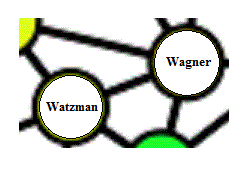
move-010.gif

Move content:

The content of this move is Haim Watzman‘s story Piano Lesson which comes from his Necessary Stories series, on the South Jerusalem blog he shares with my friend and colleague Gershom Gorenberg. It concerns young Felix Mendelssohn, the grandson of the rabbinic scholar Moses Mendelssohn, composer – and the man who revived Bach‘s St Matthew Passion after it had lapsed into obscurity for a century or so.

Links claimed:

With Wagner, in complete refutation of the latter’s opinions about Judaism and musicianship – Watzman’s story opens with the words:

I am impressed. You play like a Jew, Felix. What I mean by that is that you have Johann Sebastian Bach in your heart as well as in your fingertips…

contains this more detailed assertion:

This piece you have played so beautifully for me this morning, the Partita No. 5 in G Major, can only be played properly, in our falscherleuchtung age, this time of false enlightenment, by a person of Jewish sensibility. Please do not interrupt me. At your age you are to listen to your elders first. After you listen you may disagree, you may do whatever you want. But first you must listen.

Sebastian Bach was a devout Lutheran, true, but he wrote Jewish music. I do not say this simply to embellish the repute of my ancestral people. The nation Israel needs no trills. I say this after long years of study and performance of Bach’s music, during which I have come to know this remarkable man. Better, I hazard to say, than his own sons did.

What is Jewish about the music? To see that, you have to know music. Which, of course you know. You also have to know what Judaism is. Which, thanks to my niece, you do not. This is scandalous. The grandson of the great Moses Mendelssohn knows nothing of his own people’s special relationship with God.

and closes with:

Remind me to show you the “St. Matthew Passion.” It is such wonderfully Jewish music!

Comment:

I read this story a day or two after completing moves 8 (Wagner) and 9 (Golgotha) and posting the game thus far to Zenpundit, and was astonished and delighted to find that a mind and heart in Jerusalem – friend of a friend – was touching on the same territory: the relationship of music, especially that of Bach, and Judaism.

But not only does Watzman deftly refute Wagner’s position on Judaism and music as presented in move 8, he also specifically discusses the contrapuntal aspect in both music and religious understanding, and the power of dissonance at times to work towards resolution.

This he accomplishes through a discussion of the two “laws” of Judaism, and the complexities of their musical relationship with one another:

I kept working on the piece and the morning prior to the performance I had my epiphany. Here, let me play it for you.

So where is the stress? Yes, here. And here too. At the end of the melodic line. And at the end of the harmonic progression. Which do not coincide.

You see, the underlying harmonics here are the Torah, the Written Law. And the melody playing above it is the Oral Law. The melody would be hollow, meaningless without the underlying harmony, and the underlying harmony would be incomplete and useless without the melody above it.

The simple-minded might think that the two laws should coincide. What good is a God if his message is not clear?

Yet it is the lack of clarity, the occasional dissonance, the unsynchronized phrases that move us forward, that propel us toward the final resolution. And that final tonic itself sends us off into new melodic and harmonic firmaments, from which we again return to our G major chord. One idea begins before the previous idea has been completed. As when you interrupt your Great Aunt Sara.

There is thus an uncanny melodic line here, running from Said through Bach, Gould, Wagner, to Watzman.

said-watzman.gif

Whatever I am doing here – and it feels at times quite lonely, I am not sure how many people will find this game an easy work to follow – in reading Watzman’s tale of Felix Mendelssohn I felt again my kinship with what has been termed the “invisible cloud of witnesses”…

Indeed, my sense of the gracious synchronicity involved in my stumbling across this particular story of Watzman’s at this particular time can only deepen as Watzman concludes his story – and I my move – with this rendition of the Bach Partita No. 5 in G major BWV 829, played by one Glenn Gould

____________________________________________________________________________________________

Meditation part 2 / Move 11

If the first part of this meditation relates to the game <as a whole, and to the fabric of grace of which, it seems, the universe as a whole is woven, this second part addresses the sense — as bitterly merciless to those who suffer it as grace is merciful to those who receive it — that the fabric of grace is itself picked at and torn by humans, in danger at any point (and perhaps in this moment more than most) of unravelling.

In my personal perspective, I should no more ignore the threat than ignore the grace — for love extends itself in compassion to the one, even as it extends in gratitude to the other.

____________________________________________________________________________________________

Move 11: Auschwitz and Theodor Adorno
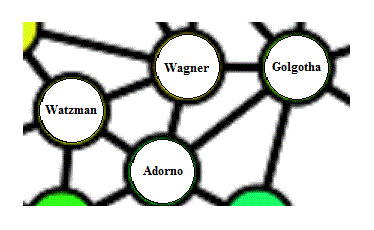
move-011.gif

Move content:
Theodor Adorno famously said: “To write a poem after Auschwitz is barbaric.”

*

Think of this move as a sort of metaphysical black hole, an anti-game.

To expand on this idea a little: Adorno was a musical advisor to Thomas Mann while Mann was writing his novel Doctor Faustus — a copy of which he inscribed to his friend Hermann Hesse with the words “To Hermann Hesse, this glass bead game with black beads, from his friend Thomas Mann, Pacific Palisades, January 15, 1948” – featuring a composer named Adrian Leverkuhn, whose intention in his final work was to retract — cancel, annul — Beethoven‘s Ninth Symphony, and in particular its Ode to Joy with his own oratorio, The Lamentation of Doctor Faustus.

 “I find,” he said, “that it is not to be.”
“What, Adrian, is not to be?”
“The good and the noble, what we call the human, although it is good, and noble. What human beings have fought for and stormed citadels, what the ecstatics exultantly announced — that is not to be. It will be taken back. I will take it back.”
“I don’t quite understand, dear man. What will you take back?”
“The Ninth Symphony,” he replied.

Herbert Marcuse — another modernist philosopher of the left — is quite clear on the power of this Faustian attempt, which he approves as liberating us from “illusion” and indeed “making us see the things which we do not see or are not allowed to see, speak and hear a language which we do not hear and do not speak and are not allowed to hear and to speak”:

The present situation of art is, in my view, perhaps most clearly expressed in Thomas Mann’s demand that one must revoke the Ninth Symphony. One must revoke the Ninth Symphony not only because it is wrong and false (we cannot and should not sing an ode to joy, not even as promise), but also because it is there and is true in its own right. It stands in our universe as the justification of that ‘illusion’ which is no longer justifiable.

Links claimed:

To Wagner, because the mythology of blood and race which he promulgated so stirred one Adolf Hitler that the latter carried out the Shoah, in face of which Adorno finds poetry – hence Orpheus and the muses — speechless.

To Golgotha, because Christ is banished and beaten from the city, Jerusalem, whose name is The Abode of Peace — because there is no more despairing cry than his cry at Golgotha: “My God, My God, why hast Thou forsaken Me?” — because the Descent of Mercy in human form is then brutally executed as a common criminal – because the very veil that protects the holy of holies in the JerusalemTemple is then torn asunder, as his body is broken – because all this marks the darkest moment in the Christian narrative – and because such desolation, felt by the Marys gathered at the foot of the cross, is nowhere so closely mapped in the history of the arts as by the silence of poetry and the arts before atrocity.

And to Watzman, because despite the Shoah — the Golgotha of my civilization and Hesse’s and Bach’s — and despite Adorno, there is poetry in his voice — an Israeli voice, speaking after Auschwitz, in an Israeli State, in Jerusalem.

Comment:

As I was setting out the ground-rules for this game, my friend Lexington Green made what I’d like to call “the essential objection”. He wrote:

Pals send their teenagers to be suicide bombers. That is beyond dissonant. There is no symphony where one group of musicians is committed to a relentless campaign of murder and terror. Said was using this as one more way of playing make-believe, and claiming moral equivalence. In other words, it was a sophisticated move in an elaborate scheme to help disarm his opponents so his fellow Palestinians could kill them.

There is another point of view, which sees the Israelis enforcing a mutant form of apartheid with attendant horrors on an occupied population – indeed, I have Israeli friends who hold some version of this view — but Lex’s point is crucial:

There is no symphony where one group of musicians is committed to a relentless campaign of murder and terror.

This cuts to the heart of the work, as it cuts to the heart of our world. It is, in essence, the issue of theodicy, and which Lex’s permission I am addressing it in this meditation, within the work itself …

My linking of the cry of Golgotha –“My God, My God, why hast Thou forsaken Me?” – with the cry of Adorno – “To write a poem after Auschwitz is barbaric” – is my presentation of the most godforsaken of despair of which we are humanly capable, and I present it within that opposite extremity of human possibility represented by Bach’s motto which I invoked earlier, Soli Deo Gloria.

It is precisely in the context of free will that both possibilities arise, and theodicy becomes an issue. Here, then, is the relationship of darkness to light as described by St John in the Prologue to his gospel:

the light shines in the dark, darkness does not blot it out.

I can say no fairer than that.

____________________________________________________________________________________________

Conclusion:

Oliver Sacks in Musicophilia tells the story of a Manhattan psychiatrist who lived immediately opposite the Twin Towers, and whose otherwise rich interior musical life went blank for months after he witnessed the 9-11 attacks:

My internal life was dominated by a dense and silent pall, as if an entire mode of existence were in an airless vacuum. Music, even the usual internal listening of especially beloved works, had been muted…

“Music”, the psychiatrist said, “finally returned as a part of life for and in me” after an absence of several months. The first music to return was Bach‘s Goldberg Variations.

Again, I must admit it was by no skill of mine but some grace of god or muse that I stumbled on Sacks’ book today, while searching my cramped and overflowing shelves for something else entirely.

There are, it seems true, periods of silence in the arts, while we absorb horrors of our human doing.

There is also a return from those horrors to the arts — even Marcuse admits this — and as forgiveness, mercy and compassion alike claim, to that great possibility, “a happy issue out of all our afflictions”.

Or so the mystics tell the realists — and time grinds all to dust.

[ next ]

Switch to our mobile site