“War is more than a true chameleon that slightly adapts its characteristics to the given case. As a total phenomenon its dominant tendencies always make war a remarkable trinity–composed of primordial violence, hatred, and enmity, which are to be regarded as a blind natural force; of the play of chance and probability within which the creative spirit is free to roam; and of its element of subordination, as an instrument of policy, which makes it subject to reason alone.” -Carl von Clausewitz, On War
“Thus the highest form of generalship is to balk the enemy’s plans; the next best is to prevent the junction of the enemy’s forces; the next in order is to attack the enemy’s army in the field; and the worst policy of all is to besiege walled cities….Therefore the skillful leader subdues the enemy’s troops without any fighting; he captures their cities without laying siege to them; he overthrows their kingdom without lengthy operations in the field. With his forces intact he will dispute the mastery of the Empire, and thus, without losing a man, his triumph will be complete. This is the method of attacking by stratagem.” – Sun Tzu, The Art of War
This blog is read by many people with a deep interest in strategy coming from different philosophical and professional perspectives. While I have my own speculations based on years of study, I would like to begin by first posing a few questions to the readership:
What is the relationship between strategy and creativity?
Or between strategic thinking and creative thinking?
Is “doing strategy” primarily an act of planning, calculation and rational problem-solving or is it also a profoundly creative and intuitive enterprise?
If we get better at thinking creatively, do we become better, more effective strategists? The reverse?
Is creativity more useful in “grand strategy” (or “statecraft”, if you prefer) and policy than in straightforward “military strategy”?
[ by Charles Cameron — cross-posted from Sembl, side-scrollers for the mind, light but deep ]
.
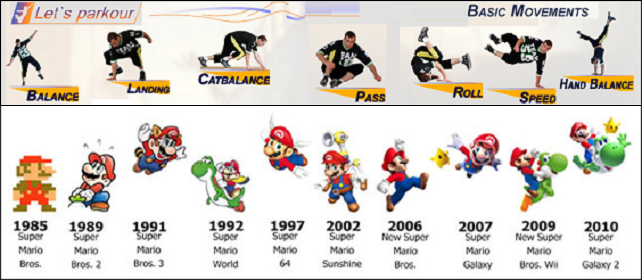
According to 25 Years of Super Mario Bros: A Look Back Through Mushroom Kingdom History, from which I grabbed the Mario Bros portion of the graphic at the foot of this page, “Since 1985’s release of the second-most selling console game of all-time, over 200 Nintendo titles have featured the eponymous Mario Bros” — on which I’ve played perhaps three or four levels of one or two early versions.
The Super Mario Bros side-scrollers (image above, left) are the work of the brilliant Shigeru Miyamoto, and part of what I find so fascinating about them is the way in which they resemble the mind-blowing practice known as Parcours (image, right), which apparently developed from the work of one David Belle, born in 1973 — who would have been 12 when the first Super Mario Bros game came out.
Let’s take a look at Super Mario Bros and Parcours, and then move on to the issue of parcours for the adventuring mind.
**
First, for those of you who don’t remember them, here’s what the early Mario Bros games were like…
I don’t think there’s much doubt that the Super Mario Bros games are essentially digital versions of Parcours, and you can see by comparing the video above with this next one:
Finally, this video from Jesse La Flair confirms the comnnection, at least in the mind of one top flight traceur:
**
My own question is: what would a mental parcours game look like?
I was thinking for a while last week about what a Mario-like side-scrolling game of mental parcours would be like. We already have the “creative leap” side pretty well covered with the various variants of Sembl we’ll be developing, so I thought about other types of mental agility, and what a game might look like if it incorporated a bunch of them — induction? deduction? causality? the sorts of pattern skills that go into IQ tests? — in a side-scroller with playful graphics…
Two things:
One: my friend Derek Robinson pretty quickly informed me that the actual build of such a game would be enormously complex — I resisted him, saying I wasn’t aiming to build the entire game, just to get the idea down on paper to see whether we could get the initial phases funded…
Let’s just say Lumosity seems to have a variety of cognitive skills well in hand, which leaves me free once again to concentrate on what Derek calls the mind’s opposable thumb.
**
That’s a brilliant concept, I think, and gets to the heart of what we’re working on with Sembl.
The various other conceptual skills that essentially add up to linear thinking — Zen calls it vertical thinking, see this helpful diagram — are important, and well-studied. They work best where what you are talking about is quantifiable and amenable to logic and cause and effect analysis, and is explored within fields, not across them.
But lo, that approach may help you quantify the trees and evaluate them as board feet of lumber, but consistently misses the forest, the greater context, the big picture –the combined systemic impact of many tiny details, insects, mosses, the tree as ecosystem within an ecosystem, and the ecosystems within that – the time scale, the slow growth, the root system, the transformation of mulch into nourishment, the sudden spurt of tiny leaves in spring, the photosynthesis — and the human wonder — the glory, dappled sunlight on fallen leaves, the shelter afforded to lovers by a weeping willow (I’m thinking of one willow in an Oxford college garden, but I’m time-traveling and I digress) – the poetry, of beech and birch, copper beech and silver birch, the trees, the words, the metals…
Context, quality, complexity, systems, dynamics, process, simplicity, value, passion, poetry – these are the things linear thinking has problems with. Poetry, passion, value, simplicity, process, dynamics, systems, complexity, quality, context – these are the things horizontal thinking does best.
**
That’s it.
Oh, and hey — just because I like the tiny antics they’re getting up to in the graphics:
[ by Charles Cameron — Netanyahu’s UN speech, Jyllands-Posten cartoon, a nifty film technique, and is there an echo there? ]
.
**
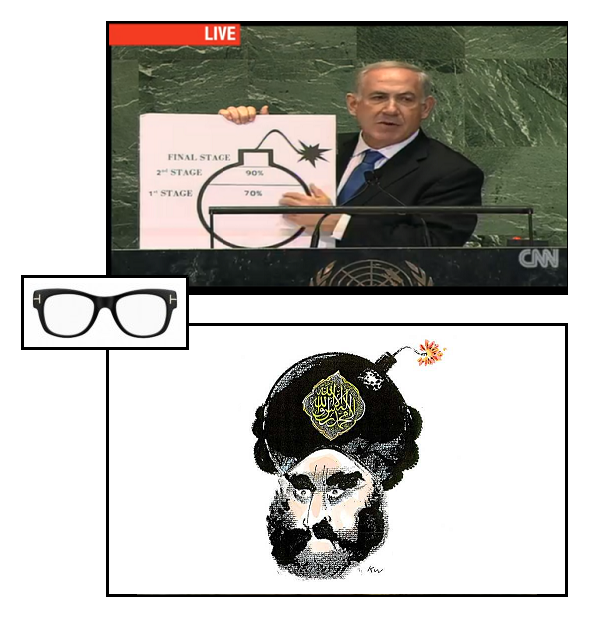
A fair number of people have commented on Israeli PM Netanyahu‘s displaying a cartoonish bomb graphic in the course of his UN address today, and some have complained, fairly IMO, at the choice of photo used to depict Netanyahu during his speech by eg Fox News:
I think it’s important to read graphic messages closely for the cues they contain.
**
Sometimes, as with images of the Virgin Mary seen in grilled cheese sandwiches or oil slicks, the correspondences don’t really mean much more than that the brain is designed for pattern recognition, and a little “imagination” without critical appraisal can get things wrong: the terms commonly used for this are apophenia, patternicity and pareidola.
Nonetheless, I’m reluctant to ridicule such modes of perception without also recognizing the utility of Rorschach blots in psychology and the even more creative uses to which Leonardo put them.
**
Perceived visual similarities, in short, can be the result of creative or merely overheated imagination, but in the visually sophisticated they become much more.
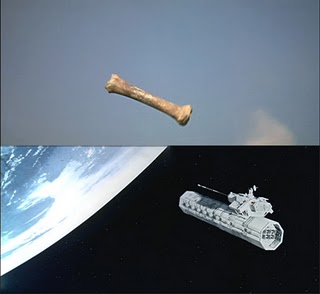
Film-makers, in particular, have several names for the kind of skillful editing by which one scene segues into another via a well-chosen visual similarity: match cut and graphic match.
My personal favorite example is that of Apocalypse Now, where the rotors of the fan in that claustrophobic hotel room in Saigon morph into the rotors of the helicopter coming to take Captain Willard out and away on his mission up river…
Perhaps even more celebrated, though, is Kubrick’s match between the bone tumbling through the air and the space station tumbling through space, in 2001: A Space Odyssey:
**
To get back to Netanyahu, then — is his hand held out a little above vertical, palm down, really a Hitler salute? I think not.
And does his image of a bomb carry any resonance from the Jyllands-Posten cartoon? I have to admit I’m almost undecided on that one.
And if there’s just a hint of a correspondence, would it be conscious or unconscious?
**
The thing is, politicians have to be extremely careful about tossing graphic matches onto dry kindling.
To my own way of thinking, both Netanyahu’s “cartoonish bomb” graphic and his “mid-heil” salute are potential fodder for incautious speculation — but neither one is even remotely as far-fetched as Jerome Corsi‘s claim in a recent WND that a recent Obama campaign use of the Stars and Stripes (above, upper panel) — in admittedly terrible taste — suggests that Obama in any way favored the decease of Ambassador Christopher Stevens in Benghazi (lower panel).
**
My point here, as so often, lies not in any political content or conclusion, so much as in a general purpose invitation to persons of intelligence (and a fortiori, intel) to watch out for possible graphic matches, to make close and cautious readings of visual as well as textual data — in short, to take a closer look…
As of August 2012 this is the best non-fiction book I’ve read this year. Professor Sumida brings a potentially dry topic to life making Alfred Thayer Mahan relevant in the process; as indeed, he should. At a mere 117 pages of moderately footnoted text, Sumida provides the reader a grand tour of Mahan’s life work, not just The Influence of Sea Power 1660-1983. Sumida includes the major works of Alfred Thayer Mahan’s (ATM) father Dennis Hart Mahan, as he introduces ATM’s major works, lesser works, biographies, essays, and criticisms.
Sumida begins his chapters with quotes, and weaves his recounting of ATM’s work with musical performance, Zen enlightenment, and naval command; which is quite a combination, but convincing. Of ATM’s “approach to naval grand strategy” he writes:
Mahan believed the security of a large and expanding system of international trade in the twentieth century would depend upon the creation of a transnational consortium of naval power. His handling of the art and science of command, on the other hand, was difficult, complex, and elusive. It is helpful, therefore, to achieve an introductory sense of its liminal character by means of analogy.
This is where musical performance and Zen enlightenment become relevant and instructive. Sumida writes on musical performance:
Teaching musical performance…poses three challenges: improving art, developing technique, and attending to their interaction.
Sumida goes on to illustrate the parallels between learning musical performance and naval command/strategy and the common thread is performing or, “doing it.” He writes that most musical instruction is through the understudy watching demonstrations by the master, but the higher purpose of replicating the master’s work is “to gain a sense of the expressive nature of an act that represents authentically a human persona.” In other words, the development of relevant tacit knowledge, or as I have come to refer to this as “tacit insight.”
Sumida continues with six short chapters that pack a powerful punch and a good introduction to the trajectory of Mahan’s work from the beginning to end. My favorite was Chapter Six, The Uses of History and Theory. In this chapter Sumida deals with complexity, contingency, change, and contradiction, naval supremacy in the Twentieth Century, Jomini, Clausewitz, and command and history. Quite a line-up, but a convincing inventory of Mahan’s influences and how his work remains relevant today. Sumida writes:
Mahan’s role as a pioneer and extender of the work of others has been widely misunderstood and thus either ignored or misused. The general failure to engage his thought accurately is in large part attributable to the complexity of his exposition, the difficulties inherent in his methods of dealing with several forms of contingency, changes in his position on certain major issues, and his contradictory predictions about the future and application of strategic principles…His chief goal, however, was to address difficult questions that were not susceptible to convincing elucidation through simple reasoning by analogy. He thus viewed history less as a ready-made instructor than a medium that had to be worked by the appropriate intellectual tools.. Mahan’s analytical instruments of choice were five kinds of argument: political, political-economic, governmental, strategic, and professional.
The first three were used in grand naval strategy, the latter two with the “art and science of command.” The section of Command and History is particularly relevant given two recent posts, one at the USNI Blog, The Wisdom of a King, by CDR Salamander, and the other in a September 2012 Proceedings article by LCDR B.J.Armstrong, Leadership & Command. Here’s why: Sumida quotes Admiral Arleigh Burke, who latter became Chief of Naval Operations, during WWII. Of “Decentraliztion,” Burke wrote:
…means we offer officers the opportunity to rise to positions of responsibility, of decision, of identity and stature—if they want it, and as soon as they can take it.
We believe in command, not staff. We believe we have “real” things to do. The Navy believes in putting a man in a position with a job to do, and let him do it—give him hell if he does not perform—but be a man in his own name. We decentralize and capitalize on the capabilities of our individual people rather than centralize and make automatons of them. This builds that essential element of pride of service and sense of accomplishment.
The U.S. Navy could do worse than return to this “father” of naval strategy and give his ideas more attention; Professor Sumida’s little book would be a good place to start.
Strongest recommendation—particularly to active duty Navy personnel.
It appears that the Pentagon no longer intends to educate the most talented members of the officer corps to think strategically.
I say this because the status of the premier professional military education institutions – the war colleges and NDU – have been devalued, their leadership slots demoted and their educational mission degraded. As a guest columnist for Tom Ricks noted back in June:
….The new uniformed leadership of the Armed Forces, i.e., General Dempsey and his staff, apparently intend to prune NDU back to where it was a few decades ago. There will be some modest resource savings, but since the entire university budget doesn’t amount to the cost of a single joint strike fighter, one has to wonder what is motivating all of what is happening here. In the cuts that have been discussed, Dempsey’s deputy, Marine Lt. Gen. George J. Flynn has wielded the meat axe, often with the aid of micromanaging action officers. No one here in the rank-and-file is sure if the urbane chairman is on board with the details of all of this. (Ironically, both the chairman and J-7 are NDU graduates with advanced degrees.)
This set of changes took place in stages. First, while very few general or flag officer slots were cut in the armed forces, the three-star president of the university slot was downgraded to two, and the school commandants, downgraded from two to one star. No big deal, one might say, but one would be wrong, very wrong. A three star in Washington can go head-to-head with a principal on the joint staff or a senior OSD bureaucrat to protect the university. To compound the problem, the last three star president was retired in the spring and the university was left for a few months under the command of a senior foreign service officer, a former ambassador, a woman of great diplomatic talent and experience with no clout in the Pentagon. The new commandant — a highly regarded Army two-star — will not report until deep into June, when all or most of the cuts have been set in concrete. (Interesting question: can an employee of the State Department legally or even virtually assume command of a DoD organization?)
….A new “charter” was subsequently published by the Chairman. It focused the university on joint professional military education and training, which in itself, is a good thing. Immediately, however, the research and outreach activities of the university, often more focused on national strategy than military affairs, came under intense scrutiny. These outfits had grown way beyond their original charters and had become effective and highly regarded servants of a wider interagency community. Much of their work was not done for the joint staff but for OSD Policy, and some of that in conjunction with civilian think-tanks. The research arm of the university was productive, even if not always useful in a practical way to the joint staff. It also was helpful to the colleges in a much more proximate and direct fashion than other think tanks, like RAND.
….The research, gaming, and publications arms of the university — a major part of the big-think, future concepts and policy business here — will be cut to somewhere between half and a third of their original sizes. To make things worse, many of the specific cuts appear to have been crafted in the Pentagon, and nasty emails have come down from on high, about how the university is bankrupt and going into receivership, which was never the judgment of the military and civilian accrediting officials, who inspect us regularly and have generally given the university high marks.
If it would be impressive if some of our senior generals had been as effective on the battlefield as they are in the bureaucracy.
Uncreative destruction of intellectual seed corn is a bureaucrat’s way of telling everyone to shut up, don’t question and get in line. There’s nothing wrong with having excellence at joint operations as an educational goal for most future brigadiers and major generals but our future theater commanders, combatant commanders, service chiefs and their respective staff officers need something more – they need strategy. More importantly, the Secretary of Defense, the President, the Congress and the American people need the DoD to have an in-house capacity to generate deeply thought strategic alternatives, question assumptions and red-team any self-aggrandizing options the services or bureaucracy feel like offering up in a crisis.
The motivation here is simple, really. If you put out all the strategic eyes of the Pentagon, then the one-eyed men can be King. Or he can always contract out his strategic thinking to highly paid friends to tell him what he wishes to hear.
Naturally, this will have bad effects downstream in a superpower whose civilian leadership seldom has as good a grasp of geopolitics and the fundamentals of classical strategy as they do of law or the partisan politics of running for office. They will be in need of sound strategic advice from uniformed military leaders and they will be much less likely to get it. Instead, they will have senior officers who are less likely to balk when the President’s back-home fixer turned “adviser” or superstar academic with delusions of grandeur pushes a half-baked plan at an NSC meeting to “do something”. When that happens, the jackasses kicking down this particular barn will have long-since retired and cashed out with consultancies and sinecures on boards of directors.
While a lack of strategic thinking can undermine even a lavishly funded and well-trained military, the reverse is also true; strategic leadership can revive an army that is but a half-dead corpse.
A brief illustration:
After WWI the two states that made the most extreme cuts in military power were defeated Germany and the victorious United States. Germany was forced to do so by Versailles, but responded by opting under General von Seeckt to reduce to 100,000 men by making the Reichswehr a qualitatively superior nucleus of a future expanded German Army. Prohibited from having mass, the Germans opted for class with every long-serving recruit being considered officer material and being superbly trained (even to the extent of covert training and weapons testing jointly with the Red Army deep inside the Soviet Union to evade Allied inspections). Von Seeckt also instituted a shadow general staff office that thought deeply about tactical lessons, operations and strategy for the next war. Without the Reichswehr being what it was it is highly dubious that Hitler could have so rapidly expanded the Wehrmacht into a world-class land fighting force in so few years time.
.
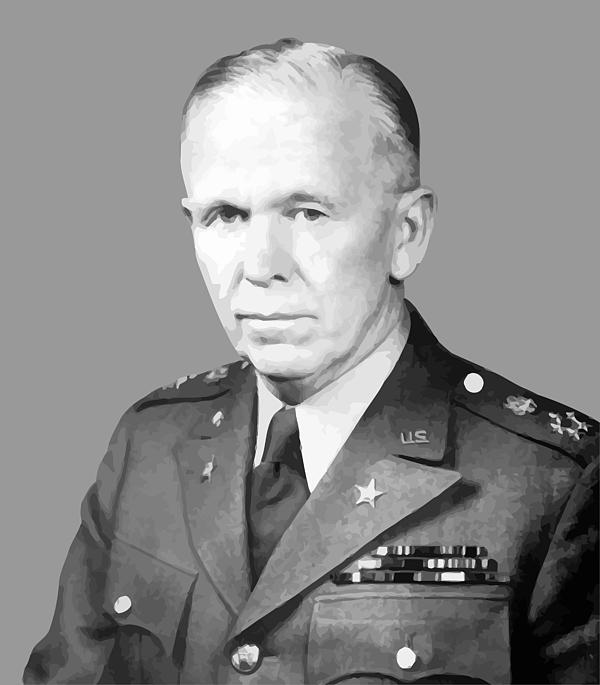
In contrast, the United States radically reduced the size of the regular Army and starved it of weapons, ammunition, gasoline, training and basic supplies. Promotions slowed to a crawl where ancient colonels and elderly majors lingered on active duty and future four and five star generals like Eisenhower, Patton, and Marshall all despaired and contemplated leaving the service. The Army’s – and to extent, America’s – salvation was in the fact that George Marshall persevered as a major and colonel in keeping a little black book of talented, forward thinking, officers and thought deeply and reflectively about building armies, helping enact “the Fort Benning Revolution” in military training. When FDR placed the power in Marshall’s hands as Chief of Staff he knew exactly what to do because he had a well-conceived vision of where the US Army needed to go to meet the national emergency of WWII. He was the American von Seeckt, except that Marshall was an infinite improvement morally, strategically and politically on his German counterpart. We were extremely fortunate to have had him.
Zenpundit is a blog dedicated to exploring the intersections of foreign policy, history, military theory, national security,strategic thinking, futurism, cognition and a number of other esoteric pursuits.