Osama and the flute of the devil
Wednesday, May 9th, 2012[ by Charles Cameron — curiosity and classical music leads me on a merry chase from Bach and bin Laden via LastFM and Chorus Angelus to the heraldry of the Afridi, a Forsane Alizza video and the death of Superman ]
.
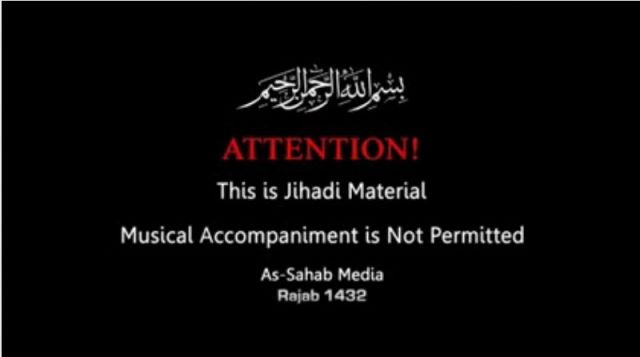
I’m grateful to JM Berger (@intelwire) and Chris Anzalone (@ibnsiqilli) for their encouragement and help with this post. JM provided the screengrab above, which shows a title card from a recent al-Zawahiri video — I suspect it may have been the one he mentioned here [text now mildly updated]:
Back in the day, when Adam Gadahn was just getting started as guru to Al Qaeda’s media operations, he released a couple of fairly slick videos designed to appeal to Western audiences by mimicking Western documentaries — up to and including the presence of a musical soundtrack.
It is therefore interesting to note that the latest release from As-Sahab (which Gadahn basically runs at this point) opens with a short disclaimer. “ATTENTION: We do not permit musical accompaniment with our productions.” One second later, a nasheed (religious song) fired up, but I guess that doesn’t count.
I’m guessing this is due to input from one of Gadahn’s Al Qaeda overseers. It’s interesting that these guys can rationalize away visits to strip clubs but they can’t handle a light orchestral score.
Chris tells me that Tehrik-i Taliban Pakistan has included similar notes in some of its videos. Indeed as JM put it in a tweet yesterday, “The odd thing is most of these guys would not be cool with music” — while as Chris noted, “Opposition to music with instruments, it should be said, isn’t unique to jihadis.”
So that’s the context: here’s the thing that interests me.
*
I can appreciate using the Old Master’s portrait of Christ that’s on the album cover to accompany a YouTube video of Bach’s B Minor Mass performed by Philippe Herreweghe (left), I can understand using a series of “nature scenes” for the Diego Fasolis performance (middle), I can even bite my lip and remain silent when someone lays a cute graphic of a wide-eyed young thing with a white rabbit (right) on top of Ton Koopman‘s version —

But my eyes simply bug out when I find someone has posted not one but four versions of Bach’s great Mass on YouTube, on not four but 42 separate videos, with bin Laden talking — silently, his lips moving — on each one.
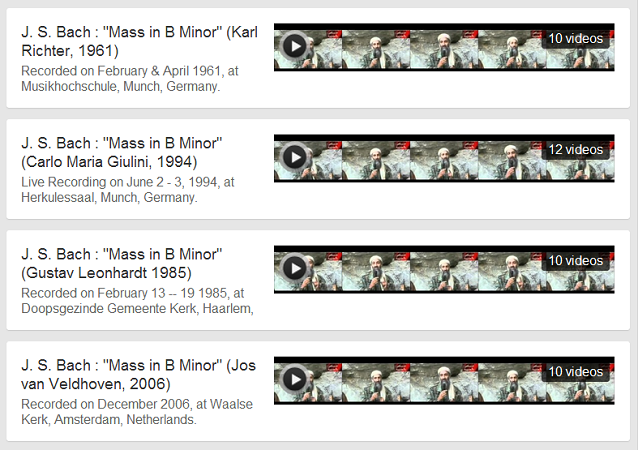
Amazingly enough, that’s what someone calling themselves SOMALIAAFGHANISTAN has done.
*
Look, people, this is strange.
Lawrence Wright quotes Osama bin Laden [link, at p 167] as saying “Music is the flute of the devil”.
I was doing some research for this post on Google, and ran across this:

Fair enough, I thought, and went to Last.FM, where I found this artist featured:

Bullet for my bloody valentine.
I kid you not.
*
See, this all started because I was looking to play myself some Bach organ music and ran across a video of Marie-Claire Alain performing Bach’s BWV 767, which is pretty terrific — Alain is a great organist, it’s a remarkable work, etc etc — and found myself staring at this:

I mean, that’s not from the Bach part of my life, that’s from the part of my life that tracks jihadist utterances and theology…
*
As my friend Chris Anzalone, whose posts on jihadist graphics I always read with interest, pointed out to me, this particular video has an extensive explanation of its heraldic significance attached:
Coat of Arms Of The Famous Afridi Pashtun Afghan Pathan Tribe
Flag of the Afghan Tribe – The Afridi.
Made from historical Texts & references.
Main Circle/Islam Symbolism:
White circle: Unified, unbroken & Islam 4 stars: 4 sons of Qis/Kesh/Qais Abdur Rashid Crown: Representation of Qis/Kesh/Qais Abdur Rashid & his Bani Israel lineage which is from the Ancient Royal House of Israel Lion with Flag: The Lion of Judah/The Bravery of the Afghans & the emblem of many Afghan Kingdoms Olive Tree: Descent from the House of Israel/Bani Israel Black Background: The world in troment, pain & ignorance, showing the messianic dedication of Afghans that spread Islam through kings and Sufis throughout India.
Tribal Symbolism on Coat of Arms:
Babe Khyber/Fort: Defending the borders of Afghanistan for centuries and masters of siege warfare. They successfully held the mountain passess of Afghanistan against the counter attack of many Indian Armies. Bolt Rifle: One of the first among Afghans to master the art of local Rifle and small arms making. They were famous for their sniper marksmen skills with the 3 not 3 or .303. Camel Caravan: Afridis are skilled businessmen. AK 47: Every Afridi child is given one before passing into adulthood.
Red Background: The Traditional color of the Afridis.Reference Material:
* The Pathans 55O B.C.-A.D. 1957 By Sir Olaf Caroe
* History of the Afghans by Bernhard Dorn
* History of the Afghans Original by Neamet Ullah (active 1613-30) in the court of the Mughal emperor Jahangir (1569-1627)
* Tareekh i Farishta
* History of the Afghans edition X by Fut’h Khan in 1718
* The Works of the Pashto Academy Peshawar University and The Pashto Dept. Islamia College Peshawar through countless publications, both online and offline, and may writers including Dr. Yusafzai, much of which you can find at Khyber.org
* History of Kohat -Gazetteer of the Kohat District
* History of Peshawar -Gazetteer of the Peshawar District
* Afghan Poetry: Selections from the poems of Khush Hal Khan Khattak., Biddulph, C.D., Saeed Book Bank, Peshawar, 1983 (reprint of 1890 ed.)
* A Grammer Of The Pukhto, Pushto: Or Language Of The Afghans, Raverty, H.G., London, 1860
* Poems from the Diwan of Khushâl Khân Khattak, MacKenzie, D.N, London, Allen & Unwin, 1965
* Notes on the Tarikh-e-Murassa, Plowden, Maj.
* Settlement Report of Bannu, Thorburn
This text, in turn, comes from a Wikipedi page on the Afridi Tribal Flag posted by a user named Afghan Historian. Who has an enviable library.
Sadly enough, Wikipedia notes “The factual accuracy of this description is disputed” — although it’s not clear by whom.
*
There are interesting references in the scholarly footnotes to the Afridi flag to “Qais Abdur Rashid & his Bani Israel lineage which is from the Ancient Royal House of Israel” and to “the messianic dedication of Afghans that spread Islam through kings and Sufis throughout India”…
The idea that the Afghans are descendants of the “lost tribes” of Israel is explored in the Jewish Virtual Library here. As to the Afghans’ “messianic dedication” — I’m not clear exactly what the word messianic means in this context, but it’s an interesting word choice in any case.
*
When I first looked up this image on TinEye, my image-search engine of choice, the only version it reported was from the site of Forsane Alizza, a now-disbanded group in France whose leader claims to preach only non-violence:
Je vous préviens dès maintenant que je n’ai ni armes, ni explosifs, ni drogues, ni même quoi que ce soit d’illégal. Si cela venait à arriver, soyez intelligent réfléchissez et souvenez vous que depuis sa création et jusqu’à la fin, Forsane Alizza use et n’usera, que de sa liberté d’expression et son droit à manifester contre des lois injustes et illégal au vu des droits de l’homme. D’ailleurs toutes nos actions sont non violentes et elles le resteront.
while the security police claim to have found weapons in his house.
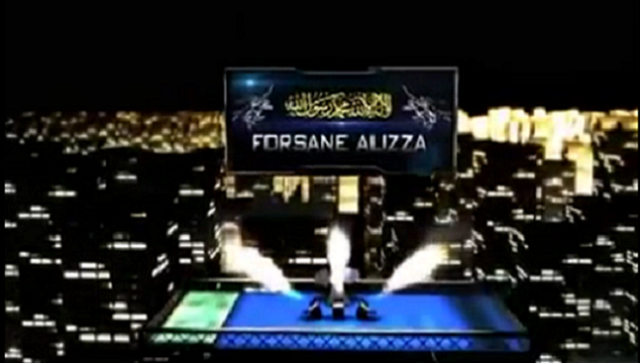
The Forsane Alizza video, from which the snazzy image directly above was taken, shows members practicing martial arts and painball games…
*
And how’s this for an illustration of Bach’s BWV 566, the C Major Toccata and Fugue — and the death of American pop culture?
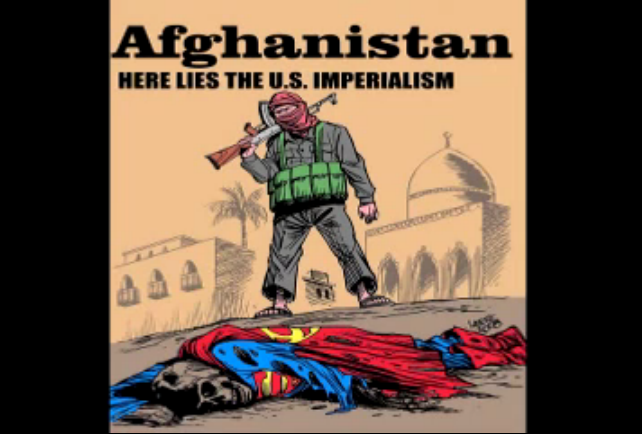
To sum up: what’s all this about? Why pair Bach with bin Laden, the Afridi, the demise of superman and all the rest?
*
I don’t want to leave you with a bad taste in your mouth.
If you want to see what it’s like to hear Gustav Leonhardt conducting the Kyrie from the B Minor Mass juxtaposed with images of bin Laden, you’ll find that here. You may, of course, prefer the Herreweghe version, with another variant of his album cover with the face of Christ as the accompanying visual…
And for Marie-Claire Alain performing Bach, sans the Afridi, may I recommend this hour long recital, which I just happened upon myself thanks to this post?