zenpundit.com » national security

Archive for the ‘national security’ Category

Foreign Affairs on the National Security Adviser

Wednesday, May 27th, 2009

This caught my eye, from Foreign Affairs:

Jonestown: Will Obama’s National Security Council Be “Dramatically Different?”

But Jones remains something of a question mark. The most successful national security advisers — McGeorge Bundy, Henry Kissinger, Brent Scowcroft, and Sandy Berger — were effective thanks to strong personal and policy relationships with their presidents, and it remains unclear whether Jones will establish a similarly close connection with Obama. The retired marine general has garnered widespread bipartisan respect for his integrity, but he had met Obama only twice before being appointed to the job.

History suggests that this is not an insuperable obstacle: Bundy built his relationship with Kennedy, and Kissinger his with Nixon, only after moving to the White House. But both Bundy and Kissinger immersed themselves in the substance of presidential policy, and their operational styles (Bundy’s was open and casual, while Kissinger’s was tight and controlled) were natural fits for their respective bosses.

Jones’s personal style does not seem to be so good a match for Obama’s. Jones is a career military man accustomed to operating within a hierarchical structure, where rank matters and information and recommendations move through predictable channels. Even at its most structured, policy-making in the White House is never like this, and it appears to be particularly far from it under this president. For Jones, Bundy’s experience may be the most relevant, since Obama resembles Kennedy more than any other U.S. president since World War II. He is cool, cerebral, and substance-oriented.  Like Kennedy, he is a former senator and accustomed to informal processes, going to individuals rather than large organizations for advice. As a onetime community organizer, he has had additional experience with fluid situations that Kennedy never had. And as a former law professor, Obama is attracted to disputation as a means of garnering facts and making decisions instead of relying on the counsel, however well grounded, of a single aide, or having others’ views channeled through a particular aide

This would seem to be a misreading of the situation to me.

Gen. Jones, first of all, is not Al Haig or some general out of Hollywood central casting. He is forceful, a useful trait as President Obama intends to hold tight control over foreign policy, but Jones’ career was marked both by innovative thinking and the holding of high posts unusual for a Marine general officer, including leadership of humanitarian and multinational intervention and supreme allied commander in Europe. Excellent preparation for the sort of foreign policy problems the Obama administration is most likely to face – complex, disorderly, subnational and/failed state and with heavy diplomatic-political implications as well as shooting wars of insurgency, COIN and terrorism.

President Obama spent most of his time before becoming chief executive on a limited number of domestic policy issues, constitutional law and navigating the treacherous waters of Chicago politics. Neither foreign policy nor military affairs was an area of interest or expertise for Barack Obama and the presence of General Jones at the NSC is politically useful in itself, as is Jones’ determination to rein in the bureaucracies at meetings of NSC principals or their deputies. Making Jones both enforcer and consigliere  – but also one who has enormous “street cred” in the national security-defense communities.

ADDENDUM:

Matt Armstrong is discussing consolidation and revamping at the NSC.

Barnett, the Bomb and Obama

Friday, May 15th, 2009

In line with the vigorous discussion in the comment section of the previous post, Tom Barnett weighs in on Obama’s nuclear utopianism in Esquire Magazine:

3. An America with fewer nukes breeds a new class of military powers.

By reducing “barriers to entry” to the marketplace called great-power war, I believe we would actually encourage the proliferation of nuclear weaponry. If Obama and his successors were to withdraw America’s virtually global nuclear umbrella, numerous middle powers would become highly incentivized to fill that security gap.

Of course, the dream would be to include all such states in a global rejection of nuclear weaponry, but that’s not likely if the system’s clear Leviathan (the United States) demotes itself to the status of a de-nuclearized great power. That scenario (Obama’s scenario) instantly elevates a slew of suddenly “near-peer” military powers in a manner that smaller states will likely find strategically unpalatable. As in, they could be blown into oblivion — strategic or literal — at any moment.


4. A new class of military powers breeds a new round of local wars.

The fallout from the collapse of our nuclear umbrella would be as frightening as it would be immediate: the resumption of great-power rivalries and proxy wars in regions once again subject to profound spheres of influence. That would further complicate the strategic landscape and undo so much of the Obama administration’s diplomatic success between now and then.

Read the rest here.

I think that Tom belted it out of the park here. Good policy seldom emerges from bad premises.

The Wrath of Kahn

Wednesday, May 13th, 2009


The post title is tongue in cheek. Herman Kahn was anything but wrathful and came across in his day as a remarkably cheerful strategist of the apocalypse and deep futurist. Long time readers have noted my admiration for Kahn’s metacognitive strategies but for those unfamiliar with Herman Kahn, he was one of those polymathic, individuals of the WWII generation who, like Freeman Dyson and Richard Feynman, could jump into high level nuclear physics research without bothering to first acquire a PhD in the field (Feynman later received a doctorate, Dyson and Kahn never did). Kahn was noted for his forthright willingness to consider humanity’s long term prospects despite the worst calamities imaginable – unlike most optimists, he assumed the events most terrible could happen – but life nevertheless would go on. A position that caused many of his critics to go ape, including the editors of Scientific American.

I bring this up because his daughter, Deborah Kahn Cunningham, emailed to say that Kahn’s classic On Thermonuclear War  had been reissued by Transaction Publishing and there would soon be a new edition of On Escalation the latter of which will have a new foreword by the eminent nuclear strategist Thomas Schelling.
This could not come at a better time. The Obama administration is making grandiose gestures with America’s nuclear deterrent based less on a hardheaded and comprehensive strategic analysis than self-serving political showmanship, tailored to mollify a Left-wing base deeply resentful of the COIN strategy the administration is starting to take in Afghanistan. Nuclear weapons affect the strategic calculus across the entire spectrum of potential decisions, they’re not just shiny, anachronistic, bargaining chips but the overwhelming reason that great power war came to an end in 1945. Period.

Human nature has not made much moral progress since the end of the Third Reich but its very worst instinct for total destruction has, so far, been held at bay by the certainty of self-destruction.

We need someone to remind us again of how to think about the unthinkable.

The Pushtunistan War

Tuesday, May 12th, 2009

Juxtaposition of two events today, for your consideration.

Former CIA Kabul Station Chief and NIC member Graham E. Fuller, bitterly blasted the Obama administration over Afghanistan-Pakistan strategy at the Huffington Post in a piece he originally had run, oddly, in The Saudi Gazette:

Global Viewpoint: Obama’s Policies Making Situation Worse in Afghanistan and Pakistan

— Military force will not win the day in either Afghanistan or Pakistan; crises have only grown worse under the U.S. military footprint.

— The Taliban represent zealous and largely ignorant mountain Islamists. They are also all ethnic Pashtuns. Most Pashtuns see the Taliban — like them or not — as the primary vehicle for restoration of Pashtun power in Afghanistan, lost in 2001. Pashtuns are also among the most fiercely nationalist, tribalized and xenophobic peoples of the world, united only against the foreign invader. In the end, the Taliban are probably more Pashtun than they are Islamist.

— It is a fantasy to think of ever sealing the Pakistan-Afghanistan border. The “Durand Line” is an arbitrary imperial line drawn through Pashtun tribes on both sides of the border. And there are twice as many Pashtuns in Pakistan as there are in Afghanistan. The struggle of 13 million Afghan Pashtuns has already inflamed Pakistan’s 28 million Pashtuns.

— India is the primary geopolitical threat to Pakistan, not Afghanistan. Pakistan must therefore always maintain Afghanistan as a friendly state. India furthermore is intent upon gaining a serious foothold in Afghanistan — in the intelligence, economic and political arenas — that chills Islamabad.

— Pakistan will therefore never rupture ties or abandon the Pashtuns, in either country, whether radical Islamist or not. Pakistan can never afford to have Pashtuns hostile to Islamabad in control of Kabul, or at home.

— Occupation everywhere creates hatred, as the U.S. is learning. Yet Pashtuns remarkably have not been part of the jihadi movement at the international level, although many are indeed quick to ally themselves at home with al-Qaida against the U.S. military.

— The U.S. had every reason to strike back at the al-Qaida presence in Afghanistan after the outrage of 9/11. The Taliban were furthermore poster children for an incompetent and harsh regime. But the Taliban retreated from, rather than lost, the war in 2001, in order to fight another day. Indeed, one can debate whether it might have been possible — with sustained pressure from Pakistan, Iran, Saudi Arabia and almost all other Muslim countries that viewed the Taliban as primitives — to force the Taliban to yield up al-Qaida over time without war. That debate is in any case now moot. But the consequences of that war are baleful, debilitating and still spreading.

— The situation in Pakistan has gone from bad to worse as a direct consequence of the U.S. war raging on the Afghan border. U.S. policy has now carried the Afghan war over the border into Pakistan with its incursions, drone bombings and assassinations — the classic response to a failure to deal with insurgency in one country. Remember the invasion of Cambodia to save Vietnam?

Read the rest here.

Fuller does not understand his Vietnam War history (or if he does, then he is the master of irony) but he has a good handle on the nature of Pustunistan and of regional Islamism. The Taliban and neo-Taliban are half-educated, zealously religious, violent hillbillies who are looked down upon by Pakistani elite much the way Manhattan hedge fund managers and New Yorker magazine columnists would look at snake handling, fundamentalist, Christians from Appalachia if the latter were tramping around Georgetown suburbs with shotguns and RPG’s. I agree with Fuller that culturally transforming the average, functionally illiterate, 25 year old Pushtun tribal warrior with a 3rd grade education from a stripped-down neo-Deobandi madrassa funded by wealthy Saudi Arabian fanatics is well beyond our capacity.

But in terms of shifting U.S. strategy in Afghanistan and Pakistan, is that kind of cultural tranformation really the goal?

I think not. Predators are not meant to be persuaders except in the negative sense to communicate to al Qaida and the Taliban that no safe haven exists on the Pakistani side of the imaginary Durand line. I do not think the Obama administration is aiming for a quarter-century process of housebreaking the Pathans into a gentle Islamic debating society. Nor should they. We’d have an easier time sending men to Mars.

The second and far more reported item is that General David McKiernan has been fired by Secretary of Defense Robert Gates and replaced by Lieutenant-General Stanley McChrystal, a specialist in black ops and irregular warfare. I was asked for a quote earlier today by Dr. James Joyner of The Atlantic Council, and my immediate impression of the news was as follows:

Policy wonk Mark Safranski guesses that this has to do with tensions between McKiernan and new CENTCOM boss David Petraeus. Via email, he suggests that the recent decision to treat Afghanistan and Pakistan as a single theater “requires somebody very comfortable with close coordination with CIA special activities staff and the AF-CIA joint targeting shop, who is used to having the White House looking over his shoulder as operations are conducted.” He adds that, “Traditionally, the regular Army has never made appropriate use of special forces, a history that goes back to the Vietnam War – and definitely an issue in Afghanistan since at least late 2002. If McKiernan continued that hallowed tradition, it would have been an added irritant in his relations with Petraeus, who as CENTCOM boss is the 800 pound gorilla. I would expect, further, that Petraeus and Gates are on the same page in regard to how special operations troops are to be integrated into any strategy in Afghanistan.”

Subsequent leaks in the news indicate that Gen. McKiernan was viewed as “too conventional” in his thinking, though I will wager that is not the whole of the backstory. I would add, after digesting some of the news, that the United States is moving toward an operational posture in Afghanistan for the use military force that is more like a rapier than a sledgehammer – but the rapier is going to be used to stab very deep into Pakistan, whose ISI refuses to stop funding, arming and training wild-eyed neo-Taliban militias. This will also cause some of the Islamist Frankenstein monsters running around the FATA, to return to their creators. An action John Boyd would have describe as “folding the enemy back on themselves”.

Interesting times.

ADDENDUM:

Fine blogs commenting on these stories…..

Armchair Generalist

Thomas P.M. Barnett

Registan

Danger Room

Thomas Ricks

Threatswatch.org (Fraser)

The Newshoggers (Hynd)

Abu Muqawama

SWJ Blog

SWJ Blog – Round Up Post

New Atlanticist

Foreign Policy -Passport

Strangling OSINT, Weakening Defense, Censoring Criticism: The Pentagon

Wednesday, April 29th, 2009

banned.jpg

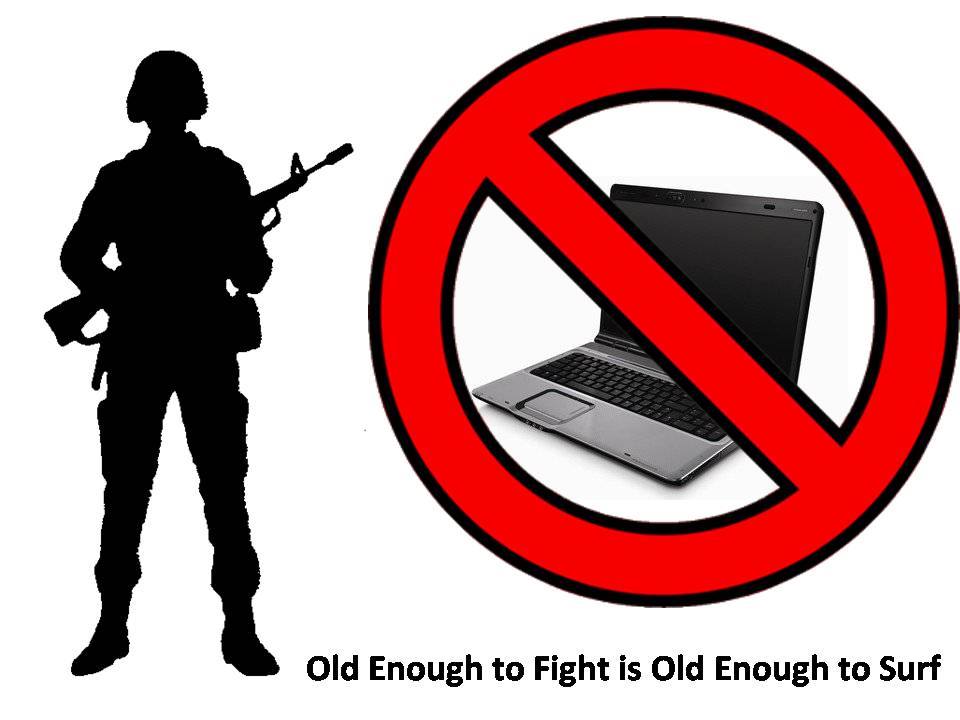
William Lind has a new post up at Defense and The National Interest that addresses the issue of the IT restrictions on the use of the internet by military personnel. This topic has been touched on previous by others such as at the SWC, SWJ Blog, Haft of the Spear, Hidden Unities and many milbloggers, intel and cyberwonks but previously, IT policy varied across services and from command to command. That appears to be changing – for the worse.

On War #302: Blinders

At the height of the Cold War, a U.S. army corps commander in Europe asked for information on his Soviet opposite, the commander of the corps facing him across the inter-German border. All the U.S. intelligence agencies, working with classified material, came up with very little. He then took his question to Chris Donnelly, who had a small Soviet military research institute at Sandhurst. That institute worked solely from open source, i.e. unclassified material. It sent the American general a stack of reports six inches high, with articles by his Soviet counterpart, articles about him, descriptions of exercises he had played in, etc.

What was true during the Cold War is even more true now, in the face of Fourth Generation war. As we have witnessed in the hunt for Osama, our satellite-photo-addicted intel shops can’t tell us much. But there is a vast amount of 4GW material available open-source: websites by and about our opponents, works by civilian academics, material from think-tanks, reports from businessmen who travel in areas we are interested in – the pile is almost bottomless. Every American soldier with access to a computer can find almost anything he needs. Much of it is both more accurate and more useful than what filters down through the military intelligence chain.

Or at least he could. In recent months, more and more American officers have told me that when they attempt to access the websites they need, they find access is blocked on DOD computers. Is al Qaeda doing this in a dastardly attempt to blind American combat units?
Sadly, no. DOD is doing it. Someone in DOD is putting blinders on American troops.

I do not know who is behind this particular bit of idiocy. It may be the security trolls. They always like to restrict access to information, because doing so increases their bureaucratic power. One argument points to them, namely an assertion that the other side may obtain useful information by seeing what we are looking for. That is like arguing that our troops should be given no ammunition lest muzzle flashes give away their positions in a fire-fight.

But the fact that websites of American organizations whose views differ from DOD’s are also blocked points elsewhere. It suggests political involvement. Why, for example, is access to the website of the Center for Defense Information blocked? CDI is located in Washington, not the Hindu Kush. Its work includes the new book on military reform America’s Defense Meltdown, which has garnered quite a bit of attention at Quantico.

The goal of the website blockers, it seems, is to cut American military men off from any views except those of DOD itself. In other words, the blockaders want to create a closed system. John Boyd had quite a bit to say about closed systems, and it wasn’t favorable.

Read the rest here

What is disturbing to me is that Lind indicates that the previous policy, which left IT restrictions up to commanders, seems to be coalescing behind one of systemic, tight, restrictions on access for all uniformed personnel to all kinds of blogs or websites that do not jeopardize information security. Or may even be useful to the conduct of their mission. The previous excuse by DoD bureaucrats was “conserving bandwidth” but it’s hard to see how esoteric sites like the Center for Defense Information or some university PDF on Islamist madrassas in Pakistan clog up a combatant command’s skinny pipes.

Intel and cyber experts in the readership are cordially invited to weigh in here.

ADDENDUM:

Professor Sam Liles offered up this manifesto on cyberthreats and cybersecurity.

ADDENDUM II:

Fabius Maximus, Ubi war and Wings Over Iraq took a similar view ( Wings though, added “Curse you Zenpundit!”).

ADDENDUM III THE COUNTERPOINT:

Galrahn says Bill Lind does not understand the legitimate cybersecurity aspect that causes blogs and websites to be blocked and then offers some practical advice to the blocked bloggers (such as myself):

….but I’d bet at least 5 shots of Canadian Whiskey (I’m a Crown Royal fan until summer gets here) that the problem that triggered his rant doesn’t originate in the DoD or any government entity, rather the private sector.

But I will say this. There are several legitimate reasons why websites, blogs, and other forms of social media sites on the web are blocked. If your website or blog is blocked, please understand you can do something about it besides whine.

Use Feedburner, or some other form of syndication software to distribute your content, including by email. Organizations including the military may block Blogger but typically they do not block syndication service sites because from an IT perspective, syndication services like Feedburner is a better way to manage bandwidth for larger enterprises. If an organization is blocking syndication sites too, then your organization has a very strict IT policy, BUT if your favorite websites are distributing content by email, problem solved

I used Feedburner previously with my old blogger site when Feedburner was in beta but when it was purchased or absorbed by Google, that account went dormant. I think I will ressurect it and then look into Galrahn’s other suggestions.


Switch to our mobile site