zenpundit.com » science

Archive for the ‘science’ Category

Numbers by the numbers: four

Wednesday, July 18th, 2012

[ by Charles Cameron — importance of the ratio form (“this is to that as thus is to so”) as a bridge between domains and silos, creative leaps, the glass bead game, and finally, Chittick’s joke about camels, sex and translations from the Arabic ]
.
.

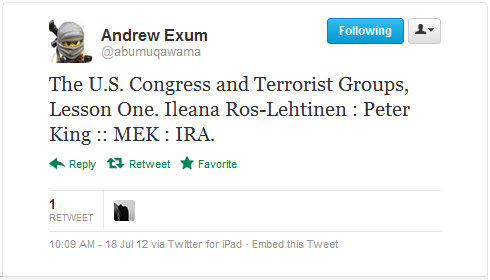
I retweeted this tweet of Andrew Exum‘s to my friend Paul Pilkington because I know he’s working on a project to find out what “this is to that” is to some other “this is to that” — across a wide swathe of human culture.

Note particularly that Exum is using this formal device to illuminate, to give insight, in an area of importance to analysts, strategic thinkers and decision makers.

I’m also retweeting Exum to Paul because I believe Paul’s simple experiment, based as it is on his reading of Hermann Hesse‘s Glass Bead Game, has the capacity to build an architecture of thought (a) crossing all disciplines and (b) spanning the trivial with the profound.

I’m doing something similar with Cath Styles in our Sembl games project — but this time I want to concentrate on Paul’s approach, and since there are four moving parts in an a is to be as c is to d configuration, I’m calling this post Numbers by the numbers: four — number three will just have to wait a while.

**

To get a sense of what Paul is up to, we can go to his Twitter Project page, which describes the fourth in a series of books he’s writing — and also follow him on Twitter, where he posts as Just Knecht.

Two of Paul’s recent tweets express his sense of the task pretty incisively:

The whole of language is the holding up of one unlike thing to compare, contrast and connect with another

Curating is a matter juxtaposition of work against work, artist against artist, place against place – A.Searle on Documenta 13, The Guardian

On his Twitter Project Page, he tells us:

Each tweet is an individual Glass Bead Game move, which is a comparison (metaphor, simile or analogy) across different areas, and may be either a statement or a question.

In question form, these are not unlike analogy questions from SAT tests with an additional dimension of general knowledge, cultural invention and intellectual playfulness. The basic challenge is to work out the relationship between two terms in one context, and apply it in another. Sometimes a tweet will extend an analogy further, which would be the beginning of forming a larger game from an individual move.

Some of the most interesting moves do not have right or wrong answers. Some have canonical or original answers, but they’re not necessarily right. In fact, very often I will post something I’ve picked up from elsewhere which I would love to see improved on, challenged, or at least better explained by others.

He then poses some of the sorts of questions that intrigue him:

Who is the J.H.Prynne of contemporary dance? Like Prynne in contemporary poetry they need to have been ‘out there’ right at the edge of theory and practice for some time, and also deeply steeped in tradition at the same time. Merce Cunningham? Suggestions welcome … And Heston Blumethal or Ferran Adrià might be the Prynne of cookery. But what about the Prynne of contemporary warfare?

What is the equivalent of sonata form in architecture? Goethe and Hegel both said ‘architecture is frozen music’ but neither really explained what they meant. If it is, then is there an architectural equivalent in Western architecture of the key structural form in Western art music? Suggestions welcome …

So, Zenpundit readers — who is the JH Prynne of contemporary warfare?

**

Not so long ago, in Numbers by the numbers: one, I posted a series of self-referential tweets that I’d collected over the last month or two — here I’d like to present some of Paul’s recent tweets:

Let’s start with one that’s a foreign policy insight, arguably as significant to day as it was when Vance first said it:

16 Jul @justknecht
“The Strait of Hormuz is the jugular vein of the West” (Cyrus Vance)

If these tweets can be timeless, they can also be timely:

4 Jul @justknecht
The Higgs boson is the quantum of the Higgs field, just as the photon is the quantum of the electromagnetic field

As they accumulate over time, they can build a conceptual “mesh” that engages an entire field — in this case, recent classical music — while linking it to a variety of other areas:

16 Jul @justknecht
“Boulez’ Derive 2 sounds like birthday cakes ought to” – Philip Clark, Gramophone

22 Jun @justknecht
Wagner was a beautiful sunset that was mistaken for a dawn – Claude Debussy, quoted by Geoffrey Norris in Gramophone

30 May @justknecht
Fauré’s Theme and Variations (no. 9) is like an evening star falling slowly from the sky – Bryce Morrison cites Alfred Cortot in Gramophone

11 May @justknecht
Kraftwerk is the Warhol of pop music – The New Yorker

There’s profundity here:

9 Jun @justknecht
“Space is to place as eternity is to time.” – Joseph Joubert

This could be, as Paul says, “the beginning of forming a larger game from an individual move” — that quote in itself could plausibly be the keystone of an architecture bridging science with religion…

There are historical parallels to consider:

31 May @justknecht
Robert Burton : Oxford :: Jeremy Prynne :: Cambridge

Catty remarks by Nobel laureates:

21 May @justknecht
“Thinking is to humans as swimming is to cats” (Nobel laureate Daniel Kahneman)

Near-tautologies:

21 May @justknecht
Macon Telegraph: Recipes are to food as blueprints are to buildings.

And, ooh, exotic forms of slander!

18 May @justknecht
“[Your daughter] has lovers as numerous as the striking of tablas on Palm Sunday” – Arabic satire by Abu Nawas, 756 – 813 AD

Once again, it’s form that generates insight, not content. Get used to form, play around with it, and content will leap out at you from the page, from the screen.

**

I’m no Arabist myself, but ah! that last quote reminds me irresistibly of the difficulties faced by translators from the Arabic, as recounted by William Chittick in The Self-disclosure of God: Principles of Ibn Al-‘Arabi’s Cosmology (SUNY Press, 1998, pp. xxxv-xxvi.)

An old joke among orientalists tells us that every Arabic word has four meanings: It means what it means, then it means the opposite of what it means, then it has something to do with sex, and finally it designates something to do with a camel …. The rational mind tends to push the meaning of a word away from experience to ‘what it means’ but the imaginal mind finds the self-disclosure of the Real in the sex and the camel … it is in the world’s concrete realities that God is found, not in its abstractions.

I’d been looking for an excuse to post that quote on Zenpundit — now I’ve found it!

On the Limits of Human Intelligence

Monday, July 16th, 2012

IQ as a concept (and specifically “g“) and the psychometric instruments used to quantify them has provoked fierce political and scientific debate for decades. The political debate tends to be heatedly emotional and revolve around the inescapably inegalitarian societal implications of crafting policy (education, public health etc.) in light of a wide spectrum of IQ scores being unevenly distributed through the population. Scientific debate tends to be more focused on defining or identifying the parameters of intelligence, the relationship between physical brain structure, cognition and human consciousness,  heritability, neuroplasticity, the accuracy of psychometric instruments and more specialized topics beyond my ken.

What’s usually seldom disputed by scientists is that large differences in IQ are significant and that a very, very small number of individuals – the top 1% to .0001% of the Bell Curve, have unusually gifted and varied cognitive capacities.  It is technically more difficult to measure people who are such extreme outliers with accuracy as their intelligence might very well exceed the parameters of the test. Stephen Hawking’s IQ is frequently estimated in the media to be in the 160’s and Albert Einstein’s in the 150’s but those are speculative guesses. Most of the people touted as being “smarter than Einstein” with astronomical IQ scores, like Marylin vos Savant or Christopher Langan do not (for whatever reason) produce any tangible intellectual work comparable to that of Stephen Hawking, much less Albert Einstein. Maybe we really ought to use that cultural comparison with greater humility until there’s a better empirical basis for it 🙂

[If you are curious what the extremely smart do think about, browse the Noesis journals of The Mega Society]

It is being asserted that any evolutionary improvements to human intelligence are apt to come with (presumably undesired) tradeoffs or deficits. That we are “bumping up against” our “evolutionary limits”. I’m not qualified to evaluate that hypothesis, but it’s assumptions are not stable as advanced societies are already radically changing their cognitive environments as well as approaching the ability to directly manipulate our genetic legacy. Whether it is Kurzweil’ssingularity” or not matters less than these things change the “natural” probability of our evolutionary trajectory. A one in a billion random genetic mutation is no longer so if you can design it in a lab.

How much higher could we push cognition? Or could we expand the existing range by adding a new dimension of senses?

Why would a dictatorship not bound by ethical scruples not do this, even at considerable cost to the individual subjects of such experiments, in order to systematically harness the results of “a genetic arms race” for the benefit of the state? Though a growing body of supersmart people would eventually become difficult to control if your secret police were not intelligent enough to comprehend what they were doing .

The potential economic rewards of increasing human intelligence would inevitably outweigh any risk assessment or ethical constraints.

TED: E.O. Wilson -Advice to Young Scientists

Sunday, July 1st, 2012

When you have a worldview, it all fits together

Saturday, June 30th, 2012

[by Charles Cameron — the difficulty of difference, plus a poem for M ]
.


.

When you have a worldview, it all fits together pretty seamlessly. You see a map of record high temperatures such as the one above, swiped from emptywheel today, and it’s either global warming, and maybe:

this is getting to a point where the terror industry and the homeland security industry, generally, needs to come to grips with the fact that the biggest immediate threat to the “homeland” is not terrorism or drugs or even hackers, but climate change…

or it’s the hot face of an angry God:

And the fourth angel poured out his vial upon the sun; and power was given unto him to scorch men with fire.

— Revelation 16.8

**

I read the Book of Revelation in much the same spirit in which I read William Blake or WB Yeats — as figurative, imaginative thinking rather than future history. Record high temperatures, rising sea levels, dazzling storms, wildfires and the like I tend to view as natural phenomena belonging to the realm of science as far as causation is concerned, and to first responders and FEMA in terms of crisis response.

But they’re still awesome, the poet in me still stirs…

**

What concerns me here, though, is not to explain my own position nor to refute or approve either the prophetic or scientific explanations, but to emphasize that when you have a worldview, you have explanations ready-made in place for (almost) whatever happens.

And that goes for the Taliban, for Al Qaida, for the Brotherhood, for Christians of the Dominionist or Soon Coming or Episcopalian varieties, for Buddhists, for Scientists, and for many who are braiding their own, picking up different strands in different places as they go along.

If someone else’s worldview is not your worldview, it may very well be as different as the world in which God is blasting His displeasure at Washington DC is different from the world in which Washington DC needs to do something about global warming before nature re-balances our ecosystem in a manner we find decidedly inhospitable.

**

In a shared worldview, you can talk face to face. Across worldviews, you can only talk worldview to worldview — and the “other” worldview may well be unable to make sense of what you say or do, or take a meaning from it that has serious negative consequences for you in your world.

Just yesterday, Gulliver tweeted:

Ha!

But it’s true, as Paul Van Riper said and I know, I’ve quoted him before, but this is good:

What we tend to do is look toward the enemy. We’re only looking one way: from us to them. But the good commanders take two other views. They mentally move forward and look back to themselves. They look from the enemy back to the friendly, and they try to imagine how the enemy might attack them. The third is to get a bird’s-eye view, a top-down view, where you take the whole scene in. The amateur looks one way; the professional looks at least three different ways.

The thing is: how do you get inside a magical head with a rational mind?

It’s not impossible, mind you — but it takes great strength of imagination.

That’s the point I’m trying to make here. Done. Finished.

**

And this is for Madhu, who encourages me to post my poems:

Storm words
.

There are no words for the stride of thunder –

pounding stride of clouds across a drumhead of plains,
the traveling downpour, drenching
the dry gullies and passing, words cannot
see nor show what the eye sees, the great lights
thrown, the target trees scorched and left —

but for man who lives in the path of thunder,
wrestling a little grass for soup from the parched land,
feeling thrum of a god’s advance under bare feet,
seeing the lowering god with his bright arms striding,

sensing the god’s strong coming, longing
for the fresh grasses after the storm’s passing,
the calm that follows the god: fearing
the god’s blasting, scorching, man’s words are prayer.

Sanctity, vision, science, ecology and the creativity of diagrams

Saturday, May 12th, 2012

[ by Charles Cameron — of [almost] no military or intelligence interest, this is a post for computer scientists, historians, scientists, artists, contemplatives and other creatives ]
.

I’ve been on a bit of a binge about medieval and renaissance diagrams recently, putting together an anthology of early “semantic networks” for the Sembl game site – but also thinking about the alternate track of art history which would focus on diagrams rather than paintings (I’m thinking of two dimensions here, hence no mention of sculpture) – an alternate history which may have something to teach our richly diagrammatic and data-visual times.

My interest in all this tracks back at least to my early encounter with an essay by the computer scientist Margaret Masterman in Theoria to Theory (1967).

*

Yesterday brought me a post from Jason Wells, a scientist and bright all-rounder I follow on Google+, in which he posted an image of the cosmos from the Ptolemaic (pre-Copernical) point of view, which I’ve put at the head of this post.

Jason commented on this diagram:

As pretty as this is, this is not how your universe works.

That is all.

The diagram Jason posted purports to be mathematically and astronomically based: it is, if you like, a quantitative diagram. I don’t happen to think it’s pretty, although the two creatures (angels, goddesses?) up towards the top of the circle may be, and the serpent eating its tail around it is nicely done -– I think it has a rather austere beauty to be honest, but I’m likely to concede to Jason that it isn’t “true” in the sense of being an accurate representation of the (abstract) laws of celestial motion.

But then I also think there’s more to truth than accuracy, useful though that may be – there’s also a qualitative element to truth, and perhaps “beauty” is (among other things) a name for it.

*

Yesterday also brought me a news bulletin that ties into that same interest in medieval and renaissance diagrams. From the Vatican Information Service (via Chant Cafe) , we learn that Hildegarde of Bingen (1098 – 1179) is now a saint of the Catholic Church with universal cultus:

Vatican City, 10 May 2012 (VIS) – The Holy Father today received in audience Cardinal Angelo Amato S.D.B., prefect of the Congregation for the Causes of Saints. During the audience he extended the liturgical cult of St. Hildegard of Bingen (1089-1179) to the universal Church, inscribing her in the catalogue of saints.

Consider, then, in contrast to Jason’s mechanistic Ptolemaic diagram, this diagram which today’s fresh-minted saint produced in the late 1140s or early 1150s to illustrate her visionary intuitions of the universe in the first of three books, Scivias:

and these two, from Liber divinorum operum:

and:

These, I take it, are purely qualitative images in contrast to the Ptolemaic diagram — making no propositional claims as to physical or mathematical accuracy, but portraying Hildegarde’s sense of cosmic order. And just as we would not argue whether it is Van Gogh or El Greco who is “right” about the skies in their respective paintings, so I don’t think Hildegarde is worried about which of her diagrams is “right” in its portrayal of the world she lived and prayed in – each one illustrates some aspect of her vision of the world, and one does not necessarily contradict another.

*

Here are two descriptions of Hildegarde’s world, which may give us some insight into the diagrams above. For the top one:

For Hildegard of Bingen, twelfth century German Benedictine abbess, the universe is like an egg in the womb of God. Her view of the universe, conditioned as it is by her times and her education, represents her visionary understanding of God’s motherhood of this sphere that we call the universe. Hers is a view that is organic and holistic, coloured neither by Greek philosophy nor Enlightenment rationalism, refreshing and strikingly “true” in its perceptions around the source of created life.

Jean Evans, RSM, Viriditas and Veritas: The Ecological Prophets Hildegard of Bingen and Miriam Therese MacGillis, OP

And for the third:

God created the world out of the four elements, to glorify His name. He strengthened the world with the wind. He connected the world to the stars. And he filled the world with all kinds of creatures. He then put human beings throughout the world, giving them great power as stewards of all Creation. Human beings cannot live without the rest of nature, they must care for all natural things.

von Bingen, Physica, 755, quoted in Stephanie Roth, The Cosmic Vision of Hildegard of Bingen,” The Ecologist 30, no. 1 (2000).

It’s probably worth mentioning that three of the “four elements” of the ancients are still known to us, though we call them “states” rather than “elements” at this point — the solid, liquid and gaseous states correspond with what the ancients called “earth”, “water” and “air”, respectively — and it has even been suggested that their “fire” corresponds to the fourth state we now term “plasmas” — not my line of business, however, so who knows?

*

Hildegarde picked up the word “viriditas” from Gregory the Great and made it peculiarly her own. It means greeness, literally, and freshness by extension — but for Hildegarde’s integral view of all that is, it also carries a theological dimension, Christ being the greening of the world for her:

For Hildegard, viriditas was an attribute of the Divine nature, a reflection of God’s goodness and beauty. It stood for vitality, fertility, fruitfulness and growth; in fact all the things that we now associate with the “greenness” of nature. For us today “greenness” is a sign that the Earth is healthy and flourishing. Similarly, for Hildegard, viriditas was synonymous with physical and spiritual health, with the continuing vivifying force of the Holy Spirit.
.
Dr Carmel Bendon Davis, Hildegard of Bingen: Eco-warrior and Superwoman

This greening or freshening is not, for Hildegarde, just a matter of earth and water, of river and forest, it is also infused with fire and air:

I am likewise the fiery life of the substance of divinity. I flame over the beauty of the fields and sparkle in the waters, and I burn in sun, moon, and stars. And with an airy wind that sustains all things with invisible life, I raise them up vitally. For air lives in greenness and flowers, waters flow as if alive, the sun, too, lives in his light, and when the moon comes to her decline she is kindled by his light, as it were to live again… Thus I, the fiery force, am hidden in [the winds], and they take fire from me, just as breath continually moves a man, and as a windy flame exists in fire. All of these live in their essence and are not found in death, because I am life.

Nor is it “merely” natural, it can also be found in the soul:

Understanding in the soul is like the Veriditas of the branches and the leaves of the tree

It is, in fact, neither exclusively natural nor supernatural, but non-dual.

*

Dylan Thomas, being a Welshman and a poet, thus has an insight that bears a family resemblance to Hildegarde’s, but phrases it in a way that leaves the “force” neither personified nor otherwise… and thus with no necessary doctrinal implication:

The force that through the green fuse drives the flower
Drives my green age; that blasts the roots of trees
Is my destroyer.
And I am dumb to tell the crooked rose
My youth is bent by the same wintry fever.

Due to the idiocy of copyright, you’ll have to go elsewhere to read the whole, fine poem.

For Hildegarde, this “force” is also Christ — for he himself is the “the fiery life of the substance of divinity” — and his coming to earth a greening and freshening of a world until then barren of the love he brought.

*

Hildegarde was the abbess in charge of a small flotilla of nuns — but also a mystic, a visionary, philosopher, poet, painter and songstress…

Her song of creation, O Viriditas, bears comparison in spirit with St FrancisCanticle of the Sun. She writes to her “green” Christ and his “green” planet:

O greenness of God’s finger
with which God built a vineyard
that shines in heaven
as an established pillar:
You are glorious in God’s preparation.
And o height of the mountain
that will never be dispersed
in the judgment of God,
you nevertheless stand from afar as an exile,
but it is not in the power
of the armed man
to seize you.
You are glorious in God’s preparation.
Glory be to the Father and to the Son
and to the Holy Spirit.
You are glorious in God’s preparation.

And she sets her words to the music of the times:

Indeed, her music is sung even today…

How’s that for a twelfth century statement of what we’d these days call “ecology”?

*

But all this risks getting far too ethereal, I have wandered far along my own epicycles from Jason Wells’ point, and methinks I should bring us back down to earth.

Dennis The Constitutional Peasant, in Monty Python and the Holy Grail, meets King Arthur and complains, “What I object to is you automatically treatin’ me like an inferior.” It’s understandable — but so, perhaps, is king Arthur’s response: “Well, I am king.”

Two worldviews clash here — and in the ensuing debate, Arthurian myth meets contemporary politics:

Dennis’ Mother: Well how’d you become king, then?
Arthur: The Lady of the Lake,… [Angel chorus begins singing in background] her arm clad in the purest shimmering samite, held aloft Excalibur from the bosom of the water signifying by Divine Providence that I, Arthur, was to carry Excalibur. [Angel chorus ends] That is why I am your king!
Dennis: Listen. Strange women lying in ponds distributing swords is no basis for a system of government. Supreme executive power derives from a mandate from the masses, not from some farcical aquatic ceremony.
Arthur: Be quiet!
Dennis: You can’t expect to wield supreme power just ’cause some watery tart threw a sword at you!
Arthur: Shut up!
Dennis: I mean, if I went ’round saying I was an emperor just because some moistened bint had lobbed a scimitar at me, they’d put me away!

Or if some bint told me the universe was a cosmic egg in the womb of God, for that matter — even if Benedict XVI did just add her to the calendar of saints.

*

Here you go, courtesy of YouTube:

*

Frankly I appreciate both modes of thinking — the mythic and the scientific — and believe we’re in the sort of territory here that Nils Bohr was thinking of when he said:

The opposite of a true statement is a false statement. But the opposite of a profound truth may be another profound truth.

For more on the story of diagrammatic and pictorial imagery in western civilization, see Ioan Couliano, Eros and Magic in the Renaissance (University of Chicago, 1987). And for more diagrams from the renaissance, there’s nothing I know of better than SK Heninger, The Cosmographical Glass: Renaissance Diagrams Of The Universe (Huntington Library, 1977).


Switch to our mobile site

