zenpundit.com » blogosphere

Archive for the ‘blogosphere’ Category

Of the tsunami and Mt. Fuji

Friday, April 1st, 2011

[ by Charles Cameron — cross-posted from ChicagoBoyz ]

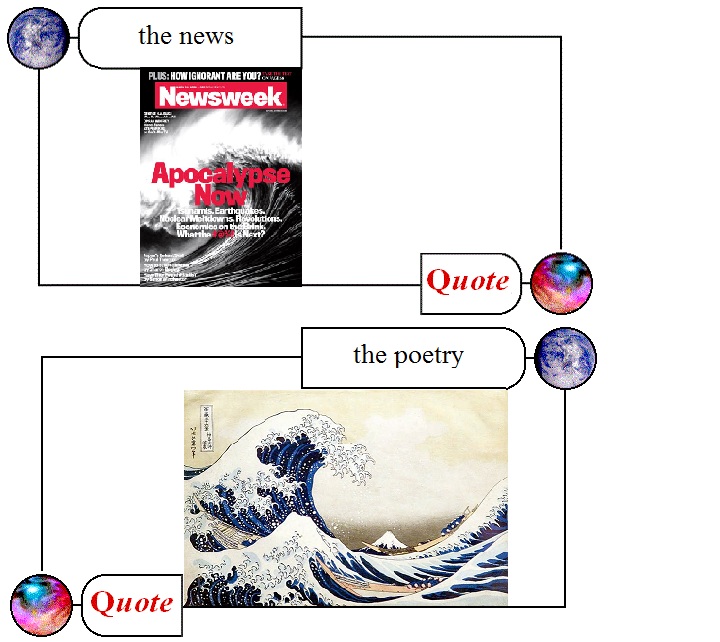
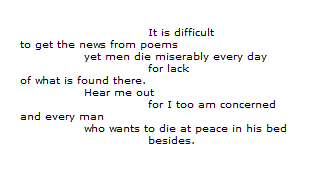
I’ve been thinking quite a bit about William Carlos Williams and his observation in Asphodel, That Greeny Flower:

Our news media blare with (apocalyptic but not revelatory) trumpets…

while Hokusai, painting circa 1831, conveys the vulnerability of the (Japanese and human) situation with his image of boats in a storm.

*

Here’s Dr. Barnett, in my own transcript of his video this week:

The surprise factor here really shouldn’t exist in our minds. I mean the mega-disaster of a tsunami plus and earthquake plus a nuclear meltdown in Japan – well, those three are already highly linked. Japan highly depends on nuclear power, it’s one of the most seismically active island chains in the world, and tsunami is a Japanese word. So if you are going to put a forty year old very aging early technology nuclear power plant right on the coast in Japan, the only mega-disaster you’re going to get there is an earthquake-triggered, tsunami-delivered nuclear meltdown. So these are not surprising connections, we’re just bumping into the connectivity that’s natural and only becoming more expansive as globalization advances.

That’s exactly right – and Hokusai should have been an early warning.

The only thing missing from Barnett’s analysis, and present in Hokusai, is Mt. Fuji – or what TS Eliot (to circle back again to “verbal” poetry) would call “the still point of the turning world”.

Announcements!

Tuesday, March 29th, 2011

A busy day for blogfriends and associates….want to draw your attention to a few highlights:

First, congratulations to Matt Armstrong of MountainRunner on his new appointment as Executive Director of the US Advisory Commission on Public Diplomacy. It’s hard to think of anyone better qualified than Matt!

There is a new Executive Director of the US Advisory Commission on Public Diplomacy

The U.S. Advisory Commission on Public Diplomacy is charged with appraising U.S. Government activities intended to understand, inform, and influence foreign publics. The Commission formulates and recommends to the President, the Secretary of State, and Members of Congress policies and programs to carry out the public diplomacy functions vested in the State Department, Broadcasting Board of Governors, and other government agencies, as well as appraising the effectiveness of the public diplomacy policies and programs carried out by government agencies.

There are seven members on the Commission, with “not more than four members may be from one political party.” In February, the White House sent to the Senate four nominations for the Commission.

Today, Matt Armstrong, author and publisher of MountainRunner.us, was sworn in as the Executive Director of the Advisory Commission. The immediate impact is the suspension of blogging, including the publishing of guest posts, at MountainRunner.us.

Secondly, Steven Pressfield has a new book out, titled Do The Work, in Kindle format and, for a limited time, it is free! One of the great things about Steve is that as an author, he gives back to his readership in myriad ways and isn’t afraid to break new ground:

A Publishing First: General Electric sponsorship for a Best Selling Author’s latest book

Never before done in the history of the publishing industry has this been done before (as far as we know, and we’ve checked) and we are so proud to be offering this phenomenal opportunity to our readership and the world.

General Electric has become our “Launch a Book” sponsor for  Do the Work, our latest release from The Domino Project.

What this means for you, the reader, is that you have access to the digital edition of this book for FREE. It won’t be free forever, so you should act now to grab your free copy. Order it here and it will be automatically delivered on pub date. You can read it on a Kindle, an iPad, an iPhone a PC and more. (If you already ordered your copy, your payment will be credited back to you…

Dr. Thomas P.M. Barnett threw some props my way for the Wikistrat futurist simulation on Turkey and managed to find a few sentences from my section that were non-abstruse and jargon-free 🙂 . The nice thing about the analytical process at Wikistrat is that people can grasp the part of the scenario where their strengths are emphasized ( I looked at possible external strategic options and impacts and left Turkish internals to those who could better drill-down):

Turkey – Re-Rise of the Ottoman Empire?

One of the most interesting things we do in Wikistrat is Scenario Planning. Through the use of live collaborative simulations, our analysts and subscribers alike engage in the mapping of scenarios, country interests and policy options on a given issue. We ran such drills on Egypt (The Egypt War Room) and on the “Sudden death of Kim Jong Il“.

Our current Simulation is on Turkey, and deals with its political and economic rise in the Middle East, its implications and potential pathways. So far several interesting scenarios were mapped, as well as interests and policy objectives for major regional and global powers affected by Turkey’s Rise.

Essentially we ask – Will Turkey’s rise continue? Will its relations with the West deteriorate given its “Shift eastward”? And- How should the US, the EU, Israel, Iran and the KSA react? [….]

Join Wikistrat

Happy Birthday, Emlyn, and Applause, xkcd

Sunday, March 20th, 2011

[ by Charles Cameron ]

*

My son, Emlyn, turns sixteen today.

He’s not terribly fond of computers to be honest — but he does follow xkcd with appreciation, as do I from time to time: indeed, I am led to believe I receive some credit for that fact.

So… this is a birthday greeting to Emlyn, among other things. And a round of applause for Randall Munroe, creator of xkcd. And a post comparing more reliable and less reliable statistics, because that’s a singularly important issue — the more reliable ones in this/ case coming from a single individual with an expert friend, the less reliable ones coming from a huge corporation celebrated for its intelligence and creativity… and with a hat-tip to Cheryl Rofer of the Phronesisaical blog.

The DoubleQuote:
quoxkcd-01.jpg

Radiation exposure:

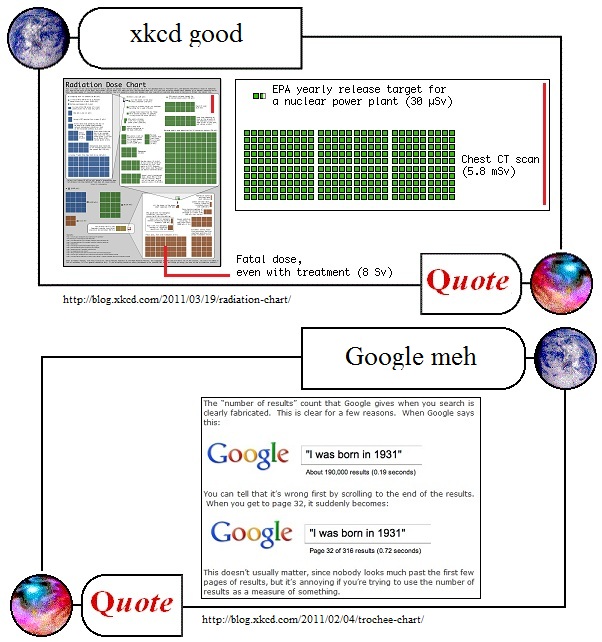
Today, xkcd surpassed itself / his Randallself / ourselves, with a graphic showing different levels of radiation exposure from sleeping next to someone (0.05 muSv, represented by one tiny blue square top left) or eating a banana (twice as dangerous, but only a tenth as nice) up through the levels (all the blue squares combined equal three of the tiny green ones, all the green squares combined equal 7.5 of the little brown ones, and the largest patch of brown (8Sv) is the level where immediate treatment doesn’t stand a chance of saving your life)…

The unit is Sieverts, Sv: 1000 muSv = 1 mSv, 1000 mSv= 1 Sv, sleeping next to someone is an acceptable risk at 0.05 muSv, a mammogram (3 mSv) delivers a little over 50,000 times that level of risk and saves countless lives, 250 mSv is the dose limit for emergency workers in life-saving ops — oh, and cell phone use is risk-free, zero muSv, radiation-wise, although dangerous when driving. [I apologize for needing to write “mu” when I intend the Greek letter by that name, btw — software glitch with the ZP version of WordPress.]

The xkcd diagram comes with this disclaimer:

There’s a lot of discussion of radiation from the Fukushima plants, along with comparisons to Three Mile Island and Chernobyl. Radiation levels are often described as “ times the normal level” or “% over the legal limit,” which can be pretty confusing.

Ellen, a friend of mine who’s a student at Reed and Senior Reactor Operator at the Reed Research Reactor, has been spending the last few days answering questions about radiation dosage virtually nonstop (I’ve actually seen her interrupt them with “brb, reactor”). She suggested a chart might help put different amounts of radiation into perspective, and so with her help, I put one together. She also made one of her own; it has fewer colors, but contains more information about what radiation exposure consists of and how it affects the body.

I’m not an expert in radiation and I’m sure I’ve got a lot of mistakes in here, but there’s so much wild misinformation out there that I figured a broad comparison of different types of dosages might be good anyway. I don’t include too much about the Fukushima reactor because the situation seems to be changing by the hour, but I hope the chart provides some helpful context.

Blog-friend Cheryl Rofer, whose work has included remediation of uranium tailings at the Sillamäe site in Estonia (she co-edited the book on it, Turning a Problem Into a Resource: Remediation and Waste Management at the Sillamäe Site, Estonia) links to xkcd’s effort at the top of her post The Latest on Fukushima and Some Great Web Resources and tells us it “seems both accurate and capable of giving some sense of the relative exposures that are relevant to understanding the issues at Fukushima” — contrast her comments on a recent New York Times graphic:

In other radiation news, the New York Times may have maxed out on the potential for causing radiation hysteria. They’ve got a graphic that shows everybody dead within a mile from the Fukushima plant. As I noted yesterday, you need dose rate and time to calculate an exposure. The Times didn’t bother with that second little detail.

In any case, many thanks, Cheryl — WTF, NYT? — and WTG, xkcd!

Google:

Once again, xkcd nails it.

I’ve run into this problem myself, trying to use Google to gauge the relative frequencies of words or phrases that interest me — things like moshiach + soon vs “second coming” + soon vs mahdi + soon, you know the kinds of things that I’m curious about, I forget the specific examples where it finally dawned on me how utterly useless Google’s “About XYZ,000 results (0.21 seconds)” rankings really are — but the word needs to get out.

Feh!

Paging Edward Tufte.

Sixteen today:

Happy Birthday, Emlyn!
Shibuya Eggman Epiphany

Wednesday, March 16th, 2011

[ by Charles Cameron — cross-posted from SmartMobs ]

*

An Easter Egg, according to one online definition, is an “undocumented function hidden in software that may or may not be sanctioned by management”. All sorts of media can in fact have Easter Eggs hidden in them, and the same definition goes on to mention occurrences in “video games, movies, TV commercials, DVDs, CDs, CD-ROMs and every so often in hardware.”

Well, okay. As of now, they can also be found on Fox News. Someone just sneaked the name of a Japanese rock club into the list of Japanese nuclear power plants:

quo-i-am-the-eggman

The definition of Easter Egg is from Your Dictionary.
The Fox News screen-grab is from Business Insider.
The image of the young rocker is from the Shibuya Eggman club website.
The song the young man is singing is undoubtedly I am the Walrus.
The hat-tip goes to Daveed Gartenstein-Ross, @DaveedGR, who pointed me to another Faux-pas, this one involving Pakistan and padded bras.

The divine comedy is that we can still find humor in the teeth of tragedy.
The triple tragedy is that Japan is reeling from quake, tsunami and nuclear plant failure.

One of the key chapters in my friend Howard Rheingold‘s book, SmartMobs, is titled Shibuya Epiphany. And that’s my epiphany for today.

Friend[s] of “Abu Reyyan” the Frankfurt Shooter

Friday, March 4th, 2011

[ by Charles Cameron ]

.

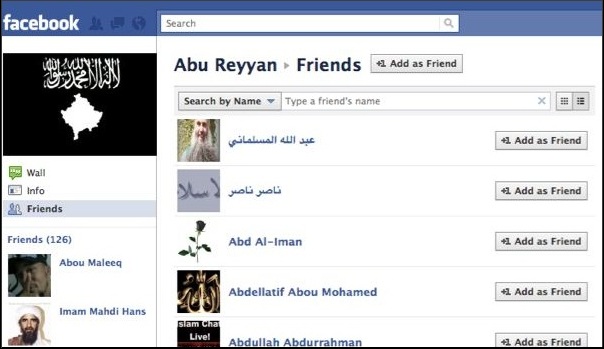
Aaron Weisburd has posted a screen-grab of “Abu Reyyan” the Frankfurt Shooter‘s FaceBook page at Internet Haganah

abu-reyyan-friends-screen-grab.jpg

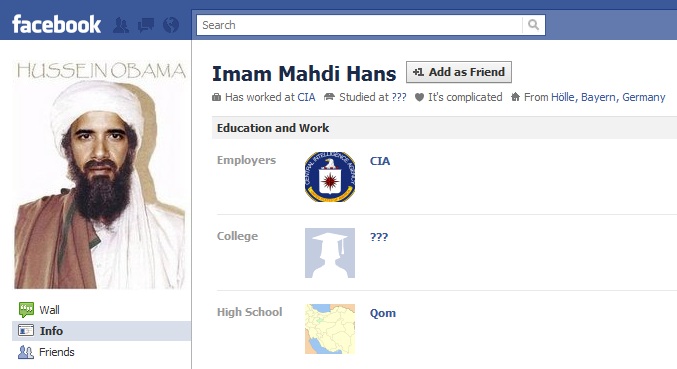
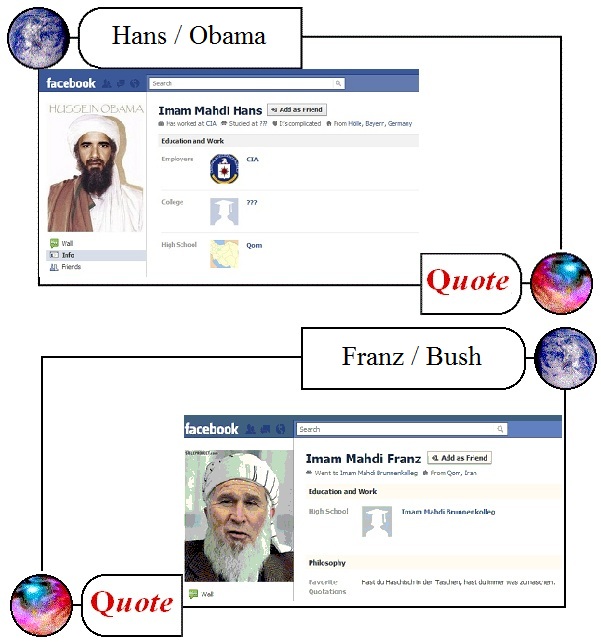
Naturally enough, the name of the second friend listed in the left-hand column, Imam Mahdi Hans, caught my eye. Here’s a screen grab of part of Hans’ own Facebook page, showing his self-image to better advantage:

imam-mahdi-hans.jpg

Okay, I’ve seen that image before — in fact, I blogged about it on my old Forensic Theology site, towards the bottom of a long post, and yes — the image clever Hans is using is a blend of Osama with Obama, and includes a credit to “Phil Dragoo”.  And yes, Hans himself does claim to be the Mahdi on his FB page.

It’s probably just a joke, and a bit of a sideswipe at the Shi’a, Obama, and no doubt the CIA — but since I noticed the connection, and Aaron doesn’t have comments enabled, I thought I should mention it here…

.

UPDATE:

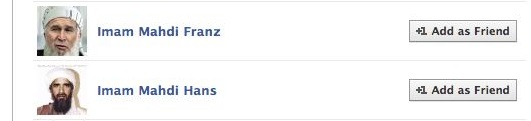
Aaron has kindly pointed out to me that there’s a second Mahdi among Abu Reyyan’s friends: Imam Mahdi Franz.

2-imam-mahdis.jpg

Like Hans, Franz’ avatar is a mashup of two images to generate a face presumably intended to represent bin Laden, but with the features of a US President: in the first case, Obama, and in the second, Bush 43.

In this case, the mashup is one that you’ll find on the cover of Tariq Ali‘s book, Clash of Fundamentalisms (the British hardback has the best version of the image; the US edition credits it to “Mister Hepburn / Slab”.

Here’s where it gets doubly interesting to me:

First, the pair of them taken together make a fine example of the anti-Shi’a strand in Salafism, picking up on the eschatology — which I don’t think they’d be doing quite like that if they felt a strong Salafi-Mahdist current themselves.

So that’s another data point in terms of the strength of what J-P Filiu calls “Apocalypse in Islam” – in Germany, Shi’ite Mahdism can be mocked by Salafis.

.. and second, for bonus points… the two pages are also pretty strongly “twinned” – Mahdi to Mahdi, Hans to Franz, Obama to Bush – so they’re also a great fit for my more playful side, suggesting an obvious example of my DoubleQuotes genre:

quo-twin-mahdis.jpg


Switch to our mobile site