zenpundit.com » economics

Archive for the ‘economics’ Category

Kesler on R2P Hypocrisy

Saturday, October 8th, 2011

Nice catch by Bruce Kesler who goes en fuego on the weirdly discordant note Anne-Marie Slaughter strikes in her latest New York Times op-ed:

Majority Rule Over Minorities: Ironic R2P Hypocrisy

The extremism of R2P’s leading proponent is exhibited in Anne-Marie Slaughter’s op-ed in today’s New York Times. Slaughter likens the Wall Street protesters to those demonstrating against oppressive regimes in the Middle East and recommends removal of the US system of checks and balances that protect minority views and avoid poorly developed political stampedes. (Slaughter doesn’t mention or give credence to the more numerous, mature citizenry participating in or supporting the Tea Parties more peaceful protests for more limited government intrusions into Americans’ private lives and earnings.)

R2P’s leading proponent, Anne-Marie Slaughter of Harvard, believes that US foreign policies and military interventions should prioritize the Right To Protect severely repressed peoples through US obeisance to liberal internationalist elites’ sentiments in favor of some they like regardless of the US Constitution or laws or national or security interests.

In today’s New York Times, Slaughter takes her R2P home to the US, advocating that majorities rule regardless of the formal and informal checks and balances of our political system and overriding the rights of political minorities. Again, it is the majorities that liberals like who should be given more powers.

Without any sense of proportionality or of core differences between the US and Middle East satrapies, Slaughter says, “Indeed, the twin drivers of America’s nascent protest movement against the financial sector are injustice and invisibility, the very grievances that drove the Arab Spring.” Slaughter then concludes, “The only effective response is a political response, of a nature and magnitude that convinces protesters on the streets that they can in fact secure the change they seek within, rather than outside, the system.”

Slaughter’s system, however, would reduce the ability of permanent or transitory political minorities to protect their interests. They would, also, further factionalize the US and make compromises more difficult as the power of centrists is reduced….

Read the rest here.

Good grief. Anne Marie Slaughter opining on the need for greater democracy and accountability to the people is somewhat akin to Ayn Rand calling for more welfare programs.

My suspicion here, since this rhetoric runs counter to Slaughter’s most influential ideas, is that Slaughter is just carrying water as part of the current Democratic political strategy of trying to co-opt the Occupy Wall Street movement. Perhaps the Axelrods and Podestas see that open-source protest movement to potentially be “their tea party”. Whatever. I will take her op-ed more seriously when she is marching against the Hedge fundies and Wall Streeters who are top donors to her Party, her administration and her university.

You can put a three corned hat on a Princeton theorist of global governance by transnational “governmental networks” but even if you adjust the hat at a suitably jaunty angle for maximum populist effect, the agenda underneath is still neither democratic nor popular.
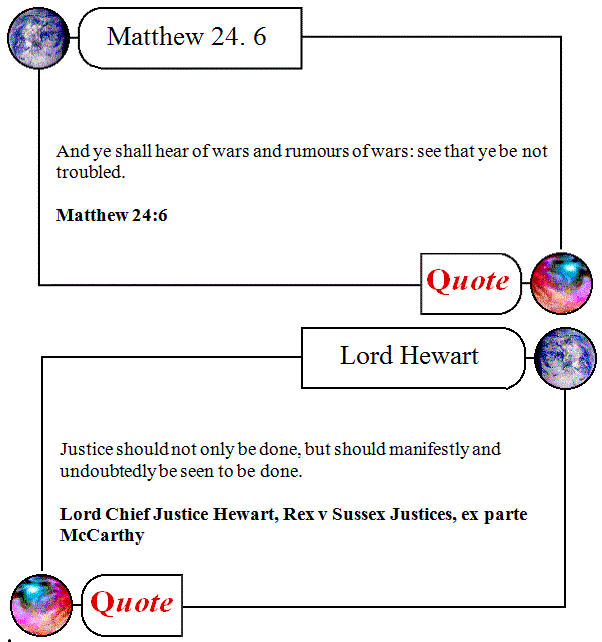
Idle thoughts: on wars, justice and banking

Sunday, September 18th, 2011

[ by Charles Cameron — reality, appearance and virtuality ]

.

quo-functions.gif

These two phrases, wars and rumors of wars and done and seen to be done have apparently been rattling around in my head for long enough that they finally dodged all the other stuff about Mahdis and Glass Bead Games and met.

Okay, I’d already thought of the first one in terms of “Cameron’s Function”:

f(x) = x + rumors of x           (i)

because it seemed to “apply” to other things than war — the instance that gave me that insight was the run-up to the Year 2000, during which it became abundantly clear that rumors of bank runs were precisely what bank runs themselves were about — which in turn became my classic instance of the need for mapping that “crossed over” between the subjective and objective realms — or morale and materiel, as I called them in a recent post.

And so here comes “Cameron’s Function #2”:

f(x) = x + seen to be x         (ii)

What I’m wondering now is whether the two of them are essentially the same “function” — any thoughts? They’re twins — but are they identical?

Shopping and sacrifice

Tuesday, August 30th, 2011

[ by Charles Cameron — values ]

.

Sacrifice was high among the unifying ideals that many Americans hoped would emerge from the rubble of ground zero, where so many Good Samaritans had practiced it. But the president scuttled the notion on the first weekend after the attack, telling Americans that it was his “hope” that “they make no sacrifice whatsoever” beyond, perhaps, tolerating enhanced airline security. Few leaders in either party contradicted him. Bush would soon implore us to “get down to Disney World in Florida” and would even lend his image to a travel-industry ad promoting tourism. Our marching orders were to go shopping.

I’ve drawn this partial paragraph from Frank Rich‘s New York piece of August 27th, The 9/11 decade is now over. The terrorists lost. But who won? – it really caught my attention.

If you shake it down in the mind like someone panning for gold to get rid of the lightweight details, the heavier material that remains for you to sort through will, I think, consist of two words: “sacrifice” as representing one order of values, gleaming in contrast with the darker “shopping” representing another.

Yesterday I made a post about words and culture, this one is about culture and sacrifice… what comes next will be the series on ritual and ceremonial…

Two Links on Political Economy

Friday, August 19th, 2011

That are complementary:

Fabius MaximusOur fears are unwarranted. America is in fact well-governed.

….America is in better shape than Europe and Japan.  We have good demographics, sound fundamentals, relatively easily solved problems, and no powerful enemies.  Why the constant sense of crisis?  QE2, hyperinflation, climate armageddon, Obama the socialist, AIDS, alar on apples, jihadists, debt, swine flu – a constant drumroll of doom, explained by Peter Moore in “The Crisis Crisis” (Playboy, March 1987).   Answer:  elites govern a weak people by exploiting their fears.  For example, look at the “government is broke” panic.

  • The Federal government’s net debt is only 2/3 of GDP, well below the 100% of GDP “red line” (that Italy reached many years ago).
  • The short-term deficit is mostly the result of the recession.  The medium-term deficit results from the Bush tax cuts.
  • Social security’s funding gap is small vs. GDP and easily fixed.
  • The massive funding gap is mostly Medicare, easily fixed by adopting features from the mixed public-private systems in Europe.

Panic pushes Americans to allow cuts to popular social services plus increased and highly regressive taxes.  No matter who wins, after the 2012 election our representatives will implement the necessary policy changes:  raising taxes, cutting expenditures, rebuilding our infrastructure, and beginning the long process of reforming health care.  It will be another morning in America.  There is no crippling polarization, just distracting noise masking a consensus between both parties about the key points of economic and foreign policy.

We do not see this long-standing pattern (see the previous post for details) because our collective OODA loop is broken (see section 6 here).  That makes us easier to lead.  Relying on wealth-based elites to run the country has a cost.  They take a large share of the pie; we take a small slice….

Global Guerrillas –JOURNAL: Global Financial Cancer

….A couple of years ago, I wrote that the underlying structure of the global financial system was a “bow-tie.”  Here’s what I said (it’s worth going back and reading the entire article and this paper on bow-ties from John Doyle at Caltech):

If we look at this new global system from a distance, its architecture is something called a bow-tie. This is a universal control system architecture that underlies complex systems from the Internet to cell metabolism.

Bowtie

What is a Bow Tie?

The bow-tie is a very powerful approach to organizing a complex system (it’s a system design that is used by controls engineers.)  Visually, it starts with complex inputs (the left side of the bow-tie), boils them down into simple build blocks (the knot), which then allows the construction of complex outputs (the right side of the bow-tie….

….Unfortunately, as I mentioned in the earlier article, bow-ties are vulnerable to organisms that attach themselves to the knot at their center (like the way cancer uses the body’s metabolism system).  These organisms relentlessly use the bow-tie’s knot to for selfish ends (rapid growth).  The end result is typically death for the system.  My suggestion was that the instability we were seeing in the financial system was an indication that it had been co-opted by a malicious, self-serving organism.

Of course, at the time there wasn’t much data to support this systemic analysis.  That has been rectified with a new paper, The Network of Global Corporate Control by Vitali et. al. from ETH in Zurich.  This paper finds, through extensive network analysis, that a small group of tightly intertwined financial institutions control the bow of the global financial system.  It is in effect, the world’s first super-organism….

They are both right. Probably not perfectly, the American economy, even more the world’s, is too complex a subject, but right enough.

FM is right that the emerging class of people I have been calling “the Oligarchy” the past couple of years do not intend to deliberately implode the system that is working outrageously to their benefit. They are currently in the stage of trying to come up with an arsenal of tax-farming schemes that will pass political muster (i.e. – not provoke uncontrollable, “Arab Spring” street demonstrations or a successful populist electoral revolt  that would eject their sycophants from government en masse in a single election) and are quietly, methodically and strategically neutering the capacity of the populace to resist their rule over the long term. It is there that we see seemingly unrelated measures as the coordinated political attack on public education and university education, restrictions on the ability of citizens to get courts to review arbitrary actions of Federal agencies, imposition of laws to permit total surveillance of US citizens and acquisition of their personal information and so on.

The elite, who are not completely cohesive or formally organized, are supremely confident in their ability to manage the technocratic economy they are putting into place, or if bumps in the road appear, to squeeze sufficient new leverage from the populace through inflation, devaluation and other forms of expropriation. Unfortunately, I am not confident that these folks are nearly as competent as they imagine themselves to be. Nor am I sure that the global system that they have built, a high-performance, deeply complex, ultra-leveraged, financial sector dominant political economy isn’t as fragile and dangerously unstable as people like John Robb and Nassim Nicholas Taleb have maintained it is. The system might not just crash, it could crash to extreme depths with unprecedented speed with unforseen consequences (financial systems also ensure the reliable and continuous logistical flow of *food* and *power* to population centers).

A Culture of Punitive Raiding

Saturday, July 9th, 2011


Robert Haddick agrees with me, albeit with greater eloquence and length ( hat tip to Colonel Dave).

From SWJ Blog:

This Week at War: Rumsfeld’s Revenge

….Rumsfeld’s and Schoomaker’s redesign of the Army into a lighter, more mobile, and more expeditionary force seems permanent. Gone is the Cold War and Desert Storm concept of the long buildup of armor as prelude to a massive decisive battle. Instead, globally mobile brigade combat teams will provide deterrence, respond to crises, and sustain expeditionary campaigns. Gen. Martin Dempsey, the current Army chief of staff (and soon to be chairman of the Joint Chiefs of Staff) recently described a sustainable brigade rotation system, an expeditionary adaptation that the Navy and Marine Corps have employed for decades. In addition, both the Army and Marine Corps have drawn up plans to shrink their headcounts back near the Rumsfeld-era levels. Rumsfeld’s concerns about personnel costs sapping modernization are now coming to pass.

There now seems to be a near-consensus inside Washington that the large open-ended ground campaigns that Rumsfeld resisted are no longer sustainable. The former defense secretary’s preference for special operations forces, air power, networked intelligence, and indigenous allies is now back in vogue. Even Gen. David Petraeus, who burnished his reputation by reversing Rumsfeld’s policies in Iraq, will now implement Rumsfeld’s doctrine in eastern Afghanistan. According to the New York Times, the U.S. will counter the deteriorating situation there not by shifting in conventional ground troops for pacification, but with “more special forces, intelligence, surveillance, air power … [and] substantially more Afghan boots on the ground.”

While we agree that this is “Rumsfeld’s revenge”, unlike Haddick, I would not choose “doctrine” to describe it. This is really about a “Community of Operators” across services , agencies and their White House superiors adopting a culture of punitive raiding for at least the medium term. A doctrine might come along later but there are downsides to institutionalizing punitive raiding that have already been very well expressed by others (see comments section at SWJ). I’d prefer punitive raiding remain a flexible tool rather than a reflexive response ( it might help if we created a “Community of Thinkers” before we get too comfortable as an international flying squad).

At this point, I will stop and recommend a fine piece by Adam Elkus on the subject of punitive raiding, From Roman Legions to Navy SEALs: Military Raiding and its Discontents. A good primer on the history, implications and drawbacks.

Why is this happening?  Economics and the subsequent electoral politics of a finance-sector driven global depression. The same thing that brought COIN to an end and then finally killed it as an operationally oriented policy.

Punitive raiding is relatively cheaper. It permits defense cuts in the size of the Army and Marine Corps that are badly desired by the administration and Congress. It preserves and justifies investments in naval and air striking power that will bring joy to the Lexington Institute and satisfy many MoC concerned about defense jobs for constituents. On a point of genuine importance, this also hedges against near peer competitors (ahem…cough…China).

Is it a done deal? Unless the economy roars back, yes.

ADDENDUM:

Check out these two directly related posts by Pundita and Joseph Fouche:

America’s Light Footprint Era (Revised) 

Unhappy Medium: The Perils of Annoyance as Your Strategic Default


Switch to our mobile site

