I have already dived a few chapters into the McGregor book and it is very good. What makes it good is that is running counter to the message of the herd in terms of popular Sinology, which is to emphasize that China is a) uniquely Chinese with deeply introspective Confucian civilizational traditions (that’s modern PC-speak for “inscrutable”) and b) the brave new world of liberal, globalized, capitalism with a benign technocratic face.
Now there’s important truths in both of the popular mass messages on China, incompatible as they can be with one another. The economic rise of China in a globalized economy is the most important story of the last quarter of the 20th century and the first quarter of the 21st ( collapse of the USSR is second; the Soviets were beaten before they imploded and imploded largely because they knew they were beaten). China is also not like America, not even when they imported stock options, blue jeans, McDonald’s and the American jobs that used to create all those things. China’s civilization is truly of a dizzying depth, complexity and scale that is best compared to Europe rather than a specific country. That in itself, is important because it points to how ignorant the average American policy maker is, never mind the average American, about what makes their Chinese counterpart tick.
[ Sidebar: Perhaps the Obama administration assembling a new senior “China/East Asia” diplomatic and national security team that does not include a single official with any professional knowledge of China was unwise? How is that better than the Bush II administration shunning Arabists during the run up to and occupation of Iraq? It is not that these diplomats and officers are poor, they are smart and experienced, but none of them are China specialists. Or Japan specialists, for that matter and only one has expertise in Korean affairs. These are the region’s great powers! This is like turning EU/NATO policy over to diplomats who speak Hindi and Swahili ]
What McGregor is doing in The Party that is important is reminding Westerners that the Soviet experience, particularly the Leninist Party model, is still deeply embedded in China’s political DNA. Not in an ideologically Marxist, Khrushchevian, shoe-pounding sense but in a functional sense. In a structural sense. In an instrumental governance sense. In a networking theory sense. And all these characteristics, which are largely innately hostile or indifferent to the values of liberal democracy, continue to shape Chinese policy, leadership succession, national security, defense strategy and geopolitical outlook to this day.
That doesn’t mean China is itching for a war with the United States, but it means they are playing a longitudinal strategic game where the first goal is to stay in power forever and the next is to advance one’s position relative to others.
We are the other.
China is not an enemy but she is no friend or ally of the United States either, yet it is the most important relationship the US has to manage for the next thirty years – and that relationship in a strategic context with rising India, Japan, South Korea and Australia.
It might help if America brought a team to the table that included people who could tell Han Fei Tzu from Mencius or spoke Chinese.
John recently gave me a preview of this ideain a much more specific context:
….Here are some of the economic reforms that turned the horde of Genghis Khan into a steamroller than flattened most of the world’s kingdoms/empires.* He:
Delayed gratification. He banned the sacking of the enemy’s camp/city until all of the fleeing soldiers, baggage, etc. were rounded up. This radically increased the loot accumulated and ensured it could be shared among all of the participants (he confliscated the wealth of those men that cheated by looting early).
Systematically shared the loot based on contribution and merit. He disregarded title or status and systematically rewarded loot to everyone in the horde that earned it (the traditional approach was to let a few take it all — sound familiar?). Of course, that fairness pissed off the nobility since they were used to backroom dealing and hereditary rights. However, the benefits of this system, were far greater than the costs. To wit: He cemented the loyalty of the men and was able to attract thousands to his banner for every noble lost.
Protected those that make sacrifices. For men killed in the campaign, he paid their share of loot to their widows/orphans posthumously.
*of course, the first unsaid lesson is: attack the places with the most loot.
“I have not lived so long, Spartans, without having had the experience of many wars, and I see among you of the same age as myself, who will not fall into the common misfortune of longing for war from inexperience or from a belief in it’s advantage and safety”
One thing on which most commentators, academics and former officials seem to agree is that the United States government has a difficult time planning and executing strategy. Furthermore, that since 1991 we have been without a consensus as to America’sgrandstrategy, which would guide our crafting of policy and strategy. This failing bridges partisan divisions and departmental bureaucracies; there are many career officials, political appointees and even a few politicians, who can explain the nuances of the Afghan War, or the Libyan intervention, the depreciatory tailspin of the US Dollar or America’s Russia policy – but none who would venture to say how these relate to one another, still less to a common vision.
Sadly, they do not, in fact, relate to one another – at least not, as far as I can discern, intentionally.
Few American policies or even military operations (!) in one country can be said to have been conceived even within a coherent and logically consistent regional strategy and it is not just common, but normal, to have DIME agencies working at completely contradictory purposes in the same area of operations. The interagency process, to the extent that it exists, is fundamentally broken and incapable of interagency operational jointness; and the institutional coordinating mechanism for any “whole of government” effort, the National Security Council, has become too consumed with crisis management. A mismatched prioritization of resources which leaves little time for the kind of long range planning and strategic thinking that allows nations to seize the initiative instead of reacting to events.
It would be a useful corrective for the better conception and execution of US policy, for the President and the Congress to create a special board for grand strategy that could give presidents and key officials frank assessments and confidential guidance to help weave their policy ideas into a durable and overarching national strategy. One that might last beyond a few days’ headlines in The New York Times.
The President of the United States, of course has a number of bodies that could, should but do not always provide strategic advice. There’s the Defense Policy Advisory Board, an Intelligence Advisory Board, the National Intelligence Council, the State Department’sPolicy Planning Staff, theOffice of Net Assessment and not least, the NSC itself and the Joint Chiefs of Staff, whose Chairman, by act of Congress, is the military advisor to the President and Secretary of Defense. While strategic thinking does percolate from these entities, many have very specific mandates or, conversely, wide ranging briefs on matters other than strategy. Some operate many levels below the Oval Office, are filled with superannuated politicians or have personnel who, while intellectually brilliant, are excessively political and untrained in matters of strategy. The Joint Chiefs, the professionals of strategy, are highly cognizant of the Constitutional deference they are required to give to civilian officials and are very leery of overstepping their bounds into the more political realms of policy and grand strategy.
What the President could use is a high level group just focused on getting strategy right – or making sure we have one at all.
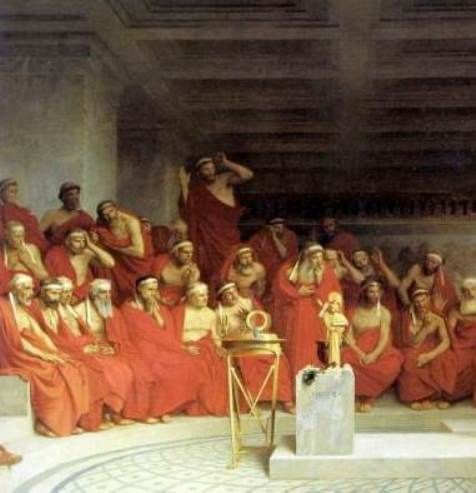
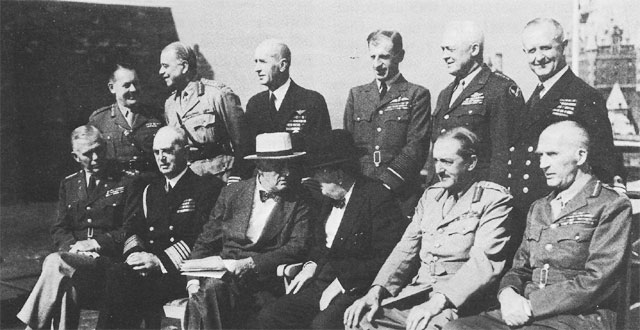
I’m envisioning a relatively small group composed of a core of pure strategists leavened with the most strategically oriented of our elder statesmen, flag officers, spooks and thinkers from cognate fields. A grand strategy board would be most active at the start of an administration and help in the crafting of the national strategy documents and return periodically when requested to give advice. Like the Spartan Gerousia, most of the members ( but not all) would be older and freer of the restraint of institutional imperatives and career ambitions. Like the Anglo-American joint chiefs and international conferences of WWII and the immediate postwar era, they would keep their eye on the panoramic view.
The Octagon Conference – FDR, Churchill and the Combined Chiefs of Staff
Here’s my grand strategy board in a hypothetical perfect world, unlike the one that prevails inside the beltway. I’m sure people will quibble with particular names or will suggest others. I freely admit, for example, that I do not have the best grasp of who our leading intellectual powerhouses are in the Navy, Air Force or the closed world of intelligence analysis and this impairs my ability to put together the list. Nevertheless, I’m trying anyway:
Let’s start with a group of acclaimed and eminent strategic thinkers who have demonstrated over a long tenure, their ability to consider matters of war, peace and statecraft as well as the nuances of strategic theory:
Thomas Schelling -Chairman
Andrew Marshall
Edward Luttwak
Colin Gray
Joseph Nye
Next, some senior statesmen:
Henry Kissinger
George Schultz
Zbigniew Brzezinski Madeleine Albright
General officers and one colonel with a demonstrated talent for challenging conventional assumptions:
Lieutenant General Paul van Riper
General James Mattis
General Jack Keane
Colonel John Warden
Two economists:
Alan Greenspan
Nouriel Roubini
Two scientists:
Freeman Dyson E.O. Wilson
Mixed group of strategists, historians, practitioners and theorists:
David Kilcullen
John Robb
John Negroponte Barry Posen
Antulio Echevarria Chet Richards
Micheal Vlahos
Thomas P.M. Barnett
Stephen Biddle
Robert Conquest
Duane Clairridge
Jack Matlock
Martin van Creveld
Visionaries and Contrarians:
Nicholas Nassim Taleb William Gibson
Ray Kurzweill
Andrew Bacevich
What are the problems with my grand strategy board (aside from having zero chance of coming into being)?
For one, it is probably way too large. In my efforts to balance expertise in strategy with varied thinking it grew bigger than what is manageable in real life, if the group is to be productive.
Secondly, it is an exceedingly white, male and conservative leaning list – though to some extent that reflects the criteria of experience, the field of strategy itself and the nature of American politics. Barbara Ehrenreich, for example, is definitely bright but her politics are fundamentally opposed to effectively maximizing American power in the world or the use of military force – thus making her of little use except as a voice of dissent.
Another limitation of this exercise is the idiosyncratic eclecticism of my approach – this was a blog post written over a few days in my spare time and not a methodical inquiry into who in American life would verifiably be the “best qualified” to help construct a grand strategy. There are “insiders” who command great respect within the national security, defense and intelligence communities who are unknown to the general public, or even this corner of the blogosphere, who would be enormously helpful to such a board. Finally, a grand strategy board would not be a panacea; it would be subject to all the inertial pressures that over time would reduce it’s ability to effect change, just as the Policy Planning Staff and the NSC have been “neutered” over decades by the forces of the status quo.
That said, the above group or one reasonably comparable to it could, for a time, markedly improve the construction of strategy , assuming American leaders are willing to enlist such advice, put aside short term political considerations and pursue long term strategic goals.
Whom would you nominate to a grand strategy board?
Dr. Chet Richards has contributed to an important new theoretical book on strategic applications to business enterprises. For those newer readers, Chet is an authoritative source on strategy, particularly the theories of Colonel John Boydand is the former proprietor of the late, great, strategy website DNI. I have learned a great deal over the years from Colonel Richards and heartily recommend his Certain to Winto anyone looking for the strategic edge.
For readers with a corporate credit card or departmental budget ( the book is *really* expensive) and a deep, academic or professional interest in strategic theoryandthinking, thisbookisforyou. I may require Inter-Library Loan. 🙂
As Chet describes it:
Deep stuff – very academic – but covers the waterfront of the research (i.e., as distinguished from the speculation) on the process of strategy. As the co-editors describe it:
While strategy content focuses on the subject of the decision, strategy process focuses on actual decision making and its associated actions. Strategy process research examines the process underpinning strategy formulation and implementation. … Although aimed primarily at the academic community, many of the contributions speak to a wider audience.
Expensive, but if you’re into this sort of thing, probably indispensable.
Matt Frost (you can find him on Twitter: @mattfrost) copied me on an email earlier today, and he’s kindly given me permission to share his thoughts with all of you:
Comparing the US’s military expenditures against the next three or five potential competitors doesn’t have much analytical value as such, because there are thresholds of capability that you can only cross at some absolute level of cost. Let $x be how much the US spends on the military.
Let $y be how much China spends. The difference between $xand $y, whether in terms of ratio or absolute dollars, doesn’t tell you much, because what matters is value $z, which is how much it costs to field a carrier battle group and maintain bases for air tankers and launch a constellation of GPS satellites and have all your planes be all-weather capable etc etc. Once you get to point $z+1, your capabilities are categorically different from those of a country at $z-1.
Sure, the US spends over $600 billion while the Chinese only spend $98 billion. That difference looks absurd in comparative terms. But between $98 billion and $600 billion there’s a threshold below which you just can’t project power globally. If we think that #winning means global power projection, then cutting to $200 billion won’t work, since it’s not a matter of keeping a 100% lead over the Chinese, or 150% or whatever. Superpower status does not depend on a proportional lead over our competitors; our place at the head of the pack requires staying above that magic increment while everyone else stays below it.
I don’t know what the magic number really is. If it’s $599 billion, then we’re spending the exact amount that our global strategy insists we spend. If it’s $300 billion, then we’re wasting half of every dollar. My hunch is that the real value is closer to the top than the bottom of this range. [Emphasis added]
Hmmm. My two cents:
Comparing the ostensible dollar figures of the Chinese and US defense budgets is a relatively meaningless exercise.
First, like the old Soviet Union, you are not dealing with honest budget figures in regard to Chinese military power. Many military expenditures in China are subsumed by other state agencies, such as for internal security paramilitary troops which even China admits to being slightly over 100% of the PLA budget. This alone would make China’s defense budget twice as large as admitted and we can reckon these figures as being a) underestimates and b) not comprehensive, failing to count military expenditures billed to scientific, industrial, intelligence, nuclear and space related entities. The official published statistics for these items could also be outright lies. Their system is as opaque as it chooses to be. If China’s real national security and defense budget is a cent under $ 300 billion I’d be very surprised.
Then there are the technical economic questions of converting their currency into dollars and whether that accurately reflects the purchasing power of the Chinese government on national security items. Hint: It doesn’t.
It turned out during the Cold War our best analytical efforts grossly overestimated the true size of the GDP of the USSR while vastly underestimating the astronomical percentage of GDP the Soviets devoted to national security and defense. What makes anyone think we are any more accurate today with China when so few of our analysts are expert Sinologists compared to the large number of Soviet specialists during the Cold War?
If you want to understand Chinese power projection capabilities, you have to count the verifiable assets and boots that give them the ability to project power and estimate the degree to which their known logistical capability can support “x” forces at “y” distance for “z” period of time. That will be about as accurate a guess as can be made, along with qualitative assessments of Chinese personnel and equipment and the most probable areas of operation for them. I don’t expect a Chinese Armada off the coast of Uruguay any time soon.
Chinese military power is growing, just ask India or Vietnam, but we need to be realistic about where the PLA is in terms of military power vis-a-vis the United States. We can put an enormously powerful military force on their front porch at will. If it was a contest today of the entire nation of China vs. just PACOM, my money is on PACOM.
That will change in time but how fast and to what degree of adversariality between our two countries depends on far more than just military spending.
Zenpundit is a blog dedicated to exploring the intersections of foreign policy, history, military theory, national security,strategic thinking, futurism, cognition and a number of other esoteric pursuits.



 by Pietro Mazzola and Franz W. Kellermans (Ed.)


