Sinophilia
Thursday, November 18th, 2010 
Historyguy99, who has a lot of “in-country” experience, offers up a nice blog round-up and commentary on China.
Historyguy99, who has a lot of “in-country” experience, offers up a nice blog round-up and commentary on China.

John Robb at Global Guerrillas:
Moral decay is often cited as a reason for why empires/civilizations collapse. The slow failure of the US mortgage market, the largest debt market in the world and the shining jewel of the US economic/financial system, is a good example of moral decay at work.
Why is this market failing? It’s being gutted — from wholesale fraud and ruthless profiteering at the bank/servicer level to strategic defaults at the homeowner level — because a relatively efficient and effective moral system is being replaced by a burdensome and ineffective one. What shift? Our previous moral system featured trust, loyalty, reputation, responsibility, belief, fairness, etc. While these features were sometimes in short supply, on the whole it provided us with an underlying and nearly costless structure to our social and economic interactions.
Our new moral system is that of the dominant global marketplace. This new system emphasizes transactional, short-term interactions rather than long-term relationships. All interactions are intensely legalistic, as in: nothing is assumed except what is spelled out in the contract. Goodness is solely based on transactional success and therefore anything goes, as long as you don’t get punished for it.
In this moral system, every social and economic interaction becomes increasingly costly due to a need to contractually defend yourself against cheating, fraud, and theft. Worse, when legalistic punishment is absent/lax, rampant looting and fraud occurs.
Given the costs and dangers of moral decay, it’s not hard to see why it can cause a complex empire/civilization to collapse.
John is drawing on an intellectual tradition goes back to Gibbon, Ibn Khaldun, Polybius, Confucius and Mencius but is mashing it up with modern concepts of social complexity, such as is found in Joseph Tainter’s The Collapse of Complex Societies
When Robert Wright wrote of “ossifying” societies unable to stand the test of barbarians in the ancient and medieval worlds, in Nonzero:The Logic of Human Destiny, he was explicit that a moral critique often correlated with economic/darwinian fitness. Rome, for example, eschewed adaptive technological innovation due to it’s heavy reliance on inexpensive slave labor. Oligarchic societies fit the moral decay theory because oligarchies focus on the zero sum game of extracting existing wealth from the population instead of creating and accumulating it. The extraction process requires an expensive social architecture of control and this is subject to diminishing returns. At a certain point, any system reaches the tipping point on adding the next level of non-productive complexity and begins to unravel.
What if the historical ratchet could be reversed?
What if the excess complexity could be systemically pared back along with the opportunities for corruption and self-aggrandizement that required countermeasures?
Societies are occasionally capable of moral and political renovation, cases in point, the Glorious Revolution and the Meiji Restoration, both of which tied ancient ideals to new political forms while sweeping away a corrupt elite. The American Revolution period, through the adoption of the US Constitution would be another example of societal transformation. These successes, which involve constitutional reforms and a rejuvenated political economy are essentially of a social contractual nature and are rare. Failure is more common, as with Sulla’s bloody reforms that temporarily got rid of bad actors and rebooted the Roman Republic to an older, more virtuous model but failed to address the fact that the structural flaws of the Republic itself were the problem, not the ambition of Marius.
Things are not yet too far gone. There is much that is wrong with the United States but we have a more resilient and coherent foundation upon which to reconstruct than did the Romans of the 1st century BC.
America has many Mariuses but a better Republic.

From FT.com:
Computers set for quantum leap
A new photonic chip that works on light rather than electricity has been built by an international research team, paving the way for the production of ultra-fast quantum computers with capabilities far beyond today’s devices.
Future quantum computers will, for example, be able to pull important information out of the biggest databases almost instantaneously. As the amount of electronic data stored worldwide grows exponentially, the technology will make it easier for people to search with precision for what they want.
An early application will be to investigate and design complex molecules, such as new drugs and other materials, that cannot be simulated with ordinary computers. More general consumer applications should follow.
I bet.
I’m no computer geek, but I know a bit about economics. Quantum computing represents a moment of comparative advantage for the nation(s) that pioneers it akin to Great Britain being first with the Industrial Revolution. The first use for the world’s first lab functional quantum computer is to apply it’s power in other fields where innovation is stymied by previously intractable math problems, thus permitting a burst of patentable breakthroughs or discoveries that lead to applied scientific and commercial uses. The second use of the quantum computer’s power will be put towards solving problems related to optimizing quantum computing itself, both in terms of refining the systems and assembling arrays.
Advantages of this nature tend to be self-reinforcing and synergistic. The state that accrues these downstream spillover benefits of quantum computing in rapid succession could potentially leapfrog over everyone else to a degree not seen in centuries.
Jeremy O’Brien, director of the UK’s Centre for Quantum Photonics, who led the project, said many people in the field had believed a functional quantum computer would not be a reality for at least 25 years.
“However, we can say with real confidence that, using our new technique, a quantum computer could, within five years, be performing calculations that are outside the capabilities of conventional computers,” he told the British Science Festival, as he presented the research
The upside of holding this kind of technological advance back from the commercial domain in order to “lock in” comparative advantage until the nearest quantum computing rival has gotten close, but not yet reached, operational use, will be overwhelming.
Don’t you feel great that the corporatist Bush administration was indifferent to venture capital start-ups, explicitly hostile to basic science research and xenophobic toward top-notch H1-B and foreign grad student talent while the Obama administration is explicitly hostile to start-ups and enamored of pouring scarce billions into rustbelt legacy industries, outdated infrastructure projects and oligarchic Wall Street paper shufflers instead of the high tech and VC sectors?
A**holes.
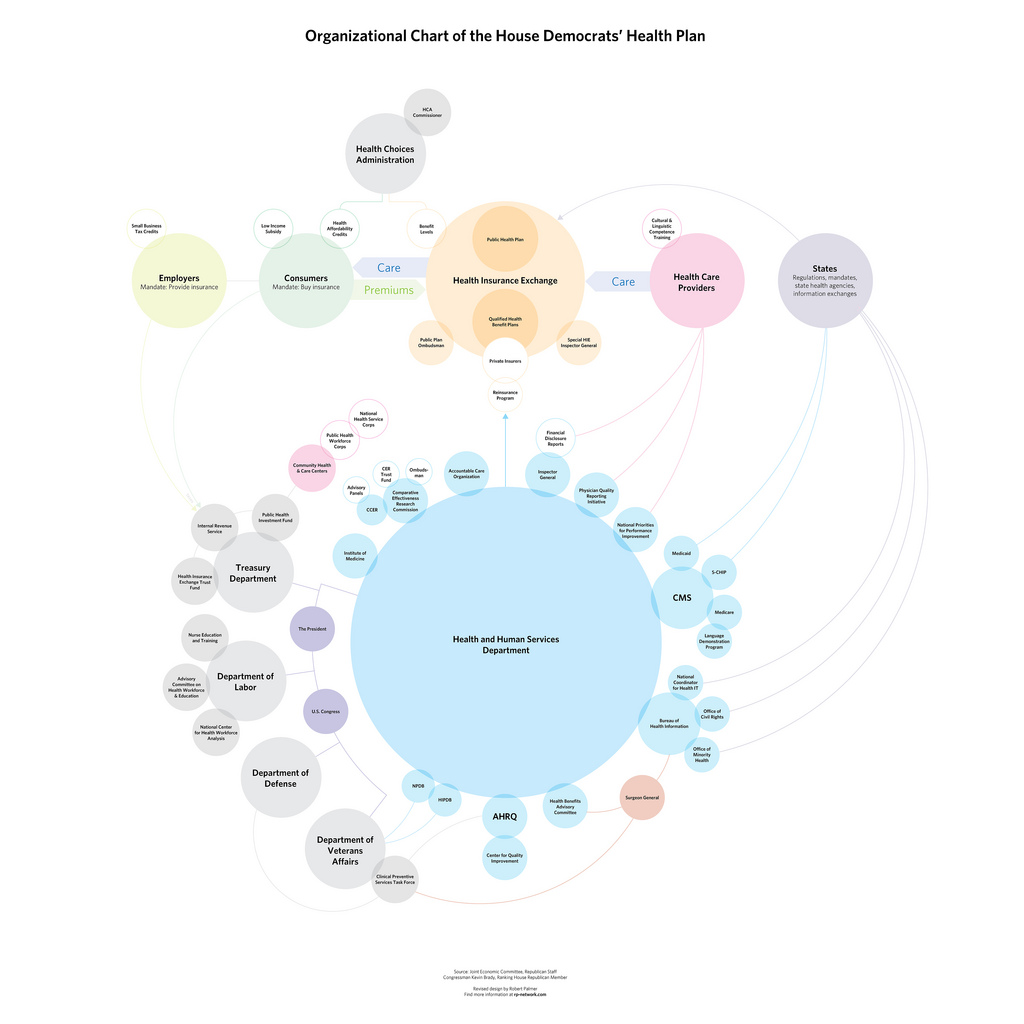
Remember this ?

Now try this:

Simple, focused and profound trumps ridiculously complex systems designed from technocratic hubris. Even if everything here worked according to plan in these charts, the intrinsic “friction” is a colossal waste of resources.
ADDENDUM:
In the interest of evenhandedness – and because it doesn’t matter in terms of the point of my post – here’s a Democratic take on the House Democratic plan for health care provided by Curtis Gale Weeks in the comments section. While this was not the same as the final Obamacare bill, there’s some congruence. If anyone has a link to a Democratic-produced chart of the final bill, I’ll post that:

Dr. Paul Craig Roberts, the famous Reagan administration economist and now an embittered and cranky paleoconservative social critic, penned a short but intriguing American “collapse” scenario set in the near future. Some of what Roberts writes fits neatly with the thesis in Joseph Tainter’s The Collapse of Complex Societies:
….As society broke down, the police became warlords. The state police broke apart, and the officers were subsumed into the local forces of their communities. The newly formed tribes expanded to encompass the relatives and friends of the police.
The dollar had collapsed as world reserve currency in 2012 when the worsening economic depression made it clear to Washington’s creditors that the federal budget deficit was too large to be financed except by the printing of money. With the dollar’s demise, import prices skyrocketed. As Americans were unable to afford foreign-made goods, the transnational corporations that were producing offshore for US markets were bankrupted, further eroding the government’s revenue base.
The government was forced to print money in order to pay its bills, causing domestic prices to rise rapidly. Faced with hyperinflation, Washington took recourse in terminating Social Security and Medicare and followed up by confiscating the remnants of private pensions. This provided a one-year respite, but with no more resources to confiscate, money creation and hyperinflation resumed.
Organized food deliveries broke down when the government fought hyperinflation with fixed prices and the mandate that all purchases and sales had to be in US paper currency. Unwilling to trade appreciating goods for depreciating paper, goods disappeared from stores.
Several interesting things here. First, the demagogic front men who are currently engaging in op-ed tirades against public pensions in order to loot them to ostensibly plug state budget deficits will, if successful, use that precedent to go after private pensions, IRAs, 401(k), mutual funds, Social Security, Medicare, Home mortgage interest deduction – any remaining big pot of money in the hands of the middle-class has a big target on it. Secondly, food shortages historically were the spark that set off the French and Russian Revolutions.
When hubris sent America in pursuit of overseas empire, the venture coincided with the offshoring of American manufacturing, industrial, and professional service jobs and the corresponding erosion of the government’s tax base, with the advent of massive budget and trade deficits, with the erosion of the fiat paper currency’s value, and with America’s dependence on foreign creditors and puppet rulers.
The Roman Empire lasted for centuries. The American one collapsed overnight.
Rome’s corruption became the strength of her enemies, and the Western Empire was overrun.
America’s collapse occurred when government ceased to represent the people and became the instrument of a private oligarchy. Decisions were made in behalf of short-term profits for the few at the expense of unmanageable liabilities for the many.
Overwhelmed by liabilities, the government collapsed.
Connectivity, contra Roberts, is good. Corruption, on the other hand, is not. Free markets are generally efficient, so long as you do not expect them to automatically create public goods of a certain scale or be perfectly self-regulating. They require a scrupulously impartial rule of law in order to not become corrupted by abusive players seeking rents. Unfortunately, a scrupulously impartial rule of law is incompatible with technocracy, where expert administrators are granted arbitrary discretion without democratic accountability, the prevailing ethos in the EU supranational bureaucracy, to cite a real world example. The late, unlamented, Soviet nomenklatura would be another, more sinister, historical one.
The primary problem with the American political economy is that in the last 10-15 years, elite, moderately liberal technocrats have made common cause with the elite, moderately conservative rentiers of the financial and corporate world to form an incipient oligarchy. One sees their fellow Americans paternalistically as children. The other sees us as sheep to be sheared. It’s a common enough ground on which to unite and it is the reason you see a very liberal Democratic Obama administration and a Pelosi-Reid Congressional leadership counterintuitively putting corporate regulation in impenetrable shadows not seen since before the Stock Market Crash of 1929 as if they were the minions of Jay Gould and J.P. Morgan.
Don’t expect mainstream Republicans in Congress to die on any hills fighting for the free market either – they aspire to be the party of no-bid contracts to the Democratic party of government by clout.
Alderman Paddy Bauler would be proud.

Zenpundit is a blog dedicated to exploring the intersections of foreign policy, history, military theory, national security,strategic thinking, futurism, cognition and a number of other esoteric pursuits.
Customized Web Site & Blog Design

