The Networks of Nations
Wednesday, December 28th, 2011Military theorist John Arqilla offers a provocative piece in Foreign Policy:
….How the new pattern will unfold is still unclear, but just as the first nation-states were often tempted to become empires, there may be a pattern in which nations and networks somehow seek to fuse rather than fight. Iran, in its relations with Hezbollah, provides perhaps the best example of a nation embracing and nurturing a network. So much so that, in parsing the 2006 Lebanon war between Israel and Hezbollah, most of the world — and most Israelis — counted it as a win for the network. China, too, has shown a skill and a proclivity for involving itself with networks, whether of hackers, high-sea pirates, or operatives who flow along the many tendrils of the Asian triads’ criminal enterprises. The attraction may be mutual, as nations may feel more empowered with networks in their arsenals and networks may be far more vibrant and resilient when backed by a nation. All this sets the stage for a world that may have 10 al Qaedas operating 10 years from now — many of them in dark alliances with nations — a sure sign that the Cold War–era arms race has given way to a new “organizational race” to build or align with networks.
Can’t say that I disagree with that in big picture terms. Looking long term to 2100, I wrote in Threats in the Age of Obama that the geopolitical position of nation-states would undergo a transformation:
….Nation-states in the 21st century will face a complex international ecosystem of players rather than just the society of states envisioned by traditional Realpolitik. If the predictions offered by serious thinkers such as Ray Kurzweill, Fred Ikle or John Robb prove true, then technological breakthroughs will ensure the emergence of “Superempowered Individuals”[1] on a sizable scale in the near future. At that moment, the reliance of the State
on its’ punitive powers as a weapon of first resort comes to an end. Superemepowered individuals, separatist groups, insurgents and an “opting-out” citizenry will nibble recalcitrant and unpopular states to death, hollowing them out and transferring their allegiance elsewhere.While successful states will retain punitive powers, their primary focus will become attracting followers and clients in whom they can generate intense or at least dependable, loyalty and leverage as a networked system to pursue national interests. This represents a shift from worldview of enforcement to one of empowerment, coordination and collaboration. States will be forced to narrow their scope of activity from trying to supervise everything to flexibly providing or facilitating core services, platforms, rule-sets and opportunities – critical public goods – that the private sector or social groups cannot easily replicate or replace. Outside of a vital core of activity, the state becomes an arbiter among the lesser, interdependent, quasi-autonomous, powers to which it is connected.


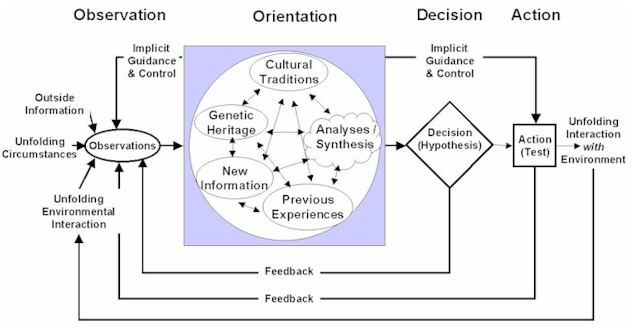
 last actions, you are already onto your next ones. Get far enough ahead and the opponent’s decision making process will collapse and victory is assured.