zenpundit.com » intellectuals

Archive for the ‘intellectuals’ Category

More on Boyd & Beyond II and Boydian Theory

Wednesday, October 19th, 2011

Two posts of note:

USNI Blog (Lucien Gauthier) – Training Sailors to be Autodidactic

….The conference spent a lot of time on the first half of the OODA-Loop, Observing and Orienting.  At some point I became convinced that the type of Sailor we need is one that is a “situational autodidact”.  Major Marcus Mainz, USMC, during his presentation made the brilliant comment that “training is for the known, education is for the unknown” in this sense, the spirit in which we must educate our Sailors must be towards making them capable of educating their self as needed when the unknown presents itself to them.

….For Sailors to take greater advantage of their experiences, they need to actively question their actions.  By this, I mean that a person analyses a question more than they do a statement.  But, it has been my experience that when someone recants an experience they had, it is a rare thing to hear someone say anything in terms of ‘why’ they did something.  Much more often someone only tells the ‘what’ of their actions.  Think of the Socratic Method, where Socrates would answer his students questions with another question.  A Sailor who has internalized such a ‘Socratic process’ would be in a position to provide more cogent feedback as well as learn from their mistakes more often than we do today.

What I am saying is not that the training we offer Sailors falls short of its objectives as they stand today.  But, that the spirit of the training is not where it needs to be-we focus our objectives too much on acting rather than orienting.  The training our Sailors receive are based on concrete and testable objectives that can be measured, quantified and turned into metrics, that fit well into powerpoint.  We do no help Sailors to become autodidactic-we are not training them to become students of their environment, but rather students of their school house.

We start to approach training Sailors to be autodidacts of their environment in the Operational Risk Management training we receive (One thing about ORM:  It is Boyd’s OODA-Loop operationalized.  The Navy has totally ripped off Boyd, and yet we never mention his name outside of the Warfare Universities-shame on us).  We need more and deeper training on ORM and how this method applies to everything we do, whether we consciously realize it or not.  In giving this deeper level or ORM, we should also find Sailors able to be more articulate of the process they’ve gone through.  Thereby becoming able to better train others of their experiences….

Naval affairs is not my bailwick, but my understanding of following online discussions by experts in the field like General Robert Scales, is that Professional Military Education across all the services is a) in need of significant reform and b) is facing a future of restricted budgets and possible deep cuts. My only firsthand knowledge of PME comes from a brief stint in June at The Army War College, courtesy of Dr. Steve Metz. The AWC curriculum was explained to me in detail by Col. Bill Lord, and while they were hitting the right notes in terms of trying to inculcate a strategic epistemology, the time frame allowed for doing so is extremely compressed.

Fast TransientsBoyd’s Conceptual Spiral – New Edition

This is from Dr. Chet Richards as well as Chuck Spinney….

Download Conceptual Spiral (152 KB PDF), Boyd’s take on the origin and importance of novelty:

Novelty is not only produced by the practice of science/engineering and the pursuit of technology, it is also produced by the forces of nature, by our own thinking and doing as well as by others. Furthermore, novelty is produced continuously, if somewhat erratically or haphazardly. Now, in order to thrive and grow in such a world, we must match our thinking and doing, hence our orientation, with that emerging novelty. (28)

Adds the original page numbers, which may seem a little odd because for readability this edition spreads several of Boyd’s originals over two or even three pages.  All of these will have the same number.

We are wired to crave and be attracted to novelty, it sets us thinking and generates insights and stimulates our creativity.
An OODA Loop Made of Straw

Saturday, October 8th, 2011

From AFJ:

…This notion that there are specific knowable causes that are linked to corresponding effects dominates military thinking and manifests in our drive to gather as much information as possible before acting. This concept was captured by Air Force Col. John Boyd’s decision loop: observe, orient, decide and act. In this OODA Loop, an endless cycle in which each action restarts the observe phase, it is implied that collecting information would allow you to decide independent of acting. Also implied is the notion that you can determine measures of effectiveness against which to observe each action’s movement toward achievement of your goal so you can reorient. The result of this type of thinking is to spend a lot of time narrowing the focus of what we choose to observe in order to better orient and decide. This drives one to try and reduce the noise associated with understanding the problem. We do this by establishing priority information requests or other methods of focused questions aimed at better understanding the core problem so we can control it.

No.

The OODA Loop is not a linear process, orientation is the key and the OODA Loop does not by default “narrow your focus”. WTF?

Maybe the military or, more likely, some brigade commander, instituted a process like this in Iraq for their information-intel analysis, maybe not, but if they did it was not what Colonel John Boyd argued they ought to do. Nor is it an understanding of what the OODA Loop is or how it works.

Here’s an OODA Loop for Dummies level brief from Dr. Chet Richards intended for businessmen but there are more sophisticated explanations out there by Chet and others. Google is your friend. 🙂

Operating Inside Their OODA Loops

This post might help as well:

Chet on TEMPO….Rao on OODA

Kesler on R2P Hypocrisy

Saturday, October 8th, 2011

Nice catch by Bruce Kesler who goes en fuego on the weirdly discordant note Anne-Marie Slaughter strikes in her latest New York Times op-ed:

Majority Rule Over Minorities: Ironic R2P Hypocrisy

The extremism of R2P’s leading proponent is exhibited in Anne-Marie Slaughter’s op-ed in today’s New York Times. Slaughter likens the Wall Street protesters to those demonstrating against oppressive regimes in the Middle East and recommends removal of the US system of checks and balances that protect minority views and avoid poorly developed political stampedes. (Slaughter doesn’t mention or give credence to the more numerous, mature citizenry participating in or supporting the Tea Parties more peaceful protests for more limited government intrusions into Americans’ private lives and earnings.)

R2P’s leading proponent, Anne-Marie Slaughter of Harvard, believes that US foreign policies and military interventions should prioritize the Right To Protect severely repressed peoples through US obeisance to liberal internationalist elites’ sentiments in favor of some they like regardless of the US Constitution or laws or national or security interests.

In today’s New York Times, Slaughter takes her R2P home to the US, advocating that majorities rule regardless of the formal and informal checks and balances of our political system and overriding the rights of political minorities. Again, it is the majorities that liberals like who should be given more powers.

Without any sense of proportionality or of core differences between the US and Middle East satrapies, Slaughter says, “Indeed, the twin drivers of America’s nascent protest movement against the financial sector are injustice and invisibility, the very grievances that drove the Arab Spring.” Slaughter then concludes, “The only effective response is a political response, of a nature and magnitude that convinces protesters on the streets that they can in fact secure the change they seek within, rather than outside, the system.”

Slaughter’s system, however, would reduce the ability of permanent or transitory political minorities to protect their interests. They would, also, further factionalize the US and make compromises more difficult as the power of centrists is reduced….

Read the rest here.

Good grief. Anne Marie Slaughter opining on the need for greater democracy and accountability to the people is somewhat akin to Ayn Rand calling for more welfare programs.

My suspicion here, since this rhetoric runs counter to Slaughter’s most influential ideas, is that Slaughter is just carrying water as part of the current Democratic political strategy of trying to co-opt the Occupy Wall Street movement. Perhaps the Axelrods and Podestas see that open-source protest movement to potentially be “their tea party”. Whatever. I will take her op-ed more seriously when she is marching against the Hedge fundies and Wall Streeters who are top donors to her Party, her administration and her university.

You can put a three corned hat on a Princeton theorist of global governance by transnational “governmental networks” but even if you adjust the hat at a suitably jaunty angle for maximum populist effect, the agenda underneath is still neither democratic nor popular.

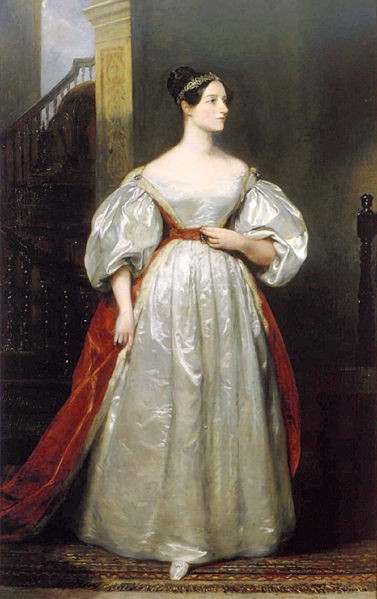
In honor of Ada, Countess of Lovelace

Friday, October 7th, 2011

[ by Charles Cameron — childhood memories, computer history, creative thinking, analogy, bead game ]

.

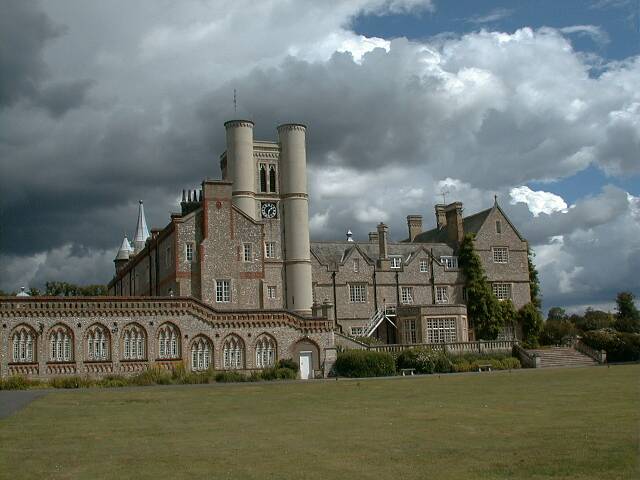
hors508.jpg

This menacing old pile, Horsley Towers — John Julius Norwich said of it in his Architecture of southern England, “The over-riding idiom seems to be vaguely Italianate Gothic, but in reality East Horsley is like nothing but itself, a grotesque Victorian Disneyland which has to be seen to be believed – and may not be even then” — was home to Ada, Countess of Lovelace, daughter of the poet Lord Byron.

Today is Ada Lovelace Day, and I have special reasons to honor her.

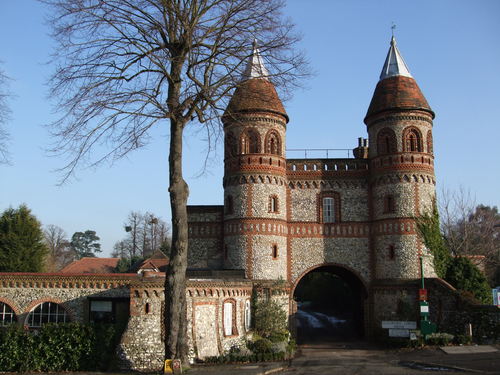
horsley-gateway.jpg

For one thing, I grew up inside these gate-towers, in the last little house before the Lovelace estate proper began, and certain features of the first fields on the way to the big pile were my childhood haunts, the old oak with its dark and mysterious hollow wound, the clovered grass and cow pats, the small mound for boyish climbing, the bramble bushes with their delicious blackberries…

*

But it is as a devotee of Hermann Hesse‘s great Bead Game that I want to celebrate Ada Lovelace today —

ada3.jpg

for she illustrates to perfection the importance of cross-disciplinary analogies in creativity.

*

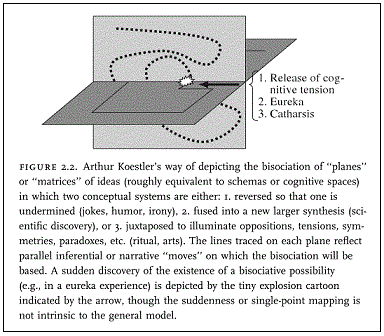
Consider this diagram from Mark Turner‘s The artful mind: cognitive science and the riddle of human creativity, based on those in Arthur Koestler‘s The Act of Creation (eg those on pp 35 and 37):

koestler-model.gif

Hesse proposes — in his Nobel-winning novel, the Glass Bead Game (aka Magister Ludi) the building of an architecture of ideas in which the great works of human culture are linked — bound together — by analogies between them.

Beginning players of his Game,  he writes, learn “how to establish parallels, by means of the Game’s symbols, between a piece of classical music and the formula for some law of nature.” As I wrote elsewhere, on a more complex level, Hesse speaks of scholars proposing materials for inclusion in the Game Archives, and specifically mentions someone who had been studying “the rhythmic structure of Julius Caesar’s Latin and discovered the most striking congruences with the results of well-known studies of the intervals in Byzantine hymns”…  Hesse couldn’t possibly have known about it when writing that particular sentence, of course, but there is actually a book by Jane-Marie Luecke, OSB, entitled Measuring Old English Rhythm: an Application of the Principles of Gregorian Chant Rhythm to the Meter of Beowulf, (Literary Monographs, vol 9, U. Wisconsin Press, 1978).

Hunh?  So?

*

Consider what Ada, Countess of Lovelace hath wrought.

She perceived just such an analogy — comparing Charles Babbage‘s Analytical Engine with Jacquard‘s mechanical loom, and writing:

The Analytical Engine … weaves algebraic patterns, just as the Jacquard-loom weaves flowers and leaves.

That analogy between weaving and algebra was the great creative leap: from there to the adoption and adaptation of Jacquard’s punched card system in computation was the lesser step from insight to application.

And think about it: her mind moved unerringly between “art” and “science” — or more exactly, craft and mathematics — in 1843, to deliver a technological insight on which the mainframes of the 1970s still relied…

That, my friends, was a superb move in the spirit of the Glass Bead Game — and impossible without a well-furnished and agile mind.

Fouche on Potential and Probable Uses of Power

Friday, October 7th, 2011

My sometime Chicago Boyz colleague, Joseph Fouche, had an interesting if somewhat meandering post on how power is used, not used and possibly abused.

The Chains of the Improbable vs. The Chains of the Impossible

An old Vulcan proverb advises us that only Sulla could march on Rome. This proverb may contradict another ancient proverb that claims that all roads lead to Rome. This seeming contradiction is resolved when you include little used roads, off the beaten track, the roads not taken. Sherlock Holmes once chided John A. Watson, M.D., saying, “How often have I said to you that when you have eliminated the impossible, whatever remains, however improbable, must be the truth?” Some roads to Rome are impossible, leading to the insurmountable. Lucius Cornelius Sulla Felix took a road that, while thought impossible, proved to be merely improbable.

Sulla, consul of Rome for the year 88 B.C., was in camp preparing to take his army east to fight King Mithridates VI of Pontus. Two envoys arrived to tell him that his command had been taken away by the vote of one of the people’s assemblies in Rome. These envoys of the Roman people expected that Sulla would do the only thing possible: lie down there, obedient to their commands, as every Roman army commander before him had done. Unfortunately, what they thought was impossible was only improbable.

Sulla gathered his men, announced what the will of the Roman people was, and asked them what the will of the army was. Sulla’s soldiers answered by stoning the envoys of the Roman people to death, much to the surprise of the envoys of the people. Sulla’s soldiers then petitioned Sulla to take an impossible road, a road never taken, and lead them to Rome to reclaim his Mithridatic command. Sulla, much to the surprise of his own officers, who thought such a course impossible, decided to heed his men and march on Rome. His officers resigned en masse except a happy few. But the poor bloody legionaries of Sulla’s army eagerly began the march on Rome.

Envoys from Rome streamed towards Sulla’s army as it marched north.These envoys were shocked and grew increasingly shocked as they protested to Sulla that surely, surely it was impossible that he wanted to march a Roman army through the city limits and into Rome itself. The law forbade it. The unwritten constitution forbade it. The Republic forbade it. The gods forbade it.

Sulla responded to the effect of, “Go tell the Romans that I don’t lie here obedient to their commands. I’m coming to Rome and hell’s coming with me.” The tone of these envoys’ entreaties and the mood of the people of Rome grew increasingly hysterical as the improbable dawned on them: not only could a Roman army commander march an army on Rome, it was increasingly probable that Sulla would march armed Roman legionaries right into the heart of Rome itself to deal with his political enemies. Indeed, Sulla led his men across the sacred pomerium that divided the “public thing” (res publica) of sacred Roma herself from land that was merely the property of Rome. Sulla’s veteran legionaries easily dispatched the hastily gathered mob of gladiators and other ruffians that his political opponents had thrown together at the last moment in a futile attempt to stop them.

Sulla had revealed that the impossible was merely the improbable.

Sulla spent the rest of his life trying to disguise this state of improbability as a mere state of impossibility.

He failed.

That was merely Fouche’s introduction. The post is well worth reading in full.

The post caught my eye because of Sulla, a Roman who did a monstrous thing but who was himself no monster. Much like a surgeon whose patient’s body is riddled with cancer, Sulla attempted to buy the old Roman Republic time and restore a semblance of political health by ruthlessly cutting out a tumorous faction and ratcheting back a host of constitutional gimmickery that had been welded onto Roman government over the years by ambitious politicians. Older, original rules of the game, or new ones in their spirit, were restored after blood shed in the proscriptions was scrubbed from the forum. Sulla even formally stepped down from the supreme power he held, like Cincinnatus, to further drive home the point to his fellow Romans regarding the sanctity of their traditions – though reportedly Sulla remained, even in a debaucherous retirement, a terrifying figure and stringpuller.

Fouche is correct that Sulla’s extreme measures failed. The underlying structural problems of the Republic were rooted in an increasing concentration of wealth, primarily in land ownership by Patricians and politically favored trading opportunities in “the East”, held mostly by the elite of Rome’s Italian “allied” city states, that left many Roman citizens too impoverished to perform military service or to be active in politics, except as dependent members of a clientela. The Republic’s legions and it’s political virtue had been based on an economically independent smallholding class who were being despoiled by politically powerful Patricians. Sulla’s reforms may have tempred political conflict within the ruling class for a time, but they also aggravated the social grievances that provided the Populares with political support from ordinary Romans and tilted the delicate political balance in the Republic toward extreme oligarchy.

In his retirement, observing the young Julius Caesar, whom Sulla had reluctantly spared, his toga fashionably loosely belted, long sleeved and wearing boots, like the ancient kings of Alba Longa, Sulla remarked “ He contains many Mariuses“. Caesar did. And unlike Marius but like Sulla, Julius Caesar was successful, Sulla having shown him the way to cross a Rubicon.

Power is power but power coupled with legitimacy endures. Sulla to Caesar to Augustus is the continuum.


Switch to our mobile site