2081
Sunday, December 19th, 2010Long overdue yet exceedingly timely. From one of the great short stories of all time.
2081 Trailer from 2081 on Vimeo.
Long overdue yet exceedingly timely. From one of the great short stories of all time.
2081 Trailer from 2081 on Vimeo.
I very much like the turn toward the publication of short interviews with experts occurring of late at SWJ BLog, for example the COIN series by FP’s Octavian Manea. To toot my own horn for a moment, I did an early one for SWJ when I interviewed Tom Barnett.
There are two new ones up right now that I recommend:
Octavian Manea – Thinking Critically about COIN and Creatively about Strategy and War An Interview with Colonel Gian Gentile
Q: To what extent should Algeria be a warning for present?
A: The warning it should provide is that you should never think that improved tactics, whether it is a conventional or a counterinsurgency war, can rescue a failed strategy or policy. Sun Tzu offers one of the most profound statements on the relationship between tactics and strategy: Strategy without tactics is the slow road to victory, but tactics without strategy is the noise before defeat. Another historical example comes to mind. The German army up to a certain point in WWII was arguably one of the finest tactically fighting armies in history. But it lost. The warning is to be careful how much faith you place in the idea that better tactics can save a failed strategy or policy (or in the case of the Vietnam War – better tactics rescuing a war that was unwinnable in the first place)
Mike Few –A Conversation with Dr. Douglas Porch Relooking French Encounters in Irregular Warfare in the 19th Century
A: Alas, Arquilla’s representation of these incidents as primitive versions of modern concepts are a stretch, when not total misrepresentations. At worst, his examples are lifted from context, include material factual inaccuracies, and misconstrue reasons for French “success.” (The “successes” themselves are debatable.) Finally, Arquilla perpetuates the fundamental COINdanista heresies that tactics can rescue flawed policy and defective strategy, while “modernizing” Western occupations will be perceived as “liberation” by indigenous societies. I will take each of Arquilla’s examples in turn to explain their context, in the process illustrating why an incomplete history can lead to misleading results.
Under Suchet, Aragon did in fact enjoy the reputation as the most pacified Spanish province in Spain. But Suchet’s achievement was temporary, contingent and a “success” only when contrasted with the overall catastrophic outcome of Napoleon’s Spanish project. Aragon and the sliver of bordering Catalonia over which Suchet had charge only shines in context: The French totally lost the narrative in Spain. Napoleon’s deposition and imprisonment of the Bourbon Ferdinand VII — whom he replaced with his brother Joseph Bonaparte in 1808 — established a government regarded as illegitimate, not only in Spain, but in Europe and Latin America as well. The obligation imposed by the Napoleon that the Spaniards pay the costs of occupation meant high taxes and requisitions of Church lands. “Modern” French secular ideas taken from the French Revolution were an affront to the values of conservative Spaniards, who were horrified that Napoleon had imprisoned two Popes and annexed the Papal States to the Roman Republic. The fact that Napoleon was unable to vanquish Great Britain, and the presence
Kudos to Bill and Dave! Keep’em coming!

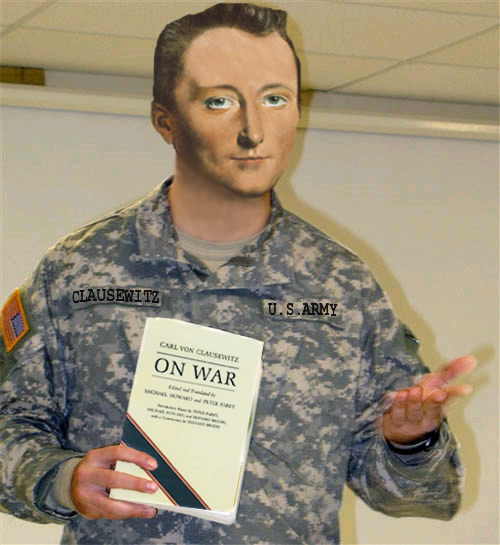
This article at SWJ blog has stirred a lively debate in the comments section with some very able practitioner-scholars weighing in.
….Sun Tzu?s ancient military philosophy of indirectness and gradualism runs counter-culture with much of mainstream western military strategy. Western reliance on superior technology and firepower shaped American counterinsurgency doctrine to be largely lethal in nature and enemy focused. Clausewitz instructed generations of military officers that the destruction of the enemy?s army is the primary goal in all combat1; therefore, all political-military conflict results in offensive action where attrition of the enemy force becomes a universal requirement. Clausewitzian war theory „worked? in both world wars in that the Allies did accomplish their desired goals; however critics such as Israeli strategist Shimon Naveh raise valid questions on whether Clausewitz?s fixation on offensive action and attrition warfare helped or hindered the Allied causes2. Despite Clausewitzian strategy?s seemingly illogical structure, application of his theories in the major 20th century conflicts created an enduring military school of war strategy with „On War? taking a sacred position.
In fairness to Clausewitz, this is over the top.
The US military could use more Sun Tzu; it is far more Clausewitzian in the perspective of the officer corps than it is “Sun Tzuite”, but the armed services are not the Children of Clausewitz. Not even the US Army. We’d probably be better off if the American military was more thoroughly one or the other in terms of strategic culture than the industrial age, bureaucratic, ad hoc, legacy thinking non-strategic hodgepode that currently prevails.
I do not expect that to change. American military organizational culture is driven more by appropriations than by ideas.
Some Related Links:
Sonishi.com Interview with Martin van Creveld on Sun Tzu
Sonishi.com Interview with Chet Richards on Sun Tzu and Boyd
Christopher Bassford on Sun Tzu, Jomini and Clausewitz
I have too many books that I have read that I would like to review that, realistically, I will never get to post on in conventional fashion. A fair number belong with Summer Series which seems ridiculous as it is two weeks to Christmas! Therefore, brace yourselves, as I commence the first, and hopefully only, Mini-Reviews post:

Play: How It Shapes the Brain, Opens the Imagination, and Invigorates the Soul
Dr. Stuart Brown, scientist and psychiatrist, has written a short tome on the nature and cognitive value of play. While there is plenty of child social development information and “pop”self-helpish type chapters, ZP readers wil gravitate to the chapters on play’s vital role in creaivity and innovation ( which are not the same thing), scientific discovery and work. Also of interest are the spectrum of “play personalities” and the “dark side of play”. Not an academic book but a reasonable read on a deceptively complex subject.

The Collapse of Complex Societies
A superb academic book, previously featured and reviewed in the blogosphere by John Robb and Joseph Fouche, The Collapse of Complex Societies embarks upon a critical examination and partial de-bunking of theories that purport to explain the “sudden” fall of great empires, such as Rome or the vanishing of the Mayans. With caveats, Tainter settles on declining marginal returns from increasing societal investment in complexity as a rough proximate cause capable of subsuming a ” significant range of human behavior, and a number of social theories” under it’s rubric. Highly recommended.

The Bin Ladens: An Arabian Family in the American Century
A biography of the Bin Laden family, this book does not come close to matching the impact or importance of Coll’s previous instant classic, Ghost Wars. There are many interesting trivialities about the divergences between the “religious and the hard Rock Cafe wings” of the Bin Laden families, and intriguing nuggets about political matters such as the 1979 takeover of the Grand Mosque and the connections between the Bin Ladens and elite figures inside the beltway but anyone looking for insight into Osama bin Laden will be disappointed. The most infamous member of Saudi Arabia’s dominant non-royal business clan is a subdued figure in this biography. Coll’s superior skills as a wordsmith and reporter manage to make the book a pleasant page turner.

The Death and Life of the Great American School System: How Testing and Choice Are Undermining Education
Conservative education scholar and historian Diane Ravitch lays out the demise of the movement for high curricular standards in public education that she once championed and it’s transmogrification under NCLB into a punitive system that is slowly imposing an unprecedentedly narrow and dumbed down national curriculum focusing on basic math and reading skills, featuring gamed test results, highly paid lawyer-consultant insiders and perverse incentives for public and charter schools alike. A depressing but important read.
[ by Charles Cameron ]
[ note: all links are to youtube videos ]
The pianist Glenn Gould is celebrated for his ability to bring the different and at times positively oppositional voices in a fugue by Bach to our attention, so that we follow each one separately while hearing all at the same time as a single whole. What is less known is that he liked to sit at a table in a truck stop and listen to the different conversations at the other tables and booths, mentally braiding their pale or brightly colored threads of human together into an analogous tapestry — one voice harmonizing with or conflicting against another, here a new subject introduced, there an echo of an earlier idea heard in a fresh context, with the murmurings of waitresses punctuated by the kaching! of the cash register, the hydraulic hiss of a door closing — conversation as counterpoint.
Organizations and individual alike, we all have different and at times dissonant voices, and strive to bring them to some kind of resolution. The many stakeholders debating an issue in town halls, blogs or letters to the editor, the many drives within each one of us, idealistic, hopeful, defeated, paralytic, angry, evasive, sluggish, vengeful, curious, alert, defiant, all have voices, all constitute an experience of polyphony, a “music of many voices”, in point counter point.
One of my interests is to find a way to score these many fugues, these musics of meaning.
My DoubleQuotes, then, can be considered as two-part inventions, attempts to show the multiple tracking of the mind — whether of a single individual, as in this case, or of a group, a community, a world divided – so that something of the music begins to be visible, and some of the dissonances can move towards necessary resolution.
*
*
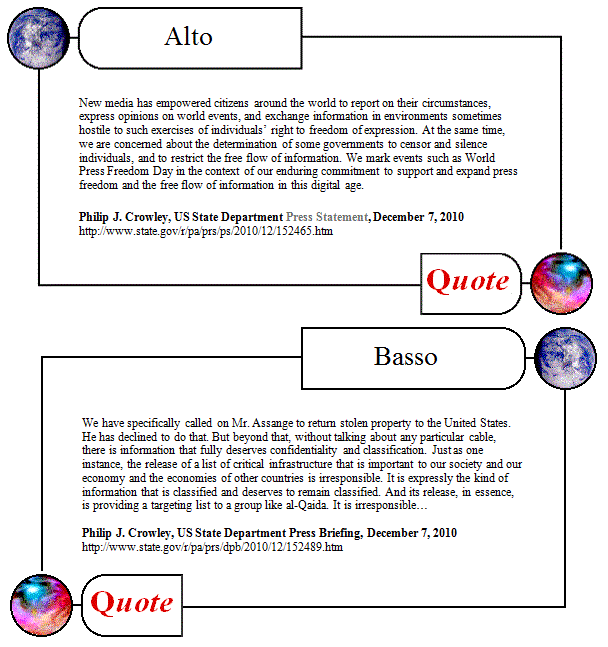
I believe there is unresolved irony between these two statements, made on the same day by Philip J Crowley, the US State Department’s Assistant Secretary, Bureau of Public Affairs – but each has its reasons, and there are arguments to be made for both transparency and opacity, diplomacy and publicity, secrets and revelations.
Between them lies the possibility I think of as a virtual music of ideas.
*
Bach published a series of two-part inventions, BWV 772–801, and wrote of them that he intended to offer them as an honest method
by which the amateurs of the keyboard – especially, however, those desirous of learning – are shown a clear way not only (1) to learn to play cleanly in two parts, but also, after further progress, (2) to handle three obligate parts correctly and well; and along with this not only to obtain good inventions (ideas) but to develop the same well; above all, however, to achieve a cantabile style in playing and at the same time acquire a strong foretaste of composition…
Later comes the Art of Fugue.

Zenpundit is a blog dedicated to exploring the intersections of foreign policy, history, military theory, national security,strategic thinking, futurism, cognition and a number of other esoteric pursuits.
Customized Web Site & Blog Design

