zenpundit.com » military reform

Archive for the ‘military reform’ Category

Do Oligarchies Create Insurgencies?

Tuesday, November 29th, 2011

“…. But when the sons of these men received the same position of authority from their fathers-having had no experience of misfortunes, and none at all of civil equality and freedom of speech, but having been bred up from the first under the shadow of their fathers’ authority and lofty position-some of them gave themselves up with passion to avarice and unscrupulous love of money, others to drinking and the boundless debaucheries which accompanies it, and others to the violation of women or the forcible appropriation of boys; and so they turned an aristocracy into an oligarchy. But it was not long before they roused in the minds of the people the same feelings as before; and their fall therefore was very like the disaster which befell the tyrants.”-Polybius

One of the tenets of pop-centric COIN is that better governance will deliver the loyalty of the people who are the center of gravity over whom the insurgent and state contest. This usually means cajoling the state to reform and remove the worst abuses that serve to politically fuel the insurgency. Occasionally this is successful (El Salvador), frequently it is not (South Vietnam, Afghanistan) and in other cases it may be irrelevant as the method is eschewed in favor of indiscriminate brute force and punitive expeditions (Sri Lanka, Soviet COIN) but it begs the question of:

“What kind of governance is most likely to create insurgencies in the first place?”

Of insurgencies that are wholly indigenous, what form of government spawns them most frequently? A chart of historically recent insurgencies is given below containing who fought and who won (“negotiated” indicates a political settlemt “tie” of sorts, with some political accomodation and not settlements that are trucial “exit agreements” for the defeated belligerent): 

COUNTRY GOVERNMENT VICTOR
Aden Colonial Insurgents
Afghanistan (1979-1989) Communist/Occupied Insurgents
Afghanistan (2001-2011) Republic/Occupied Ongoing
Algeria (1954-1962) Colonial Insurgents
Algeria (1991-2006) Dictatorship Government
Angola(1961-1975) Colonial Insurgents
Angola (1975-2002) Communist Negotiated
Bolivia Dictatorship Government
Britain (N. Ireland) Democracy Negotiated
Cambodia (1970-1975) Dictatorship Insurgents
Cambodia (!978-1991) Communist/Occupied Negotiated
Colombia Democracy Ongoing
Chechnya Republic Government
China (1911-1949) Dictatorship Insurgents
Cuba Dictatorship Insurgents
Cyprus Colonial Insurgents
El Salvador (1930’s) Dictatorship Government
El Salvador (1970’s-1980’s) Dictatorship/Democracy Government
Greece Monarchy Government
Guatemala Dictatorship Government
India Democracy Ongoing
Indonesia (1945-1949) Colonial Insurgents
Indonesia (1965) Dictatorship Government
Iraq Democracy/Occupied Government
Israel (1st Intifada) Democracy/Occupied Negotiated
Israel (2nd Intifada) Democracy/Occupied Government
Jordan (Black September) Monarchy Government
Libya Dictatorship Insurgents
Malaya Colonial/Republic Government
Mexico Democracy Ongoing
Mozambique Communist Negotiated
Nepal Monarchy Insurgents
Nigeria (Biafra) Dictatorship Government
Nigeria (Delta) Democracy Ongoing
Nicaragua (1979) Dictatorship Insurgents
Nicaragua (1980’s) Dictatorship Negotiated
Palestinian Mandate Colonial Insurgents
Philippines (1899-1902) Colonial Government
Philippines (Huk Rebellion) Republic Government
Philippines Dictatorship/Democracy Ongoing
Rhodesia Colonial/Apartheid Insurgents
Saudi Arabia (Ikhwan Revolt) Monarchy Government
South Africa (Boer war) Colonial/Occupational Government
South Africa Apartheid Insurgents
Soviet Union (Basmachi Revolt) Communist Government
Soviet Union ( partisans) Communist Government
Syria (Hama Revolt) Dictatorship Government
Syria Dictatorship Ongoing
Vietnam (1930’s) Colonial Government
Vietnam (French War) Colonial Insurgents
Vietnam (American War) Dictatorship Insurgents
Yemen Dictatorship Ongoing
Yugoslavia Occupied Insurgents

The chart is fairly comprehensive, but I have not accounted for all movements or conflicts that can loosely be grouped under the heading of “insurgency” in the previous century. There are more. Corrections and additions are welcomed in the comments section. I also recognize that such a broad historical comparison as this chart involves a fairly massive degree of simplification of diverse examples. To some extent, simplification is unavoidable if insurgency is to be studied as a phenomenon at all rather than as an event in the history of a particular state or people.

EXCLUSIONS: 

Insurgencies before 1900.  A blog post cannot aspire become the encyclopedia of insurgency. 

The Russian Civil War (1918-1921) and the Lebanese Civil War of the 1980’s on the basis that while these conflicts contained many aspects of irregular warfare, they were primarily civil wars with extensive foreign intervention. The Greek and Chinese civil wars, by contrast are included because, despite foreign intervention in each case, the character of one of the belligerents in each conflict remained authentically and continuously insurgent in nature. The Greek communist army supported by Tito had previously been an anti-Nazi partisan force while Mao ZeDong’s Red Army were in rebellion against the Nationalist government before, after and to some extent, during, the WWII Japanese invasion of China.

Unlike the Vietnam War, the Korean War was neither an insurgency, nor a civil war, the adjunctive use of guerrilla operations by the North Korean and Chinese armies and the pro-DPRK apologetics of historian Bruce Cumings notwithstanding. The Korean War is better understood with Clausewitz than Galula.

The Soviet Bloc cases of Czechoslovakia in 1968 and Hungary in 1956 were excluded primarily because the resistance to Soviet domination was led by, or at least included, the leadership of the local satellite Communist Parties and governments, making those examples partially state vs. state conflicts. Of the two, Hungary presents a better empirical case for inclusion but from my readings of Soviet history, Khrushchev’s concerns were rooted in what he saw as counterrevolutionary and anti-Soviet elements in the Hungarian Party, army and security agencies and the Soviet response was a conventional invasion. I could be persuaded otherwise, but for now I am excluding Hungary.

The Katangan Secession – the reason here is my own lack of familiarity with the subject, as well as Mobutu’s later fall from power. Readers are invited to weigh in here or on any point.

Inadvertantly awol but intended to be included was Sri Lanka which recently crushed the Tamil Tigers. My error and one not easily remedied at this point for technical reasons, having tweaked the chart with another software program.

ANALYSIS:

Foreign Invasion 

First, if we wish to know what kind of governments most frequently suffer insurgencies, let us set aside insurgencies that derive primarily from resisting foreign invasion and occupation. While these conflicts are legitimately considered insurgencies, the cause of them is fundamentally external to the nature of the state. People have a natural, visceral and ingrained tendency to fight violent intruders and that reaction ought to be taken for granted and planned for accordingly. Even the much abused and absolutely impoverished peasantry of Russia rose up against Napoleonic armies and Nazi conquerors. So we would remove from consideration the cases of Afghanistan after the Soviet and American occupations, Yugoslavia, the Boer War, the Vietnamese occupation of Cambodia and the American occupation of Iraq and the Philippines as being externally provoked.

Likewise, insurgencies that are predominantly the creation of foreign powers, which would eliminate the US supported Contras in the 1980’s and parts of the Taliban like the Haqqani Network or Lashkar-e-Taiba in Kashmir (India however, has something like 17 ongoing insurgencies so it remains on the list). Also gone is Che Guevara’s quixotic and numerically insignificant expedition in Bolivia.

Totalitarian Dictatorships

To look at the chart, the type of government that seems to endure insurgency least often are, ironically, totalitarian governments. The USSR is listed with two revolts – the Basmachi in Central Asia in the 1920’sand the Banderists of Ukraine in the late 1940’s. The former began prior to the Revolution and Stalin’s absolute ascendancy and continued while Soviet governmental authority in Central Asia was still relatively weak. In the Ukraine, Bandera’s partisans only took root as a result of the chaos created by the Nazi invasion of the Soviet Union in 1941, which demolished the democidal grasp of Stalin’s NKVD apparatus there while replacing it with that of the genocidal SS

Historically, governments that exercised analogous control via terror to Stalin’s USSR simply did not endure insurgencies except in foreign territories they invaded, like Vietnam’s occupation of Cambodia. North Korea today, despite inhuman cruelties has not provoked an insurgency, nor did Nazi rule in Germany, the Khmer Rouge in Cambodia or even minor regimes like Enver Hoxha’s Albania, where efforts by the CIA to spark a guerrilla movement failed miserably. There is simply very little social “space” in a society atomized by terror and continuous surveillance for an insurgency to get started except by a spontaneous riot.

It is important to note however, as Jeane Kirkatrick did long ago, that totalitarian rule is qualitatively distinct from authoritarian rule. The USSR before an after Stalin was a different regime, regardless of outward continuity – and the same can be said of Communist China under Mao.

Democratic States 

The type of government that is next least likely to be fighting an insurgency at home are democratic ones – though they are perhaps very likely or most likely to be the states fighting them abroad.  The democratic states listed include Britain, Colombia, Israel, India, Mexico and Nigeria while the Philippines and El Salvador transitioned to democracy while fighting insurgencies and Iraq emerged from American occupation while an insurgency raged.

Of the democratic governments that fought insurgencies at home, Nigeria and the Philippines inherited their conflicts from previous dictatorships and all of the states have significant to severe demographic divisions based on language, religion, caste, tribe, ethnicity or legal status that are reinforced by economic discrimination and (except for Britain) serious to severe levels of corruption.

The economies of Mexico, El Salvador, Philippines and Colombia are historically oligarchic with the economic status quo being reinforced by extralegal violence in the rare instances where the government did not formally side with elite interests (usually because of factional disputes among the elite). The social complexities of Nigeria or India are too great to be delved into here but traditional structures and social relations were neither free nor highly mobile and that these legacies negatively impact or undermine democratic governance.

Of democracies that have not or have never needed to fight an insurgency, the supposition would be that liberal democracy represents the best vehicle for satisfying popular demands and defusing grievances. Further, there is an implicit assumption that democracies are functionally better at solving social and political problems and are less aggressive than dictatorships or traditional regimes. Therefore, a a key tenet of pop-centric COIN theory, the need for good governance, tends in practice to become conflated with implementing democratic and liberal reforms of regressive and repressive states, as was successfully done in El Salvador, to win over the loyalty of the population for the state.

I would like to believe that this theory is correct for intuitive and anecdotal reasons – it seems like common sense because our experience is that citizens of liberal democracies lead more prosperous, freer and more peaceful lives and are therefore unlikely to pick up arms against their government. Unfortunately, this reasonable assumption may be shakier than it appears and have little relation to success or failure of a COIN campaign.

The first problem with this line of COIN thinking is first, it mirrors the flaw in Democratic Peace theory – most democracies are of such new vintage historically that we are not assessing risks and probabilities from an adequate data set. Democracies have been, until the last twenty years, rare historical outliers. Of those democracies that have been around for the longest period of time – the European great powers, the United States and Japan – these nations have a formidibly warlike track record of military intervention or establishing the colonial empires that created the conditions for insurgency in most of the world’s hotspots. This alone should give us pause about the pacifistic nature of democracies if we have failed to learn this lesson from Thucydides.

The second problem is that good democratic governance does not equate with or guarantee military effectiveness of the counterinsurgent forces in the field. The shooting part of COIN wars matter and the “good guys” can lose when out-thought and out-fought; “bad guys” can be courageous, adaptive, highly motivated and militarily skillful adversaries. Nor does democratic governance ensure that wars of choice are fought for sound strategic reasons to accomplish affordable goals. The tendency toward idealism in democratic politics, making a war of choice attractive to an electorate can mitigate against maintaining a strategic perspective and tilt toward pursuing open-ended and ill-defined goals.

 The third problem is that the population is not always the “center of gravity” in 4GW or other non-maoist model insurgencies that have as a strategic objective something other than a takeover of the state. The population itself may in addition, be fundamentally illiberal in their orientation and inclined toward customs that are incompatible with Western notions of democracy or “good governance”.

Overseas, democracies are also historically active in fighting foreign insurgencies or aiding states to do so. Many of these examples are derived from the age of imperialism and the aftermath of decolonization that, as in the Malayan Emergency, became amalgamated with Cold War conflict between the West and Communism. It is also important to note, that liberal democracies are not strictly counterinsurgent/counterrevolutionary powers. Democratic states are also known to frequently aid or sponsor foreign insurgencies for ideological reasons, as under the Reagan Doctrine or the recent R2P intervention by NATO to aid rebels against Libyan dictator Col. Gaddafi.

Colonial regimes:

Colonial regimes along with authoritarian dictatorships most frequently faced insurgencies and generated many of the insurgent movements that lingered on into independence, fighting successor governments (Vietnam, Angola, Rhodesia etc.). While not the sole source of inspiration and historical experience, colonialism was the cradle of COIN theory with such luminaries as Callwell, Templer, Galula, Thompson and Fall as patron saints and the “red team” of Mao, Giap, Che, and Fanon on the other side.

Anti-colonial insurgencies are not considered to be in the same category here as insurgencies fighting foreign invasion because of the duration of colonial rule, decades or even centuries in length, mean that there are always other proximate causes for an insurgency than just the violent intrusion by foreign conquerors, though that grievance will always be present even if the memory of the event is purely historical. No power maintains itself for long periods of time without securing at least grudging political acceptance from a plurality of the population over which it rules and developing enough economic growth to make the imperial enterprise at least self-sustaining.

That said, despite their variable political nature of imperial powers, colonial administrations are almost always engaged in upholding unequal de jure privileges, even when the colonial territory is to be politically integrated into the mother country (ex. Algeria as a French department) or the imperial authorities are more liberal and solicitous of the indigenous population than are the colonial settlers ( ex. British Cape Colony). These unequal colonial priviliges typically relate to economic concessions that range from relatively normal productive capital investments (ex. British railroads in India) to rapacious looting and imposition of slave labor on a vast scale (ex. the Congo Free State under Leopold).

Colonial states are almost always minority governments of a settler/creole population and allied indigenous subgroup dominating a resentful majority excluded from the lion’s share of any economic benefits the regime is capable of generating. In the meantime, while badly outnumbered , colonial regimes tend to lack the overwhelming internal security capacity of the totalitarian police states, making control relatively fragile and dependent in part upon “divide and rule” political tactics. Markets do not operate freely but are arranged under  mercantilist restrictions designed for an export-driven economy based extraction of raw materials and commercial agriculture, a system that directly benefits only a narrow elite even within the privileged settler population. The mercantilist colonial economic structure is so durable that it is seldom dislodged even by independence, as the history of Latin America testifies, with a political elite assuming the privileged role once played by the imperial authorities and settler population.

Authoritarian dictatorships:

This category contains a highly diverse set of regimes, including the absolute monarchies on the list, with widely differing attitudes on political economy, foreign policy and social control. An authoritarian state may be a generally despised government controlled by a minority group (Baathist Syria, Rhodesia under Ian Smith) or it may enjoy nationalist legitimacy (Tito’s Yugoslavia, Egypt under Nasser) or even international respect (Singapore). They may also be bizarrely personalist tyrannies, like that of Jean-Bedel Bokassa, the cannibal emperor of the Central African Republic, or the aforementioned Colonel Gaddafi in Libya. Finally, most Communist states eventually mellowed from totalitarian dictatorships with supreme leaders to collective leadership based party oligarchies, China being the most successful example of such transitions.

In terms of insurgency, it is more difficult to generalize among authoritarian dictatorships than totalitatian ones, or even democracies. Repression alone is not the crucial variable as not all authoritarian states face an insurgent challenge at home and almost no totalitarian states do despite being several orders of magnitude more oppressive. It would be useful to draw distinctions between authoritarian states that faced insurgencies and those that did not.

Looking at authoritarian regimes that are or were free of insurgency – say for example, Nasser’s Egypt, Pinochet’s Chile, Tito’s Yugoslavia or Singapore and China today we notice that they share some nominally positive traits – competent leadership, nationalist or populist appeal, pro-active security policies, provision of public goods and/or effective economic policies – that reinforce or maintain the regime’s political legitimacy. Repression, even brutality, is more easily swallowed when the state is delivering a rising standard of living and is seen by the public as an effective guardian of communal values and reliable protector against threats. Even a certain amount of corruption is tolerable, from the perspective of the average citizen, if the elite polices its members to remediate gross abuses of power. Some minor corruption (baksheesh, na levo) humanizes a rigid system on the margins for people without access to powerful patrons and relieves frustration.

Authoritarian or autocratic states that faced serious insurgencies lack these qualities – South Vietnam, Afghanistan under Karzai, Nigeria, Batista’s Cuba, Nationalist China, the Philippines under Marcos – coupled repression with incompetence, alienation from the public, massively dysfunctional levels of corruption and economic stagnation that magnifies and focuses popular resentment against the regime and provide fertile soil for insurgency and revolution. Contrary to Machiavelli’s famous advice, the rulers of these states made themselves more hated  than feared – and usually were also helping themselves to the “patrimony” of their citizens along the way via looting on a scale that exceeded even that of the European colonial powers. The Arab Spring began in Tunisia where hatred for the family of the wife of President Zine El Abidine Ben Ali as a bloodsucking mafia burst like a flood and most recently toppled the mad Colonel Gaddafi, who is now estimated to have stolen $ 200 billion dollars from the Libyan people over the course of his 41 year regime.

CONCLUSIONS:

  • Insurgencies do not appear everywhere and where they appear they do not all enjoy similar success. Some are crushed virtually before they begin; others take over the state only to face new insurgencies against their own brand of government. Local conditions matter a great deal in determining whether an insurgency will appear at all, with some of the most monstrous governments in human history reigning unchallenged while relatively mild tyrannies are ignominiously toppled. A sufficiently omnipresent security regime, while economically wasteful, can make an insurgency’s emergence virtually impossible.
  • Oligarchical policies seem to increase the likelihood of rebellion by being repressive, economically exploitative, politically unrepresentative and also incompetent, governing in opposition to the interests of a majority of the population. Most of the states comprising historical cases on the insurgency table, though not all, were oligarchical to a significant degree, including the democratic states. However we can qualify this by recognizing that some states that are politically organized as oligarchies, one-party dictatorships such as China, are also capable of moderation and pursuing a version of enlightened authoritarianism and competent governance that secures a degree of genuine popular support. At least for a time.
  • Democracies are janus-faced in terms of insurgency. On the one hand, excepting the French Fourth Republic, advanced liberal democracies in the last century have rarely faced a serious rebellion at home (the 1970’s wave of upper-class Marxist terrorism never exceeded a handful of terrorists). On the other hand, these same democracies have an extensive historical record of provoking insurrection in overseas colonial possessions, fighting insurgencies on behalf of client states or even sponsoring insurgents as proxies against unfriendly states. This uneasily complicated relationship between democratic governance qand insurgency mitigates any unstated assumptions regarding promotion of democracy as a natural adjunct of COIN; democracy can be highly subversive of traditional mores or it can manifest itself as intolerant and illiberal majoritarianism.
  • Pop-centric COIN is a paradigm for fighting insurgency that is more suitable for some scenarios than others. As such, it would an error to keep it as official doctrine but it would likewise be an error to get rid of it entirely. An array of different COIN approaches of which pop-centric COIN is only one, would be a more realistic replacement; with the caveat, stated many times by many experts, that local conditions should determine and shape a COIN campaign rather than resorting to an established template.

More Commentary on COIN is Dead

Friday, November 25th, 2011

SWJ Blog – COIN is Alive: Know When to Use it!

In his opinion piece, COIN is Dead:  U.S. Army must put Strategy Over Tactics published November 22 in World Politics Review, Colonel Gian Gentile appears to base his argument on the premise that COIN is not a strategy, but rather a collection of methods and tactics. Given his extensive combat experience and his impressive academic accomplishments, it is clear why his analyses of recent operations carry significant weight with leaders at all levels of our Army. However, I am unconvinced that his desire to reduce COIN from doctrine to a collection of methods and tactics is prudent at a time when we appear to be on the cusp of a scientific understanding of what fuels violent group behavior and the establishment of a strategic framework to determine when and where COIN may be best applied.

The scientific approach to the study of war has resided in the backwaters of military theory since the years immediately following the First World War. However, recent advances in evolutionary biology led by Harvard sociobiologist E.O. Wilson are providing insights to what generates warlike behavior within, between, and among groups of the social species, including our species Homo sapiens. Today, evolutionary behavior can be rudimentarily characterized by adaptations that are considered either beneficial toward the individual and their kin, or to a larger group or even a species….

Rethinking Security –COIN-Ish Thoughts

….First, it is a bit too soon for us to hail or mourn the death of COIN. What this represents is the end of COIN as practiced and theorized by elements within the Army and Marine Corps from 2006-2010, just as the Kennedy-era idea of counterinsurgency within elements of the US defense establishment died with Vietnam. The United States has faced insurgencies, terrorists, armed rebellions, guerrillas, partisans, and irregular raiding forces since the early days of colonization. It will continue to do so in the near future as long as American allies, clients, and proxies face irregular threats, although the shape of the response will vary.

Second, COIN, for all of the heat and noise about it, is still rather poorly understood in Iraq and Afghanistan. So much of the debate is weighted down with external baggage, mainly because it was never entirely about Iraq or Afghanistan. Rather, the COIN debate was often a proxy for many different political, professional, interdepartmental, and other battles within the United States political and defense establishments. Ollivant’s paper, and newer research highlights significant uncertainty to cause and effect in both sides of the COIN debate that will likely not be definitely settled soon.

Colin Clark (AOL Defense) –U.S. Military To Scrap COIN; Focus on Pacific, Says Vice Chairman

Omaha: The United States, which rushed to replace and rebuild its ability to wage counter insurgency warfare over the last decade, must plan for a new future in the Pacific and leave COIN behind.

“We are not likely to have as our next fight a counterinsurgency,” he said. While America has been teaching its troops Arabic and other regional languages, training them how to win friends and influence people at the village and provincial levels, “the world has changed,” Winnefeld said. America’s enemies and competitors are “coming up with new asymmetric advantages. They’ve been studying us closely…,” he said. So, “we need to avoid the temptation to look in our rear view mirror.”

Our future conflicts, the vice chairman said, will probably occur “in a far more technically challenging environment.” As he described it, the fight will be much closer to a conventional military conflict, characterized by “intense electronic warfighting,” swarm attacks and cyberwar.

All this is occurring as 20th century’s warfare, characterized by state clashes over “nice bright Westphalian borders” fades to black. Now, “borders are simply fading away,” with cyber best exemplifying this trend. “The border between near and far…has been obliterated by the Internet…,” the admiral said. The border between public and private is fading, as is the divide between companies and countries, with “some companies acting as countries” and some individuals being used by countries as “proxies.”

It is extremely difficult to free military bureaucracies, which are budget-centric, turf-conscious and institutionally track career incentives to the former, from the tyranny of either-or thinking. Bureaucracies as complex organizations are sustained and steered culturally by cherishing and reinforcing simple narratives.

A very few astute individual leaders can shape changes in the organization’s outlook while counterintuitively using the reforms a career accelerant. CIA Director General David Petraeus is both widely admired and bitterly disparaged for having pulled off this rare neat trick with re-establishing COIN within the US Army while rising to four stars, theater and combatant command and Washington “player” status.

Normally, institutional change-agents are like Colonel John Boyd, mavericks, who opt to do something important at the career cost of being somebody important. They try to create something new, sometimes do, but metaphorically perish in the process.

Most members of any organization, civilian or military, simply go with the flow and color within the lines they are given.

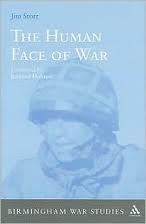
The Human Face of War, a second review

Wednesday, November 16th, 2011

[by J. Scott Shipman]

images-1.jpeg

The Human Face of War by Jim Storr 

[Zen reviewed this book earlier here. I had forgotten that I wrote a rather long review at Amazon after finishing in January 2010. Perhaps Storr will gain a wider audience as a result.]

Mr. Storr’s The Human Face of War will be I predict, a book studied by military professionals (and smart policy makers) for years to come. Using straightforward prose, Mr. Storr seeks to provide a philosophical approach to war—as he says, “In practice we are concerned so much with war as with waging it.” Storr goes on to differentiate between war and warfare; where war is an “issue” with history and warfare dedicated to methods/methodology. Storr rejects notion that war is art or science, and prefers instead to embrace pragmatism and limited empiricism. He points out correctly: “Pragmatism has obvious application to warfare. A significant aspect of warfare is `a process of trial and error; seeing what wins and exploiting it.” Storr continues that “empiricism is not just trial and error: it is a logical process based on structuring observed facts.” What “works” will suggest a way ahead. 

Storr uses broad themes of what has worked and what has not worked in military history by explaining the nature of combat and tools and models available to the practitioner. He uses Clausewitz’s “dialectic of aims and means” in conjunction with Systems Theory to describe the holistic nature of military units; where effective/efficient output is dependent on input—where a good outcome is “winning” (as Storr repeatedly observes throughout the book, armies aren’t paid to come in second). Hence, organization of military units is fundamental; efficient/effective organizations are more likely to succeed. He observes: “Cohesion and collective performance indicate the whole is greater than the sum of the parts. There is a systemic effect, and we should see armed forces as systems.” 

Storr is a proponent of forcing decision making to the folks on the ground using brief and succinct communications. His chapter on Commanding the Battle is excellent. Storr advocates lean command staff’s and dispersed decision making. “We should employ the best brains in small groups, rather than try to assemble a collective brain.” He points out that “when staff numbers are reduced, the effectiveness of HQ improves.” “Reducing staff numbers would increase speed with which they could get things done.” [Amazingly, Storr quotes a work from 1998 that reports a typical Western division commander has 600 people supporting!—and that number has, I’m sure increased in 10 years.] He concludes this excellent chapter making a distinction between technology and the human factor: “…the future is not digital: it’s human. What is needed is things that bind talents together as a team, not more bandwidth…given time, resources, open minds and not much money we could revolutionize land tactical command. The key problems are human, cultural and institutional.” 

Storr asserts that successful modern commanders are most likely intuitive thinkers and possess the ability to learn from experience. He suggests further the “tendency to learn is more critical. It implies a tendency to reflect on experience and to learn from it, to maximize the benefit of the experience.” This tendency is key to the development of “skills”. He encourages a “permissive man-management regime that allows those who can learn rapidly from their experience to do so.” At the opposite end, Storr makes clear the unsuitability of many leaders who use bullying tactics and fear to motivate. 

Storr concludes by observing that “institutional conservatism” inhibits armed forces from improving significantly during times of peace; that “the current size and shape of Western armies reflect issues that are not primarily related to warfighting effectiveness.” He insists that doctrine should be explicit, relevant,(descriptive and where appropriate, prescriptive), coherent, and practical. The short tours common in western armies harm team integrity—which is “huge”. Innovation is vital, and in many cases military members aren’t with a unit long enough to have the experience necessary to truly innovate. Storr advocates “experience is the best way to achieve practical coordination and overcome the fog of war, as long as the experience gained is positive.” He discourages the common use of lieutenant-colonels in jobs where a captain or major could function/thrive/learn; as these junior officers will have less experience when they are promoted and will have probably developed the habit of “referring decisions upwards, and hence develop little initiative.” 

According the Storr, the “human” aspect of war should take prevalence over technology. He acknowledges the utility of technology, but asks the reader to “…pause and look for a moment at the Vietnam War, which suggests that superior technology is not always the deciding factor.” [9-11 is illustrative of this point on the “terror” side; determination and box cutters wreaked havoc.] 

My review does not do justice to the wealth of information, insight, and counsel in Storr’s book and I quote him frequently because his style is better than a summary. This book was aimed at a narrow audience, hence the high price. When I began, I was concerned about Storr’ opinions concerning John Boyd’s OODA loop; but in late 2009 I rejected Boyd’s deterministic underpinnings of OODA—Storr’s pragmatic and partial empiricism makes more sense. OODA remains, in my humble opinion, a valuable and versatile methodology in both the military/law enforcement and business arenas. 

This book is highly recommended; particularly for junior officers and NCO’s—the price is high, but what you will gain will be worth the cost.

UPDATE 11.17.2011: Jim Storr contacted me and confirmed the issue of a paperback for about $40.

The Myth of British Counterinsurgency?

Sunday, October 30th, 2011

This SSI monograph by Dr. Andrew Mumford should stir some robust debate in the COIN community:

Puncturing the Counterinsurgency Myth: Britain and Irregular Warfare in the Past, Present, and Future

Most of Mumford’s points are valid criticisms but I need to quibble with Myth # 1 The British Military is an Effective Learning Institution:

MYTH #1: THE BRITISH MILITARY IS AN EFFECTIVE LEARNING INSTITUTION

According to John Nagl, the British succeeded in Malaya-in contrast to the American failure in Vietnam-because the British army had an organizational culture akin to a so-called “learning institution,” whereby the army quickly adapted to COIN conditions and changed tactics accordingly.2 The array of operational activity, ranging from limited to total war, that the British army has experienced has arguably led to a greater degree of pragmatism in its military outlook. A dogmatic adherence to rigid military doctrine has been absent, which, when compared to the generation-long postmortem on the failure of U.S. strategy in Vietnam, perhaps explains more than most other factors why an almost mythic reputation has descended upon the British. However, this does not explain, nor should it obscure, the languid application of appropriate irregular warfare tactics and the absence of swift strategic design. When it comes to COIN, the British are slow learners.

The early phases of nearly every campaign in the classical era were marred by stagnancy, mismanagement, and confusion. The military was 2 years into the Malayan Emergency before it conceived of a cohesive civil-military strategy in the form of the Briggs Plan. The crucial early years of the troubles in Northern Ireland were marked by displays of indiscriminate force and an inability to modulate the response.3

The Director of the United Kingdom (UK) Defence Academy also concedes that, in relation to Northern Ireland, “[I]t is easy in the light of the later success . . . to forget the early mistakes and the time it took to rectify them.”4 As Lieutenant General Sir John Kiszely rightly observes, the Malayan Emergency was, “a much lauded counterinsurgency campaign, but often overlooked is the fact that in the early years . . . the British Army achieved very little success.” In COIN terms, therefore, the British have been consistently slow to implement an effective strategy and achieve operational success. Moreover, the vast body of campaign experience has not translated into a cogent COIN lesson-learning process within the British military. The very need to re-learn COIN in the post-September 11, 2001 (9/11) conflict environment has undermined assertions as to the British military’s being an effective learning institution. Such amnesia has created an imperative for the armed forces now to hone their lesson-learning abilities while simultaneously adapting to the intricate challenges of sub-state and transnational post-Maoist insurgent violence in the third millennium.

What sort of time frame is reasonable for “organizational learning” – that is, transforming a large, hierarchical, bureaucratic entity’s conceptualization and understanding of a situation and reforming and adapting it’s practices in light of experience? How fast can this really happen? An org is not an individual, two years while under fire does not seem slow to me. Am I missing something in Mumford’s argument?

Furthermore, I infer from the third paragraph that Mumford expects evidence of learning were for the Brits to have arrived in Basra good-to-go on COIN doctrine. Learning, whether in a person or org, is not represented by doctrine (lessons frozen in time) but rather a capacity to adapt to new circumstances. Mumford is on firmer ground criticizing British general officers for their blind assumption that they had all the answers on counterinsurgency  while the ragtag Mahdi Army bullied and ran circles around British units.

A monograph worth reading.

Hat tip to Lexington Green and SWJ Blog)

A Strategy for the Pacific – Will the US have the $$$ and the courage for a credible and survivable one?

Tuesday, October 4th, 2011

[by J. Scott Shipman]

To have an executable strategy, a nation needs the wherewithal to pay for it. This applies the United States, too. 

As the United States heads into an election year with rising unemployment, a double-dip recession threatening, and deep cuts to defense on the horizon (even as we continue to prosecute the war on terror) a controversy continues to brew in the South China Sea. China has increasingly heated up the rhetoric. On 30 September the Taipei Times reported on an opinion article in the Chinese Communist Party-run Global Times (the original article is here), calling on the Chinese to declare war on Vietnam and the Philippines over their intransigence with respect to China’s claim of the South China Sea as being part of China proper. While this tantrum might be a saber-rattling “fire for effect” exercise aimed at intimidation, the writer surmised the position of the United States:

“The US has not withdrawn from the war on terrorism and the Middle East … so it cannot afford to open a second front in the South China Sea,” he wrote…“[Military] action by a big country in the international arena may result in initial shock, but in the long run, regional stability can be achieved through great power strategic reconciliation.”

“It cannot afford” is writ large. What, indeed, would the US do if China followed the advice of this hot-headed pundit? The US Navy is operating at about 283 ships, and the op-tempo is wearing out both ships and crews—fast. A recent article in the Atlanta Constitution reported the USN is investigating extending the typical six month deployment for fast-attack submarines. As I wrote earlier, we are retiring our submarines faster than we’re replacing them. With the US defense budget under the axe for even further cuts, what is the proper course of action? And do we have a strategy supported by an adequate budget? Are we strengthening our relationships among allies, or are we neglecting relationships that will be vital if hostilities break out? I would submit the US refusal to Taiwan’s request to purchase modern F-16 C/D variants, offering instead upgrades for A/B sends a message of waning US resolve to honor the Taiwan Relations Act (TRA). (A rumor within the Beltway is the upgrades were a first step, with what the administration hopes will be a request by Taiwan for the troubled and increasingly costly F-35.) The TRA requires the United States “to provide Taiwan with arms of a defensive character”, and “to maintain the capacity of the United States to resist any resort to force or other forms of coercion that would jeopardize the security, or the social or economic system, of the people on Taiwan.” We may have that “capacity” today, but what are we doing to insure we sustain the capacity to maintain open sea lines of communications? Can we afford it?

Our friends in the South China Sea environs aren’t feeling the love. India, Indonesia, Japan, Malaysia, the Philippines, Singapore, South Korea, Taiwan, and Vietnam have all expressed concern about China’s increasingly belligerent actions with respect to the South China Sea areas. All of these nations rely ultimately on the USN to keep the sea lanes of communication open. Most have modest defense budgets, but they’re beginning to realize the new reality and are acting and good for them—we could learn something in the reality department. Vietnam has ordered six Russian Kilo Class diesel boats (very good subs, btw), and the Philippines are shopping. Singapore has a pretty impressive sub fleet (six reasonably modern hulls) and national defense given her size. Taiwan has two 20-plus year old subs and two WWII era US boats that are 60 years old!

If we look at numbers, our strategy seems pretty puny. As our fleet continues to atrophy in numbers, the Chinese continue to build. An inventory of submarines in the area shows that between China and North Korea there are about 128 hulls compared to a total of 42 among the aforementioned nations. Our friends in the area will continue to need US submarine support in the area for the foreseeable future as subs are long lead time platforms.

In this theater alone, cutting our defenses seems nuts. Rather than cut line units, perhaps DoD should begin to improve/streamline our antiquated procurement and acquisition processes. Our acquisition process is so complicated we have a Defense Acquisition University (DAU)! At an estimated $124M for FY012, perhaps we should cut DAU first. Last year at Boyd & Beyond 2010, Dr. Ray Leopold shared the contrasts in commercial contracting versus government contracting. Commercial contracts are built on the presumption of trust, government contracts are written on the presumption of distrust. Rather than use normal legal remedies to hold mischievous and unscrupulous contractors to account, DoD has erected mind-numbing processes that attempt to eliminate any risk a contractor could successfully rip-off the government. And when a contractor does rip-off the government, the contractor pays a fine and continues to do business with the Pentagon. If someone steals from you, do you continue to do business with them? Not me. This would be a good place for DoD to begin true accountability—you can bet one defense company out of the market would send a message to the others. The sad truth is the revolving door between the military and the contractor community has created a incestuous and inbred swamp of rules and processes only the participants understand that are so impenetrable DoD has no idea how much money it is spending (never mind tracking waste)—so fiscal irresponsibility continues in an increasingly dangerous world with budget cuts guaranteed. What’s the strategy again? This madness is fast becoming an issue of national security. On our current track we could well be incapable of defending ourselves, much less our allies.

Here are few other ideas for consideration before touching a single line unit:

  • DoD should lay-off every nonessential employee. Whenever there is a snowstorm in the DC area, nonessential personell are instructed to stay home or “liberal leave” is in effect. We need to disabuse ourselves of the luxury of the nonessential employee. Regular businesses don’t operate like this, neither should DoD. Every employee should be integral, essential, and necessary; if they’re not essential, we can’t afford them—not while we have troops in harm’s way.
  • Stop double-dipping on 1 January. If a member retires from the military, they shouldn’t be able work for the government (often in the same office where they separated from service) and draw two salaries. If the member wants to work for the government,  pick one, but not both. We can’t afford it and this contributes to the ongoing inbreeding in defense. And here’s a cruel truth: why should we pay a member who could not continue advancing in the military a military pension and a government civil service salary?
  • Flag officers and members of the Senior Executive Service should have a minimum five year ban on working in the defense or defense lobbying industry. Stop the revolving door. Our current mess was created by many of these folks (even if well-intentioned), they should take a five-year time out and give others a chance to fix the mess they’ve helped create.
  • Abandon the current acquisition process and close DAU. Hire commercial attorneys at a commercial rate to write contracts based on trust, but contracts with teeth. This would be cheaper than the bloated and incestuous bureaucracy we now carry.  If a contractor defrauds the government, ban that company for 10 years from doing business with the government, and put the offending members in jail. Word will get around, and folks will behave.
  • Allow contractors to earn 8-10% on their work and stop nickel-diming them on fee. Businesses are in business to make money.
  • The government should assume more technical oversight/intimacy in procurement programs. We have too many generalist contracting officers who can be misled by an unscrupulous contractor, or perhaps worse, have no idea “what” they’re buying. The government needs to get engaged and informed and know “what” they are buying and know real costs.
  • Develop a promotion system based on merit, not time in grade. Our promotion system breeds risk averse officers who focus on punching career tickets instead of doing. Following John Boyd’s “to be or to do” maxim, the promotion system should reward officers who think and take risks, not poster-boy/cookie cutter conformists. “We’re warriors, dammit!” was a phrase my old CO used—let warriors be warriors! Scrap time in grade and promote based on performance, and if folks don’t perform well enough to be promoted, separate them from service.

Robert Frost said good fences make good neighbors; well a good deterrent makes good neighbors, too—but fences and deterrence costs money. DoD can and must do better; business as usual is becoming a death of a thousand paper cuts for us, and our allies. We need a real strategy and the budget to make it happen—that won’t happen with our current acquisition rules. The axe should fall on the Pentagon procurement bureaucracy before it touches a single line unit.

America is better than this, we must raise the standard by bringing DoD into the real world of fiscal responsibility and contract law, so whatever our strategy it can have a sound fiscal and legal foundation.


Switch to our mobile site