zenpundit.com » army

Archive for the ‘army’ Category

Spot On Question: Who Are Today’s Military Thinker’s ?

Thursday, January 24th, 2008

I am seconding Younghusband in recommending the post up at The Strategist as well as the subsequent discussion:

Who and Where are Today’s Military Thinkers

Quentin recently asked if there are people in western militaries who are “thinking outside the square” about strategy and warfare.

It’s a good question and one that I don’t have a ready answer for. Over the last 200 years there have been a number of great thinkers, like Carl von Clausewitz, Alfred Mahan, T E Lawrence (pictured), Basil Liddell Hart, J F C Fuller, and John Boyd. They developed general theories about war or thought deeply about the nature and shape of future warfare.

There were also military officers who operationalized radical ideas and thinking. They include Erwin Rommel and Heinz Guderian, the German pioneers of armoured warfare, along with Orde Wingate and David Stirling, the Brits who trail-blazed the use of special forces in WW2.

These thinkers thought deeply about their subjects. Their ideas were backed by experience, or they tested and refined their ideas in the field. They tended to be outsiders and were often regarded by the military establishment as odd, unorthodox, even dangerous. Some, like Fuller and Guderian, gravitated towards experimental military areas. To paraphrase Boyd, they tended to ‘do something not be someone’. 

What about today? Who are the thinkers in western militaries? In the US, John Nagl comes to mind for his work on counterinsurgency. As Zenpundit and Armchair Generalist point out, Nagl recently left the army for a job with a think tank. The British have Sir Rupert Smith, who wrote The Utility of Force after he retired from the British forces.

Other than these people, I’m struggling. Any nominations? Or are we more likely to find today’s military thinkers in universities and think tanks (e.g., Martin van Creveld and Willam Lind), in aid agencies and private military companies, in IT companies, or, heaven forbid, in the blogosphere?

Join in the discussion here.

Canaries in the Mineshaft

Thursday, January 17th, 2008

Abu Muqawama – “LTC John Nagl to retire

Thomas P.M. Barnett – “Flunk the SysAdmin, lose the Leviathan

The Washington Monthly -“The Army’s Other Crisis: Why the best and brightest young officers are leaving

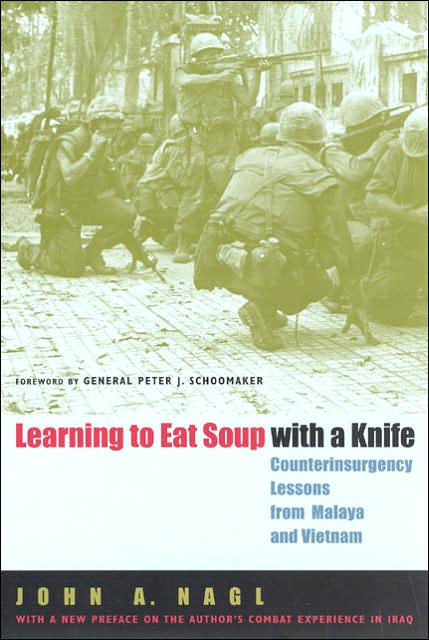
I enjoyed reading and was impressed by LTC John Nagl’s Learning How To Eat Soup With A Knife and I heartily recommend it. I have no doubt that he has been given a better offer – probably a much better offer financially and one more in line with his demonstrated abilities – than rolling the dice and sticking with a career in the “up or out” U.S. Army.  I’m also certain that Col. Nagl will be contributing to the war of ideas long after he ceases to be a uniformed part of the war and that Nagl probably made the best decision possible for himself and his family. Anyone who believes that a post-Iraq U.S. Army won’t restructure itself by downsizing it’s most talented warfighters in favor of career desk jockeys simply wasn’t paying attention during the 1990’s.

As the links demonstrate, Nagl is merely the well-known face of an ominous trend. When an institution – be it military, educational, corporate, civic, religious – reaches a point where it is merely a farm team that regularly sends it’s best and it’s brightest elsewhere then it is an institution on it’s way out. There is something worse than “breaking the Army”; broken armies get rebuilt because restoring them to health is a national priority. No, the real danger for the U.S. military is an Army that “embraces mediocrity” because if mediocrity becomes entrenched it will not be removed by anything shy of a near-total housecleaning of the general officers. Can you see America’s “no-accountability” Boomer elite doing that ? Or even recognizing if it needed to be done?

I can’t.

ADDENDUM:

Fabius Maximus -“Recommended reading: transforming the Army, the hard way” and “The Army is losing good people. That is only a symptom of a more serious problem.

Intel Dump -“John Nagl has left the building

SWJ Blog – “Nagl to Leave Army

Kings of War – “High-Profile Officer Nagl to Leave Army, Join Think Tank

Neptunus Lex -“Brain drain?

Armchair Generalist – “Nagl Leaving the Army

A Jeremiad Against the Establishment

Wednesday, November 28th, 2007

My friend Bruce Kesler sent me an article by Dr. Angelo Codevilla, “American Statecraft and the Iraq War“, a senior scholar at The Army War College, that appeared under the aegis of The Claremont Institute.  The critique offered by Codevilla is scathing; in many places his argument is quite insightful and in others, his heavily state-centric approach to international affairs shares the blindness of the elite he criticizes. An excerpt:

“The occupation was unnecessary to any rational American purpose. As President George W. Bush spoke on April 30, 2003, under the banner “Mission Accomplished,” representatives of the State and Defense Departments in Iraq were putting the finishing touches on the provisional government to which they were to devolve the country’s affairs two weeks later. There was to be no occupation. Iraqis would sort out their own bloody quarrels. The victorious U.S. armed forces, having turned Saddam Hussein’s regime over to its enemies, would challenge the Middle East’s remaining terror regimes to adjust their behavior or suffer the same fate. But even as Bush seemed to be recruiting a sovereign Iraqi government, he was interviewing the disastrous Paul “Jerry” Bremer to be Iraq’s viceroy and preparing United Nations resolution 1483 to “legitimize” the occupation. The Bush team then declared that occupying Iraq was necessary to transform it into a peaceful, united, liberal democracy, whose existence would coax nasty neighboring regimes to be nice. Bush had acceded to the private pleadings of then-Secretary of State Colin Powell and National Security Advisor Condoleezza Rice, as well as of British Prime Minister Tony Blair-whose advice reflected the unanimous wishes of Arab governments. While the administration’s newly minted mission was abstract and inherently beyond accomplishment, the Arab agendas-which had nothing in common with Bush’s-were intensely practical. And they prevailed.

The occupation of Iraq should go down in history as a set of negative lessons about war, the relationship between ends and means, the need for unity of purpose and command, and dealing with the world as it is rather than as one imagines it to be. The occupation, a confection of the U.S. foreign policy establishment’s hoariest recipes, is yet more evidence of that establishment’s bankruptcy. Media myth notwithstanding, the administration’s neoconservative component was sidelined as the occupation began. Bremer’s political advisor was the realist Robert Blackwill of the Council on Foreign Relations, and his military advisor was Walter Slocombe, a liberal internationalist from the Carter and Clinton Administrations. By 2007 the occupation’s military policy was being shaped by Stephen Biddle, another Kissingerian realist from the Council, for whom success means persuading somebody to accept America’s surrender. Bush confused statecraft, the pursuit of the country’s interests, with administrative politics-the consensus of constituencies in the bureaucracies (and their contractors), the prestige media, and the academy. As the disaster became undeniable, no one in the establishment dared to try to measure the occupation of Iraq against the standards of statecraft. “

Codevilla skewers the ideological assumptions of Washington officials and intellectuals from the Neocon Right, to the Liberal internationalist Left, to those of Realist scholars and diplomats. Kesler, in a post at Democracy Project, incisively interprets Codevilla’s philosophical approach to foreign policy analysis:

” Codevilla is a student of Machiavelli, who described the rules of the game of power. The rules may be used for good or ill, but to negate the ends accomplished by the necessary means is to create weakness and allow the field to those willing to use the rules for ill ends.

“a prince … cannot observe all of those virtues for which men are reputed good, because it is often necessary to act against mercy, against faith, against humanity, against frankness, against religion, in order to preserve the state.”

Codevilla takes the US severely to task for its failure to follow the rules in Iraq and the broader Middle East. His critique should be read in full. It’s not what most, either conservative or liberal, neocon or realist or defeatist, are accustomed to hearing. But, it cuts to the heart of our bleeding for four years, and the limited best outcomes we face. Codevilla has been consistently opposed to our entering Iraq, seeing bigger game afoot, and the confusion of our aims. He’s been proven correct, so far. His forecast, therefore, should be taken seriously. Most important, his indictment of our befuddled policy class requires a new realism in Washington.”

A weakness in Codevilla’s analysis is that while he correctly identifies the culpability of regional Arab states and Iran in sponsoring and tolerating terrorist groups and argues for meaningful penalties to be applied to such regimes, he overestimates the competency and resiliency of these states and simply dismisses the extent to which globalization has made non-state actors functionally independent of state patrons, who are quite helpful operationally but are no longer the existential requirement they once were in the 1970’s.  Economics and network-theory are entirely absent from Codevilla’s analytical framework and while Islamic religious identity is admirably included, it is considered a primarily reactive (even understandably so) phenomenon, which even a casual study of the 120 year evolution of Islamist ideology would refute. States still rule all, in Codevilla’s vision, an assumption that deserves careful reexamination. 

Nevertheless, a worthwhile and thought-provoking critique.
Saturday, August 4th, 2007

REVIEWING LEARNING TO EAT SOUP WITH A KNIFE

Learning to Eat Soup With A Knife -Book Review” is now up at Chicago Boyz.

Tuesday, May 22nd, 2007

650,000 MAN ARMY ?

Colonel Austin Bay’s op-ed “The bottom line is, U.S. needs a 650,000-troop Army” in The Houston Chronicle ( hat tip to Rob Thornton at SWC):

“Let’s return to 1990, just before Saddam Hussein invaded Kuwait. The U.S. Army had around 750,000 soldiers on active duty; the U.S. Marine Corps had 197,000 Marines. That same year, the U.S. population broke 250 million. Today, the U.S. population is slightly over 300 million.

That “old future” occurred during the final phases of the Cold War. Department of Defense budgeteers had already begun paring Cold War force structure. Though the Soviet Union hadn’t officially dissolved, cost-cutters identified Cold War air wings and armored divisions as expensive legacies.

Desert Storm briefly delayed the planned decline in strength. Based on “the near-term future” the Defense and Congress envisioned, the United States didn’t need Cold War troop levels. However, by 1995, peacekeeping commitments began stressing the personnel system. Then, the United States entered the Balkans, and hasn’t quite left yet.

The Army asked for a 30,000 troop “plus up” in the fiscal year 1997 budget request to meet those personnel requirements. It was denied.The Clinton administration began using the reserves as an operational force rather than as a strategic, war-winning reserve.The Bush administration continued to do this after 9/11, nudging Army end strength from around 480,000 in 2001 to approximately 515,000 today.

While that’s arguably close to the 30,000 “missing” since 1996, it’s a far cry from the forces on hand on Aug. 2, 1990, when Saddam Hussein’s tanks were on the move. It’s also proved to be inadequate to support Iraq, Afghanistan, peacekeeping operations and emergency contingencies”

Read the rest here. I recall when we had 300,000 soldiers in West Germany alone. It wasn’t all that long ago.

I’m inclined to agree that DoD and USG resources can be much better allocated to permit a significant increase on boots on the ground; the tasks assigned to the new boots though, is the critical variable. Not the boots themselves.

The spear needs more “point” and far less “butt”.


Switch to our mobile site

