Archive for the ‘21st century’ Category

Irregular Warfare
Thursday, April 10th, 2008SWJ Blog posts up on a very 4GW-van Creveldian shift at the DoD:
Last week, Air Force Brig. Gen. Robert H. Holmes, Central Command’s deputy director of operations, told reporters that an interagency task force on irregular warfare is about to be announced. He called it “our way at the combatant command to be able to focus all of the instruments of power in order to prosecute the irregular warfight in our region.”
But what does “irregular warfare” mean?
Essentially, it is an approach to future conflict that the United States has been carrying out ad hoc in Iraq and Afghanistan. Two years ago, Deputy Defense Secretary Gordon England signed off on a Pentagon “working definition” that described it as “a form of warfare that has as its objective the credibility and/or legitimacy of the relevant political authority with the goal of undermining or supporting that authority.” …
Given the fluidity of the geopolitical situation and it’s own internal political divisions, American military doctrine will be better off if doctrinal definitions are “working” and lean toward the “open-ended”.
Naxalite Rage
Wednesday, April 9th, 2008For readers who are not aware, blogfriend Shlok Vaidya also publishes the excellent Naxalite Rage site dedicated to the analysis of that particular insurgency in India. Shloky has been getting well-deserved VIP attention of late – check out Naxalite Rage and find out why.
Seeds of a Caste Soldiery
Tuesday, April 1st, 2008I found this news snippet to be intriguing:
In a historic but little-noticed change in policy, the Army is allowing scores of husband-and-wife soldiers to live and sleep together in the war zone – a move aimed at preserving marriages, boosting morale and perhaps bolstering re-enlistment rates at a time when the military is struggling to fill its ranks five years into the fighting.
“It makes a lot of things easier,” said Frazier, 33, a helicopter maintenance supervisor in the 3rd Infantry Division. “It really adds a lot of stress, being separated. Now you can sit face-to-face and try to work out things and comfort each other.”
Throughout history, civilized societies have basically fielded armies with three different orientations: caste, professionals and citizen-soldiers. The United States opted with the switch to the All-Volunteer Force under the Nixon administration to abandon conscription and adopt a professional ethos. The above policy of the U.S. Army is essentially a humane, on-the-spot, accomodation to demographic changes in the force and the exigencies of war in Iraq; but it also highlights an incipent trend toward the emergence of a military caste within American society.
Much like universities, the American military, as women have been gradually integrated into the services in ever wider roles, has become a social filter bringing men and women of prime marriageable age together. It should be no surprise that some of them, sharing similar values and career interests, are indeed marrying and raising families within the context of military culture. We would need many generations for this practice to play out in order to discern the results, but it would stand to reason that such a policy, if institutionalized, would accelerate the cultural divergence between members of the U.S. military and the mainstream of American society at large to the detriment of both.
The U.S. military as a caste apart, would not be, in my view, an ideal result. Obviously, the answer is not to further burden military personnel already serving in combat zones under the most difficult of circumstances. Instead, other policies should promulgated to narrow the “culture gap” by encouraging greater volunteerism among the civilian population, perhaps by a wider range of military service options and to give career military personnel increased time working in “para-civilian” roles, increasing their “Sys Admin” skill-sets which can later be brought to bear on the spectrum of missions the U.S. military is forced to handle.
Fisking McCaffrey’s Futurism
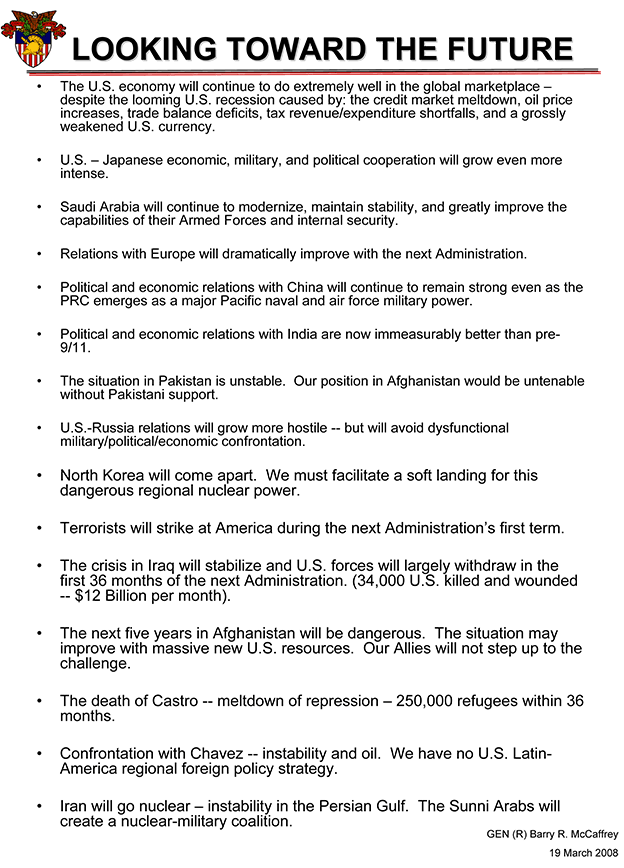
Monday, March 24th, 2008Yesterday, The SWJ Blog ( and blogfriends on Twitter, one of whom characterized it as “weak”) aleted me to a futurist slide by General Barry McCaffrey with his predictions of potential national security events faced by the United States in the near term. I’m certain this was in the context of a much larger presentation, given to a specific group with stated policy concerns; unfortunately, those particulars are unknown to me:
My commentary:
First of all, one notes the number of “safe” predictions in the sense that none of these represent even the likeliest of outliers much less scenarios representing true, statistical rarity, “Gray Swans”. There’s a certain probalistic logic to doing so – the status quo more often than not in any given scenario will continue uninterrupted except by minor adjustments. On at least half of this list, given the breadth and/or vagueness, I’m certain that McCaffrey will be able in five years to say that he was more right then wrong. Unfortunately, the narrow number of domains from which he is extrapolating – nothing on cutting edge tech, applied science, the environment, macrodemographics, religious fundamentalism or interesting “intersectional” possibilities – leaves policy makers with a vision that may be more susceptible to a Black Swan event than before by reinforcing previously held expectations.
Sidebar: I’d love to see Art Hutchinson, Tom Barnett, John Robb , Michael Tanji and the gents at Kent’s Imperative also critique the slide.
Now, in fairness, to the good General, a few of his bullet points are more interesting than others. I think McCaffrey’s called a hard landing for Cuba correctly unless Raul Castro has a secret admiration for Deng Xiaoping and the comprehension of economics to execute a Deng-like transition. It will be difficult for Cuba to really open up without the economic logic of the American market and favorable asylum policies for Cubans immediately kicking in as it did for the East Germans when the other Soviet bloc states ceased cooperating with Honecker’s repressive policies. With Chavez too, I think General McCaffrey is correct given that there is a little remarked friction between Venezuela the oil producer and America the refiner of Venezuelan oil ( refining capacity is itself a choke point along with oil production nor is all crude created equal; some is more expensive to refine than others). Finally, the temptation for al Qaida to “send a message” to the new administration and create downstream political effects may prove well-nigh overwhelming; it may even override their present policy of waiting until to pull off a catastropic level act of terror.
How do you see it ? Comments, questions, rants are all welcome.


