zenpundit.com » 21st century

Archive for the ‘21st century’ Category

New! Vandergriff’s Adaptive Thinking Blog & Cameron’s Cognitive Mapping Blog

Sunday, March 23rd, 2008

Military education reformer and author Don Vandergriff has joined the blogosphere and  he is off to a nice start:

First of all, my hat’s off to anyone that ventures out and participates in something like the adaptability conference. It takes moral courage to admit, “maybe I can get better, let’s see what happens here.” More compliments to the person’s organization if the organization was willing to support and encourage its people to get better. Too many organizations focus on the short term profit and simply don’t want to lose control of its people, don’t take the opportunity to make a long term investment in making its people more competent and confident. These attributes are the hallmark of adaptability.

I use a series of different games and scenario based education to involve the students (or participants) in the discussion about how to evolve adaptability in themselves and in their organization. The students end up doing the talking and usually solving or finding the answers to their questions. Each and every time any group does these exercises, they assume that I, as the facilitator, limit what they can do, like asking question to broaden their assumptions and courses of actions, and that I will always say no if they do ask a question, like “can we have more time.”

I will leave you with this thought, after doing this approach with games and getting similar results from audiences the past 50 times, why do students box themselves in? What does that tell us about ourselves and our organizations, when we always assume the negative? How does this limit our “evolutionary adaptability”?

Facilitation is the skill that separates the great teacher, who leaves an intellectual legacy in the form of students whose worldviews they have been profoundly impacted, from the scholar who is merely competent in the classroom. The latter knows their field while the former knows how to elicit students to think about the field in a deep and meaningful way.

Not all “star” scholars are great facilitators because that skill requires a good deal of self-restraint to guide students to the point where they can make the leap to discovery and comprehension on their own ( genuine learning, in other words). A high tolerance for failure and error is required because students will initially go down well-trod blind alleys ( well trod to the instructor, not to the students – this is a perspective that academics frequently overlook) before realizing that they need to generate alternative solutions. Facilitation, unlike pontification, keeps students cognitively active and on-task with timely re-direction or adaptively ( modeling for the students) takes advantage of a student insight to create a learning moment for the larger group.

I look forward to reading more in this vein from Major Vandergriff in the future ( Hat tip to DNI )

Charles Cameron, who already blogs in his area of professional expertise at Forensic Theology, has added Hipbone Out Loud to his arsenal:

Understanding is modeling, mapping.

In this blog, I want to capture the glimpses I have of an extraordinary world, each glimpse being a tiny area of a vast map – certainly more sophisticated than any individual can generate with data visualization tools and modeling software, perhaps more complicated than a single culture can grasp as a collective – but important, as it is the matrix in which our individual and cultural life-maps fall.

You will find I favor quotes and anecdotes as nodes in my personal style of mapping – which lacks the benefits of quantitative modeling, the precision with which feedback loops can be tracked, but more than compensates in my view, since it includes emotion, human identification, tone of voice.

The grand map I envision skitters across the so-styled “Cartesian divide” between mind and brain. It is not and cannot be limited to the “external” world, it is not and cannot be limited to the quantifiable, it locates powerful tugs on behavior within imagination and powerful tugs on vision within hard, solid fact.

Doubts in the mind and runs on the market may correlate closely across the divide, and we ignore the impacts of hope, fear, anger and insight at our peril.

I’ve featured the writing of Charles Cameron here before because he produces posts rich in both complexity and depth, generating intriguing horizontal-thinking patterns that would have easily escaped my attention.  This another blog that I’ll be checking frequently.

The Last Doughboy

Saturday, March 22nd, 2008

I meant to note this at the time of publication but America now has only one surviving veteran of the First World War, Frank  Buckles, age 107:

Now there is only one. When Harry Richard Lucas died recently, Frank Buckles was left as the only American soldier who can recount his personal experience in World War I. He is the last surviving American World War I veteran. The Great War, as it was once known, is receding into ancient history, an era as distant from us today as the Civil War or the American Revolution.But every war lingers, long after the last soldier has died. Generations hence, the ghosts still speak to us, even if we no longer acknowledge the voices. Look no further than our current travails in the Middle East, in large measure a result of the political consequences of World War I, which created the political boundaries of those tribal regions. And in an echo of the current presidential debate, Americans in 1917 were passionately divided about being drawn into a European conflict we had little direct stake in, arguably less than we have in Iraq today.

When Mr. Buckles went ” Over There” the nation was still more agrarian than urban and both the Civil War and Slavery remained within living memory, neither the electric light nor running water were taken for granted and motion pictures were silent. The changes that Frank Buckles has seen in his lifetime surpass that of most 500 year periods in history.

WWI had been overshadowed for decades by the sheer enormity of it’s larger and more lethal sequel, the Second World War but historians are coming to see the Great War as a watershed in modern history, the tipping point at which the twentieth century went unpredictably, horribly, wrong.  John Keegan elegantly writes of the war, despite having been “curiously civilized”, cutting down a generation like stalks of wheat and twisting the survivors, turning them against the liberal and rational civilization of the Enlightenment. The war’s unprecedented slaughter desensitized Europeans to violence and cultivated widespread disillusionment with the traditional order, leaving a spiritual and political vacumn that would be filled by the malevolent dynamism of Fascism and Communism.

For practical purposes, that “Lost Generation” is now gone and the “Greatest Generation” that had to fight WWII and “finish the job” is going fast. Let’s hope the hard lessons they learned do not pass from memory along with them.

4GW or applying the OODA Loop?

Thursday, March 20th, 2008

Dave Schuler, a longtime blogfriend, had a post up the other day at The Glittering Eye that examined some commentary on the War on Terror by The New York Times and Dan Drezner, whom I have not read much lately.

Developments in U. S. Strategy in War on Terror

Contra Drezner the best description of the tactic is neither deterrence nor containment but fourth generation warfare. We’re attempting to get into the enemy’s decision-making loop and the NYT article is a very interesting description of that process….The methods described are all excellent method of getting into the enemy’s decision-making process and it’s about damned time. More, please.

It is indeed about damned time. Dave is undoubtedly correct that Drezner is getting it as wrong with his “containment” analogy as the NYT ( which did not even recognize the tactic used by the NYPD in the article was swarming) was with “deterrence”. Neither is really an adequate descriptor of what the NYT reporter is attempting to articulate.

As I read the original article, I see institutions (finally) experimenting with applying a variety of tactics – swarming, psychological warfare, IO, soft power – to create disorientation in our adversaries and a mismatch between their perceptions and their response. By intent or

by default, we seem to be moving, however tentatively, to getting on the good side of John Boyd’s OODA Loop dynamic rather than being hammered on the receiving end. As the article also points to a concern with the moral level of warfare, in undermining Islamist terrorist’s reputation for piety and impugning them with shame, Dave is correct in seeing progress toward the state adapting to 4GW.

This would be a rare good piece of news because it would mean that our security and law enforcement bureaucracies are starting to overcome years of inertia and are taking some baby steps toward becoming adaptive, learning, organizations that act from forethought rather than from “going by the book”.  When they internalize that “the book” isn’t really a book but a process of continuous creative destruction, we’ll be halfway home.

UPDATE:

HG’s World and Asia Logistic Wrap are also posting on the OODA Loop.  Thanks HistoryGuy99!

On Synchronicity and Other Variables

Saturday, March 15th, 2008

Blogfriend Matt Armstrong was recently featured at the USC Center for Public Diplomacy where he had a very thorough and well-considered op-ed on Information Operations and New Media. Pretty much everything Matt had to say were things the USG should be doing in attempting to craft some kind of coherent narrative of it’s national objectives, policies and values:

SYNCHRONIZING INFORMATION: THE IMPORTANCE OF NEW MEDIA IN CONFLICT

Insurgents and terrorists increasingly leverage New Media to shape perceptions around the globe to be attractive to some and intimidating to others. New Media collapses traditional concepts of time and space as information moves around the world in an instant. Unlike traditional media, search engines and the web in general, enable information, factual or not, to be quickly and easily accessed long after it was created.The result is a shift in the purpose of physical engagement to increasingly incorporate the information effect of words and deeds. Thus, the purpose of improvised explosive devices, for example, is not to kill or maim Americans but to replay images of David sticking it to Goliath.
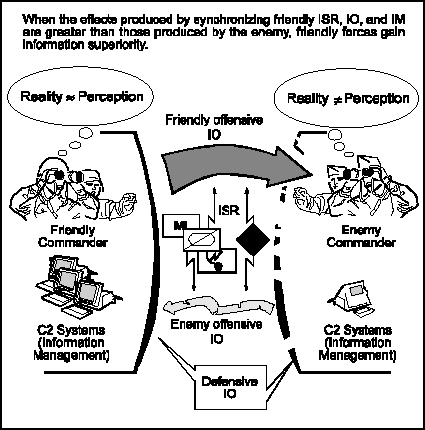
The U.S. military is actively and aggressively revising its role in shaping its own narrative in cyberspace, but this is falling short. While the U.S. is finally coming to grips with the centrality of information and perceptions, it remains confused as to how to use information effectively. American responses seem to stem from the belief that the message and the messenger we are countering are the same without regard for the target audience, intent, or how the message fits into a larger narrative, which perhaps mirrors our own perception of information as propaganda. ….A famous dead Prussian once said that war is a continuation of politics by other means, but the reality today is that war is not part of political intercourse with foes but an orchestrated, if loosely, effort to gain strategic influence over friends, foes, and neutrals. YouTube, blogs, SMS and traditional media, make every GI Joe and Jihadi a communicator, public diplomat, and persuader. Our adversaries understand and exploit this reality. Writing to Abu Musab al-Zarqawi in 2005, Ayman al-Zawahiri stated that “we are in a battle, and that more than half of this battle is taking place in the battlefield of the media [sic].”The U.S. military as reluctant heir to the information throne in an online world has several inherent challenges. First, operating in the environment of New Media requires awareness and agility inconsistent with the current organizational culture of the military. For example, in Iraq the military broke through the bureaucratic red-tape and started posting videos on YouTube. However, this small “victory” was incomplete: the group that uploaded to YouTube was still not permitted to view YouTube. In effect, they were posting information they were not authorized to see.”
Those quotes were snippets. Matt’s post is rich in detail and really requires being read in full.

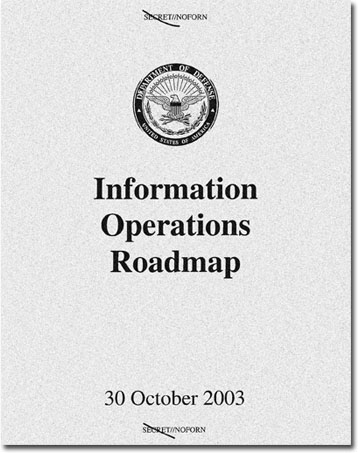
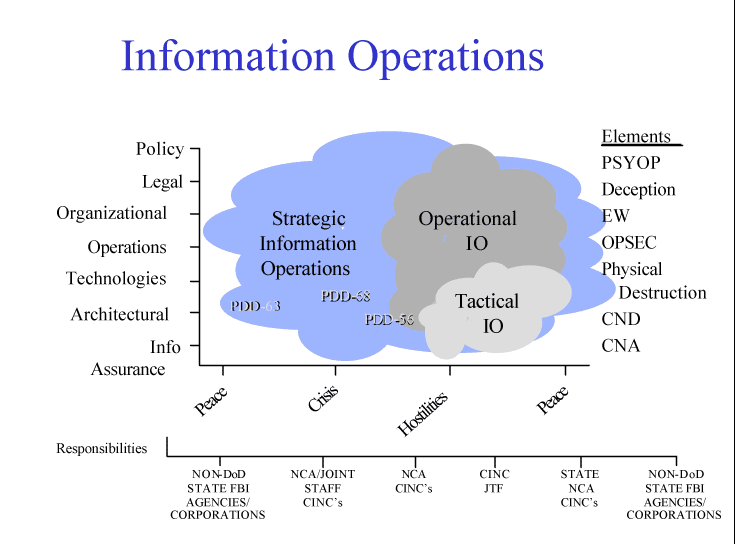
I have tilted at the IO windmill a few times in the past. It’s a subject that is both easy as wel as difficult to analyze. Easy, because the USG has yet to initiate and/or master the fundamentals of good IO as Matt’s post makes clear ( there are genuine IO experts in the USG, perhaps even a large number of them, but the bureaucracies are not institutionally optimized to conduct IO with consistency or coordination) but difficult because the level of genuine sophistication and effective nuance in strategic communication remains so far off. Even if that level of “play” was achieved by our civil service and soldiers, any  IO campaign could be undone in an instant by some clumsy action or statement from a political appointee or elected official concerned primarily with fellating some domestic special interest group. 

Matt’s focus on “synchronicity” is apt. It will be a herculean task needing laser beam focus to get all of the USG players on the same message most of the time; even then some dissension and debate being showcased is itself a vital advertisement of the attractive nature of a liberal, open society and a sharp contrast with the dismally intolerant and brutally ignorant alternative our Islamist enemies have to offer. In pursuing that, I’d like to offer a few suggestions:

Credibility is the COIN of the Realm:

Matt touched on this but I want to give this principle added weight. For all our official, overt, communication by any spokesman representing the United States, the best long term strategy is a reputation of credibility. It may hurt to concede errors or enemy successes in the short run but having the global audience grdugingly concede that “the Americans speak the truth” adds momentum of every word, every idea and every action we undertake. It will not bring us love because oftentimes, our pursuing national interests will come at the expense of others but truth-telling will yield something more valuable, respect. No one cares to be treated as if they were a fool and most of the transparently self-serving gibberish official spokesmen offer up pays dividends only in contempt being added to the anger foreigners already feel at some of our policies.  Credibility is to the war of ideas what COIN is to guerilla warfare and it is a valuable and exceedingly rare quality because once your credibility is lost, it is lost.
Without Attention Being Paid All Our efforts Are Useless:

Credibility is not enough. Key messages or memes also have to be interesting. If people are not psychologically engaged in the presentation then they are not hearing it, much less reaching the points of comprehension, sympathy or agreement. American popular culture and commercial advertising is nothing short of an unrelenting global juggernaut that is eroding traditional mores of every society with which it comes into contact, yet our official proclamations remain starkly uninteresting even to most Americans so why should a Yemeni teen-ager or Afghan farmer tune in to what we are selling ? As long as our attempts at capturing attention remain at the level of dull mediocrity we can expect to fail.

Influence is a Long Term Investment:

The 1980’s saw a march toward capitalism and democracy in part because we were reaping the harvest of decades of student visas, cultural and scientific exchanges and consistent public diplomacy outreach. From Mongolia to Czechoslovakia Chile there were reformers taking power who were ” Chicago Boys” who had imbibed free markets at the feet of Nobel laureates. The National Endowment for Democracy, the USIA, VOA, Radio Free Europe and NGO’s like the AFL-CIO whose efforts and programs abroad were robust and self-confident. American society was permitted by the USG to sell itself. These things cost pennies on the dollar compared to having to  use hard power options and they lower our transaction costs when sanctions or military intervention is the order of the day.

Deception is Best Left to the Clandestine Operators :

HUMINT based strategic influence efforts, black propaganda and disinformation and various arts of deception will be better left to covert programs, plausibly deniable third parties and used sparingly and with subtlety. The increasingly “radically transparent” world ensures that too many sophisticated eyes with all sorts of agendas will be analyzing our official spokesmen 24/7. The best will can hope to accomplish is effectively framing our public message to be truthful and compelling. Any meme that is verifiably false, if we believe we must put it out into the global media environment, cannot have a return address.


IO is a secondary area of operations for the United States.  Good IO programs cannot remediate incompetent statecraft or poor military leadership or put a “happy face” on obvious disasters but poor or absent IO capabilities can fritter away the capital that successful diplomacy or military action can accrue when our enemies accusations go unanswered. 

Crossposted at Chicago Boyz

Credit Where Credit is Due

Sunday, March 9th, 2008

After my Two Quite Reasonable Observations post, I had some uncharacteristically swift and well-informed feedback that pointed to IC amd military working groups, quietly engaged in the very kind of strategic futurism that I hoped to see the USG explore. As I cannot share confidential correspondence, I was delighted that the gents at Kent’s Imperative took up the same cudgel in public.

Vision and error

The recurring debate regarding such matters has once again surfaced in a series of blog posts at Global Guerrillas, Fabius Maximus, Zenpundit, and Opposed Systems Design.We must take exception with John Robb’s comment that there “isn’t a single research organization or think tank that is seriously studying, analyzing or synthesizing the future of warfare and terrorism”. Such statements, of course, are a common enough type of criticism which stems from what is also unfortunately a common error – the assumption that because one is not aware of a particular effort, then it must not exist. While not every shop which concerns itself with the problems of contemporary asymmetric conflict looks up from the current fight, there are a number of efforts which have attempted to answer the question of “what next” alongside the other work exploring the “what” and “so what” which tends to dominate current publications. Among just a few of the recent public aspects of such efforts that we can name off the top of our heads are the Proteus project, JFCOM’s Deep Futures project, and several of the publications authored by folks at the USMC’s Center for Emerging Threats and Opportunities, the Naval War College and Army War College, the Naval Postgraduate School, the Air University, West Point’s Combating Terrorism Center, the National Defense Intelligence College, and many other elements within the khaki tower. Of course, to this we should also add the Global Futures Forum effort where it touches upon related areas of interest.

….We would also argue that this is already occurring to some extent within the intelligence community itself, particularly given the emerging style of smaller, more specific papers circulated in an almost academic fashion as discussion points. Indeed, we see this beginning to reshape coordination efforts prior to more formalized, and more visible assessments for major publications. We certainly see a greater role for outside subject matter experts and other thinkers in the process, but while far from perfect, this is quickly evolving given recent emphasis on analytic outreach.In short, the there that these gentlemen appear to be reaching for is already there – just not evenly distributed….”

This is certainly good news, from my perspective. Hopefully, those readers out there – and there appear to be more than I had realized – who have their hands in this process on ” the inside” will continue to push the USG’s intellectual range and bureaucratic boundaries. We are all well-served by their sub rosa efforts and I offer a hearty “Huzzah!” in their honor.


Switch to our mobile site