zenpundit.com » 21st century

Archive for the ‘21st century’ Category

Benedict XVI — a reading between the lines

Friday, September 23rd, 2011

[ by Charles Cameron — Benedict XVI, Lutherans, ecumenism, C Peter Wagner’s “new paradigm” of Christianity ]
.

ukreuterscom.jpg
Photo: Pope Benedict XVI and Nikolaus Schneider (R), Chairman of the Council of the Evangelical Church in Germany (EKD) attend the Ecumenical Service of the World in the church of the Augustinian Monastery in Erfurt, September 23, 2011.  Credit: Reuters / Norbert Neetz / Pool
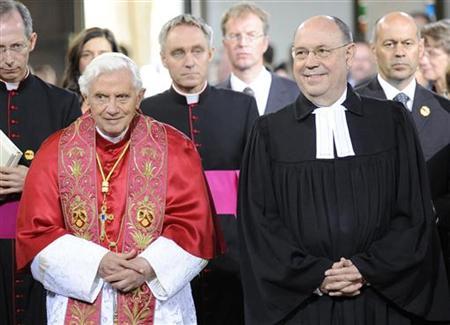
Earlier today, Pope Benedict visited the cloister in Erfurt which once housed Martin Luther, for an ecumenical meeting with leaders of the Evangelical Church in Germany (EKD), a mainline Protestant coalition of Lutheran, Unified and Calvinist churches.

In the course of his presentation, the Pope made clear his admiration for Luther himself:

As the Bishop of Rome, it is deeply moving for me to be meeting representatives of Council of the EKD here in the ancient Augustinian convent in Erfurt. This is where Luther studied theology. This is where he was ordained a priest in 1507. Against his father’s wishes, he did not continue the study of Law, but instead he studied theology and set off on the path towards priesthood in the Order of Saint Augustine. On this path, he was not simply concerned with this or that. What constantly exercised him was the question of God, the deep passion and driving force of his whole life’s journey. “How do I receive the grace of God?”: this question struck him in the heart and lay at the foundation of all his theological searching and inner struggle. For him theology was no mere academic pursuit, but the struggle for oneself, which in turn was a struggle for and with God.

“How do I receive the grace of God?” The fact that this question was the driving force of his whole life never ceases to make an impression on me. For who is actually concerned about this today – even among Christians?

That’s a striking utterance from the holder of the office that Martin Luther so often assailed, writing (for instance):

St. Paul calls Antichrist the man of sin and the son of perdition, because through his precepts and laws he will turn all the world from God and prevent God and the world from coming together; he shall be a master of sin and all iniquity, and yet will retain the name and appearance of Christ and call himself Sanctissimus and Vicarius Dei and Caput Ecclesiae [“most holy one; vicar of God; head of the Church”], and persecute all who will not obey him. It is easy to recognize that the pope more than fits this description.

Things have clearly changed since that time, and the US branch of Lutheran World Ministries has proposed to its member churches:

That they officially declare that the Lutheran commitment to the Confessions does not involve the assertion that the pope or the papacy in our day is the anti-Christ.

It is not, therefore, the Evangelical Churches (ie mainstream Protestants like the Lutheran and Reformed churches) that Benedict is thinking of when he raised an issue that obviously disturbs him, saying:

The geography of Christianity has changed dramatically in recent times, and is in the process of changing further. Faced with a new form of Christianity, which is spreading with overpowering missionary dynamism, sometimes in frightening ways, the mainstream Christian denominations often seem at a loss. This is a form of Christianity with little institutional depth, little rationality and even less dogmatic content, and with little stability.

The matter seems urgent to Benedict, precisely because, as he had just said:

It was the error of the Reformation period that for the most part we could only see what divided us and we failed to grasp existentially what we have in common in terms of the great deposit of sacred Scripture and the early Christian creeds. The great ecumenical step forward of recent decades is that we have become aware of all this common ground and that we acknowledge it as we pray and sing together, as we make our joint commitment to the Christian ethos in our dealings with the world, as we bear common witness to the God of Jesus Christ in this world as our undying foundation.

Catholics and Lutherans may still have their differences – but on “the great deposit of sacred Scripture and the early Christian creeds” they have much in common – and it is of this common ground that Benedict says, “The risk of losing this, sadly, is not unreal” immediately before speaking of the new “form of Christianity with little institutional depth, little rationality and even less dogmatic content, and with little stability”.

The Pope continues:

This worldwide phenomenon poses a question to us all: what is this new form of Christianity saying to us, for better and for worse? In any event, it raises afresh the question about what has enduring validity and what can or must be changed – the question of our fundamental faith choice.

The Pope is a diplomat, and he is expressing his concern as diplomats do, in a carefully worded, highly generalized and eminently tactful way. But can we read between the lines? What does the Pope mean by “this new form of Christianity”?

The “world” of Christianity is changing very rapidly, both demographically and doctrinally, and that’s putting things mildly. I hope to address some of these changes in a series of future posts on ZP — but for now, let me just say we should watch Pope Benedict’s future utterances closely for further signs of exactly what worries and what encourages him.

*

I cannot image, for instance, that Benedict would be altogether comfortable with what C Peter Wagner of the new Apostolic Reformation refers to in his forward to Bishop Bill Hamon‘s book Apostles, Prophets and the Coming Moves of God: End Times Plan for His Church on Planet Earth as

my “paradigm shift” from traditional Christianity to an openness to the person and to the full ministry of the Holy Spirit.

This “full ministry of the Holy Spirit” includes, as the title of Harmon’s book suggests, the idea that Apostles and Prophets will arise in our times, which are the End Times.

In his book Apostles Today: Biblical Government for Biblical Power, Wagner states:

We are now living in the midst of one of the most epochal changes in the structure of the Church that has ever been recorded. I like to call it the “Second Apostolic Age.”

Wagner goes on to say, “The Second Apostolic Age is a phenomenon of the twenty-first century” and then identifies four “notable movements of the Spirit of God” that “have been building the foundation of the Second Apostolic Age for several decades.” These are (pp. 8-9):

  • The African Independent Churches
  • The Chinese House Churches
  • The Latin American Grassroots Churches
  • The U.S. Independent Charismatic Movement.

Is any of this beginning to sound like the “new form of Christianity, which is spreading with overpowering missionary dynamism” that Benedict mentioned – a “form of Christianity with little institutional depth, little rationality and even less dogmatic content”?

Let’s turn back to Bishop Bill Harmon for a moment. Hamon himself appears to be clear that he is both an apostle and prophet. In the body of the book which I linked to above – and not on the dust jacket, where over-the-top praise from an author’s friend is commonly found — he quotes one of his supporters, Dr Henry Ramaya of Grace Assembly, Fasan, Malaysia, who writes:

The global recognition and acceptance of bishop Bill Harmon as Father of the Apostolic-Prophetic movement speaks for itself.

and refers to Harmon as “the Apostle Prophet Statesman”.

Dr. Ramaya’s description of the apostolic and prophetic functions, also quoted by Harmon in his book, puts both the missionary and apocalyptic elements of this movement together in a nutshell:

The apostle is God’s vehicle of invasion like light invading darkness, and the prophet is God’s ultimate weapon of warfare. This end-time Apostolic-Prophetic Movement will climax into the apocalypse with a spontaneous outburst of joy because the missionary mandate will be fulfilled.

And one last quote, if I may.

According to notes published on the Elijah List, a listserve that supports the New Apostolic Reformation agenda, Bill Harmon told an “International Gathering of Apostles and Prophets” back in 1999:

We are seeing prophets and apostles coming forth for a strategic reason. … We are about to move from the dispensation of grace to the dispensation of dominion. We are about to see Jesus, not as the suffering lamb that was slain, but the roaring Lion who is King!

If we’d be well-advised to follow Pope Benedict’s further utterances, we should also take note of sources like the Elijah list, and critical considerations of the movement, like those posted on such Evangelical sites as Herescope.

*

Please note that I am not saying that Benedict’s remarks were directed specifically at the New Apostolic Reformation — they were diplomatic and highly generalized for good reason — merely that the NAR is a prominent, if not the preeminent, manifestation of the kind of shift that Benedict is talking about. The second section of this analysis, in other words, is simply one person’s attempt to “read between the lines”…

And did I really just promise to write a series of posts on demographic and doctrinal shifts within Christianity?

Also in the pipeline, a series on the psychological impact of ritual and ceremonial, whether of state, military or religious origin, and a series on the “other wing” of AQ’s jihad, the Ghazwa-e-Hind hadith, Pakistan’s ISI and related matters.
The Nine Eleven Century?

Sunday, September 11th, 2011

nineleven2.jpg

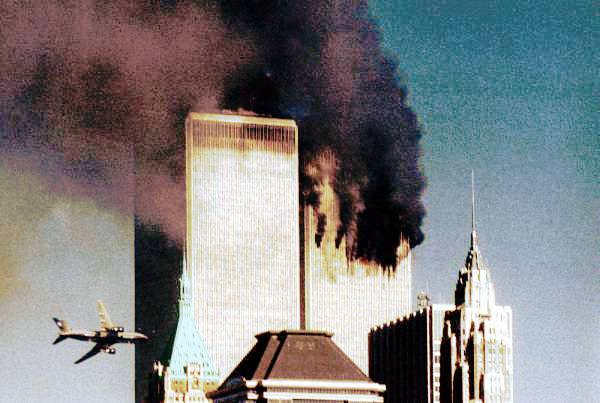
Ten years ago to this day, almost to the hour of which I am writing, commercial jetliners were highjacked by al Qaida teams armed with boxcutters, under the direction of Mohammed Atta, were flown into the towers of the World Trade Center and the Pentagon. A fourth plane, United Airlines Flight 93, believed to be headed to the US Capitol building, crashed in Pennsylvania when passengers led by Todd Beamer heroically attempted to stop the highjackers. The whole world watched – most with horror but some with public glee – on live television as people jumped out of smoke-engulfed windows, holding hands, to their deaths. Then, the towers fell.

From this day flowed terrible consequences that are still unfolding like the rippling shockwave of a bomb.

We look back, sometimes on the History Channel or some other educational program, at the grainy, too fast moving, sepia motion pictures of the start of World War I. The crowds wildly cheered troops with strangely antiquarian uniforms that looked reminiscent of Napoleon’s day, march proudly off to the war that gave Europe the Somme, Gallipoli, Passchendaele and Verdun. And the Russian Revolution.

After the armistice, the victors had a brief chance to reset the geopolitical, strategic and economic patterns the war had wrought and in which they were enmeshed. The statesmen could not rise to that occasion, failing so badly that it was understood even at the time, by John Maynard Keynes and many others, that things were being made worse. World War I. became the historical template for the short but infinitely bloody 20th century of 1914-1991, which historians in future centuries may simply describe as “the long war” or a “civil war of western civilization”.

There is a serious danger, in my view, of September 11 becoming such a template for the 21st century and for the United States.

On the tenth anniversary of 9/11, as we remember the fallen and the many members of the armed services of the United States who have served for ten years of war, heroically, at great sacrifice and seldom with complaint, we also need to recall that we should not move through history as sleepwalkers. We owe it to our veterans and to ourselves not to continue to blindly walk the path of the trajectory of 9/11, but to pause and reflect on what changes in the last ten years have been for the good and which require reassessment. Or repeal. To reassert ourselves, as Americans, as masters of our own destiny rather than reacting blindly to events while carelessly ceding more and more control over our lives and our livelihoods to the whims of others and a theatric quest for perfect security. America needs to regain the initiative, remember our strengths and do a much better job of minding the store at home.

The next ninety years being molded by the last ten is not a future I care to leave to my children. I can think of no better way to honor the dead and refute the current sense of decline than for America to collectively step back from immersion in moment by moment events and start to chart a course for the long term.

Elkus on Wikileaks and Sovereignty

Sunday, September 4th, 2011

Adam Elkus has a smart piece up at Rethinking Security that deserves wider readership:

WikiLeaks and Sovereignty

….WikiLeaks represents the idea that states have no inherent authority to hold onto vital national secrets. Because information is fundamentally boundless and unlimited by the “oldthink” of national borders and politics, state control over proprietary information is irrelevant. WikiLeaks and other radical transparency advocates believe that they-an unelected, transnational elite-can pick and choose which states are good and bad and whose secrets deserve exposure. And if information deserves to be free-and the only people who would keep it from being so are those with something to hide-then it is fine for non-state networks to arrogate themselves the right to receive and expose state secrets.

….While WikiLeaks is often positioned as a champion of digital democracy, it is actually wholly anti-democratic. It transfers power and security from national governments and their publics to unelected international activist organizations and bureaucrats. While this may seem like a harsh interpretation, there is no check on the likes of Julian Assange. Governments-even autocratic ones-still must contend on a day-to-day basis with the people. Even China had to face a reckoning after the Wenzhou train crash. WikiLeaks and other radical transparency organizations mean to replace one group of elites-which at least nominally can be called to court-with another who are accountable only to their own consciences.

Read the whole thing here.

Let me add a few comments to Adam’s excellent analysis.

Wikileaks and Julian Assange were not and have never been, lone wolves or information-must-be-free martyrs. They are allied with important institutions and individuals within the Western progressive elite, not least major media heavyweights like The New York Times, The Guardian and Der Spiegel, but also sympathizers within Western governments. Unless you think that Pvt. Bradley Manning was a hacker wunderkind with an intuitive grasp of which files that could be swept up to further a sophisticated political agenda, the man had some inside help from further up the food chain.

Adam is correct to describe these political factions as anti-democratic because they are and while leaking has been going on as long as there have been governments, we now have the emergence of a transnational generational clique that see themselves as entitled to rule and impose policies that comport with their social prejudices, economic self-aggrandizement and ideological fetishes, whether the people support them or not. A vanguard attitude, if not an organizational vanguard.

Wikileaks and other devices operating in shadowy undercurrents are their form of liberum veto against the rest of us in the instances where they are not completely in control, thus migrating political power from responsible state institutions to the social class that currently fills most of the offices and appointments. So far, their actions have been largely cost-free because their peers in government, however irritated they may be at the effects of Wikileaks, are loath to cross the Rubicon and hammer these influential conspirators with whom they went to school, intermarry, do business, live amongst and look out for the careers of each other’s children the way they have hammered Bradley Manning.

The same oligarchical class indulgence is seen in the financial crisis where almost none of the people responsible for massive criminal fraud in the banking and investment  sectors that melted the global economy have faced prosecution, unlike previous financial scandals like the S&L crisis or BCCI where even iconic figures faced grand juries. Instead of indictments, the new class received subsidies, bonuses and sweetheart, secret deals from their alumni chums running central banks and national governments. 

Carl Prinecommenting on a much narrower and wholly American slice of this corrupt camarilla, described this new class very well:

Let me be blunt.  A late Baby Boomer generation of politicians, bankers, reporters and generals has formed into a cancer inside this democracy, and their tumorous leadership won’t be kind to your future.

Unfortunately, this cancer is not limited to our democracy, it is the root of the decline of the West.

R2P is a Doctrine Designed to Strike Down the Hand that Wields It

Saturday, September 3rd, 2011

There has been much ado about Dr. Anne-Marie Slaughter’s ennunciation of “Responsibility to Protect” as a justification for the Obama administration’s unusually executed intervention (or assistance to primarily British and French intervention) in Libya in support of rebels seeking to oust their lunatic dictator, Colonel Moammar Gaddafi. In “R2P” the Obama administration, intentionally or not, has found it’s own Bush Doctrine, and unsurprisingly, the magnitude of such claims – essentially a declaration of jihad against what is left of the Westphalian state system by progressive elite intellectuals – are beginning to draw fire for implications that stretch far beyond Libya.

People in the strategic studies, IR and national security communities have a parlor game of wistfully reminiscing about the moral clarity of Containment and the wisdom of George Kennan. They have been issuing tendentiously self-important “Mr. Z” papers for so long that they failed to notice that if anyone has really written the 21st Century’s answer to Kennan’s X article, it was Anne-Marie Slaughter’s battle cry in the pages of The Atlantic.

George Kennan did not become the “Father of Containment” because he thought strategically about foreign policy in terms of brutal realism. Nor because he was a stern anti-Communist. Or because he had a deep and reflective understanding of Russian history and Leninism, whose nuances were the sources of Soviet conduct. No, Kennan became the Father of Containment because he encapsulated all of those things precisely at the moment when America’s key decision makers, facing the Soviet threat, were willing to embrace a persuasive explanatory narrative, a grand strategy that could harmonize policy with domestic politics.

Slaughter’s idea is not powerful because it is philosophically or legally airtight – it isn’t – but because R2P resonates deeply both with immediate state interests and emotionally with the generational worldview of what Milovan Djilas might have termed a Western “New Class”.

While it is easy to read R2P simply as a useful political cover for Obama administration policy in Libya, as it functioned as such in the short term, that is a mistaken view, and one that I think badly underestimates Anne-Marie Slaughter. Here is Slaughter’s core assertion, where she turns most of modern diplomatic history and international law as it is understood and practiced bilaterally and multilaterally by sovereign states in the real world (vice academics and IGO/NGO bureaucrats) on it’s head:

If we really do look at the world in terms of governments and societies and the relationship between them, and do recognize that both governments and their citizens have rights as subjects of international law and have agency as actors in international politics, then what exactly is the international community “intervening” in?

…For the first time, international law and the great powers of international politics have recognized both the rights of citizens and a specific relationship between the government and its citizens: a relationship of protection. The nature of sovereignty itself is thus changed: legitimate governments are defined not only by their control of a territory and a population but also by how they exercise that control. If they fail in that obligation, the international community has the responsibility to protect those citizens.

Slaughter is a revolutionary who aspires to a world that would functionally resemble the Holy Roman Empire, writ large, with a diffusion of power away from legal process of  state institutions to the networking informalities of the larger social class from whom a majority of state and IGO officials are drawn, as a global community. In terms of policy advocacy, this is a brilliantly adept move to marry state and class interests with stark moral justifications, regardless of how the argument might be nibbled to death in an arcane academic debate.

As with Kennan’s X Article, which faced a sustained critique from Walter Lippmann who realized that Containment implied irrevocable changes in the American system, R2P has attracted criticism. Some examples:

Joshua Foust –Why sovereignty matters

Much as advocates of the “Responsibility to Protect,” or R2P, like to say that sovereignty is irrelevant to the relationship of a society to its government (which Slaughter explicitly argues), it is that very sovereignty which also creates the moral and legal justification to intervene. For example, the societies of the United States and NATO did not vote to intervene in Libya – their governments did.

Foreign Affairs – The Folly of Protection

….RtoP, responding to the sense that these domestic harms warranted international response, solidified the Security Council’s claims to wider discretion. Yet it also restricted its ability to sanction intervention to the four situations listed in the RtoP document — genocide, war crimes, ethnic cleansing, and crimes against humanity — and thus precluded, for example, intervention in cases of civil disorder and coups. Although the resolution authorizing force against Libya will certainly further entrench the principle of RtoP, it will not completely resolve the tension between RtoP — in itself only a General Assembly recommendation — and the UN Charter itself, which, according to the letter of the law, limits action to “international” threats.

Dan Trombly –The upending of sovereignty and Responsibility to Protect Ya Neck

Beauchamp, along with Slaughter, have revealed R2P for what it actually is: a doctrine based on regime change and the destruction of the foundations of international order wherever practically possible. After all, are intervening powers really fulfilling their responsibility if they fail to effect regime change after intervening? This is exactly why I believe R2P is far more insidious than many of its advocates would have us believe or intend in practice. It is essentially mandating a responsibility, wherever possible, to seek the sanction, coercion, or overthrow of regimes which fail to meet a liberal conception of acceptable state behavior. Even if R2P is never applied against a major power, it is hard to see why such behavior would not be met with just as much suspicion as humanitarian intervention and previous Western regime change operations were. Indeed, a full treatment will reveal there is immense pressure for R2P to initiate the more fundamental, and more universal, impulse to revert to the potential ruthlessness inherent in international anarchy.

Understandably, such critiques of R2P are primarily concerned with sovereignty as it relates to interstate relations and the historical predisposition for great powers to meddle in the affairs of weaker countries, usually with far less forthrightness than the Athenians displayed at Melos. It must be said, that small countries often  are their own worst enemies in terms of frequently providing pretexts for foreign intervention due to epic incompetence in self-governance and a maniacal delight in atavistic bloodshed. Slaughter is not offering up a staw man in relation to democide and genocide being critical problems with which the international community is poorly equipped and politically unwilling to counter.

But R2P is a two edged sword – the sovereignty of all states diminished universally, in legal principle, to the authority of international rule-making about the domestic use of force is likewise diminished in it’s ability to legislate it’s own internal affairs, laws being  nothing but sovereign  promises of state enforcement. Once the camel’s nose is legitimated by being formally accepted as having a place in the tent, the rest of the camel is merely a question of degree.

And time.

As Containment required an NSC-68 to put policy flesh on the bones of doctrine, R2P will require the imposition of policy mechanisms that will change the political community of the United States, moving it away from democratic accountability to the electorate toward “legal”, administrative, accountability under international law; a process of harmonizing US policies to an amorphous, transnational, elite consensus, manifested in supranational and international bodies. Or decided privately and quietly, ratifying decisions later as a mere formality in a rubber-stamping process that is opaque to everyone outside of the ruling group.

Who is to say that there is not, somewhere in the intellectual ether, an R2P for the the environment, to protect the life of the unborn, to mandate strict control of small arms, or safeguard the political rights of minorities by strictly regulating speech? Or whatever might be invented to suit the needs of the moment?

When we arrest a bank robber, we do not feel a need to put law enforcement and the judiciary on a different systemic basis in order to try them. Finding legal pretexts for intervention to stop genocide does not require a substantial revision of international law, merely political will. R2P could become an excellent tool for elites to institute their policy preferences without securing democratic consent and that aspect, to oligarchical elites is a feature, not a bug.

R2P will come back to haunt us sooner than we think.

ADDENDUM:

Doug Mataconis at Outside the Beltway links here in a round-up and commentary about R2P posts popping up in the wake of the Slaughter piece:

The “Responsibility To Protect” Doctrine After Libya

….It’s understandable that the advocates of R2P don’t necessarily want to have Libya held up as an example of their doctrine in action. Leaving aside the obvious contrasts with the situation in Syria and other places in the world, it is by no means clear that post-Gaddafi Libya will be that much better than what preceded it. The rebels themselves are hardly united around anything other than wanting to get rid of Gaddafi and, now that they’ve done that, the possibility of the nation sliding into civil and tribal warfare is readily apparent. Moreover, the links between the rebels and elements of al Qaeda that originated in both Afghanistan and post-Saddam Iraq are well-known. If bringing down Gaddafi means the creation of a safe haven for al Qaeda inspired terrorism on the doorstep of Europe, then we will all surely come to regret the events of the past five months. Finally, with the rebels themselves now engaging in atrocities, one wonders what has happened to the United Nations mission to protect civilians, which didn’t distinguish between attacks by Gaddafi forces or attacks by rebels.

….Finally, there’s the danger that the doctrine poses to American domestic institutions. If Libya is any guide, then R2P interventions, of whatever kind, would likely be decided by international bodies of “experts” rather than the democratically elected representatives of the American people. American sailors and soldiers will be sent off into danger without the American people being consulted. That’s not what the Constitution contemplates, and if we allow it to happen it will be yet another nail in the coffin of liberty.

Read the rest here.

New Book: The Five Percent by Coleman

Saturday, August 20th, 2011

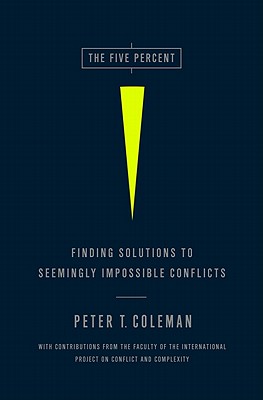
The Five Percent: Finding Solutions to Seemingly Impossible Conflicts  by Peter T. Coleman

A courtesy review copy just arrived. Intriguing, because the study here is about intractable or seemingly “wicked” socio-political conflicts. Coleman is an academic, researcher and activist in conflict resolution studies. Perhaps it will have some nuggets of wisdom for “de-escalating” 4GW or Hybrid wars.


Switch to our mobile site
