zenpundit.com » 21st century

Archive for the ‘21st century’ Category

Eeben Barlow’s Military & Security Blog

Tuesday, February 3rd, 2009

The founder of the famous but now defunct PMC Executive OutcomesEeben Barlow has a blog and it will be interesting to most readers here ( major hat tip to Lexington Green but more to Adam Elkus). The link and some samples from Barlow’s posts:

Eeben Barlow’s Military and Security Blog

Putting an End to Piracy – The Only Way

…Surely, someone somewhere must have realised by now that using political correctness as a method of countering piracy has failed – and can never succeed. Water cannons and bean bags have never been a real deterrent – except maybe to ill-prepared rioters. Sending naval task forces into the pirate-infested areas is likewise a hollow threat. Yet, the taxpayers have to fund these navies in order to protect the shipping companies who don’t repay the costs of the naval task forces. In short, it is a great business deal for the shipping companies.Whereas many PMCs and individuals – myself included – have written concepts, plans, proposals and more on how to counter this menace, no one has yet had the courage to implement these plans for fear of international condemnation. International law is in this instance also a prohibiting factor as there is great uncertainty as regards the legalities of having weapons on-board a ship, something that is in reality very simple. But, it seems, no one likes a simple plan. The more complicated it is, the more people like it.

…Even more astonishing is that everyone is keen to give an excuse why the pirates are operating – from the failed-state theory to great poverty. That is, in a sense, much like condoning a bank robber and then making excuses for his criminal behaviour. As long as no one gets seriously hurt, it must be okay…

International Law activists attempting to enforce international law (more of a slippery concept than the MSM presents) are much like the drunkard looking for his car keys under the lamp post. It’s not terrorists, pirates, warlords, genocidaires or dictators or other dangerous and lawless men with guns who consume the attention, time and energy of these generally left-wing intellectuals but instead Western armies, intelligence agents and police who might try to fight stateless brigands. The light is better there, you see.

Fighting Organized Crime

….In South Africa, those that are supposed to police crime are very seldom keen to do their duty. Many of them are, indeed, part of the problem and not part of the solution. Whereas there are police officers trying to make an impact on crime, they are few and far between. Sadly though, success is not something that is evident in these counter-crime actions. Public regard for crime scene investigators and detectives is reaching an all-time low. Their lack of interest in attending to crime scenes is well documented with excuses as feeble as “we don’t have a vehicle…” Visible policing is seen by many to simply be a reconnaissance operation by men in police uniforms before they strike

A worthy add to your RSS feeder or blogroll.
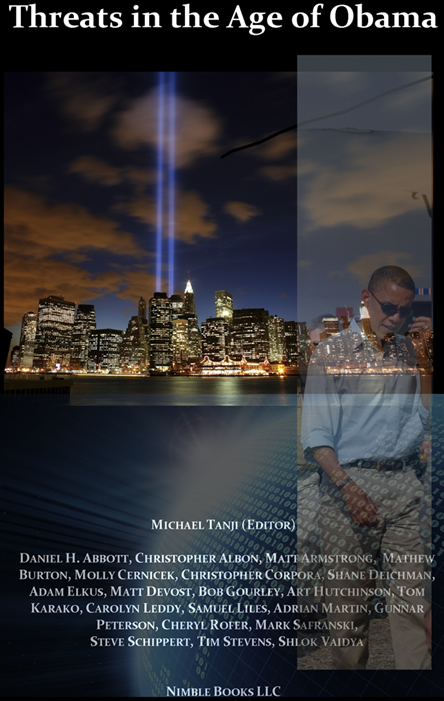
New Book – Threats in the Age of Obama

Tuesday, January 27th, 2009

tttaob_cover_cropped.jpg

I am both excited and very pleased to announce the release of Threats in the Age of Obama by Nimble Books

Edited by my friend Michael Tanji, a former senior member of the intelligence community, the volume is a 224 page  A-Z anthology on the cutting edge security challenges faced by the United States in the 21st century and the strategic thinking required to deal with them. Tanji recruited an impressive stable of experts, many with high level USG and private sector experience, in intelligence, cyberwarfare, terrorism, pandemics, nuclear proliferation, human terrain, information operations, public diplomacy, foreign policy and national security. It was a high honor for me to be included among the authors, who are:

Dan tdaxp, Christopher Albon, Matt Armstrong, Matthew Burton, Molly Cernicek, Christopher Corpora, Shane Deichman, Adam Elkus, Matt Devost, Bob Gourley, Art Hutchinson, Tom Karako, Carolyn Leddy, Samuel Liles, Adrian Martin, Gunnar Peterson, Cheryl Rofer, Mark Safranski, Steve Schippert, Tim Stevens, and Shlok Vaidya. And last, but really first, editor, contributor and chief cat-herder, Michael Tanji.

“….If you are on a mission to change the way government works, particularly in the national security arena, this is one a place where some independent and intellectually diverse thinking is to be found. In these essays, we offer our view of some of the more pressing threats the Obama administration will have to deal with in these early days of the 21st century.”

If support the idea that the national security establishment needs to embrace change, then this is the book for you.

When Old Government Intersects with New Media

Thursday, January 22nd, 2009

Galrahn at Information Dissemination:

Admiral, Do You Tweet Sir?

….In no small part due to a comment in the article by John Nagl, the Small Wars Journal gets an honorable mention in this article as an example where new media is having influence in the national security debate. While it is possible other areas of new media are having a similar effect, I would argue the Small Wars Journal is the exception, not the rule, and is the only place this is happening. What makes the Small Wars Journal unique?Because it is where active and retired members of the military want to debate their ideas, want their opinions in the open source on any given topic, and Dave has tapped into a community that has become comfortable with their ideas debated in an open forum. The Small Wars Journal has the capacity to “help shape the public debate about national security policy” primarily because those involved in the debate have found value participating in the public debate.

As I have noted in the past, each military service has taken a unique approach to new media. The article highlights unique examples where our military leadership has found utility within new media to introduce and discuss their message. I follow all of these discussions, and they have all met the same challenge: the discussion is still one way and while there is a network, it is yet to become a truly interactive network of idea sharing, or just as relevant, idea shaping.

….What is the role of new media in the national security debate? I have asked this question on the blog since I began blogging, and have seen some brilliant answers in my email and in the comments. This CSM article added another slide to a brief I am building that answers this question. I think it is a really good brief, but the question I still haven’t answered is whether the better audience for the brief is the military services, or the think tanks. That John Nagl hasn’t suggested CNAS buy the Small Wars Journal from Dave suggests to me that the think tanks somehow believe the Web 1.0 model they all currently use will somehow stay relevant in the rapidly evolving information age.

Read the rest here.

Very interesting thoughts by Galrahn and I agree with his assessment of the value of SWJ as it evolved under the stewardship of Dave Dilegge and Bill Nagle though I’m not certain SWJ is unique so much as it is  a succcessful “first” because Dave and Bill did everything right. They allowed a community to form from the ground-up without trying to ramrod an ideological agenda. Sure, SWJ is primarily about COIN but opposing views are invited, welcomed, heard and debated because the moderators are honest brokers and that imparts credibility to the entire enterprise. Intellectual integrity begets quality as well as quantity in terms of readership and submissions.

Tradtional think tanks are not set up to do what SWJ does because they come with either ideological baggage (Heritage, Brookings Carnegie) or institutional affiliations (SSI, CNA, Hoover) that preemptively circumscribe membership, discussion and research interests for fear of drying up the revenue stream. Few large donors, be they Uncle Sam, Richard Mellon Scaife or George Soros, are motivated to open their checkbook by the idea of unfettered inquiry and unlimited time horizons or providing a platform to their professional or political opponents. Attempts by official orgs to imitate SWJ will result in costly but sterile echo chambers. Genuine Web 2.0 interactivity is not desired because it is spontaneous and unpredictable but without that interactivity there’s no spark, no insight and no intellectual productivity.

The Obama White House just started a “blog” but despite the sleek visual design, “The Briefing Room” is a very Web 1.0 format. Media expert Jay Rosen of Press Think  on Twitter described it as “press releases” and scanning the posts leads me to agree with him. It’s very hard for established legacy entities – even one now filled with techies – to embrace the risk of uncontrolled discussion. Perhaps the blog should be farmed out to whatever Obama is calling his private political action group; lacking comments or an authentic, personal, voice The Briefing Room is likely to become a tepid EOB version of Dipnote – except even less interesting.

The SWJ Model can be replicated for other fields but the requirements of independence, community-building, intellectual diversity, relative transparency, openness to membership and free debate appear to be non-negotiable elements. Features, not bugs. 

“Socionomic” Futurism at Futurejacked

Friday, January 2nd, 2009

Flagg707 has a speculative post at Futurejacked that I think most readers hear will find stimulating and fun to read:

Socionomic Trendspotting for 2009

A Continued Surge in Magical Thinking

Socionomics posits that during waves of positive social mood, “practical thinking” is dominant over “magical thinking,” and a belief in science and reason dominates. During waves of negative social mood the magical thinking, with its distrust (if not hatred of) reason and science rises to a dominant position in the mass social “mind.”

My personal interpretation of this is that magical thinking actually begins to manifest during the fifth wave of a postive mood surge – where faith and hope outstrips a reasoned evaluation of the economic “fundamentals” and continues into the waves of negative mood. Either way, we can expect a lot of anti-science and anti-rationality types of behavior to explode in politics and in university settings. Hopefully it won’t go as negative as it did in Kampuchea, but we are dealing with a downturn of historic proportions, so keep in mind that herds of humans are capable of staying irrational for very, very long periods of time.

….Expect a Wave of Independence Movements

I thought this would be a more dominant theme during 2008 than it turned out to be, with only Kosovo shearing off from Serbia and, at the very end of the year, the Ruthenians declaring independence in Ukraine. As Abkhazia and Ossetia were already de facto independent from Georgia, I won’t count them. I doubt 2009 will be as calm.

Socionomics holds that during times of negative mood factionialism increases and the various “tribes” that make up a country turn towards their subgroup and away from the idea of an inclusive and tolerant society. This is the stuff of independence movements, of civil wars, of hollow states and of a return to primary loyalties.

Read the rest here.

How About an Assistant SecDef for Irregular Warfare ?

Saturday, December 20th, 2008

Real change requires budgets, bureaucratic platforms and visionary leaders who can be both champion and evangelist. Having successfully lobbied for the retention of Secretary Gates, the small wars/COIN/military reform/strategic security community should capitalize on the logical political momentum and not be afraid to ask for the moon. This and many other things.

The United States and the world are at the kind of crystallizing flux point – where paradigm shifts have been recognized but the policy responses have not been decided – that comes once in a half century or more. Many things are fluid right now in different domains that were once regarded as certainties. Time to push while doors and minds are open.

People, like Secretary Gates, who “get it” need to be put in critical positions ASAP. Broadly speaking, what gets decided in the next 6 months may impact all of us for the next 60 years.


Switch to our mobile site

