Gaddis on Grand Strategy
Thursday, December 24th, 2009Hat tip to Ian!
Hat tip to Ian!

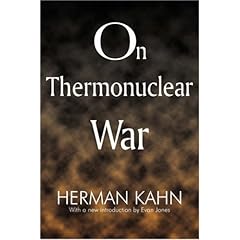
The post title is tongue in cheek. Herman Kahn was anything but wrathful and came across in his day as a remarkably cheerful strategist of the apocalypse and deep futurist. Long time readers have noted my admiration for Kahn’s metacognitive strategies but for those unfamiliar with Herman Kahn, he was one of those polymathic, individuals of the WWII generation who, like Freeman Dyson and Richard Feynman, could jump into high level nuclear physics research without bothering to first acquire a PhD in the field (Feynman later received a doctorate, Dyson and Kahn never did). Kahn was noted for his forthright willingness to consider humanity’s long term prospects despite the worst calamities imaginable – unlike most optimists, he assumed the events most terrible could happen – but life nevertheless would go on. A position that caused many of his critics to go ape, including the editors of Scientific American.
I bring this up because his daughter, Deborah Kahn Cunningham, emailed to say that Kahn’s classic On Thermonuclear War

This could not come at a better time. The Obama administration is making grandiose gestures with America’s nuclear deterrent based less on a hardheaded and comprehensive strategic analysis than self-serving political showmanship, tailored to mollify a Left-wing base deeply resentful of the COIN strategy the administration is starting to take in Afghanistan. Nuclear weapons affect the strategic calculus across the entire spectrum of potential decisions, they’re not just shiny, anachronistic, bargaining chips but the overwhelming reason that great power war came to an end in 1945. Period.
Human nature has not made much moral progress since the end of the Third Reich but its very worst instinct for total destruction has, so far, been held at bay by the certainty of self-destruction.
We need someone to remind us again of how to think about the unthinkable.
Cheryl Rofer called for national security/ foreign policy/defense bloggers to think hard regarding the strategic calculus of a state possessing just a few nuclear weapons:
What strategies are available to a country with fissionable material sufficient for 1-5 nuclear weapons, some of which may be assembled? Take into account probable responses, and assume some sort of rationality on the holders of these weapons and material. You may specifically refer to Iran and North Korea, or any other nation, or make the scenario(s) more general. Flesh out the scenario with some support
Many have answered the call ( I am still working on my response) and here they are with key excerpts:
….Therefore, we will pursue a four-fold strategy we call “Deterrence Light”:
1. INTERNAL SECURITY: Ensure the secrecy of our fissile material. Maximize employment of decoys and spoofs so as to preserve this material should it ever be needed….
2. EXTERNAL AWARENESS: Inform the world of our technological accomplishment — and embed in our announcements disinformation regarding the exact disposition of our research establishment and weapons complexes….
….Yesterday, the Iraqi Kurds announced the formation of a Kurdish confederation, minutes after introducing shocked IAEA officials inspecting Turkish nuclear facilities to a mountain bunker where two nuclear warheads (one loaded on a hybrid American-Israeli missile) were housed. Iraqi Kurdistan leaders informed the Iraqi government they were joining a Kurdish confederation but were not (as of this moment) interested in seceding entirely from Iraq. Revenues would continue to be shared as previously agreed and Kurdish units would be available to defend Iraq against Iranian aggression. Iranian Kurdish leaders explained their position to the Supreme Leader of Iran and noted targeting of Tehran and Iranian oil fields by several nuclear devices was existent. The Syrians were equally appraised of their own prime real estate being targeted
….Next, I will want to develop an indigenous capability. I won’t let any Proliferation Security Initiatives stop valuable material shipments. My engineers and scientists will train in the best universities overseas as I develop my “nuclear technology” program, which will have the purpose of supplying my people with limitless, inexpensive electricity to power their homes. Now the United States and European nations will offer me low-enriched uranium, and that will do – for starters. Once I get the nuclear technology program, I’ll build a second reactor and centrifuges for the HEU processing.
Dreaming 5GW (Arherring)
…. The 5GW Strategy: Ironically, even though the 4GW Operation benefits from more weapons being available, the 5GW strategy only requires one (and with the proper preparation you might even be able to get away with none, but that’s an advanced class). Essentially, the objective is to prove the potential of multiple weapons by openly displaying the existence of at least one weapon. Should you possess only two, one should be test-detonated and the other should be openly displayed to an authority that can realiably vouch for its authenticity. This very controlled transparency is a 5GW affect on observation that triggers existing assumptions, rule-sets and responses both in countries that are targeted and in countries that are merely in the audience
Cheryl Rofer of Whirledview has called for a blog tank on the strategic question of countries with just a few nuclear weapons:
Blog Tank: National Strategy for a Few Nuclear Weapons
Herman Kahn worked out the strategies for massive nuclear exchanges between the United States and the Soviet Union.
Both the United States and Russia are now disassembling their nuclear weapons, rather than building more. The nations that have tens or hundreds of nuclear weapons are looking fairly peaceful lately; even India and Pakistan seem to have achieved their own version of the balance of terror. Terrorists don’t seem to have any nukes hidden away yet.
So the danger is that a nation will break out of the Nuclear Nonproliferation Treaty with a few nukes. This is a very different problem from the one Kahn addressed.
The last country to face an analogous situation was the United States at the end of World War II. By the time it had tested an implosion device at Alamogordo, New Mexico, and dropped weapons on Hiroshima and Nagasaki, it was out of atomic bombs and fissionable materials. Truman bluffed for the several years it took to build some tens of nuclear weapons.
That was, of course, when no other nations had nuclear weapons.
Andy at Nuclear Mangoes reminded me over the weekend of my irritation that nobody has addressed the strategy of one to a few nuclear weapons. That’s a different problem than something in the range of 5-10, which is a different problem from a higher number. None of these have been addressed systematically for today’s world.
So let’s have a blog tank. Anyone who wants to participate should post a scenario (or scenarios) on their blog or, if you don’t have a blog, in the comments to this post. Here is the problem I want to address:
What strategies are available to a country with fissionable material sufficient for 1-5 nuclear weapons, some of which may be assembled? Take into account probable responses, and assume some sort of rationality on the holders of these weapons and material. You may specifically refer to Iran and North Korea, or any other nation, or make the scenario(s) more general. Flesh out the scenario with some support.
I envision a next step after the scenarios have been presented, perhaps a mutual critique, but I am open to suggestions on that next step. Let’s keep this first round to scenario development.
I’ll pull things together, as I did the last time around. I won’t try to reconcile one scenario with another, although I may note similarities.
Deadline for scenarios: July 18.
This is a great idea. I see that Shane has already responded but I will look more closely at his post here on Sunday.
Cheryl “CKR” Rofer of Whirledview, who initiated the Nuclear Policy “Blog Tank” challenge, skillfully brought the series to a summative conclusion with a second round-up and then a consensus post. I’d like to take a moment to look at both posts by CKR:
“The Bloggers Develop Nuclear Weapons Policy – Pulling It Together”
“The Bloggers Develop Nuclear Weapons Policy – The Consensus Statement”
While I have previously linked to the contributions from Dave Schuler and Charles Cameron, Cheryl’s first post above featured several other bloggers to whom I would like to draw attention with a brief excerpt:
Cernig – “America’s Nuclear Policy
“I’ve written before that trying to apply the Cold War assumptions of nuclear retaliation to assymetrical stateless actors is like running with nuclear scissors. it’s far more likely that you’ll fall and injure yourself or some innocent in a messy way than accidentally stab the one murderer in a crowd.
Jason suggests a posture based around a minimum deterrent force, I assume involving only a couple of hundred warheads, “prioritizing deployment on submarines which are impervious to any comprehensive first strike or pre-emptive attack.” I think that’s a good first step but would then move on to a “Virtual Swords” concept as explained by Jeffrey Lewis. Dr Lewis quotes an article from a friend of his which notes this isn’t a new idea”
PoliGazette – “Of Linus and Nuclear Weapons”
“So the fundamental question that must begin the debate over a post-Cold War nuclear weapons policy in the U.S. is: Can nuclear weapons enhance U.S. security, and if so, how? General Lee Butler, retired former commander of the United States’ nuclear weapons forces, has a surprising answer: Nuclear weapons in actuality provide very limited contributions to U.S. national security. The reason is that nuclear weapons are politically and militarily virtually unusable.”
Wampum – “Packages and Packaging”
“First, the point made by John Kerry in 2004 remains — the greatest threat to the United States (as well as Japan, China, India, Pakistan, Israel, Europe, Canada, and the Russian Federation) is the risk that the existing stockpiles of devices and fissile materials will eventually be re-purposed, and the better policy is to allocate resources nominally reducing that risk model, up to and including unilateral partial disarmament. The alternative “single weapon” risk model was articulated in the same debate by George W. Bush, and independently by Peter Daou’s sometime employers, Mssrs. Ted Turner, Sam Nunn, Warren Buffett and others, and without loss of generality, by the Robust Nuclear Earth Penetrator proponents.
Restated, the greatest quantifiable risk has no agency, and cannot be “deterred” or engaged in human discourse. It is rust. Sensor failure. False alarm. The next greatest quantifiable risk has agency, but also cannot be “deterred” or engaged in political discourse. It is covert or overt expropriation of devices or fissiles. Restated, it is sensor and inventory control failure”
Rofer did an excellent job summing up the consensus points in a discussion of nuclear weapons policy that featured bloggers with a wide spread of political and philosophical positions:
“Overview
The bloggers who have contributed to this blog-tank range in views across the center of the political and hawkishness spectra. Nonetheless, we have achieved a fair degree of consensus.Nuclear weapons strategy is part of a broader US military and international relations strategy, but it can be discussed by itself. To some degree, development of all these levels of strategy is iterative.
We need to identify short-term and long-term goals and give each its appropriate place. While abolition of nuclear weapons may be a long-term goal, making it too immediate can be counterproductive.
Nuclear weapons have a paradoxical relationship to power. They cannot be used, but their threat is potent. If a nation is tied too closely to a requirement to retaliate, its options may in fact be limited.
Nations that have nuclear weapons want to preserve their exclusivity, but that desire may increase the valuation of nuclear weapons by other nations.”
Read the rest here.
A further comment, on Cheryl’s “Blog Tank” concept. Her format was important in its’ own right:
This experience is one that bears repeating; and similar things have been called for by others, notably Michael Tanji who is part of the effort by Threatswatch.org to become a “Think Tank 2.0“. The blogosphere, for it’s many faults and idiosyncratic subculture, has matured to the point that there are enough experts and gifted amateurs that a person could probably organize an impressive intellectual “swarm” on nearly any topic under the sun in fairly short order. Just by asking folks of intelligence and goodwill to help.
To paraphrase an old revolutionary, brainpower is lying in the streets for the taking.

Zenpundit is a blog dedicated to exploring the intersections of foreign policy, history, military theory, national security,strategic thinking, futurism, cognition and a number of other esoteric pursuits.
Customized Web Site & Blog Design

