zenpundit.com » military history

Archive for the ‘military history’ Category

Our More Important National Debt

Sunday, May 29th, 2011

“…They went with songs to the battle, they were young,
Straight of limb, true of eye, steady and aglow.
They were staunch to the end against odds uncounted;
They fell with their faces to the foe.
They shall grow not old, as we that are left grow old:
Age shall not weary them, nor the years condemn.
At the going down of the sun and in the morning
We will remember them.”

 For the Fallen

Laurence Binyon

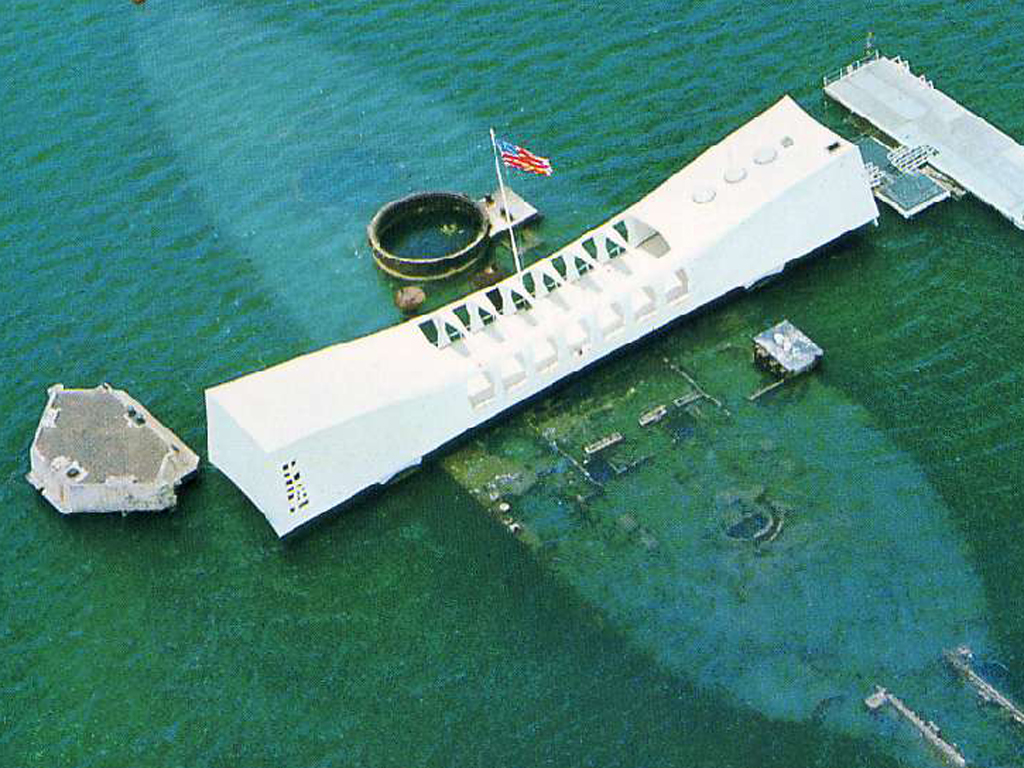
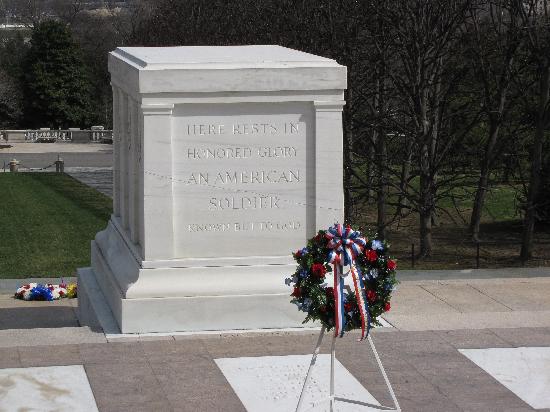
We might have a stronger Republic, a more civil society, a more robust democracy, if we gave more frequent thought to what we owe those who made the supreme sacrifice on our behalf as Americans.

MEMORIAL DAY,  2011

Book Review: The Shaping of Grand Strategy

Tuesday, May 24th, 2011

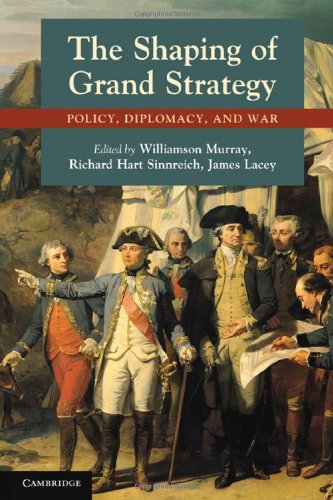
The Shaping of Grand Strategy: Policy, Diplomacy, and War by Williamson Murray, Richard Hart Sinnreich and James Lacey (Ed.)

As readers of this blog know, grand strategy is an important and timely subject that speaks directly to the difficulty American leaders have had in navigating the ship of state in the waters of the international arena. The Shaping of Grand Strategy: Policy, Diplomacy, and War by Williamson Murray, Richard Hart Sinnreich and James Lacey (Ed.) and contributing authors Colin S. Gray, Marcus Jones, Jeremy Black and John A. Lynn III postulates what grand strategy is and explain from historical case studies how statesmen struggled to fashion one in peace and war.

The Shaping of Grand Strategy has a number of strengths to recommend it to the serious student of history or strategic practitioner:

Focus: The case studies are all anchored in the Westphalian state system starting with the early modern period of European absolutism and apex of “national” monarchies and transitions through a Bismarckian 19th century to finish with the West’s cataclysmic 20th century battle with totalitarianism. This gives the chapters by different scholars a sense of cohesion and chronological succession.

Balance: The Shaping of Grand Strategy gives scholarly treatment from both the theoretical, strategic studies perspective as well as the historical case study. I learned some things about Louis XIV’s Europe and the Great Britain of the Pitts and the Hanoverian dynasty of which I was unaware. Theory bookends history in this tome.

Nuance: Each scholar gives his subject an adult treatment. Controversial points are interesting rather than shrill and each author engages an impressive synthesis of historiographic material as they cover a broad ground in investigating grand strategy. Each chapter is sound and engaging.

Limitations, such as they are, to be considered:

Absent: Powerful non-Western case studies. The ancient world.  Revolutionary war (French, Soviet or Islamist insurgent) as a grand strategy. Geoeconomics asnd political economy as a foundation for grand strategy. 

Weak: Insufficient treatment of the impact of nuclear weapons and deterrence on grand strategy, which frankly deserved a chapter of it’s own.

If you are composing a syllabus for a class on grand strategy or strategy, The Shaping of Grand Strategy would serve as an excellent generalist core for the course, supplemented by cognate, specialist or subtopical readings.

Some things that struck me while reading The Shaping of Grand Strategy:

  • Colin Gray’s distillation of the strategic dilemmas faced by Truman and an almost Boydian implicit explanation of what grand strategy is and why it needs a compelling moral power:

High policy does not emerge in a vacuum, though it can be invented in a hurry without much forethought when necessity presses. Policy requires a North Star for guidance that can inspire, yielding to would-be leaders the fuel they require to recruit and satisfy their followers

  • James Lacey’s realistic and granular treatment of the relationship between military strategy and grand strategy in the WWII Anglo-American Alliance and his generally admiring assessment of FDR as a strategist vs. a critical treatment of George Marshall.
  • Marcus Jones’ emphasis of the importance of the strategist himself and the uncertainty of decision making in his chapter on Otto von Bismarck.
  • The drawing of historical parallels with today  by John Lynn and Richard Sinnreich as well as the investigation of the reasons for grand strategic failure of British appeasement by Williamson Murray.

The Shaping of Grand Strategy is a tight, concise and focused academic book that furthers the discussion of grand strategy by providing coherent and detailed examples as well as a readable an interesting analysis from which both the professional or the the student can profit.

Strongly recommended.
Elkus on the Troubled History of Raiding

Tuesday, May 10th, 2011


Adam reminds us that punitive raiding is not by itself a substitute for clear strategies or coherent policies in a well-written piece posted at The Atlantic Monthly :

From Romans to SEALs, a Troubled History of Raiding

The Osama bin Laden raid has been hailed as the centerpiece of a new style of “collaborative” warfare that leverages intelligence fusion and networked interagency teams to focus precision force on America’s enemies. Collaborative warfare, while impressive, is only the latest and greatest in a genre of military operation that dates back thousands of years: the punitive raid. From the days of the Roman Empire through Sunday’s raid in Abottabad, Pakistan, governments have relied on punitive raids and manhunts to eliminate challengers to state power without resorting to costly, large-scale occupations. 

But a look at the history and evolution of punitive raiding reveals that it is not a substitute for sound strategy — and can be far more costly than policymakers might suspect and may have political costs that outweigh the strategic benefits. Punitive raids — whether they consist of a large column of raiders advancing by horseback or an airmobile squad of commandos about to drop into an enemy cross-border haven — have always been deceptively appealing as low-cost alternatives…

Read the rest here.

General Sam on the Battle of Saylers Creek

Thursday, April 7th, 2011


Callie Oettinger alerted me to some reflections on Civil War history by one of the fathers of Delta Force, LTG Samuel Vaughan Wilson over at Command Posts:

Memories of the Battle of Saylers Creek

I remember the holes in the wood siding of Lockett House, where my grandmother, Lucy Lockett was born and raised. The holes were made by mini balls fired by both sides.  There were thirty-two of them in the front side of the house alone, along with four larger scars made by cannon balls.

In the course of the battle, the farmhouse had been turned into a hospital for both the Northern and Southern forces, and Lucy Lockett’s young niece, Mamie Lockett, had spent most of the fight crouched on a pile of last fall’s potatoes there on the floor of the basement, her tiny frame shielded by that of her nanny’s.

When I would visit her in the early 1930’s, “Cousin Mamie-we sometimes called her “Aunt Mamie”-would sit there in the front parlor rocking and holding on to her cane, and, if I was patient and kept quiet long enough, she would talk about the battle of Saylers Creek, which shattered Lee’s Army of Northern Virginia on the way to Appomattox Courthouse.

“After a while,” she would say….

Read the rest here.

More Books and Reviews to Come

Wednesday, March 30th, 2011

Going to try to catch up this week on the backlog of book reviews I need to do, particularly those books sent to me by publishers. I may have to break down and do a set of mini-reviews, so far behind I have gotten myself.

So, naturally, that was a suitable pretext to order more books 🙂

Here’s what arrived the other day….


STRATEGY: The Logic of War and Peace by Edward Luttwak

War Before Civilization by Lawrence H. Keeley

WAR: In Human Civilization by Azar Gat

The World of Yesterday by Stefan Zweig

Why the West Rules – For Now by Ian Morris

Luttwak’s book is a strategy classic and I recently enjoyed his Grand Strategy of the Byzantine Empire. I first heard of Stefan Zweig from Lexington Green but nearly everyone who has read The World of Yesterday that I have encountered has raved about it, so I am looking forward to that one. Why the West Rules- For Now is another rec from the Chicago Boyz crowd but I do not think that anyone has reviewed it there as of yet. Finally, I am pairing War Before Civilization with Azar Gat’s War in Human Civilization – have a sense that Gat’s ideas may be somewhat in tune with Martin van Creveld.

Have you read any of these?


Switch to our mobile site