zenpundit.com » physics

Archive for the ‘physics’ Category

The Said Symphony: move 19

Sunday, March 18th, 2012

[ by Charles Cameron – extended analytic game on Israeli-Palestinian conflict — for those who wish to catch up, our game thus far consists of an intro to the game and game board, followed by moves 1-5, 6-9, then moves 10-11 which together constitute a meditation, moves 12, 13-15, 16-17, and most recently before this, move 18 with cadenza ]

Move 19: The view from above

Move content:

Discussing strategy, the very canny LTG (USMC, Ret’d.) Paul Van Riper had this to say:

What we tend to do is look toward the enemy. We’re only looking one way: from us to them. But the good commanders take two other views. They mentally move forward and look back to themselves. They look from the enemy back to the friendly, and they try to imagine how the enemy might attack them. The third is to get a bird’s-eye view, a top-down view, where you take the whole scene in. The amateur looks one way; the professional looks at least three different ways.

A bird’s-eye view, a hawk’s eye view, a top-down view, an overview, a view from 30,000 feet, a God’s eye view, a view from above, a zoom…

If move 18 and its cadenza gave us a view of the depth of vision or insight that is necessary for a full and rich understanding of the world we live in — its qualitative or spiritual scope, if you like — this next move, with its picnic and drone-sight, addresses its breadth in space and time — materially and quantitatively speaking.

The classic expression of the sheer material scope of the universe was put together by Charles and Ray Eames in their justly celebrated film, Powers of Ten, from which the lower of these two images is drawn:

Here are some other relevant scans of the scope of things, in terms of time and space:

The Scale of the Universe 2
A Brief History of The Universe
The Known Universe
A Time-Lapse Map of Every Nuclear Explosion Since 1945

These are impressive videos to be sure, but as an aside I’ll invite you to ask yourselves how well they compare with this zoom in words, a poem by the zennist, ecologist, essayist and poet Gary Snyder, from his book, Axe Handles: Poems:

Such breadth of vision, such craft.

*

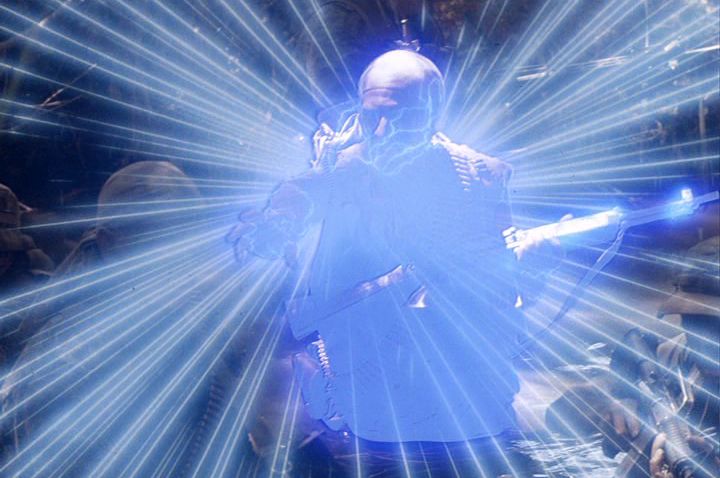
If this “material scope of things” too has a cadenza, it would be that all of this is shot through with some primary oppositions, dappled as the poet Gerard Manley Hopkins would have it, with swift, slow; sweet, sour; adazzle, dim — as indicated in the drone-sight and picnic double image at the head of this move.

This dappling, this constant flux of opposites, takes many forms — day and night lead to the more abstract light and dark, which can then be interpreted morally as good and evil, to which we respond with repulsion and attraction as the case may be, building our worldviews from love or fear…

At different scales the opposites that matter most to us may have different names and shadings, but here I’d just like to draw attention to the dappling of our world with:

competition and cooperation
Darwin‘s natural selection and Kropotkin‘s mutual aid
duel and duet (ah! — a favorite phrasing of mine)
war and peace

Provocatively, we find this dappling in scriptures, too, wherein the ripples of such verses as “The LORD is a man of war: the LORD is his name” (Exodus 15.3) dropped like a stone into the pond of the human mind, meet with the ripples of other verses such as “God is love; and he that dwelleth in love dwelleth in God, and God in him” (I John 4.16).

There are times when we take such oppositions literally, perhaps too literally, and times when we begin to see oppositions as abstract and theoretical end-points to what is in fact a yin-yang process continually unfolding…

Which brings me by a commodius vicus of recirculation to this image of the great opposition between war and peace, its dappling, its unfolding:

Links claimed:

To the Lamb, move 18: this move presents the material scope of the universe in counterpoint to its visionary scope as laid out in move 18 with its cadenza.

To Revelation, move 17 — the word revelation means unveiling, as we have seen, and our sciences and technologies, with their spectra of telescopes, microscopes, cameras and zooms, are unveiling and revealing to us much about the physicality of the world we live in — much that was accounted for in other times and places through intuition, vision and poetry.

This scientific and technical revelation of material existence, for many of us moderns, has largely eclipsed the mode of visionary revelation of move 17 — yet it cannot eradicate it. Implicit in this move, then, is the sense that we carry with us both subjective and objective, inner and outer, qualitative and quantitative understandings — though the data that “sight” and “insight” provide us with may be different in kind, and resolving them may be something of a koan to us, the deep problem in consciousness as philosophers of science have named it — and that we can discount neither one if we are to have and maintain a rich sense of our situation.

Comment:

If the two previous moves have shown us the scope of the universe we co-inhabit, perhaps we should now make our own zoom in, much as James Joyce did when he had the schoolboy Stephen inscribe his name and address in his geography book as Stephen Dedalus, Class of Elements, Clongowes Wood College, Sallins, County Kildare, Ireland, Europe, The World, Universe – an address that Stephen then read both forwards and backwards, finding himself in one direction, and finding in the other that he had no means of knowing what might lie beyond the universe…

Imagine then, skipping rapidly from (unimaginable) cosmos via such things as the intriguingly named End of Greatness to galaxy or nebula…

…solar system and planet — whence we can slow down and zero gently in on the Middle (or as my friend Ralph Birnbaum would call it, the Muddle) East, Israel / Palestine, Jerusalem / Al Quds / the Temple Mount / Noble Sanctuary – and to such matters of contemplative vision and tribal passion as the first, second and projected third Temples, the al-Aqsa mosque.

Our increasing focus will bring us, then, to that the rock which Jews believe marks the place where Abraham bound his son Isaac (the Akedah), and which Muslims believe to be the place of ascent of the Prophet to the celestial realms (the Mi’raj) on his Night Journey (Qur’an, Al-Isra).

Here again myth and history collide, and both visionary and material considerations merge in the heart of the what my friend the Israeli journalist Gershom Gorenberg has justly called “the most contested piece of real estate on earth”.
On bananas, cucumbers, tomatos and piano legs: an aside

Saturday, December 10th, 2011

[ by Charles Cameron, h/t Mike Few — bananas, cucumbers, tomatos and piano legs as sexual objects, reading the world as a book, Iraq recently, Shakespeare a while back, Robert Hooke ]
.

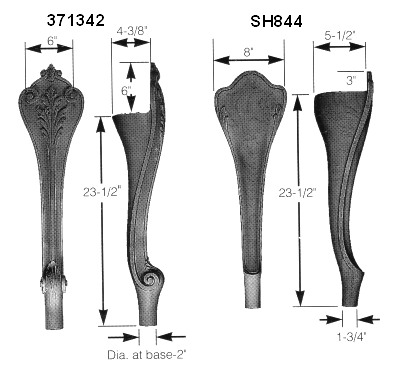
Louis XV grand piano legs, hard maple. Image credit: http://www.balaams-ass.com/grandlegs.htm

MikeF in a comment on my post, Let me put my banana in your fruitbasket, pointed us to his Small Wars Journal article The Break Point: AQIZ Establishes the ISI in Zaganiayh, in which he reports that the Mujahedeen Shura Council in Iraq passed out propaganda pamphlets providing “instruction on the proper actions of good Muslims” in preparation for the establishment of an Islamic State of Iraq. One example of “proper actions” given was as follows:

One cannot eat tomatoes and cucumbers together because one is male and the other is female. This action is immoral. Failure to comply will result in death.

Think long and hard on that one!

*

By way of light relief:

Frederick Marryat‘s 1839 book A Diary in America, in which he describes (as his title stipulates) American, not British, customs, seems to be the source of the idea that the (British, the urban legend having undergone a transatlantic metamorphosis here) Victorians covered the Legs (think: ankles, see diagram above) of their pianos for modesty’s sake.

Marryat, a credulous fellow as Matthew Sweet describes him in his Inventing the Victorians (p. xiii.), may well have been being teased when told this tale by his American friends. In any case, he reported that in an American girl’s school he visited, the head mistress “to preserve in their utmost purity the ideas of the young ladies under her charge” had “dressed all four limbs” of the school piano “in modest little trousers, with frills at the bottom of them!”

“Was this practice ever pursued, even in America?” Sweet asks sweetly, and answers himself: “Probably not.” And further, “whatever the case, the synecdochic relationship that now exists between Victorian sensibilities and the clothed piano leg is wholly fraudulent.”

Sweet is marvelous on this whole business, going on about it for pages. Most useful for my own purposes is his quotation from Richard Sennett‘s (1986) The Fall of Public Man, which argues:

that cultural change, leading to the covering of the piano legs, has its roots in the very notion that all phenomena speak, that human meanings are immanent in all phenomena.

*

And a tad more seriously…

Interestingly enough, that very notion is indeed to be found in Islam, where the Qur’an asserts that nature is to be read like a scripture. In the words of Seyyed Hossein Nasr:

The Quran refers constantly to the world of nature as well as to the human order. The sky and the mountains, the trees and animals in a sense participate in the Islamic revelation, through which the sacred quality of the cosmos and the natural order is reaffirmed. The sacred scripture of Islam refers to the phenomena of nature as ayat (“signs” or “portents”), the same term used for its verses and the signs that appear within the soul of human beings according to the famous verse: “We shall show our portents (ayat) upon the horizons and within themselves, until it be manifest unto them that it is the Truth” (41:53). Natural phenomena are not only phenomena in the current understanding of the term. They are signs that reveal a meaning beyond themselves. Nature is a book whose ayat are to be read like the ayat of the Quran; in fact, they can only be read thanks to the latter, for only revelation can unveil for fallen man the inner meaning of the cosmic text. Certain Muslim thinkers have referred to the cosmos as the “Quran of creation” or the “cosmic Quran” (al-Qur’an al-takwini), whereas the Quran that is read every day by Muslims is called the “recorded Quran” (al-Qur’an al-tadwini). The cosmos is the primordial revelation whose message is still written on the face of every mountain and tree leaf and is reflected through the light that shines from the sun, the moon, and the stars. But as far as Muslims are concerned, this message can only be read by virtue of the message revealed by “the recorded Quran.”

*

This view is not solely an Islamic one: Duke Senior, exiled to the Forest of Arden in Shakespeare‘s As You Like It (Act II Scene 1) declares:

And this our life: exempt from public haunt,
Finds tongues in trees, books in running brooks,
Sermons in stones, and good in everything.

And if Shakespeare be considered too worldly a source, here is Hugh of St. Victor (twelfth century):

For this whole visible world is a book written by the finger of God, that is, created by divine power … But just as some illiterate man who sees an open book looks at the figures but does not recognize the letters: just so the foolish natural man who does not perceive the things of God outwardly in these visible creatures the appearances but does not inwardly understand the reason. But he who is spiritual and can judge all things, while he considers outwardly the beauty of the work inwardly conceives how marvellous is the wisdom of the Creator.

More recently and less theologically, the scientist Robert Hooke (1635 – 1703), friend of Robert Boyle and discoverer of Hooke’s Law, wrote that in the interests of science it was:

much to be wisht for and indeavored that there might be made and kept in some Repository as full and compleat a Collection of all varieties of Natural Bodies as could be obtain’d, where an Inquirer might be able to have recourse, where he might peruse, and turn over, and spell, and read the Book of Nature, and observe the Orthography, Etymologia, Syntaxis, and Prosodia of Natures Grammar, and by which, as with a Dictionary, he might readily turn to and find the true Figures, Composition, Derivation, and Use of the Characters, Words, Phrases and Sentences of nature written with indelible, and most exact, and most expressive Letters, without which Books it will be very difficult to be thoroughly a Literatus in the Language and Sense of Nature.

*

All of which is to say that it may be unwise to read spiritual texts in too literal a manner.

A Recommended Blog for Metacognition

Sunday, January 30th, 2011

A while back, I added Ribbonfarm to the blogroll, which is written by Dr. Venkat Rao, a corporate scientist typeafter John Hagel featured in his twitterstream an old but amusing post by Rao analyzing sociopathology in corporate life via characters from The Office. Clever. I thought I would blogroll him and check in periodically.

Later, I noticed that Rao makes frequent references to Clausewitz in his posts and that he is writing Tempo, a book on decision making that will be of great personal and professional interest to many readers here. At this juncture, I’m intrigued.

Then last week, Rao featured a lengthy post on metacognition where he made some excellent points. Here’s a few of them, but as I can only put up a small selection, you should go read the full post:

Boundary Condition Thinking:

 ….To build mathematical models, you start by observing and brain-dumping everything you know about the problem, including key unknowns, onto paper.  This brain-dump is basically an unstructured take on what’s going on. There’s a big word for it: phenomenology. When I do a phenomenology-dumping brainstorm, I use a mix of qualitative notes, quotes, questions, little pictures, mind maps, fragments of equations, fragments of pseudo-code, made-up graphs, and so forth.

You then sort out three types of model building blocks in the phenomenology: dynamics, constraints and boundary conditions (technically all three are varieties of constraints, but never mind that).

Dynamics refers to how things change, and the laws govern those changes. Dynamics are front and center in mathematical thought. Insights come relatively easily when you are thinking about dynamics, and sudden changes in dynamics are usually very visible.  Dynamics is about things like the swinging behavior of pendulums.

Constraints are a little harder. It takes some practice and technical peripheral vision to learn to work elegantly with constraints. When constraints are created, destroyed, loosened or tightened, the changes are usually harder to notice, and the effects are often delayed or obscured. If I were to suddenly pinch the middle of the string of a swinging string-and-weight pendulum, it would start oscillating faster. But if you are paying attention only to the swinging dynamics, you may not notice that the actual noteworthy event is the introduction of a new constraint. You might start thinking, “there must be a new force that is pushing things along faster” and go hunting for that mysterious force.

This is a trivial example, but in more complex cases, you can waste a lot of time thinking unproductively about dynamics (even building whole separate dynamic models) when you should just be watching for changes in the pattern of constraints.

….Historians are a great example. The best historians tend to have an intuitive grasp of this approach to building models using these three building blocks.  Here is how you can sort these three kinds of pieces out in your own thinking. It involves asking a set of questions when you begin to think about a complicated problem.

  1. What are the patterns of change here? What happens when I do various things? What’s the simplest explanation here? (dynamics)
  2. What can I not change, where are the limits? What can break if things get extreme? (constraints)
  3. What are the raw numbers and facts that I need to actually do some detective work to get at, and cannot simply infer from what I already know? (boundary conditions).

Besides historians, trend analysts and fashionistas also seem to think this way. Notice something? Most of the action is in the third question. That’s why historians spend so much time organizing their facts and numbers.

Nice. There’s a multitude of places here to jump off and generate further epistemic analysis, and I am sure that some of the admirers of Boyd, Polanyi, Wohlstetter, Feynman, Kahn and Clausewitz in the ZP readership might do so in the comments. Or my co-blogger Charles might weigh in from the imaginative/mythic/visual domain. We’ll see.

Regardless, I think if you are following blogs like Metamodern, Thomas P.M. Barnett,  Open the Future, Global Guerrillas, John Hagel’s Edge Perspectives, Eide Neurolearning Blog or liked the old Kent’s Imperative (suddenly live again after being dormant for 2 years), you’ll want to consider adding Ribbonfarm to your RSS feed or blogroll.

ADDENDUM:

Ed at Project White Horse, another fine site for your blogroll, is also blogging on boundary conditions:

Stall, Spin, Crash, Burn and Die – Boundary Conditions for 2011

….You can’t fix things without some understanding, real understanding of the problem – nor can there be real leadership without actionable understanding. That’s where establishing boundary conditions as a vehicle to frame the problem – and therefore garner greater insight – become important.

Drilling for oil at a depth of 5000ft and in open ocean – Deepwater Horizon – should have been/should be seen as a “crisis” in waiting no matter the historical track record. Proper understanding would have meant that the National decision making level immediately recognized the high potential for the initial crisis migrating into a severely complex catastrophe after the explosion and acted, not waiting to see if BP’s response plans would work. Activities in “Blue Water”/open ocean are not a linear extrapolation from “inshore,” nor is 5000 ft a linear extrapolation from 200ft or 500ft. depths.  BP’s plans might have been up to the problem, but the shear nature of the environment, if scrutinized in context of “unconventional” as described below, should have been a trigger to initiate intermediate action.  Rather, the declaration of an Event of National Significance was 30+ days in coming??? A significant point, I believe, is the problem generated by not recognizing the nature or even acknowledging the existence of a different kind of  problem, one potentially very complex or stochastic in nature – an “unconventional crisis.”

Quantum COIN

Tuesday, January 18th, 2011


With quantum mechanics being used as a metaphor.

The New Physics: Key to Strengthening COIN by  A. Lawrence Chickering

….At the present time, most of what is being done for COIN is driven by old physics concepts, while many things we ought to be doing are understandable more in terms of the new physics.

One can see the difference between these two concepts in terms of the distinction between helping and empowering.3 The importance of this distinction is implicit in the widely quoted statement that T.E. Lawrence made in 1917 about the importance of empowering people and giving them ownership by letting them do things. -Do not try to do too much with your own hands,? Lawrence wrote.4 -Better the Arabs do it tolerably than that you do it perfectly. . . .?5 Helping is a powerful example of simple, Newtonian causation; it produces -concrete, measurable results,? which are the central concern of most philanthropy and donor programs. Unfortunately, the concrete results it produces are far weaker than the outcomes that result from empowerment and ownership.

Helping? is Newtonian and objective. You build a well, and the -measurable result? is a well. -Empowering? and -ownership? are post-Newtonian and subjective. You cannot -see? empowerment or ownership. These concepts have power when they are felt by people. Following Lawrence‘s statement, empowering and ownership are the key in COIN.

Empowering people, encouraging them to do things for themselves, shows the importance of non-local causation and results based only on probabilities. When a local community becomes empowered, there is no certainty what it will do. They will do things people care about-things they value. If you work in 100 communities, you cannot say what each village will do, but you can predict that some percentage will build wells, and some other percentage will build schools-and so on.

You know that empowering will not produce the -concrete, measurable results? you can get if the -helper? does the work, but when the helper does the work, there will be no community ownership and no sense of responsibility for security or maintenance of the -improvement?. With empowerment and ownership, people will protect a well or school and will maintain it. That explains why the well built by -an Arab? (Lawrence‘s phrase) is worth so much more than one built by -us? (the helpers).

The author has a solid point about top-down, outsider-controlled, hierarchically-organized aid activities cultivating an attitude of dependency, passivity or fatalism in populations that COIN forces are attempting to win over.

If we see symptoms of “welfare dependency” and disengagement from civil society in American neighborhoods with minimal levels of employment, high levels of violent crime and atomized social structures, as partly the product of intervention by social workers, police, state court systems and Federal programs, how much more so is this the case with third-country COIN? With bad people running around with RPG’s and AK-47’s? What would you, the impoverished and unarmed farmer of the village do? Stick out your neck? Or keep your head down?

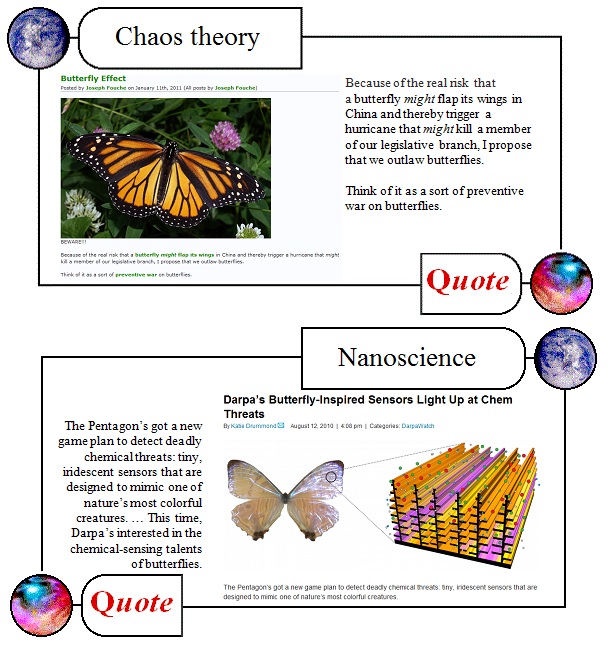
Ah yes, the entomology of war

Tuesday, January 11th, 2011

[ by Charles Cameron — in playful response to M. Fouche’s recent post on ChicagoBoyz, Butterfly Effect ]

Links: Chaos theoryNanoscience


Switch to our mobile site