zenpundit.com » society

Archive for the ‘society’ Category

Mini-Reviews: Liddell-Hart and Keeley

Saturday, June 25th, 2011


The German Generals Talk by BH Liddell-Hart

War Before Civilization by Lawrence Keeley

The German Generals Talk

A must-read book for those interested in strategy, the history of the Third Reich or the military history of WWII. That said, The German Generals Talk as a text must be treated very cautiously due to the author’s lack of objectivity, the disadvantage of his interview subjects at the time of their captivity and Liddell-Hart’s well documented efforts to use his interview subjects for self-promotional purposes.  Nevertheless, the commentaries by major Wehrmacht generals and field marshals, especially Gerd von Rundstedt, Wilhelm Ritter von Thoma, Hasso von Maneuffel, Günther Blumentritt and Heinz Guderian, are informative and at times, provocative. Liddell-Hart’s critiques of German military campaigns are often insightful, usually colorful, frequently sycophantic, but usually to the point – though they often used as a foil for advancing Liddell-Hart’s strategic ideas.

War Before Civilization

Two of the smarter, myth-debunking books I have read in the past year or so have been older, still in print, works by academic archaeologists. Much like Joseph Tainter’s The Collapse of Complex Societies, Lawrence Keeley overturns dogmatic archetypes about “primitive” warfare in prehistoric and pre-contact societies held by social scientists and military historians in War Before Civilization. Not only was prehistoric warfare more violent, more “total” and less restrained than modern warfare but Keeley argues that primitive “warriors” tended to best disciplined “soldiers” in wars when all other things were equal, except when the “soldiers” enlisted their own savage proxies (or adopted morally unconstrained  primitive tactics). It was a sliding scale; the barbaric Vikings terrorized “civilized” European and English men-at-arms, but were in turn themselves routed and expelled by the more savage Native Americans and Inuit warriors of North America.

Few at SWJ on “Less is Often More?”

Wednesday, June 22nd, 2011

Major Michael Few had a short theoretical post that sparked an important discussion at SWJ Blog and other social networking sites. He’s wrestling with the military-tactical effects of diminishing returns. Well worth your time to read through:

Less is Often More?

This is a post that I never would have written while practicing the art in Iraq. On the ground level, every commander wants more forces. In fact, one of the unstated prerequisites for command is that you must conduct at least one daily bitching session where you emphatically describe how much more effective you could be if you were given another platoon, company, battalion, etc…

– More forces equal more villages and more neighborhoods you can clear and occupy.
– More forces equal more visible power and control.
– More resources equal more money to bribe your enemies.

But, sometimes more is actually less:

– More forces mean that you can act unilaterally and just ignore the impotent host nation security forces.
– More forces mean that you can coerce and bully the corrupt political leaders.
– More resources mean that you may waste money building elaborate schools and medical clinics and digging canals rather than repairing the existing suitable structures.

Sometimes with more, we merely attack the symptoms creating short-term visible gains rather than attacking the root problems. Doctrinally, we would call this creating maneuver space on the human and physical terrain.

Read the rest here.

Follow-Up on the “Astrategic” Discussion

Wednesday, June 22nd, 2011

The real value was in the comment thread. Original post here.

That caused Joseph Fouche to post Overgrown Comment, Short Post from which I will excerpt relevant comments from JF, Dave Schuler and Seydlitz89:

Dave Schuler comments:

I think that the Obama Administration’s actions are less an instance of only an indirect relationship between means and ends than a disagreement with you on ends, Mark. Just as one example, the primary objective of the Obama Administration (as in all administrations) is a second term. Consider the actions through that lens.

Also, isn’t it possible that the Administration is really sincere about the “international support” trope that marked the Libyan intervention? International support will never be forthcoming for intervention against the Syrian regime. I don’t think that either the Russians or Chinese would stand for it. The Russian relationship with Syria at least is much cozier than that between Russia and Libya.

Noted Clausewitzian seydlitz89 comments:

Zen-

Good thought-provoking post, you actually got me out of my hiatus from blogs/blogging, just don’t tell anyone over at milpub ;-)>

While I agree with Joseph’s comment, I would add a few other points to consider:

First, “strategy”, is a specific concept in terms of strategic theory which can be linked to “strategic effect”, but not necessarily so.  Force and personality alone (which are not “strategy” the way I define it -see http://milpubblog.blogspot.com/2010/11/when-strategy-is-not-strategy.html) can achieve strategic effect.  So we need to be clear how we  are using this particular adjective, which need not be linked to a specific strategy at all.  Also the strategy in question might be bad, even self-defeating, as Joseph points out and still be a strategy.

Second, when has our Middle Eastern policy ever been consistent, in terms of treating all countries the same?  Perhaps under Bush I during 1990-91, but we have always treated the different Arab countries differently in line with our different interests involved.  Bahrain gets a pass, whereas Libya gets NATO intervention, and Syria gets referred to the ICC .  .  . In each case the US interest is seen as different so the response is different.

Third, the real root cause of the problem is imo our dysfunctional political system which is unable to implement policies which are in the best interests of the country as a political community.  The Iraq war was essentially a collapse of US strategic thought and rather was based on narrow and corrupt interests, deceptive politics and notions of unlimited US power (force) and exceptionalism (personality)  which triggered a still ongoing strategic disaster for US interests in the region, but not limited to it.

We have a long way to go and I don’t see us getting there any time soon, unfortunately.

The Committee comments posts:

Scottish historian Niall Ferguson, just before transmogrifying into Scottish celebrity historian Niall Ferguson, proposed an approach that serious credentialed historians could use if venturing to write the generally silly and uncredentialed genre of counter-factual history:

To produce serious counter-factual history that is not utter bollocks, your point of departure from our factual timeline has to be a documented and real credible alternative raised by a documented and real credible person at a documented and real point in time prior to the moment when factual and the proposed counterfactual timelines diverge.

As Dave Schuler alludes, how Zen, I, or seydlitz interpret what is strategic, what is astrategic, and what is antistrategic is often determined by what we individually interpret as political, apolitical, or antipolitical. We put events in boxes and eventually there is a box beyond which we do not stray because we don’t know this outer box is there. We can perhaps use Ferguson’s approach to separate which of the Administration’s factual alignment of ends to means are impossible and which are merely improbable and which of our various counterfactual alternative alignments of ends to means are impossible or merely improbable.

….I’ll close my observations on this post and its comment thread with two points:

  • Whatever framework you use to analyze human actions, especially those actions your framework categorizes as war or conflict, it should be equally capable of shedding light (and defining) “good” or “successful” actions and “bad” or “failed” actions. Categorizing one lump of actions as Actions while excluding another lump of actions as less than actions does not a good framework make. For those frameworks that aspire to pass as “strategic theory”, this means that they should be just as capable of analyzing Hitler’s strategy of dividing Germany into bloodied, burned out, and thoroughly wrecked fragments occupied by foreigners as they are of analyzing Bismarck’s strategy of creating a unified and independent Germany. A proposed strategic analytic framework that accepts some strategic phenomena into the garden of strategy while consigning others to the outer darkness of non-strategy does serve a useful purpose. Strategic effect rains on both righteous and wicked alike. Neither can be barred from opening an umbrella to shield themselves from strategic fallout because an observer runs up and commands them to stop because theory forbids it. One of the fundamental principles of strategic theory is that theory cannot absolutely forbid umbrella opening: the umbrella opener will inevitably seek to subvert any theory that seeks to unnaturally restrict their freedom to open umbrellas.

That was very interesting and thought provoking. I have, in fact, thought about these comments for several days and I do not have a neat, plausible rejoinder so much as some thoughts in regard to epistemology, which is the level where this discussion really is taking place.

Dave, I think, is correct that are a jumble of motivations in play within the Obama administration, not least of which is the overriding focus of domestic politics in an administration where the national security and foreign policy apparat is heavy with politicos. There is an internationalist faction in the administration too, though they are hardly dominant. They win some and lose some.  Incidentally, most administrations, from transcripts and memoirs I have read operate in a state of crisis management much of the time – tightly focused sessions like ExComm during the Cuban Missile Crisis are exceptions. Oval Office convos and meetings as a rule, ramble like meetings do everywhere except when the POTUS (like Eisenhower) demands otherwise.

So, is it proper to categorize this behavior as something other than strategy? Yes – at least when you want to discern conscious strategic thinking about geopolitics and military operations, or absence thereof, you’d refer to what the administration is doing currently as “politics” insofar as their eye seemed to be primarily concerned with domestic political effects rather than strategic effects in the international arena. Strategy requires conscious effort because it is pro-active and often, what passes for strategy is brilliantly intuitive tactical reactions coupled with a fair piece of luck that generated fortunate outcomes that were strategic in their effect, if not intent.

I am pretty much in agreement with Seydlitz89 that the root of our inability to think and act in a strategic fashion is our dysfunction as a political community and his caution regarding strategic effects. There’s a number of reasons for this dysfunction but even if that was instantly remedied by the Good Civics Fairy, we would have to make a conscious effort to build a rational strategic culture.

Regarding Joseph Fouche’s comment on frameworks, he has a logical point regarding strategic theory that works….in theory. By that I mean that I don’t disagree, he’s right in the abstract sense that such a comprehensive and consistent structure would be preferable. My impression though – and I think this is in line with what he is arguing above – is that strategic theory as a field itself may not be quite up to the high standard to which Fouche aspires.  Strategic theory in practice, rarely demonstrates the concise  elegance of Newtonian physics. In terms of explanatory power, strategic theory used by practitioners or created by modern day theorists rarely rises beyond being situationally “good enough” for the problem at hand. An intellectual tool, like a sharp rock or a pointy stick in the fist of a paleolithic hunter-gatherer. For that matter, if strategic theory proves to be situationally accurate and useful, that is often a cause for celebration!

Going beyond “good enough” to “universally” or “generally” applicable strategic theory is an intellectual feat of the first order. That kind of system -building is usually the result of a life’s work and cannot be called into being on a moment’s notice. Aside from the fact that most people are not capable of rising to becoming a Clausewitz or Sun Tzu, the time constraints make it impossible for state decision makers to think and act within such a framework unless they have arrived into office with one already inculcated as part of their worldview (and even then, it is of great help if they spent years out of office thinking through real and hypothetical problems using that framework, internalizing the principles without losing the ability to observe and think critically).  This is why in matters of strategy, our decision makers are usually wielding the intellectual equivalent of stone tools – the statesman with the cognitive flintlock musket or strategic steam engine is few and far between.

So, we are often left with a fractured mess, analytically speaking. Entrails to root through, looking for signs from the gods.

In Search of Civilization, a review

Saturday, June 18th, 2011

 [by J. Scott Shipman]
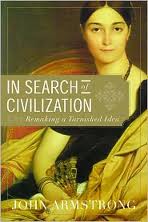
civilization.jpg

In Search of Civilization, by John Armstrong 

In Search of Civilization is a refreshing and erudite examination of civilization, how it developed in the past, negative present day connotations, and why it remains importance and relevant today. What follows is a detailed overview of Part One, and with any luck, the teaser will be enough to convince you to read this important book. For me, this is a truncated review. Normally, I would provide a 1200-1500 hundred word overview, but like Zen, I’ve been busy and wanted to share what I had with you. This books makes a nice foil for John Gray’s Black Mass, which I read recently but probably will not review.

Also, some books have wonderful finds in the bibliography. Back in the early 80’s I chased footnotes for about two years—and have no memory of what the original book was, but I went from one reference to another. Going forward, I’ll provide the titles from the bibliography that piqued my interest, which may also provide the you a little more insight on the works that influenced the author. Please let me know if this is or is not useful to you.

Part One Civilization as Belonging

Armstrong’s quest to define civilization began as he was reading a bedtime story to his son, and he advances that “with the possible exception of God, civilization is the grandest, most ambitious idea that humanity has devised.” From that introduction, Armstrong makes a compelling case for civilization.  He notes that it is difficult to get one’s mind around the concept since “civilization” touches everything. As a result, he offers that our ideas about “civilization tend to be rather messy and muddled.”

Armstrong goes on to frame civilization as “a way of living,” a level of political and economic development, “the sophisticated pursuit of pleasure,” and finally, “a high level of intellectual and artistic excellence.” Separately each of these, what I’ll call working definitions, made sense. But Armstrong rightly attempts to define, frame, contextualize civilization, not from historical perspective, but rather the philosophical in a way that is relevant to our times.

The actual word “civilization” is, according to Armstrong, not “fashionable” in our globalized world, particularly among those one would expect to be the “defenders.” He offers that civilization carries a “moral implication” whereby one society is somehow better than another, “fully human” or “superior.” And nations often advance the idea that they are better, more civilized, etc. Those defenders (in the arts and humanities) mentioned above have become “wary and negative” with respect to civilization. I’ll call this standard-less ambivalence based primarily on fear. Fear of “what,” you may ask. Fear of offending. Harvey Mansfield in City Journal made an excellent point with respect to political correctness:

“When there is no basis for what we agree to, it becomes mandatory that we agree. The very fragility of change as a principle makes us hold on to it with insistence and tenacity. Having nothing to conform to, we conform to conformism—hence political correctness. Political correctness makes a moral principle of opposing, and excluding, those of us who believe in principles that don’t change.”

Principles are a big part of civilization.A brief review of Samuel P. Huntington’s classic The Clash of Civilizations follows. Armstrong reminds of Huntington’s words: “In coping with an identity crisis, what counts for people are blood and belief, faith and family.” Armstrong recounts Huntington’s view of civilization a sense of “loyalty” and “shared identity.” Armstrong calls this an “organic conception of civilization;” witness the identity politics of the in the aftermath of 9/11 where it seemed the US, for once, stood as one. The phenomena can be found around the world, regardless race, religion, or ethnicity.  If there is a community of people, chances are there will be shared identities, but is this “sharing” civilization?

One of the strongest parts of the book is the emphasis he places on the “quality of relationships.” With the aforementioned “sharing” and “loyalty” Armstrong rightly asks about the quality of individual relationships and the impact on civilization. He compares the loyalty of religious believers to their faith to their loyalty to their civilization. Armstrong believes, and I agree, we share much more in common than one might, on first glance imagine. He says, “The rich achievements of any civilization are not in violent conflict, and in fact are on the same side in a clash between cultivated intelligence and barbarism. The irony is that such barbarism too often goes under the name of loyalty to a civilization.” Armstrong believes that a “true civilization is constituted by high-quality relationships to ideas, objects, and people.” In high quality relationships there is love and Armstrong sees civilization as “the life-support system for high-quality relationships.” Civilization sustains love; I like the implications.

The cultivation of high quality relationships tends to bring out the best in people.  He goes on to discuss the paradox of freedom—as we in the West live in cultural democracies. He asserts that vulgarity is “triumphant” because of our democratic ideals; the majority rules. Freedom comes with great responsibilities, greater responsibilities than living in a coercive state. At the level of the individual we make choices, satisfy appetites. “The civilizing mission is to make what is genuinely good more readily available and to awaken an appetite for it.”

Part Two Civilization as Material Progress, Part Three: Civilization as the Art of Living, Part Four: Civilization as Spiritual Prosperity 

References you may find of interest:

F.R. Leavis, The Great Tradition

C.P. Snow, a lecture “The Two Cultures and the Scientific Revolution

Matthew Arnold, Culture and Anarchy  A free online copy here.

 Kenneth Clark’s BBC television series Civilization

Bernard Berenson, The Florentine Painters of the Renaissance (1896)

T.S. Elliot, an essay called “Tradition and the Individual Talent

Genghis John

Friday, May 27th, 2011

Not John Boyd this time, but John Robb.

John recently gave me a preview of this idea in a much more specific context:

….Here are some of the economic reforms that turned the horde of Genghis Khan into a steamroller than flattened most of the world’s kingdoms/empires.*  He:

  1. Delayed gratification.  He banned the sacking of the enemy’s camp/city until all of the fleeing soldiers, baggage, etc. were rounded up.  This radically increased the loot accumulated and ensured it could be shared among all of the participants (he confliscated the wealth of those men that cheated by looting early).
  2. Systematically shared the loot based on contribution and merit.  He disregarded title or status and systematically rewarded loot to everyone in the horde that earned it (the traditional approach was to let a few take it all — sound familiar?).  Of course, that fairness pissed off the nobility since they were used to backroom dealing and hereditary rights.  However, the benefits of this system, were far greater than the costs.  To wit:  He cemented the loyalty of the men and was able to attract thousands to his banner for every noble lost.
  3. Protected those that make sacrifices.  For men killed in the campaign, he paid their share of loot to their widows/orphans posthumously.  

*of course, the first unsaid lesson is:  attack the places with the most loot.


Switch to our mobile site

