zenpundit.com » symmetry

Archive for the ‘symmetry’ Category

Introducing SPECS: All dressed up

Thursday, November 17th, 2011

[ by Charles Cameron — analytic and esthetic game boards, HipBone Games, bishops in procession, Darth Vader, police,  OWS, clowns ]

.

spec-format-sm.png

I’ve been frustrated for a while now by the size limitations of my DoubleQuotes format, with which regular ZP readers may well be familiar, and never more so than when trying to juxtapose images — which often have to be reduced to near invisibility to fit…

Today I had a pair of photos I wanted to juxtapose for you, and came up with a new format that allows me to do a better job with images: the Specs. That’s Brit for “the spectacles, you know, ie glasses, and thus by extension “binocular vision” — but it also references “spectacle” in the dramatic sense, and (again, by extension) “specification” in the sense of offering a minimal set of requirements for grasping the essence of a situation…

Here, then, is my first pair of spectacles:

spec-01-processional.png

The top image is from a Lutheran church function in Iceland [video and further details], the lower one is from the Occupy movement…  the hi-fashion specs in miniature in the middle are by Tom Ford

And it seems to me they’re all dressed up for their respective occasions…

Tea Party and / or Occupy?

Sunday, October 9th, 2011

[ by Charles Cameron — parallels, opppositions, analysis, games, coincidentia oppositorum ]

.

labelling-bodies1.jpg

My friend Cath Styles, who has been developing an iPad playable version of my HipBone Games under the name Sembl for the National Museum of Australia, made a point I’ve been trying to make for a while now, with sweet lucidity, in a recent blog post:

A general principle can be distilled from this. Perhaps: In the very moment we identify a similarity between two objects, we recognise their difference. In other words, the process of drawing two things together creates an equal opposite force that draws attention to their natural distance. So the act of seeking resemblance – consistency, or patterns – simultaneously renders visible the inconsistencies, the structures and textures of our social world. And the greater the conceptual distance between the two likened objects, the more interesting the likening – and the greater the understanding to be found.

That’s absolutely right, and it gets to the heart of my games and analytic practice — to see and acknowledge both parallelisms and differences, oppositions…

Oxford is the polar opposite of Cambridge as anyone at the annual boat race between them will tell you — yet they’re so similar that the term Oxbridge exists to distinguish them as a dyad from all else the wide world round…

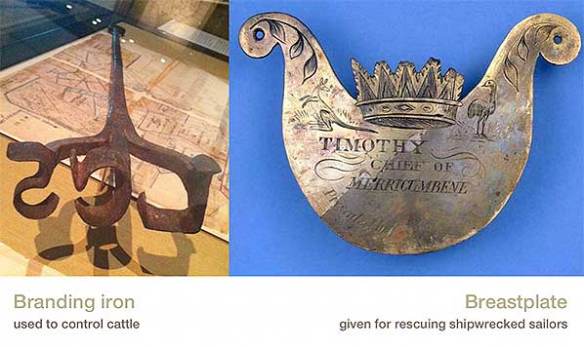
Similarly, in the example illustrated above, Cath shows two items from the Museum collection that were juxtaposed by players of an early version of her game, and writes:

the Sembl players who linked the above branding iron to the breastplate – because both are tools for labeling bodies – cast new light on the colonial practice of giving metal breastplates to Aboriginal people.

* *

Since the essence of my own analytic style (and that of HipBone and Sembl games) is the recognition of parallelisms and oppositions, I was particularly interested to see one group of early Tea Party folk reaching out to the emerging Occupy movement. Here, then, are two posts in which we can see the beginnings of recognition that there may be a kinship between the two…

Occupy Wall Street: Another View:

You know what the “Occupy Wall Street” movement is?
.
It is all the things that were in the original Tea Party, but were steadily ignored as the TP became a Republican booster club.

That comes from a post on FedUpUSA, a site with the Gadsden flag as its web-logo that was [as “Market
Ticker”], one of the founding orgs behind the TP. It’s from someone who identified as a Libertarian Party activist.

Here’s another post from FedUpUSA, not so identified:

An Open Letter From FedUpUSA To Occupy Wall Street Protestors All Over The Country:

This is a letter to OWS from FedUpUSA, one of the original Tea Parties:
.
We support you in exercising your First Amendment Right. We are outraged that any peaceful demonstrator would be assaulted or abused by any authorities.
.
If you are protesting because there are no jobs— We stand with you.
.
We are for a free economy and recognize that what we have now is NOT a free economy; it is not capitalism what we have is a fascist state or crony-capitalism. There is nothing free about doing business with Countries that manipulate their currencies to attract cheap labor. We agree that these jobs need to come back to America.
.
If you are protesting because no one has gone to jail— We stand with you.
.
Regardless of what is being said from the white house and media, we know that there are many in the financial district and the banks that have committed fraud and outright theft and we too want to see them prosecuted. We support the stop looting and start prosecuting.
.
If you are protesting because everything costs more— We stand with you.
.
We see prices rise in our food, gas, clothes yet our wages have stayed the same or have decreased. The Federal Reserve has bailed everyone out but us and not only are we going to have to pay for that, those bailouts make the price of everything else go up because it devalues our currency. We support monetary reform.
.
If you are protesting because you are tired of our bought and paid for government on both sides— We stand with you.
.
We are also against the banks and big corporations buying our politicians and writing laws that favor their special interests. We understand that our economy is broken BECAUSE of this and that all of our other issues will never be addressed as long as the financial elite control OUR government.
.
We understand that these issues cross party lines and ideologies and effect each and every one of us. We also understand that these issues will never get fixed as long as we continue to let the media, the elite, and members of the government separate us by our differing ideologies.
.
Only Together, can we Implement Change
.
It is time, We Americans, put our ideologies in our back pocket and not let them separate us so that we can work together for this ONE COMMON GOAL: to get the special interest money and elite out of OUR Government and return it to US — the people.
.
As long as the banks, largest corporations, and wealthy elite control our government, we will never have a representative republic and laws will continue to be passed that only benefit the few 1% at the expense of us 99
.
Demand that NOT ONE MORE LAW gets passed until they pass:
.
Lobby reform:
.
It is a Federal Offense punishable by a minimum 5 years in prison to:

.
Lobby any member of the US Congress outside of the district you live, work, or own a business.
Lobby a member of congress while they are physically outside the district they represent.
.
Campaign Reform:
.
It is a Federal Offense punishable by a minimum 5 years in prison to:
.
For any one person, corporation, enterprise, group, union or the like, to donate more than $2,000 to any one candidate during one campaign period.
For any member of the media to deny equal access to competing candidates.
.
These two laws will cut the control the Financial elite have on our government by leveling the playing field. You will have just as big as a voice with your representative as the big box retailer that resides in your town. Simply, it will end the Crony-Capitalism that is strangling our economy.
.
I encourage all my fellow Tea Partiers to join Occupy Wall Street protesters in their non-violent, peaceful protests and together demand that the Government be returned to the people. After all, this is precisely what the Tea Party was intended to be before it was taken over and marginalized by the establishment politicians.

.
FedUpUSA.org

* *

And we’re deep into John Robb territory…

What do you think? Do the parallelisms strike you, or the oppositions — or, perhaps, both?

FWIW, Cath’s Sembl version of my game looks like it is going to be a beautiful steampunk affair…

The Lion of Judah, Jesus and Jihad

Tuesday, September 27th, 2011

[ by Charles Cameron – a meander from Narnia via Roke and the stars to Jihad –  too religious, perhaps, or too literary — a lightweight post of no significance ]

.
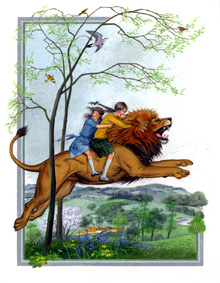
lww-1991-03-small.jpg
illustration credit: Pauline Baynes
.

In my previous post, I quoted the prophet and apostle Bill Harmon:

We are about to move from the dispensation of grace to the dispensation of dominion. We are about to see Jesus, not as the suffering lamb that was slain, but the roaring Lion who is King!

Dominion is a keyword that’s getting a lot of attention right now – it has significantly different meanings for different strands in the theological mix — but as usual I’m at least as interested in the symbols and imagery people use as I am in their doctrinal expressions.

This post, then, will explore the imagery of the Lion.

1.

Having recently written that post with the Harmon quote from 1999, I was struck to read the following account on the Elijah list just yesterday :

I had a profound encounter recently before going to bed. I think it is just like God to get you right before you fall asleep. I had to get out of bed to make a record of this! I felt it important to share with you. We see Jesus in many different expressions in the Scriptures. He is the Good Shepherd, the Lamb of God, the Lord of Hosts, the Angel of the Lord and many other looks. But one night recently He came to me as the Lion who is ready to roar. As you read, ask the Lord to reveal this aspect of His nature in your life.

I had a vision where I found myself on the back of this giant Lion with a huge mane. Then I realized it was the Lord. As the Lion turned His head, I could see His mouth open as if He was getting ready to roar. It is time to ride on the Lion of Judah. It is as if He has been waiting for this season. There is something fresh and new in the air. The breath of His mouth will destroy the enemy.

In this vision I was also running my fingers through the mane of the Lion. This represents the intimacy with God that is the foundation for our authority. Our intimacy is for a purpose – it is to establish the Kingdom of God for the King. The Lion is symbolic in that it is the “King of the Jungle”. The world is that jungle. Jesus is coming as the Lion to rule in the jungle bringing His power to set people free.

The Lord carries us into that jungle with His authority. When we are riding on the Lion we can be assured that we will succeed in all He calls us to do. He is massive, larger than life. He is ready to conquer and demonstrate His power.

In my encounter, I was suddenly on this Lion and He was of full age and postured for action. This will be a time where God will do things suddenly. It will take us by surprise. The sons of the Kingdom will advance the Kingdom for His purposes and with His power.

John Belt, Live In His Presence Ministries

2.

To be honest, it strikes me that that’s straight out of CS Lewis and his wonderful books for children – but without Lewis’ grace as a writer. Compare:

That ride was perhaps the most wonderful thing that happened to them in Narnia. Have you ever had a gallop on a horse? Think of that; and then take away the jingle of the bits and imagine instead the almost noiseless padding of the great paws. Then imagine instead of the black or gray or chestnut back of the horse the soft roughness of golden fur, and the mane flying back in the wind. And then imagine you are going about twice as fast as the fastest racehorse. But this is a mount that doesn’t need to be guided and never grows tired. He rushes on and on, never missing his footing, never hesitating, threading his way with perfect skill between tree trunks, jumping over bush and briar and the smaller streams, wading the larger, swimming the largest of all. And you are riding not on a road nor in a park nor even on the downs, but right across Narnia, in spring, down solemn avenues of beech and across sunny glades of oak, through wild orchards of snow-white cherry trees, past roaring waterfalls and mossy rocks and echoing caverns, up windy slopes alight with gorse bushes, and across the shoulders of heathery mountains and along giddy ridges and down, down, down again into wild valleys and out into acres of blue flowers.

— CS Lewis, The Lion, the Witch and the Wardrobe (illustration above by Pauline Baynes)

That captures the “riding the Lion” idea a great deal more powerfully, and it’s imaginative fiction.

3.

The other idea present in Belt’s narrative is the Lion’s roar. Again, it seems to me that what Belt offers us is a less gracious version of Lewis, who wrote:

The Lion opened his mouth, but no sound came from it; he was breathing out, a long, warm breath; it seemed to sway all the beasts as the wind sways a line of trees. Far overhead from beyond the veil of blue sky which hid them the stars sang again; a pure, cold, difficult music. Then there came a swift flash like fire (but it burnt nobody] either from the sky or from the Lion itself, and every drop of blood tingled in the children’s bodies, and the deepest, wildest voice they had ever heard was saying: “Narnia, Narnia, Narnia. Awake. Love. Think. Speak. Be walking trees. Be talking beasts. Be divine.”

It was of course the Lion’s voice.

— CS Lewis, The Magician’s Nephew

4.

Commenting on Lewis’ version of the Lion’s roar, Paul Ford writes:

This passage is remarkable for the intense breath image and the addition of the fire image (from the first conferral of the Holy Spirit in the New Testament on Pentecost; see the Acts of the Apostles 2:3-4).

— Paul F. Ford, Companion to Narnia

With in turn refers us to this passage:

And suddenly there came a sound from heaven as of a rushing mighty wind, and it filled all the house where they were sitting. And there appeared unto them cloven tongues like as of fire, and it sat upon each of them. And they were all filled with the Holy Ghost, and began to speak with other tongues, as the Spirit gave them utterance.

— Acts 2:3-4

5.

TS Eliot was notably moved by the same passage, and we can see how a poet deals with the same wind and fire in one of the final sections of “Little Gidding”:

The dove descending breaks the air
With flame of incandescent terror
Of which the tongues declare
The one discharge from sin and error.
The only hope, or else despair
Lies in the choice of pyre or pyre —
To be redeemed from fire by fire.

Who then devised the torment? Love.
Love is the unfamiliar Name
Behind the hands that wove
The intolerable shirt of flame
Which human power cannot remove.
We only live, only suspire
Consumed by either fire or fire.

— TS Eliot, “Little Gidding”, Four Quartets

6.

It’s the wind of inspiration that brings tongues of flame here, many tongues, many languages…

The wind bloweth where it listeth, and thou hearest the sound thereof, but canst not tell whence it cometh, and whither it goeth: so is every one that is born of the Spirit.

John 3:8

And the Greek is really quite wonderful here, as Phillip Comfort among others points out

In John 3:8, there is a metaphor which is purposefully polyvalent, in that Jesus was speaking of wind, spirit, and breath at the same time (inasmuch as pneuma can mean all three)

Philip Comfort, Encountering the manuscripts: an introduction to New Testament paleography, p 235

And circling back for a moment to CS Lewis — because there is really only one universe of discourse…

It must always be remembered … that the various senses we take out of an ancient word by analysis existed in it as a unity.

CS Lewis, The Allegory of Love, p 365

7.

I said earlier that CS Lewis’ writing seemed to me to have notably more grace than John Belt’s — and I think that grace has to do with the theological virtue of the same name too, that beauty is an indicator of Grace if you like.

Here’s another author, also writing for children, whose prose is a marvel of purity — describing the music of the stars of which Lewis also spoke — Ursula Le Guin:

It is no secret. All power is one in source and end, I think. Years and distances, stars and candles, water and wind and wizardry, the craft in a man’s hand and the wisdom in a tree’s root: they all arise together. My name, and yours, and the true name of the sun, or a spring of water, or an unborn child, all are syllables of the great word that is very slowly spoken by the shining of the stars. There is no other power. No other name.

Ursula Le Guin, Wizard of Earthsea

Ursula would, I think, describe herself as a Taoist: the traditions may differs, grace is still grace.

8.

Well, you might not think it would be easy to get from Narnia and CS Lewis to jihad in a single bound, but it has been done, and Jarret Brachman posted the proof a while back…

The jihadist propaganda lion:
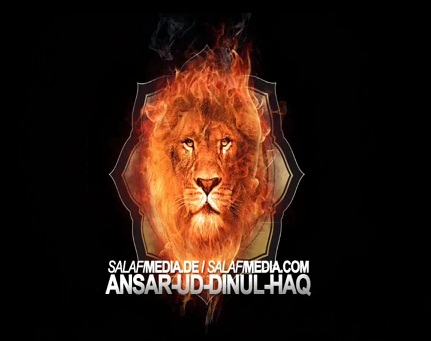
screenshot.jpg

was in fact swiped from the Narnia lion:
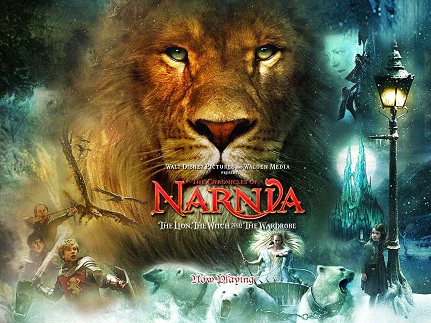
narnia.jpg

— as Brachman elegantly demonstrated:
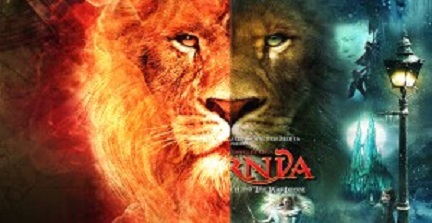
composite.jpg

all three images credit: Jarret Brachman, Cronus Global

9

Well, that’s funny — but not uplifting.

So I’ll leave you with another flight — that of the king of the birds this time in the words of Isaiah:

But they that wait upon the LORD shall renew their strength; they shall mount up with wings as eagles; they shall run, and not be weary; and they shall walk, and not faint.

Isaiah 40:31

Syed Saleem Shahzad: AQ, Khorasan and the Mahdi

Thursday, September 15th, 2011

[ by Charles Cameron — Mahdism and Khorasan, strategic implications re Afghanistan, Pakistan, India and the West ]

.

kunar.jpg

photo:  http://www.syedsaleemshahzad.com

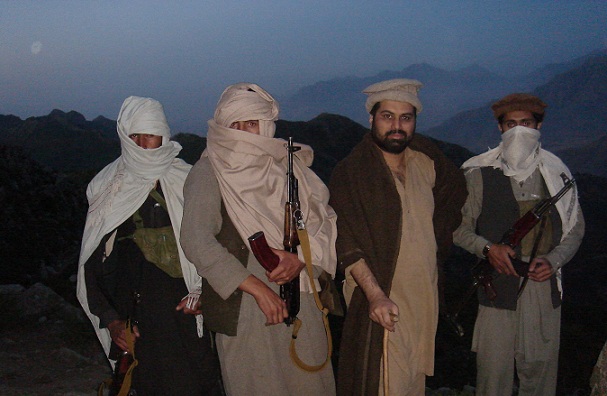
Syed Saleem Shahzad, the recently murdered Pakistani reporter (above) profiled by Dexter Filkins in The New Yorker a couple of days ago, recently published a book with Pluto Press titled Inside Al-Qaeda and the Taliban: Beyond bin Laden and 9/11.

Reading the New Yorker piece, I was struck by the explicitly Mahdist tenor of the book’s final paragraph, which Filkins quoted, and a quick glance at pages available on the Amazon site makes it clear that Shazad’s sense of AQ strategy (a) is strongly eschatological, (b) includes India in its scope, and (c) leads from greater Khorasan to Jerusalem.

Since I’ve been harping on (a) and (c) for some while now, and (b) “fits” well enough with a few other loose ends, analytically speaking, I’ll be very interested to read (and hopefully review) the whole thing. For now, I’d just like to draw your attention to the opening and closing paragraphs of the book…

Shahzad begins his Prologue (p. xiii) with these words :

The 9/11 attacks in 2001 aimed to provoke a war in South Asia. The 26/11 Mumbai assaults in 2008 warned that Al-Qaeda was expanding its war to the east, from Central Asian republics to India and Bangladesh, and that many more such actions would follow. In the ideological perspective of Al-Qaeda, this was to be a preparation for the “End of Time” battles which were referred to by the Prophet Muhammad (in what is now known as the Hadith). These pointed to parts of modern-day Iran, Afghanistan, Pakistan, and Central Asia as ancient Khurasan. Khurasan was to be the first battleground for the End of Time battles, before a decisive confrontation against the West, with the last battle being fought in the Middle East for the liberation of Palestine and all occupied Muslim lands.

In the meantime, Al-Qaeda aimed to trap the world’s most powerful states in the impossible terrain of Afghanistan. The aim was to lead them to exhaust their energies there, before the expansion of the theater of war against the West from Central Asia to Bangladesh…

His book closes (pp. 225-26) with these words:

However, the saga of Al-Qaeda’s One Thousand and One Nights tales continues with new strategies and new characters. For Al-Qaeda these are just measures to keep the West running from pillar to post until it exhausts itself and Al-Qaeda can announce victory in Afghanistan. Al-Qaeda next aims to occupy the promised land of ancient Khurasan, with its boundaries stretching all the way from Central Asia to Khyber Paktoonkhwa throiugh Afghanistan, and then expand the theater of war to India.

The promised messiah, the Mahdi, will then rise in the Middle East and Al Qaeda will mobilize its forces from Ancient Khurasan for the liberation of Palestine, where a final victory will guarantee the revival of a Global Muslim Caliphate.

Shahzad was not always the most reliable of reporters by all accounts – but certainly one of the most intrepid, and one with unparalleled contacts among the major players. The fact that he pitches his book along so clear a Mahdist through-line should give us all pause.

Formats for civil online debate II — inspired by Hesse’s Bead Game

Tuesday, August 16th, 2011

[ by Charles Cameron — hypertext, rhetoric, glass bead games, civility ]

.

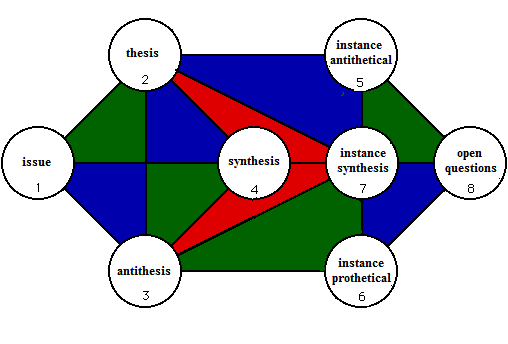
My second attempt at a format for online debate is, as I said, a variant on the “Dart Board” sometimes used for playing my HipBone Games (see, for instance, my solo game War is Sexy, says Dawn).

*

The idea here would be to format a blog post and series of 7 comments by a Querent (the one with the Question) who may also be the Umpire — both roles would be issue-neutral — a Proponent who would propose and support a thesis, and an Antagonist who would oppose it.And I should add, right at the outset, that this is a formal process for the named participants — as a white tie debate at the Oxford Union is a formal process — no matter how raucus the kibitzers may get, and accordingly requires a day or two between moves to allow for consideration, research and preparation.
dartbdwhitedebatesetup.png

The Querent makes the first move in the first position on the board, giving it short move title (short enough to be typed on the board graphic in the space currently occupied by the word “issue‘) and a paragraph or so of move content setting forth concisely the issue to be discussed — ideally via an issue neutral anecdote or quote. After each move, the Querent (or a graphically inclined observer) would ideally update and post the game board after inserting the relevant move title.

[ Those who are not among the named participants may of course kibitz at any time… ]

The Proponent next carefully chooses a pithy quote or anecdote, gives it a move title (as above), and posts the move title, the chosen move content (the anecdote or quote selected), the link claimed (setting forth concisely the nature of his or her argument as it relates to the move content of the Querent‘s issue), and if she or he so chooses, a comment (the comments in a HipBone Game are intended for meta-conversations among the various players).

The Antagonist then similarly chooses an anecdote or quote, and posts move title, move content, links claimed — in this case, showing the links with both the issue as stated at position 1 in the Querent’s move, and the thesis as stated in position 2 in the Proponent’s move — and a comment if so desired.

Okay, that’s thesis and antithesis, the Umpire then posts a move title, some move content and links claimed to all three positions in play, with a comment if so desired, in the fourth position (labeled synthesis).

The rule is that whenever playing in a position which links via a board line to one or more previous moves, the links claimed must include explanations of how the move relates to those previous moves.

The Antagonist plays next in position 5 — playing move title, move content, links claimed, comment — providing an instance with which to dispute the thesis, and linking as per the rule just stated to the thesis proposed at position 2 — only!

Since position 5 is only connected to position 2 of those positions in play, no other links should be claimed.

Similarly, the protagonist then plays in position 6, a move which I’ve called the “prothetical” instance without a clue as to whether prothetical is a real word — tho’ I like it — linking only to the antithesis in position 2, which it seeks to refute.

Move 7 is by far the trickiest of the game, and is made by the Umpire, who now has to provide move content that synthesizes the game thus far, explaining links claimed to positions 2, 3, 4, 5 and 6 (ie to the original thesis, antithesis and synthesis, but moving the synthesis to encompass also the two instances)…

But the Umpire can take consolation in the fact that in the final move 8, the Querent gets to raise afresh those questions which remain — now that both sides have had their say, and the Umpire has attempted reconcile them.

*

Three quotes, the first one on debate:

Harmony among conflicting viewpoints, not the victory of one of them, should be the ultimate goal…

— from Bizell & Herzberg, The Rhetorical Tradition, as quoted here

The second moving from debate to dialog:

One way of helping to free these serious blocks in communication would be to carry out discussions in a spirit of free dialogue. Key features of such a dialogue is for each person to be able to hold several points of view, in a sort of active suspension, while treating the ideas of others with something of the care and attention that are given to his or her own. Each participant is not called on to accept or reject particular points of view; rather he or she should attempt to come to understanding of what they mean.

David Bohm, Science Order and Creativity, p 86

And the third, from Buddhist Madhyamika philosophy, moving into the contemplative realm where all answers are seen as the stepping off points for open questions:

I wanted to use one word in Tibetan that I’ve found very useful for myself… and this is the word zöpa.. this translates usually as patience or endurance or tolerance, but there’s this very subtle translation of zöpa, which is the ability to tolerate emptiness basically, which is another ways of saying the ability to tolerate that things don’t exist in one way, that things are so full and infinite and leave you so speechless, and so undefinably grand – and these are just descriptive words, but you have to use some words to communicate, I guess — the ability bear that, that fullness, like we’ve been talking about, not turning away, not turning away.

Elizabeth Mattis-Namgyel, in (if I recall) a Shambhala-sponsored retreat video

*

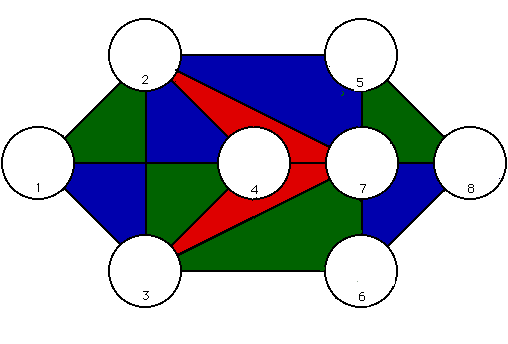
A blank Dart board, downloadable for your convenience:

dartbdwhitedebateblank.png


Switch to our mobile site