zenpundit.com » art

Archive for the ‘art’ Category

Two beauties, or how the mind meanders

Sunday, June 16th, 2013

[ by Charles Cameron — on the proposition that no topic is more than a link or two away from beauty ]
.

I was butting in on a conversation about terrorism between JM Berger and Suzanne Schroeder — JM had said something about me and I chipped in, one link or tweet led to another, and soon we were at these two images —

The top one is a Magritte-like photo that comes from the mind and eye of Alexandre Parrot, hat tip to El Cid Barett — the second a still from Maya Deren‘s extraordinary film, Meshes of the Afternoon.

**

One beauty for the startled mind; one beauty for the ravished heart…

Apocalyptic Fire in Azan #2

Wednesday, June 5th, 2013

[ by Charles Cameron — on end-times rhetoric and having no need of sun or moon ]
.

Detail from a Commentary on the Apocalypse by Beatus of Liebana

**

On the whole, the “signs of the end times” described in the installment of Maulana Asim Umar‘s Third World War and Dajjal, pp. 23-31, and now posted in the second issue of Azan on pp 83-89 are standard fare of the “wars and rumors of wars” type that could fit pretty much any time n history, including our own — “When the most despicable person of a nation would be its leader” would fit an astounding number of rulers across recorded history, depending on your point of view, including Nero and Diocletian, George III and Abe Lincoln, and a slew of Saddams, Mubaraks and Assads

There was one section, however, that struck me as a powerful piece of visionary apocalyptic, and I wanted to bring it to the attention of those interested in such things.

The Maulana writes [I’ve omitted the Arabic honorifics since I lack Arabic, and corrected one typo in Enlish]:

“Hazrat Abu Hurayrah narrates that the Prophet of Allah said that the Day of Judgment would not occur before a fire erupts from Hijaz and lights up the necks of the camels of Basra.” [Bukhari, Muslim]

The incident mentioned in this Hadith has already occurred according to Hafiz Ibn Kathir (RA) and other historians. This fire appeared in 650 H on the Day of Jumu’ah in some valleys of Madinah Munawwarah and remained for about a month. The narrators have said that the fire suddenly erupted from the direction of Hijaz. The scene looked like a whole city of fire – containing a whole castle, tower or battlement etc. Its height was 4 “farsakh” (around 12 miles) and its width was 4 miles. The fire would melt any mountain it reached as if the mountain was made out of wax or glass. Its flames had the sound of thunder and the energy of river waves. Blue and red-colored rivers looked to be coming out of the fire. In such a (horrible) state, the fire reached Madinah Munawwarah. But the curious thing was that the wind that was emanating from the direction of the flames felt cool in Madinah. The scholars have written that the fire had encompassed all the jungles of Madinah such that in the Haram-e-Nabwi and in Madinah, all the houses were lit up as if from the sun. The people would do all their work in the night from the light (of the fire); in fact, the light of the sun and the moon would became faded because of the light of the fire.

Some people of Makkah (at the time of the fire) bore witness that they saw the fire while they were in Yamama and Basra.

A strange quality of the fire was that it used to burn the stones to coal but it would not have any effect on the trees. It is said that there was a large stone in a jungle – half of it was in the limits of Haram-e-Madina and half of it was outside the limits. The fire burnt to coal the half of the stone that was outside the limits of the Haram-e-Madina. However, it cooled when it reached to the other half and hence, this half remained safe.

The people of Basrah bore witness that they saw the necks of camels light up from the light of the fire…

[The Beginning and the End: Ibn Kathir (RA)]

**

You know my interest in semblances and parallelisms. Compare:

in fact, the light of the sun and the moon would became faded because of the light of the fire

in that narrative with:

the city had no need of the sun, neither of the moon to shine in it, for the glory of God did lighten it

in Revelation 21:23.

I am not arguing that there is an echo between the two accounts, nor that they describe the same phenomenon — simply that the rhetoric of each has a similar poetic intensity. This just happens to be one of those occasions when there are more things in heaven than are dreamed of in your natural sciences.

Form is insight: the vesica piscis

Sunday, June 2nd, 2013

[ by Charles Cameron — here’s another post in my importance of form in intelligence series ]
.

Form is pattern, and pattern recognition is insight.

A while back, I started a series of posts [1, 2, 3, 4 and 5] in which I suggested that form is, from an intelligence point of view (and however you may parse “intelligence”) as important to humans as content. I’ll be saying more about this today, but wanted to complete this old and never quite completed post in that series right away, in response to a comment Grurray made today regarding Venn diagrams and the vesica piscis.
.


.

**

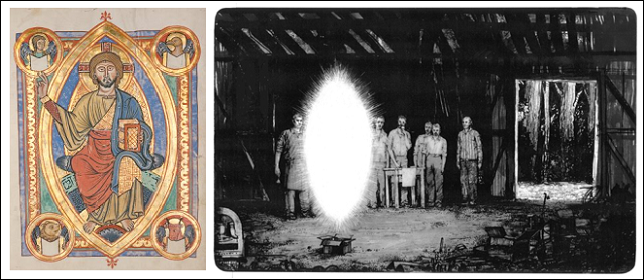
If you’ve seen a Venn diagram, you’ve seen overlap. And the simplest form of overlap — between two classes, ideas, or whatever — is the one that’s Venn diagrammed (below, left) as the overlapping of two equal circles — known to artists as the vesica piscis or eye of the fish.

MasterCard uses it for its logo (right) —

— as do Gucci and Chanel:


.

**

But let’s go back to that first pair of images:


.

Long before commerce took note of it, the vesica was a sacred image — back in the days when geometry, like nature herself, was sacred.

Like the illuminist of the Codex Bruchsal (ca 1220) with his Christ Pantocrator (above, left), Jan Valentine Saether makes sacred use of the vesica in his book The Viloshin Letters, which I hope to see published shortly — the exquisite suite of prints that accompany the text have already been exhibited to acclaim.

In his text accompanying this particular plate, he writes:

I was not sure. But a new wonder has been moving towards us. That which is… has a new presence. Entering here from elsewhere, the holy spirit manifested again in the vernacular last Wednesday, September 16th.

We were standing around, being together in our own fashion, when suddenly through our common imagination, right there on the floor in the old barn, the donna and the madonna, the loose one and the holy one, merged and became visible.

**

It seems to me there is more to the glory of God than there is to the glory of handbags and perfumes — but your mileage may vary, credit cards are handy little items, and then again, it’s all part of the glory in my opinion.

A neat koan, that.

Of images and likenesses

Thursday, May 30th, 2013

[ by Charles Cameron — a storm in a tea-kettle, various resemblances to Hitler, how Pudovkin perceived and practiced montage, what happened when the talkies came along, and four faces of Christ ]
.

It begins with something as innocent ad a tea kettle:

Does this otherwise innocuous tea kettle resemble Hitler? Does it look enough like Hitler to merit JC Penney withdrawing it from sale?

**

Let’s take a look at a couple of other “resemblances to Hitler”:

Who most resembles Hitler — Chaplin, or Stalin?

On the face of it, that’s an easy question. If I were to just ask you the question “who is most like Hitler” in words, you might very well say Stalin, or Pol Pot perhaps — or, I suppose, if you were very focused on World War II and the Axis leaders, Mussolini.

And if I asked you “who looks most like Hitler?” you might well say Charlie Chaplin — but you’d be “thinking visually” in terms of appearances, rather than “verbally” in terms of meanings.

So there are at least two different ways someone can resemble Hitler — in terms of appearance, and in terms of behavior.

**

We don’t notice our own noses most of the time, even though they’re within our field of vision — and it’s a bit like that with likeness. We don’t have a grammar of resemblance, and that’s part of what I want to explore here, in drawing your attention to these two ways (at least) in which we can think of someone resembling Hitler.

Placing two pictures side by side — Charlie Chaplin and Hitler, Hitler and Joseph Stalin — gets us to think a bit about the parallelisms and oppositions. And that’s a large part of what my DoubleQuotes format is good for. I am interested in what the mind does with juxtapositions, and I’m interested in getting us able to hold two contrasting thoughts in mind at the same time. As F Scott Fitzgerald said:

The test of a first-rate intelligence is the ability to hold two opposed ideas in mind at the same time and still retain the ability to function.

I’m in two minds as to whether he’s right, of course.

**

So montage. So the beginnings of Russian cinema, and the great directors of the silent era in film, Vsevolod Pudovkin and Sergei Eisenstein.

Pudovkin wrote quite a bit about montage, about what he called relational editing, telling us:

editing is not merely a method of the junction of separate scenes or pieces, but is a method that controls the “psychological guidance” of the spectator.

He talked about five modes of editing, getting close to the foundations of a grammar of resemblance of the kind I mentioned above — contrast, paralleliem, symbolism, simultaneity and leit-motif. He said, for instance:

Suppose it be our task to tell of the miserable situation of a starving man; the story will impress the more vividly if associated with mention of the senseless gluttony of a well-to-do man.

and went on:

it is possible not only to relate the starving sequence to the gluttony sequence, but also to relate separate scenes and even separate shots of the scenes to one another, thus, as it were, forcing the spectator to compare the two actions all the time, one strengthening the other.

Under the heading of Symbolism, he noted:

In the final scenes of the film Strike the shooting down of workmen is punctuated by shots of the slaughter of a bull in a stockyard. The scenarist, as it were, desires to say: just as a butcher fells a bull with the swing of a pole-axe, so, cruelly and in cold blood, were shot down the workers.

I don’t suppose I’m alone in thinking here of the ending of Coppola‘s Apocalypse Now — and I doubt Coppola would have been unaware of the tribute he was paying to one of the early masters of cinematography, either. And what doe Pudovkin say about the symbolic editing together of the shooting of workmen punctuated by the slaughter of a bull?

This method is especially interesting because, by means of editing, it introduces an abstract concept into the consciousness of the spectator without use of a title.

**

All this, of course, during the silent era. And when the talkies begin…

After the advent of the talking pictures, Eisenstein, Pudovkin, Alexandrov and Vertov issue a statement, attempting to salvage the emotional impact of montage which is in danger of being capsized by the oh so new and glittery charm of verbals — of people talking:

Only a contrapuntal use of sound in relation to the visual montage piece will afford a new potentiality of montage development and perfection.

The first experimental work with sound must be directed along the line of its distinct nonsynchronization with the visual images. And only such an attack will give the necessary palpability which will later lead to the creation- of an orchestral counterpoint of visual and aural images

You see what’s going on here? Eisenstein, Pudovkin, Vertov want the mind to be working on two tracks of ideation at once — a visual track, full of emotional impact, and a verbal track, in counterpoint to the visual.

They want us to be able “to hold two opposed ideas in mind at the same time” — not in synchrony but in counterpoint.

So this business of juxtaposition, of contrapuntal thinking, goes quite deep, and it’s my contention that it’s a skill we need both to develop and to understand — hence my interest in building a grammar of resemblance, of rhyme, of fugue, of graphic match, of equation.

**

One final example. If the “likeness of Hitler” example confronted us with the “nature of likeness” as between facial resemblance and similarities of behavior, this next instance will deal more with “evidence of likeness”:

Here’s the question: are these “real” likenesses?

**

The two likenesses above are both of interest as possible “likenesses of Christ” — the top one taken from the Shroud of Turin, the lower one allegedly photographed in the snow, perhaps in China. The image on the Shroud might be a sort of “photographic negative” of the actual face of man a crucified two thousand years ago — and scientific techniques may or may not offer us evidence as to that likelihood. The other image — supposedly of the face of the same Christ, this time seen and recognized by a photographer in shadows on snow — how does one check the provenance of an image like that?

We don’t have a photographic record of what Christ looked like to compare our own images with — unless the Shroud turns out to offer us just that — so it’s likely we’re back at the distinction first drawn by theologians over a century ago, between “the Jesus of History” and “the Christ of Faith”.

Consider the two images below, neither one perhaps what a camera might have seen if a photographer could time-travel back two thousand years, but each suited to the people for whom it was produced — in China, in Africa:

The Christs these two images evoke come from a different mode of seeing to the images captured in biometric scans and on ID cards — yet they are well-suited for devotion and inspiration…

Of Alice, Angels and Apsaras

Wednesday, May 15th, 2013

[ by Charles Cameron — squeezed between the space of astronomers and the paradise of the believers, is there yet room for the dancing play of poetry, music and imagination? ]
.

My first question for you today would be — do you believe in Alice?

And further to that, do you believe in the Red Queen?

**

Two things collided to cause me to write this post today. First, Emptywheel opened her blog post on Putin’s outing of an American spy today with a quote from Lewis Carroll:

‘I declare it’s marked out just like a large chessboard!’ Alice said at last. ‘There ought to be some men moving about somewhere–and so there are!’ she added in a tone of delight, and her heart began to beat quick with excitement as she went on. ‘It’s a great huge game of chess that’s being played–all over the world -– if this is the world at all, you know. Oh, what fun it is!’

I can’t really ignore Lewis Carroll when he crops up in my morning feed like that: he’s a Christ Church man and a poet, as I am, and it would be rude of me to ignore him. And besides, what he’s on about here is the world-as-game concept, which is never far from my mind — hence my inclusion of that question about the Red Queen.

**

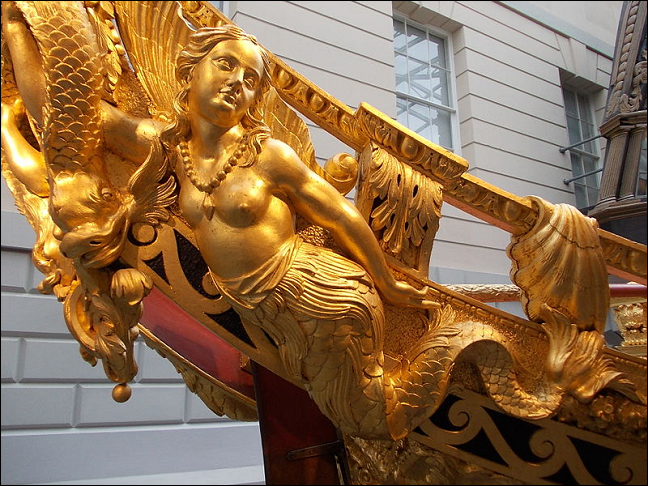
And second, mermaids.


.

It gets more interesting, you see. Because what collided with that first question was a conversation @khanserai aka Humera Khan was having with @mujaahid4life aka Abdallah via Twitter, in which the Harry Potter books were discussed and the topic of unimaginative clerical fatwas on games and works of fiction came up. At which point, Abdallah pointed us all to this now-archived fatwa regarding the permissibility of eating mermaid flesh:

Ruling on eating mermaids

A mermaid is a creature that lives in water and looks like a human. As to whether it really exists or it is a mythical being, that is subject to further discussion.

It says in a footnote in al-Mawsoo’ah al-Fiqhiyyah (5/129): From the modern academic resources that are available to us, it may be understood that the mermaid, which is called Sirène in French, is a mythical creature that is described in fairy tales as having an upper body like a woman and a lower half like a fish.

See the French Larousse encyclopédique on the word Sirène.

The encyclopaedia goes on to say: The widespread notion in ancient times was that the wonders and animals of the sea were more and greater than the wonders of dry land, and that there was no kind of animal in the sea that did not have a counterpart on land. This was confirmed by Prof. Muhammad Fareed Wajdi in his encyclopaedia, quoting from modern academic sources. See: Daa’irah Ma’aarif al-Qarn al-‘Ishreen: Bahr – Hayawiyan. End quote.

Al-Dumayri said in Hayaat al-Haywaan al-Kubra: Mermaid: it resembles a human but it has a tail. Al-Qazweeni said: Someone brought one of them in our time. End quote.

Many of the fuqaha’ mentioned mermaids and differed on the ruling concerning them. Some of them said that they are permissible (to eat) because of the general meaning of the evidence which says that whatever is in the sea is permissible. This is the view of the Shaafa’is and Hanbalis, and is the view of most of the Maalikis and of Ibn Hazm and others. And some of them regarded it as haraam because it is not a kind of fish. This is the view of the Hanafis and of al-Layth ibn Sa’d.

Ibn Hazm (may Allaah have mercy on him) said in al-Muhalla (6/50): As for that which lives in the water and cannot live anywhere else, it is all halaal no matter what state it is in, whether it is caught alive and then dies, or it dies in the water and then floats or does not float, whether it was killed by a sea creature or a land animal. It is all halaal to eat, whether it is the pig of the sea (i.e., a dolphin), a mermaid, or a dog of the sea (i.e., shark) and so on. It is halaal to eat, whether it was killed by an idol-worshipper, a Muslim, a kitaabi (Jew or Christian) or it was not killed by anyone.
What’s outside the box?

And it goes on… ending, mercifully:

And Allaah knows best.

Sometimes I think those might be my favorite words evvah!

**

Are mermaids real enough for religious scholarship to address them?

Is Alice?

John Daido Loori Roshi, late zen master and abbot of the Mountains and Rivers Order’s Mt Tremper abbey, once gave a teisho using a passage from Alice as his koan:

Many Zen koans contain references to myths and folktales of ancient India, China, and Japan. Since Westerners generally are not familiar with these stories, koan study without extensive background information is often a frustrating and exasperating process.

In this dharma discourse, Abbot John Daido Loori fashions a koan, complete with pointer and capping verse, from a classic of children’s literature, Lewis Carroll’s Alice in Wonderland. The koan revolves around Alice’s encounter with a caterpillar who explains the magical properties of a special two-sided mushroom that to Alice’s eyes appears perfectly round. Alice’s struggles with this dilemma make for a stimulating story that mirrors the conflicts and dualities we face in our everyday life.

You can read it here.

**

All of which brings me to the question of the place of deep imagination in a sometimes shallow world.

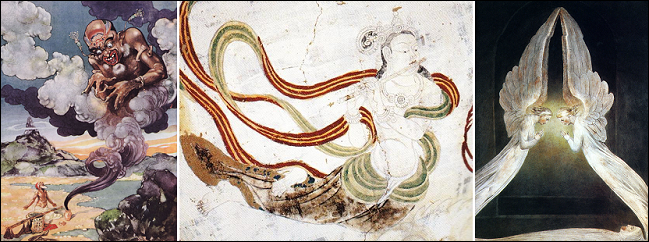
Alice, do you believe in her? Mermaids and Macbeth mean something to sailors and theater-folk, respetively. Angels? If angels, then the djinn, too? Christian scripture speaks for the existence of one, the Qur’an of both — is one more probable, more real, perhaps, than the other?

And what of the gandharvas and apsaras — middle panel — the celestial musicians and airy dancers who move to their music? Is there any poet who can claim never to have sensed them?

**

And thus we come to Robert Graves and the muse as he depicts her, in his book The White Goddess, and in many poems such as this:

In Dedication
.

Your broad, high brow is whiter than a leper’s,
Your eyes are flax-flower blue, blood-red your lips,
Your hair curls honey-colored to white hips.

All saints revile you, and all sober men
Ruled by the God Apollo’s golden mean;
Yet for me rises even in November
(Rawest of months) so cruelly new a vision,
Cerridwen, of your beatific love
I forget violence and long betrayal,
Careless of where the next bright bolt might fall.

**

But here the waters are getting deeper…


Switch to our mobile site