[ by Charles Cameron — the subject of interest is in the details ]
.
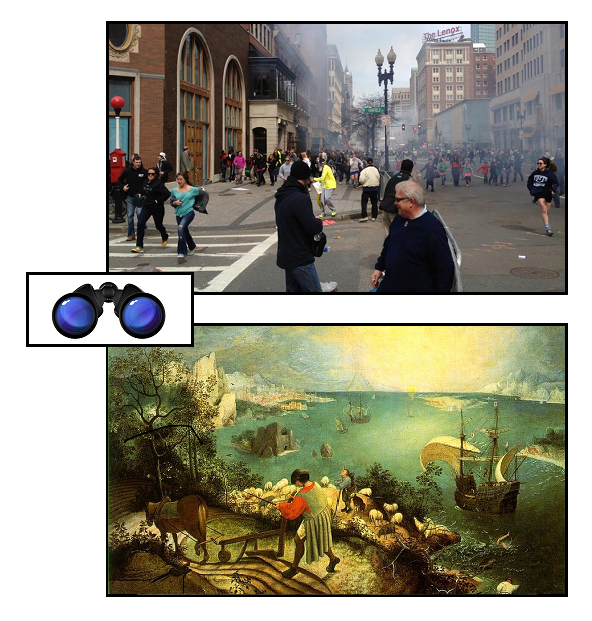
My friend Jim Friedrich, an Episcopalian priest and artist, posted a thought-provoking juxtaposition of images on FaceBook yesterday, which I have resized and cropped to fit my own DoubleQuotes format:
Fr Friedrich’s comment:
This photo snapped Monday in Boston is like Brueghel’s “Fall of Icarus.” The critical subject in each is, from the viewer’s position, just a small detail practically lost in the totality of the scene. Very strange to look at, and to think about – ethically, existentially, theologically…
About suffering they were never wrong,
The old Masters: how well they understood
Its human position: how it takes place
While someone else is eating or opening a window or just walking dully along;
How, when the aged are reverently, passionately waiting
For the miraculous birth, there always must be
Children who did not specially want it to happen, skating
On a pond at the edge of the wood:
They never forgot
That even the dreadful martyrdom must run its course
Anyhow in a corner, some untidy spot
Where the dogs go on with their doggy life and the torturer’s horse
Scratches its innocent behind on a tree.
In Breughel’s Icarus, for instance: how everything turns away
Quite leisurely from the disaster; the ploughman may
Have heard the splash, the forsaken cry,
But for him it was not an important failure; the sun shone
As it had to on the white legs disappearing into the green
Water, and the expensive delicate ship that must have seen
Something amazing, a boy falling out of the sky,
Had somewhere to get to and sailed calmly on.
**
I hope to post something tomorrow on the Mahdist video that Tamerlan Tsarnaev “liked” on FaceBook and added to his “Islam” folder. In its own way, that’s a minor — yet significant — detail, too.
[ Charles Cameron, introducing Caitlin Fitz Gerald ]
.
I was among those deeply moved by Caitlin Fitz Gerald‘s post, Boston’s Best Day, which I quoted from two days ago, and today she posted a series of tweets which again struck me. Knowing Caitlin’s love of visual expression, I invited her to take those tweets and make a guest post of them here, with an illustration should she so choose.
Her post, both text and its illumination, follows:
**
Turns out I hate the theater of this. I don’t want to hear politicians talk about what happened, or about how strong we are, or anything. I just want the professionals to do what they do, find the people who did this, and along the way to keep us as informed as they can without compromising what they’re doing. I want people to grieve in their way, I don’t want this to be a political speech opportunity. Let our local religious leaders offer comfort and our community leaders direction. I’m sure others feel differently, and if it offers comfort to others, that’s wonderful, but I’ve been surprised how very much I don’t want to hear speeches from, e.g. the President on this. And if focus is on anyone, it should be on the medics and doctors and nurses and cops and firefighters and regular old people who helped each other. People keep calling them heroes, which is nice but almost undercuts the absolute gobsmacking amazingness of what they actually are: regular, good people whose instinct in a crisis was to help other people. Isn’t that more incredible than needing some superlative hero in a time like this? Isn’t it more amazing that what looks like heroism is really just what people are? How remarkable, that we all have that capacity in us. It’s not extraordinary, it’s miraculously ordinary.
….By using this power in addition to examine human history, we can gain insights into the origin and nature of aesthetic judgment. For example, neurobiological monitoring, in particular measurements of the damping of alpha waves during perceptions of abstract designs, have shown that the brain is most aroused by patterns in which there is about a 20 percent redundancy of elements or, put roughly, the amount of complexity found in a simple maze, or two turns of a logarithmic spiral, or an asymmetric cross. It may be coincidence (although I think not) that about the same degree of complexity is shared by a great deal of the art in friezes, grillwork, colophons, logographs, and flag designs. It crops up again in the glyphs of the ancient Middle East and Mesoamerica, as well in the pictographs and letters of modern Asian languages. The same level of complexity characterizes part of what is considered attractive in primitive art and modern abstract art and design. The source of the principle may be that this amount of complexity is the most that the brain can process in a single glance, in the same way that seven is the highest number of objects that can be counted at a single glance. When a picture is more complex, the eye grasps its content by the eye’s saccade or consciously reflective travel from one sector to the next. A quality of great art is its ability to guide attention from one of its parts to another in a manner that pleases, informs, and provokes
This is fascinating. My first question would be how we could determine if the pattern of degree of complexity is the result of cognitive structural limits (a cap on our thinking) or if it represents a sufficient visual sensory catalyst in terms of numbers of elements to cause an excitory response (neurons firing, release of dopamine, acetylcholine etc. ) and a subsequent feedback loop. Great art, or just sometimes interesting designs exhibiting novelty can hold us with a mysterious, absorbing fascination
Later, Wilson writes:
….If ever there was a reason for bringing the humanities and science closer together, it is the need to understand the true nature of the human sensory world, as contrasted with that seen by the rest of life. But there is another, even more important reason to move toward consilience among the great branches of learning. Substantial evidence now exists that human social behavior arose genetically by multilevel evolution. If this interpretation is correct, and a growing number of evolutionary biologists and anthropologists believe it is, we can expect a continuing conflict between components of behavior favored by individual selection and those favored by group selection. Selection at the individual level tends to create competitiveness and selfish behavior among group members—in status, mating, and the securing of resources. In opposition, selection between groups tends to create selfless behavior, expressed in greater generosity and altruism, which in turn promote stronger cohesion and strength of the group as a whole
Very interesting.
First, while I am in no way qualified to argue evolution with E.O. Wilson, I am dimly aware that some biological scientists might be apt to take issue with Wilson’s primacy of multilevel evolution. As a matter of common sense, it seems likely to me that biological systems might have a point where they experience emergent evolutionary effects – the system itself has to be able to adapt to the larger environmental context – how do we know what level of “multilevel” will be the significant driver of natural selection and under what conditions? Or does one level have a rough sort of “hegemony” over the evolutionary process with the rest as “tweaking” influences? Or is there more randomness here than process?
That part is way beyond my ken and readers are welcome to weigh in here.
The second part, given Wilson’s assumptions are more graspable. Creativity often is a matter of individual insights becoming elaborated and exploited, but also has strong collaborative and social aspects. That kind of cooperation may not even be purposeful or ends-driven by both parties, it may simply be behaviors that incidentally help create an environment or social space where creative innovation becomes more likely to flourish – such as the advent of writing and the spread of literacy giving birth to a literary cultural explosion of ideas and invention – and battles over credit and more tangible rewards.
[ by Charles Cameron — concerning a valid bishop acting in an illicit manner ]
.
.
Whatever language you speak in this era when a polyphony of tongues might indicate Babel (not so good), Pentecost (way better), glossolalia (no comment) or heteroglossia (yowza!), it’s apparently easy enough to label Ralph Napierski (left, black hat, shaking the hand of Cardinal Sergio Sebiastiana, to his right, red skullcap) a non-bishop:
Massimo Introvigne, sociologist of religions, founder of the international Center for Studies on New Religions and Chairman of the Observatory of Religious Liberty set up by the Italian Ministry of Foreign Affairs, monitors religious movements small and large. He commented on a scholarly listserv today, and I quote him with permission:
Some of you may be curious about Bishop Ralph Napierski, who today managed to enter the Vatican with the cardinals preparing the Conclave, and even gave some interviews, before being identified as a non-Catholic «imposter» and thrown out.
Napierski is not a simple prankster dressed as a Bishop. He is one the so called “wandering Bishops” claiming a consecration as a Bishop which from the Catholic point of view is not “lawful” – since lawful consecrations of new Bishops should be approved by the Pope – but nonetheless is “valid” according to the (prevailing) Catholic doctrine, which maintains that a Bishop, even excommunicated, maintains the power to validly consecrate another Bishop, who in turn may consecrate further Bishops. “Validity” means that this “illicit” Bishop, although automatically excommunicated, will have the power to ordain priests who would be “real” priests, i.e. from the Catholic point of view will have the power of converting bread and wine into the body and blood of Jesus Christ in the Eucharist, provided they perform the correct ritual and believe in it.
The greatest manufacturer of wandering Bishops in the 20th century was the former Archbishop of Hué, Vietnam, Pierre-Martin Ngo-Dinh Thuc (1897-1984). Among others he consecrated as a Bishop Clemente Dominguez (1946-2005), later to proclaim himself Pope Gregory XVII for the Catholic Palmarian Church headquartered in Palmar de Troya, Spain. Dominguez consecrated in 1978 his German follower Alfred Seiwert-Fleige, who however in 1980 organized a schism among German members of the Catholic Palmarian Church. And our Napierski was originally consecrated by Seiwert-Fleige for his group.
As many other wandering Bishops, Napierski makes a living by selling titles in bogus Orders of Chivalry and degrees from his Jesus Christ University. He also appears often at LGBT events. He acquired some notoriety years ago by claiming that Dan Brown was right and Jesus did indeed marry Mary Magdalene.
**
The Episcopi Vagantes or Wandering Bishops are a fascinating lot, and given my interest in the byways of Church history I’ve been intrigued by them since I first read Peter Anson‘s Bishops at Large while at Oxford.
My good friend the painter Jan Valentin Saether is a priest in one such succession, that of the Ecclesia Gnostica under Bishop Stephan Hoeller.
[ by Charles Cameron — the art of memory, with a sidelong glance at swans, typhoid and theodicy ]
.
Thomas Harris (and by extension Hannibal Lector) has been interested in memory palaces for a long time. We can begin to infer this this because Lector describes his hobby in Red Dragon (1981) and again in Silence of the Lambs (1988):
So — church collapses?
**
As you can tell from that last comment in the Silence of the Lambs quote — to my mind the most brilliant presentation of the problem of theodicy for our day — if there’s a God worth defending, it has to be a God who allows sparrows to fall, typhoid to accompany swans in the vast ecology of existence, churches to collapse on worshipers, and “bad things to happen to good people” from time to time.
And such things, specifically including collapses of religious buildings atop worshipers, do indeed happen in fact as well as fiction.
And they don’t only happen to Christians, either… Bon is the shamanistic religious tradition of Tibet, prior to — and later, somewhat assimilated by — Buddhism…
**
The thing is, when I read that Hannibal Lector collected church collapses, it not only made me start to take note of them myself, it also made me think of Simonides. As Frances Yates tells us in her book, The Art of Memory:
At a banquet given by a nobleman of Thessaly named Scopas, the poet Simonides of Ceos chanted a lyric poem in honour of his host but including a passage in praise of Castor and Pollux. Scopas meanly told the poet that he would only pay him halfthe sum agreed upon for the panegyric and that he must obtain the balance from the twin gods to whom he had devoted half the poem. A little later, a message was brought in to Simonides that two young men were waiting outside who wished to see him. He rose from the banquet and went out but could find no one. During his absence the roof of the banqueting hall fell in, crushing Scopas and all the guests to death beneath the ruins; the corpses were so mangled that the relatives who came to take them away for burial were unable to identify them. But Simonides remembered the places at which they had been sitting at the table and was therefore able to indicate to the relatives which were their dead. The invisible callers, Castor and Pollux, had handsomely paid for their share in the panegyric by drawing Simonides away from the banquet just before the crash. And this experience suggested to the poet the principles of the art of memory of which he is said to have been the inventor. Noting that it was through his memory of the places at which the guests had been sitting that he had been able to identify the bodies, he realised that orderly arrangement is essential for good memory.
And by way of reinforcing my Lector-Simonides conjecture, Lector certainly had a remarkable interest in memory, as we learn from his dialogue with Clarice Starling:
“Did you do the drawings on your walls, Doctor?”
“Do you think I called in a decorator?”
“The one over the sink is a European city?”
“It’s Florence. That’s the Palazzo Vecchio and the Duomo, seen from the Belvedere.”
“Did you do it from memory, all the detail?”
“Memory, Officer Starling, is what I have instead of a view.”
A belvedere, from the Italian, is “a structure (as a cupola or a summerhouse) designed to command a view” — and a beautiful view at that. Belvedere is also, ironically, the name of the town in Ohio where Buffalo Bill, Lector’s serial killer ex-patient, lives…
**
So it didn’t surprise me to discover that in Hannibal (1999), the book that follows Silence, this brilliant man who as we have seen collects church collapses and has an exquisite memory in place of a view, is revealed as a practitioner of Simonides’ art:
The memory palace was a mnemonic system well known to ancient scholars and much information was preserved in them through the Dark Ages while Vandals burned the books. Like scholars before him, Dr. Lecter stores an enormous amount of information keyed to objects in his thousand rooms, but unlike the ancients, Dr.Lecter has a second purpose for his palace; sometimes he lives there. He has passed years among its exquisite collections, while his body lay bound on a violent ward with screams buzzing the steel bars like hell’s own harp.
Hannibal Lecter’s palace is vast, even by medieval standards. Translated to the tangible world it would rival the Topkapi Palace in Istanbul for size and complexity.
We catch up to him as the swift slippers of his mind pass from the foyer into the Great Hall of the Seasons. The palace is built according to the rules discovered by Simonides of Ceos and elaborated by Cicero four hundred years later; it is airy, high-ceilinged, furnished with objects and tableaux that are vivid, striking, sometimes shocking and absurd, and often beautiful. The displays are well spaced and well lighted like those of a great museum. But the walls are not the neutral colors of museum walls. Like Giotto, Dr. Lecter has frescoed the walls of his mind.
Brilliant. And a delight, years later, to have my hunch connecting the church collapses and prison cell with only memory for a view with Simonides and the Art of Memory confirmed by the third book and film in the series…
You’ll note, btw, that the Lector (caveat lector) of the first two books has now become Lecter in alignment with the films starring Anthony Hopkins.
**
I love symmetries, so let’s move from the most monstrous criminal mind in literature, to the greatest detective…
Sherlock Holmes — in his latest television incarnation — builds memory palaces of a sort, though I’m not sure Simonides would recognize them.
I’m posting the clip from the series here to honor my son Emlyn, with whom I have been watching the series…
In 1596 Matteo Ricci taught the Chinese how to build a memory palace. He told them that the size of the palace would depend on how much they wanted to remember: the most ambitious construction would consist of several hundred buildings of all shapes and sizes, “the more there are the better it will be,” said Ricci, thought he added that one did not have to build on a gradiose scale right away. One coul create modest palaces, or one could build less dramatic structures such as a temple compound, a cluster of government offices, a public hostel, or a merchants’s meeting lodge. If one wished to begin on a still smaller scale, then one could erect a simple reception hall, a pavilion, or a studio. And if one wanted an intimate space one could use just the corner of a pavilion, or an altar in a temple, or even such a homely object as a wardrobe or a divan.
You’ll note that in this early example of virtual reality as an pedagogical technology, Ricci doesn’t start with the easy stuff, the single wardrobe or divan — he begins with “the most ambitious construction”…
Enough for now. When I want to talk about in a follow up post is detail… the crucial importance of detail.
Zenpundit is a blog dedicated to exploring the intersections of foreign policy, history, military theory, national security,strategic thinking, futurism, cognition and a number of other esoteric pursuits.