zenpundit.com » art

Archive for the ‘art’ Category

Sow wind, reap whirlwind

Sunday, December 30th, 2012

[ by Charles Cameron — on blowback, in praise of a Gregory Johnsen post, and literacy ]
.

William Blake, The Lord Answering Job Out of the Whirlwind

.

ED Hirsch and Joseph F Kett‘s New Dictionary of Cultural Literacy doesn’t appear to have an entry for the phrase “For they have sown the wind, and they shall reap the whirlwind” which is straight out of the prophet Hosea and is now something of a proverb in the form “sow the wind, reap the whirlwind”. Hunh.

It’s an elegant phrase. The translators of the King James Bible were masterful in their singular ear for English, and no doubt Hosea‘s original Hebrew (Hosea 8.7) is no less pithy. Seed preceding harvest is about as basic a notion of cause resulting in effect as one can find in the lived world of agriculture, with the actual mechanism through which it comes to pass hidden in the “black box” between them where, as another biblical passage (John 12.24) puts it:

unless a kernel of wheat falls to the ground and dies, it remains only a single seed. But if it dies, it produces many seeds.

**

Sow the wind…

It doesn’t sound like much, does it? Put an airy nothing in the ground…

reap the whirlwind.

If you were within media reach of the devastation that Sandy caused to New York and New Jersey — or Haiti (yet again) for that matter — you know what reaping the whirlwind is about. And the proverb, with the prophet behind it, tells us we get it by sowing the wind.

Blowback.

**

Gregory Johnsen, in a recent Waq-al-Waq post, Sowing the Wind: Three years of strikes in Yemen, pulls together three recent news pieces on Yemen to give us a view from 30,000 feet — in which blowback is clearly visible as the “whirlwind” his title implies we are already beginning to reap.

This sort of “here’s how the weather system looks from above” picture comes from the juxtaposition of key quotes, and since that’s one of my specialties, I’ll present two quotes that Johnsen selected in my own format devised with just that sort of exercise in mind:

That first quote is from Letta Tayler in Foreign Policy, and the second from Sudarsan Raghavan in the Washington Post.

As Johnsen puts it:

This is clear: the US bombs, kills civilians and AQAP sends compensation – ie, helps out the families that have been killed – and takes advantage of the carnage the US has sown to reap more recruits.

This is at once all too sad, and at the same time all too predictable.

**

There’s plenty more in Johnsen’s post, obviously, and being a trawler for religious details, I myself was particularly amused, or maybe alarmed, by this sentence:

That opening strike in the US’ war against AQAP in Yemen was a disaster, a strike so bad that the Pentagon lawyer who authorized it famously said later: “if I were Catholic, I’d have to go to confession.”

Indeed, as I hope to show shortly in a review of his book, The Last Refuge: Yemen, al-Qaeda, and America’s War in Arabia, Johnsen has a great deal to tell us, and he tells it with the added grace of a real appreciation for the language he uses.

Which brings me to the reason why I singled this particular post for commendation, given that I read a number of insightful people on a number of interesting topics each day.

Gregory Johnsen is literate, lettered.

**

I can’t estimate for myself just how many people would know and recognize the Hosea quote, nor how many more would at least know the proverb “sow the wind, reap the whirlwind” well enough to recognize its first half and provide the second half from memory… That’s why I looked it up in Hirsch’s New Dictionary of Cultural Literacy. And when I didn’t find it there, I have to say I wasn’t surprised.

Way back in 19232, was it, TS Eliot was dropping snippets of already obscure (obsolete?) texts in English, Italian, Latin, and French — from Thomas Kyd‘s Spanish Tragedy, Dante‘s Purgatorio, the Pervigilium Veneris, and Gérard de Nerval‘s El Desdichado — into his poem The Waste Land, with the comment “these fragments I have shored against my ruins.”

As Eliot would note later in Burnt Norton, “Words strain, / Crack and sometimes break, under the burden, / Under the tension, slip, slide, perish, / Decay with imprecision, will not stay in place…”… And how much more so the myths, fables and proverbs made of them — myths, fables and proverbs which pass down the embodied wisdom of generations, as this proverb from Hosea passes down embodied wisdom about blowback — or negative positive feedback loops, as a latter-day Hosea might call them.

Johnsen is, precisely in this sense, literate, and in addition to the benefit his analysis brings, it’s a delight to read him for that very reason.

But there’s an even bigger issue here — the one Eliot was on about — the question of what happens when we lose the cultural underpinnings which, I’ll repeat, pass down the embodied wisdom of generations?

Johnsen speaks to the present, to Yemen, to the Yemeni people and to American politics. But in quoting that fragment of a proverb in his title, and expecting us to recognize it, he also speaks to memory, to culture, and to wisdom — wisdom, the capacity to act wisely — to which memory and culture are portals.

**

William Blake painted The Lord Answering Job Out of the Whirlwind, which I’ve placed at the top of this post, and it is said in Job 38.1, “the Lord answered Job out of the whirlwind”.

In a forthcoming post — how often have I posted those words, and how seldom do I manage to fullfil them? — I hope to address the other possibility, the one in which as I Kings 19 has it (verses 11-12):

And, behold, the Lord passed by, and a great and strong wind rent the mountains, and brake in pieces the rocks before the Lord; but the Lord was not in the wind: and after the wind an earthquake; but the Lord was not in the earthquake: And after the earthquake a fire; but the Lord was not in the fire: and after the fire a still small voice.

But the Lord was not in the wind — it might be nice if the evangelists of righteous doom would remember that verse, before they inform us that a hurricane like Sandy is simply God reproving Cuba, Haiti and the eastern seaboard of the United States!

The Hobbit: Narrative Validation or Vandalism?

Sunday, December 30th, 2012

The Hobbit: An Unexpected Journey a film by Peter Jackson

The Hobbit:Or There and Back Again by J.R.R. Tolkien 

Last night, I took the kids and my nephew to see The Hobbit. In essence, it was less the classic tale woven by J.R.R. Tolkien than a sequel to The Avengers with a cast of Dwarves.

Peter Jackson has made, as he did with The Lord of the Rings movie trilogy, a visually stunning film with The Hobbit. Jackson once again excelled at translating many physical settings of Tolkien’s Middle-Earth into screen reality. Erebor looks the way you would expect an age-old Dwarven kingdom should. Dol Guldor (alluded to ever so briefly in the book) appears to be the place of dread that would attract a great malevolent spirit like Sauron, This extends to some of the characters; the Great Goblin’s semi-comic personage manages to capture some of the original charm of The Hobbit as a children’s story before it later became part of the narrative for Tolkien’s larger and darker romantic epic, The Lord of the Rings.

Unfortunately, the tendency that Jackson demonstrated as the films of The Lord of the Rings progressed,to take ever greater artistic liberties with Tolkien’s story, have, with his swollen ego, run riot in The Hobbit. The primary antagonist in the film, Azog the Orc chieftain is lifted from other Tolkien material, given mutant powers, a scary metal hand and an albino warg by Jackson and is brutally imposed on the story. The wizard Radagast the Brown, whose head for some reason is encrusted with bird crap, gets much screen time as he  zips around Middle-Earth like Mario Andretti on a sleigh pulled by magical bunnies when he is not getting high on ‘shrooms.

What began as a necessary fleshing out of narrative allusions and foreshadowing to effectively translate literature into a movie ended up as Jackson’s sheer invention and gratuitous abuse of the characters, all of whom sword fight more often than Conan the Barbarian and more bloodily than Leonidas. If Thorin had shouted in the midst of battle with the Goblins, “Dwarves! Tonight we dine in Mordor!” no one in the audience would have been the least bit surprised.  Zorro and the Three Musketeers had less skill with a blade in hand-to-hand combat than do these Dwarves, Gandalf or at times, Bilbo Baggins.

The only scenes where Jackson manages genuine fidelity to the story are the ones with Gollum, Bilbo and their Riddle-Game – perhaps out of fear of trivializing his previous movies, Tolkien’s actual dialogue and plot  enters the script before vanishing again into a Jacksonian cinematic homage to every American action movie ever made. No wonder Christopher Tolkien looks on with weary despair.

There’s a name for this kind of genre….

Fan fiction.

Steven Pinker on Analogy

Thursday, December 6th, 2012

[ by Charles Cameron — importance of analogy as an under-developed cognitive skill ]
.

There was a interview with five prominent “science writers” in the Guardian a few days back, titled Science writing: how do you make complex issues accessible and readable? and one of the writers, Steven Pinker, makes two highly interesting observations:

**

There are a couple of things going on here that I’d like to note. One is that without intending to do so specifically, he is in essence formulating a view about a possible, central difference between scientific and religious thinking, since what he says about the humanities in general applies with great specificity to religion and the arts: in both religion and art, the expansive nature of “symbolism” is a key to the experience.

And that in turn prompts me to suggest that perhaps both the arts and religion are geared towards provoking, evoking or invoking an experience — whereas the sciences are geared towards obtaining an understanding.

I’ll have to think about that, and come to some sort of understanding of my own — perhaps expressed via symbolic means.

**

My second point of interest is that there’s an analogy to be made between Pinker’s two remarks: each of them has a form I could portray thus in terms of cause :: effect

science : humanities :: simplicity : complexity

Nobody present — the interviewer, Pinker himself, and four other very bright science writers — picked up on the close correspondence between those two statements at the time. And I find that very interesting.

I find it very interesting because the six of them were more interested in seeing what they could say (of what they already thought) than in saying what they could see (in light of the ongoing, immediate conversation).

I think we all tend to do that — which is why David Bohm‘s approach to dialogue is so important: if brings us to speak more into the moment as it surrounds us, not quite so much from the past as it has informed us.

**

Then there’s the interesting fact that Pinker’s sense of the difference between modes of thought in the humanities and the sciences as expressed in the top quote translates so directly to the difference between uses of analogy in the second — and his fairly emphatic statement:

one could argue that we understand everything except for the physical world of falling objects by analogy.

Analogy is the central device in our mental toolkit, and yet we know far more about trains of logic than we do about analogical leaps. We know so little, in fact, that distinguishing between “literary metaphor” and “scientific analogy” (both of which are based in the recognition of resemblance) on the basis of one looking for multiple, rich connectivity and the other for a single tight connection is something noteworthy enough for Pinker to bother to point it out. It is indeed a provocative and perhaps essential insight. But it is also pretty basic — dividing a field up into significant chunks, the way anthropology got divided into “cultural”, “archaeological”, “linguistic” and “physical anthropology”…

It’s time we learned to understand and use analogic with the same rigor we’ve applied to learning and using logic — and Sembl is just the tool for this.

**

Experience wants to be rich: factual understanding wants to be clear.

Of ID cards and innermost mysteries

Thursday, November 29th, 2012

[ by Charles Cameron — just another angle on personal identity and ID, nudged on by two news pieces I saw today, and written to set the thought juices flowing ]
.

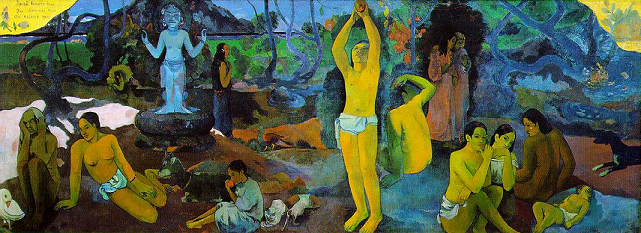
Life’s four deep questions are often listed thus: Who am I? Where did I come from? Why am I here? and Where will I go? We humans can spend a lifetime in search of the answers, and Paul Gauguin made three of them them the title of what some consider his greatest painting:

Paul Gauguin: D'où je viens, qui je suis, où je vais?

**

These are deeply personal questions — and now governments and bureaucracies everywhere would like to know the answers to them, too:

**

The poet Hopkins, in his tightly compressed way, teaches us that we are not our driving licenses, we are not files in a desk drawer or on a computer, we are not our photos, we are not numbers, we are not even our names, we are… that which is most natural to us, that which is most essential about us, what you might call our “true natures”:

Each mortal thing does one thing and the same:
Deals out that being indoors each one dwells;
Selves — goes itself; myself it speaks and spells,
Crying Whát I do is me: for that I came.

We selve, we go ourselves — most precisely, we deal out that being which dwells within us.

And to learn what that being is, that mystery which most richly propels us, is our life task.

**

In our desire to identify, classify, count and track everybody and everything, our governments and bureaucracies keep losing track (!) of the simple fact that a person’s person is that person’s innermost mystery.

Søren Kierkegaard on espionage & Kenneth Burke on strategy

Thursday, October 25th, 2012

[ by Charles Cameron — a meditation on theological espionage, literary strategy, a Sufi tale from Jalaluddin Rumi, and why the arts and humanities offer excellent preparation for analytic work ]
.

Kit Marlowe's portrait, Corpus Christi College, Cambridge, Kierkegaard sketch, Niels Christian Kierkegaard

.

It may seem somewhat strange, at least on the surface, for a poet to be interested in strategy and a theologian in the world of intelligence analysis.

We poets. however, have been termed “the unacknowledged legislators of the world” by Mr. Shelley, one of our own number, and we theologians long considered our study the Queen of the Sciences – so here we have the roots of attitudes that may flower into this strange hybrid being that is myself.

**

It’s not easy to list significant writers who were also in the intelligence business, in part because both “writing” and “intelligence” are subject to varied definitions — so my own list here will lean heavily British, and have the patina of old age rather than the glamor of the freshly minted. Let’s just say that Christopher Marlowe, who wrote the great play Doctor Faustus, was apparently sent on extended errands while up at Cambridge on “matters touching the benefit of his country”.

More recently Rudyard Kipling, John Buchan, Somerset Maugham, Graham Greene, even JRR Tolkien apparently, Ian Fleming, John le Carré, and Anthony Burgess have been among British writers who were also spies, and Peter Matthiessen can serve as a distinguished recent American example.

Which brings me to the OSS, and this quote from a 2003 piece on Boston.com:

Yale’s literature specialists played a key role in shaping the agency’s thinking. Mole-hunter James Jesus Angleton, the most controversial figure in CIA history, began his career as an apprentice of the New Critics on Yale’s English faculty, and his literary training in “close reading” may have shaped his hyper-skeptical (some would say paranoid) approach to counterintelligence.

**

Why do fine writers make decent intelligence analysts?

John le Carré, who has been both, has this to say:

Artists, in my experience, have very little centre. They fake. They are not the real thing. They are spies. I am no exception.

I’d like to take that a little further. I’d like to say that to be a keen observer of human behavior, you must be a keen observer of your own – only one who has taken the beam out of his own eye can see clearly the mote that is in another’s. That brings you, I believe that chameleon-like condition of receptivity and observation that Keats termed “negative capability” in his letter to Richard Woodhouse of October 27, 1818.

More on that in the Sufi story below. Now, onward to the two quotes that anchor this piece.

**

Here’s Kenneth Burke on “strategy” in the arts, in his Literature as Equipment for Living [link is to .pdf]:

For surely, the most highly alembicated and sophisticated work of art, arising in complex civilizations, could be considered as designed to organize and command the army of one’s thoughts and images, and to so organize them that one “imposes upon the enemy the time and place and conditions for fighting preferred by oneself.” One seeks to “direct the larger movements and operations” in one’s campaign of living. One “maneuvers,” and the maneuvering is an “art.”

Are not the final results one’s “strategy”?

And Kierkegaard on “spying” as a theologian, in the chapter, Governance’s Part in My Authorship from his The Point of View:

l am like a spy in a higher service, the service of the idea. l have nothing new to proclaim, I am without authority; myself hidden in a deception. l do not proceed directly but indirectly — cunningly; I am no saint — in short, l am like a spy who in spying, in being informed about malpractices and illusions and suspicious matters, in exercising surveillance, is himself under the strictest surveillance. See, the police also use such people. For that purpose they do not choose only people whose lives have always been most upright; what is wanted is only experienced, scheming, sagacious people who can sniff out everything, above all pick up the trail and expose. Thus the police have nothing against having such a person under their thumb by means of his vita ante acta [earlier life] in order precisely thereby to be able to force him unconditionally to put up with everything, to obey, and to make no fuss on his own behalf. It is the same with Governance, but there is this infinite difference between Governance and the municipal police — that Governance, who is compassionate love, precisely out of love uses such a person, rescues and brings him up, while he uses all his sagacity, which in this way is sanctified and consecrated. But in need of upbringing himself, he realizes that he is duty-bound in the most unconditional obedience.

**

To return, then, to the issue of those who spy upon themselves…

Jalaluddin Rumi has a story in his Masnavi, one of the many facets of which, I suspect, can illuminate this point, albeit a bit obliquely.

He describes a contest that a sultan once held between the Chinese and Greek schools of artists, to determine which had the greater ability in art. Each school was given one half of a room, and a great curtain fixed between them. The Chinese, with a vivid appreciation of nature’s moods and humanity’s place between skies and mountains, painted their half of the room with exquisite care and subtlety. The Greeks took quite an other approach, covering the walls on their side with silver plate, then buffing and burnishing it to a brilliant reflective sheen.

When the work was done and the curtain drawn back, the beauty of the Chinese room was stunning – but the loveliness of the Greek room, in which the Chinese room was reflected to dazzling effect, was even more so:

The image of those pictures and those works
was mirrored on those walls with clarity.
And all he’d seen in there was finer here –
his eyes were stolen from their very sockets.

Rumi explains that the Chinese in his fable are like those who see the outer world only, while the Greeks are those who “stripped their hearts and purified them” – and that “the mirror’s purity is like the heart’s”…

Those who examine their own hearts — Ursula le Guin nicely calls them “withinners” since their voyages, adventures, discoveries and treasures are found primary within themselves — may make reluctant spies, for they do not easily see one side of a dispute as entirely right and the other side utterly wrong: but their nuance places them among the finest of analysts.

**

Oh, but let’s be sensible and worldly: most of us like to balance our mundane lives with the more exciting possibilities that are their opposites, and espionage – the derring-do more than the analysis, to be sure – is a wonderful foil for scholars’ fantasies, just as being swept off one’s feet by a prince and loved tempestuously between the pages of a book is a sweet shift from the menial paper trails of office life, and space opera a fine venture for those beset by gravity and white lab coats.

And whether Jason Bourne, Jack Bauer, James Bond or just a little J&B‘s your tipple, you may find espionage, dealing as it does with secrets, is a natural launching pad for fantasy…

**

More sseriously, for the analysts and educators among our ZP readership — let me just suggest that the literary and humane arts will deepen analytic understanding as surely as big data will extend its technical reach.

And when you come right down to it — your human mind is still the best and subtlest software engine in the room…


Switch to our mobile site