zenpundit.com » innovation

Archive for the ‘innovation’ Category

Congratulations!!

Tuesday, December 4th, 2012

To Lexington Green and James Bennett, for finishing their new book, America 3.0 – due out (I think) in 2013 published by Encounter Books.

A political vision for an era desperately short on imagination and needing statecraft of inspiration.

The Sounds of Silence and Your Own Mind

Tuesday, November 27th, 2012

Scott Shipman had an excellent book review post An Unknown Future and a Doubtful Present: Writing the Victory Plan of 1941 — a review-lite and a few questions in which he discussed the intellectual seriousness and evolution of war planner   Major Albert C. Wedemeyer as a military officer and strategist:

….Wedemeyer was an honor graduate of the Command and General Staff College, and his performance earned him the opportunity to attended the Kriegsakademie, the German staff college. However, coupled with impressive academic preparations, Kirkpatrick writes that Wedemeyer’s curiosity exposed him to a “kaleidoscope” of ideas and methods. Kirkpatrick summed-up Wedemeyer: “Competence as a planner thus emerged as much from conscientious professional study as from formal military education…” Going on to say:

In common with many of his peers, much of Wedemeyer’s professional and intellectual education was less the product of military schooling than of personal initiative and experience in the interwar Army.

Wedemeyer’s intellectual development was purposeful and paid off. In Wedemeyer’s deep study of his profession he used the prescribed paths, but also explored on his own. How common is that today? 

As often happens, the discussion can take an unexpected turn in the comments section. Lexington Green weighed in with this:

Think about George Marshall in China, traveling around on horseback.  No cell phone, no email.  The man could actually think.  Or Eisenhower meeting with Fox Connor to talk about the books Connor had him read. Telephone calls were not even common.  The military might do well to have two days once a quarter of silent retreats, only emergency communication permitted, with literally no unnecessary conversation, for groups of officers and non-coms, with some assigned reading and some self-selected on the same theme, then an open discussion after dinner. It would cost virtually nothing and would be an intellectual and mental oasis, and some good ideas might come out of it.  Religious silent retreats which last a couple of days and are truly life-restoring. This would probably be useful as well.

That in turn provoked this response from Marshall:

My sense is that many of us live, work, and fraternize in a culture of crisis. Everything is urgent. One response is to just shut off the moment we get some downtime. TV, drinking, schlock fiction, immersion in pop culture, video games, blog reading are some of the ways I’ve coped. I grew out of those as timewasters as I realized that I no longer had time to shut off if I wanted to do something.

But I still live in a culture of crisis. Almost everybody around me “has no time”. It doesn’t really matter what is being proposed, the sense of urgency kills all ambition toward progress. Defending myself and my space form this is a daily challenge – and some days I lose.

I’m visiting family this week on a long-scheduled “vacation” that has been interrupted by my office several times already, but always with the promise, “just this thing, Marshall, we don’t want to take you away from your family”. And these are the people I choose as my allies!

The culture of crisis doesn’t believe in people’s choices. It says that time will only be wasted, so we have to keep our people busy. After all, see how they spend their “free” time? Dissolute wastrels the lot of them. And then the culture of crisis tells us that we need to recharge by shutting off our minds. You need to vege out, man, you’re stressed; turn on the TV and have a beer, mate. Or else fire up your e-mail and write six more. And, hey, sorry about your insomnia, but it lets you get a jump on the day, amirite? [….]

The discussion moved on, but I have been mulling upon this exchange ever since.

The first thing that came to mind is that what we mean by “silence” really isn’t silent, what is really meant is that there is an absence of human voice pulling at our limited capacity for attention. Cognitive load is probably a real, if variable, limit on human cognition and the nature of hyperconnected information society is that all too frequently we are -and feel – “overloaded”.

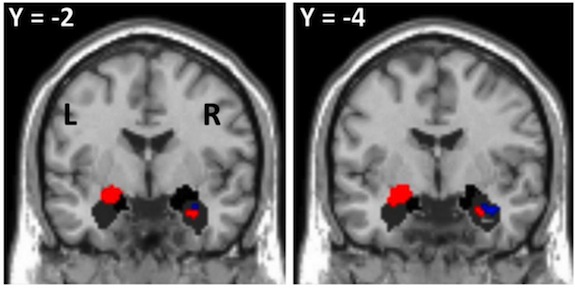
When human voices are absent the “background” environmental noise comes “forward” , natural (wind through trees, animals etc) or mechanical (various humms and clicks) that we unconsciously tune out as a matter of routine focusing on conversation or distracting hearsay, broadcasts and so on. The processing in the brain is significantly different depending on what kinds of sounds you are listening to, for example:

1. Listening to Music

2. Listening to Language

3. Listening to unpleasant sounds (nails on chalkboard etc.)

So eliminating human speech from your environment but not hearing (earplugs) itself allows other regions of your brain to become more active than usual, depending on whatever else you may be doing at the time (walking, chopping wood, smelling a flower, scanning the horizon and so on).  Your brain’s performance and how it varies when thinking under conditions of different combinations and levels of sensory stimuli – “crossmodal processing” – is not yet well understood as research is in early stages of investigation.

I will speculate here that what is important for enriching your thinking is that taking your brain out a linguistic-saturated environment (let’s include the “soundless noise” of intruding textual symbols as well from smartphones, iPads, laptops)  gives it an opportunity to operate differently for a time and establish new neuronal network patterns of activity. Various forms of meditation – which involves both silence and an intentional modulation of attention – also  alters normal  brain activity.

I will now go further out on a data-free analytical limb and hypothesize that making a practice of “silence” and/or meditation might improve your thinking by making moments of creative insight more likely. Studies on insight tend to show that as a cognitive event, insight  comes about as a kind of a “pulse” of activity and relaxation in the brain:

….Mark Jung-Beeman, a cognitive neuroscientist at Northwestern University, has spent the past fifteen years trying to figure out what happens inside the brain when people have an insight. Jung-Beeman became interested in the nature of insight in the early nineteen-nineties, while researching the right hemisphere of the brain. Mentions Jonathan Schooler. Jung-Beeman decided to compare word puzzles—or Compound Remote Associate Problems (C.R.A. Problems)—solved. He teamed up with John Kounios, a psychologist at Drexler University, and they combined fMRI and EEG (electroencephalography) testing to scan people’s brains while they solved the puzzles. The resulting studies, published in 2004 and 2006, found that people who solved puzzles with insight activated a specific subset of cortical areas. Although the answer seemed to appear out of nowhere, the mind was carefully preparing itself for the breakthrough. The suddenness of the insight is preceded by a burst of brain activity. A small fold of tissue on the surface of the right hemisphere, the anterior superior temporal gyrus (aSTG), becomes unusually active in the second before the insight. Once the brain is sufficiently focused on the problem, the cortex needs to relax, to seek out the more remote association in the right hemisphere that will provide the insight. As Kounios sees it, the insight process is an act of cognitive deliberation transformed by accidental, serendipitous connections. Mentions Joy Bhattacharya and Henri Poincaré. The brain area responsible for recognizing insight is the prefrontal cortex. Earl Miller, a neuroscientist at M.I.T., spent years studying the prefrontal cortex. He was eventually able to show that it wasn’t simply an aggregator of information, but rather it was more like a conductor, waving its baton and directing the players. In 2001, Miller and Princeton neuroscientist Jonathan Cohen published an influential paper laying out their theory of how the prefrontal cortex controls the rest of the brain. It remains unclear how simple cells recognize what the conscious mind cannot. An insight is just a fleeting glimpse of the brain’s huge store of unknown knowledge.

Another interesting data point to consider re: “silence” and insight is that the mental illness of schizophrenia, where delusions and other mental “noise” exists is significantly negatively correlated with insight.  Researchers are currently investigating if meditation can ease the symptoms of schizophrenia and other mental illnesses.

For myself, I find my best ideas come via insight when I am doing something primarily physical requiring steady but not all of my concentration and I am alone – working out, walking the dog, a household chore and so on. Relatively useful ideas can happen when I am reading or writing or debating (i.e. interacting with a text or a person), but they tend to be analytic and derivative, sort of an intellectual “tweaking” or “tinkering” but not ones that are fundamentally creative or synthesizing.

Lexington Green may be right – Silence is golden.


New Release: Creating a Lean R&D System, by Terry Barnhart—a preliminary review

Thursday, October 18th, 2012

[by J. Scott Shipman]

Creating a Lean R&D System, by Terry Barnhart

Friend of this blog, and friend, Terry Barnhart’s new book is available on Amazon. Terry is one of the leading thinkers among those who admire John Boyd’s work.

Terry has spoken at the last three Boyd and Beyond events, and much of the substance of those talks are reflected in this book. I’ve read most of it, and believe it will have wide applicability outside the “lean” community. His sections on the use of A3’s (the subject of his talks at B&B this year) for problem identification/solution and rapid learning have potential at the personal and the organizational level. At the core, Terry is advocating a culture of innovation and providing tools he has proven in practice.

Recommended.

A version is cross posted at To Be or To Do.

Strategy and Creativity: Part I.

Tuesday, October 9th, 2012

“War is more than a true chameleon that slightly adapts its characteristics to the given case. As a total phenomenon its dominant tendencies always make war a remarkable trinity–composed of primordial violence, hatred, and enmity, which are to be regarded as a blind natural force; of the play of chance and probability within which the creative spirit is free to roam; and of its element of subordination, as an instrument of policy, which makes it subject to reason alone.”
                                                                                                -Carl von Clausewitz, On War

“Thus the highest form of generalship is to balk the enemy’s plans; the next best is to prevent the junction of the enemy’s forces; the next in order is to attack the enemy’s army in the field; and the worst policy of all is to besiege walled cities….Therefore the skillful leader subdues the enemy’s troops without any fighting; he captures their cities without laying siege to them; he overthrows their kingdom without lengthy operations in the field. With his forces intact he will dispute the mastery of the Empire, and thus, without losing a man, his triumph will be complete. This is the method of attacking by stratagem.”
                                                                                             – Sun Tzu, The Art of War 

This blog is read by many people with a deep interest in strategy coming from different philosophical and professional perspectives. While I have my own speculations  based on years of study, I would like to begin by first posing a few questions to the readership:

  • What is the relationship between strategy and creativity?
  • Or between strategic thinking and creative thinking?
  • Is “doing strategy” primarily an act of planning, calculation and rational problem-solving or is it also a profoundly creative and intuitive enterprise?
  • If we get better at thinking creatively, do we become better, more effective strategists? The reverse?
  • Is creativity more useful in “grand strategy” (or “statecraft”, if you prefer) and policy than in straightforward “military strategy”?

The floor is yours, strong argument is welcomed.

The best war game is a library of windows

Tuesday, July 3rd, 2012

[ by Charles Cameron — Escher, Borges, simulating the future, wargames, A Pattern Language, Sembl ]
.

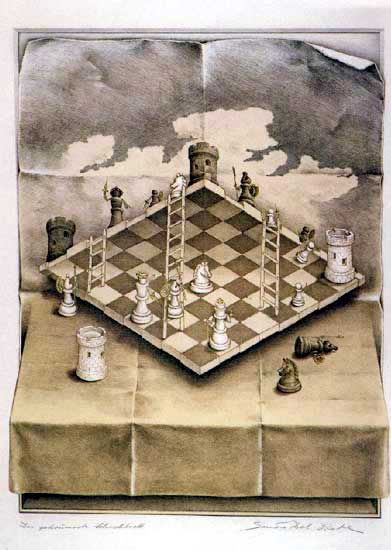
MC Escher, Relativity

.
Ridiculous phrase, a library of windows. Unless you think, as I do, of books as windows onto different worlds, in which case it makes a whole lot of sense, and a decent library has more windows onto more profoundly different worlds than any physical room — and here we are getting into the territory of Jorge Luis Borges (links to Library of Babel) and Maurits Escher (image above).

And let me just state for the record that Godel Escher Bach could just as well have been Escher Carroll Borges, and that a comparison between the logics of Escher and Borges is one of the desiderata of our times.

That’s a Sembl move.

**

Let’s expand the concept of window to include the sort of inter-worldview glimpse that Haaretz describes today here:

Last week, in a small beit midrash (study hall) named after Rabbi Meir Kahane in Jerusalem’s Shmuel Hanavi neighborhood, an emergency meeting was convened to discuss instigating freedom of religion and worship on the Temple Mount. It was a closed meeting attended by representatives of the Temple Institute, HaTenu’ah LeChinun HaMikdash (the Movement to Rebuild the Holy Temple) and the Temple Mount Faithful, as well as two representatives of Women for the Mikdash, and others. The activists met to try to understand how they could overcome the authorities, who they believe are plotting against them, and return to the Temple Mount. At this meeting, Haaretz was offered a rare behind-the-scenes glimpse of the most ardent activists in the battle to Judaize the Temple Mount.

**

Here’s the meat of the post, as yet uncooked. Back in 2005, but brought to my attention today by Rex Brynen at Paxsims, is this piece from Strategy Page:

After eight years of effort, and spending over $300 million, the U.S. Army has officially received its new wargame (WARSIM) for training battalion, brigade, division, and as big as you want to get, commanders, and their staffs. Now even the most elaborate commercial wargame would not get $300 million for development, and eight years to create the system. But wargames for professional soldiers have different requirements, and a troublesome Department of Defense bureaucracy to deal with. First, the requirements. Commercial wargames shield the player from all the boring stuff (support functions, especially logistics.) But professional wargames must deal with these support activities, because in a real war, these are the things commanders spend most of their time tending too. …

WARSIM covers a lot of complex activities that a commander must deal with to achieve battlefield success. Besides logistics, there’s intelligence. Trying to figure out what the enemy is up to is, next to logistics, the commanders most time consuming chore.

— which in turn was referenced by Michael Peck writing in a Kotaku piece today titled Why It’s So Hard to Make a Game Out of the 21st Century:

Let’s build a game. Let’s make it a strategy game. We will realistically simulate global politics in the 2030s. Perhaps a sort of Civ or Supreme Ruler 2020-type system.

Where shall we start? How about something easy, like choosing the nations in the game? It’s simple enough to consult an atlas. We’ll start with Britain…but wait! Scotland is on the brink of declaring independence from the United Kingdom. Should Britain be a single power, or should England and Scotland be depicted as a separate nation? What about Belgium splitting into Flemish and Walloon states? And these are old, established European nations. How will states like Syria and Nigeria look in two decades? It was only a bit over 20 years ago that the Soviet Union appeared to be a unshakeable superpower that controlled Eastern Europe and Central Asia.

**

Let’s cook that meat, let’s make a meal of it.

Peck’s piece goes into many other ways in which predictive gaming isn’t terribly productive.

But it left me asking the question, what would I do with a game-sized budget, if my aim was to push military and intelligence towards greater insight.

And my answer would be to embed information in walls. In corridors…

To build windows at sparse and irregular intervals into the internal corridors that connect any given office in the Pentagon or three-letter agency — or my local preference (hush, I know it’s the Glorious Fourth tomorrow) MI-5 and -6 — through which analysts and decision makers can glimpse snippets of information.

Which can then fall into the deep well of memory.

It is deep within that well of half-forgotten knowledge, ST Coleridge tells us, that the “hooks-and-eyes of memory” link one thought with another to build a creative third.

**

A wall, then. I would build a wall embedded with facts and fancies, maps and illustrations, graphs and stats, film clips and news clips, anecdotes and quotes — even, perhaps, tiny alcoves here and there with books free for the taking, music CDs, DVDs of movies, old, new, celebrated, strange…

And I would be constantly shifting and rearranging the “views” from my windows, so that what was seen yesterday would not be what would be seen tomorrow — yet with a powerful index of words, topics, themes, memes, image contents, names of actors, newscasters, authors and so forth, so that what was once seem and dimly recalled could be recaptured.

**

The concept here is pretty much the exact opposite of having a huge black poster proclaiming Creativity Matters!

Don’t get me wrong, creativity does matter (get that poster and others here), but it “works in mysterious ways its wonders to perform” — and the way to entice it is to see things out of the corner of the eye…

The windows I’m looking for, therefore, offer glimpses you wouldn’t necessarily notice if you were deep in thought or conversation, and conversely, wouldn’t see twice and grow so familiarized to that they’d become irrelevant by repetition. They’d be glimpsed in passing, their esthetic would be that of Christopher Alexander’s Zen View, pattern 134 in his brilliant work — the closest we have to a Western I ChingPattern Language:

The idea, then, is to seed the memory with half-conscious concepts, patterns, facts and images, carefully selected and randomly presented — so that those hooks and eyes have the maximum chance of connecting some scrap of curious information with a pressing problem.

Which is how creativity tends to work.

**

That way each corridor becomes a game-board — but it is in the analyst’s focused mind that the game is played and won.

What you’d get, in effect, would be community-wide, ongoing free-form gameplay in complete alignment with the web-based game we’re currently developing at Sembl. Games of this genre will also have powerful application in conflict resolution.

And peace.


Switch to our mobile site