zenpundit.com » counterintuitive

Archive for the ‘counterintuitive’ Category

The best war game is a library of windows

Tuesday, July 3rd, 2012

[ by Charles Cameron — Escher, Borges, simulating the future, wargames, A Pattern Language, Sembl ]
.

MC Escher, Relativity

.
Ridiculous phrase, a library of windows. Unless you think, as I do, of books as windows onto different worlds, in which case it makes a whole lot of sense, and a decent library has more windows onto more profoundly different worlds than any physical room — and here we are getting into the territory of Jorge Luis Borges (links to Library of Babel) and Maurits Escher (image above).

And let me just state for the record that Godel Escher Bach could just as well have been Escher Carroll Borges, and that a comparison between the logics of Escher and Borges is one of the desiderata of our times.

That’s a Sembl move.

**

Let’s expand the concept of window to include the sort of inter-worldview glimpse that Haaretz describes today here:

Last week, in a small beit midrash (study hall) named after Rabbi Meir Kahane in Jerusalem’s Shmuel Hanavi neighborhood, an emergency meeting was convened to discuss instigating freedom of religion and worship on the Temple Mount. It was a closed meeting attended by representatives of the Temple Institute, HaTenu’ah LeChinun HaMikdash (the Movement to Rebuild the Holy Temple) and the Temple Mount Faithful, as well as two representatives of Women for the Mikdash, and others. The activists met to try to understand how they could overcome the authorities, who they believe are plotting against them, and return to the Temple Mount. At this meeting, Haaretz was offered a rare behind-the-scenes glimpse of the most ardent activists in the battle to Judaize the Temple Mount.

**

Here’s the meat of the post, as yet uncooked. Back in 2005, but brought to my attention today by Rex Brynen at Paxsims, is this piece from Strategy Page:

After eight years of effort, and spending over $300 million, the U.S. Army has officially received its new wargame (WARSIM) for training battalion, brigade, division, and as big as you want to get, commanders, and their staffs. Now even the most elaborate commercial wargame would not get $300 million for development, and eight years to create the system. But wargames for professional soldiers have different requirements, and a troublesome Department of Defense bureaucracy to deal with. First, the requirements. Commercial wargames shield the player from all the boring stuff (support functions, especially logistics.) But professional wargames must deal with these support activities, because in a real war, these are the things commanders spend most of their time tending too. …

WARSIM covers a lot of complex activities that a commander must deal with to achieve battlefield success. Besides logistics, there’s intelligence. Trying to figure out what the enemy is up to is, next to logistics, the commanders most time consuming chore.

— which in turn was referenced by Michael Peck writing in a Kotaku piece today titled Why It’s So Hard to Make a Game Out of the 21st Century:

Let’s build a game. Let’s make it a strategy game. We will realistically simulate global politics in the 2030s. Perhaps a sort of Civ or Supreme Ruler 2020-type system.

Where shall we start? How about something easy, like choosing the nations in the game? It’s simple enough to consult an atlas. We’ll start with Britain…but wait! Scotland is on the brink of declaring independence from the United Kingdom. Should Britain be a single power, or should England and Scotland be depicted as a separate nation? What about Belgium splitting into Flemish and Walloon states? And these are old, established European nations. How will states like Syria and Nigeria look in two decades? It was only a bit over 20 years ago that the Soviet Union appeared to be a unshakeable superpower that controlled Eastern Europe and Central Asia.

**

Let’s cook that meat, let’s make a meal of it.

Peck’s piece goes into many other ways in which predictive gaming isn’t terribly productive.

But it left me asking the question, what would I do with a game-sized budget, if my aim was to push military and intelligence towards greater insight.

And my answer would be to embed information in walls. In corridors…

To build windows at sparse and irregular intervals into the internal corridors that connect any given office in the Pentagon or three-letter agency — or my local preference (hush, I know it’s the Glorious Fourth tomorrow) MI-5 and -6 — through which analysts and decision makers can glimpse snippets of information.

Which can then fall into the deep well of memory.

It is deep within that well of half-forgotten knowledge, ST Coleridge tells us, that the “hooks-and-eyes of memory” link one thought with another to build a creative third.

**

A wall, then. I would build a wall embedded with facts and fancies, maps and illustrations, graphs and stats, film clips and news clips, anecdotes and quotes — even, perhaps, tiny alcoves here and there with books free for the taking, music CDs, DVDs of movies, old, new, celebrated, strange…

And I would be constantly shifting and rearranging the “views” from my windows, so that what was seen yesterday would not be what would be seen tomorrow — yet with a powerful index of words, topics, themes, memes, image contents, names of actors, newscasters, authors and so forth, so that what was once seem and dimly recalled could be recaptured.

**

The concept here is pretty much the exact opposite of having a huge black poster proclaiming Creativity Matters!

Don’t get me wrong, creativity does matter (get that poster and others here), but it “works in mysterious ways its wonders to perform” — and the way to entice it is to see things out of the corner of the eye…

The windows I’m looking for, therefore, offer glimpses you wouldn’t necessarily notice if you were deep in thought or conversation, and conversely, wouldn’t see twice and grow so familiarized to that they’d become irrelevant by repetition. They’d be glimpsed in passing, their esthetic would be that of Christopher Alexander’s Zen View, pattern 134 in his brilliant work — the closest we have to a Western I ChingPattern Language:

The idea, then, is to seed the memory with half-conscious concepts, patterns, facts and images, carefully selected and randomly presented — so that those hooks and eyes have the maximum chance of connecting some scrap of curious information with a pressing problem.

Which is how creativity tends to work.

**

That way each corridor becomes a game-board — but it is in the analyst’s focused mind that the game is played and won.

What you’d get, in effect, would be community-wide, ongoing free-form gameplay in complete alignment with the web-based game we’re currently developing at Sembl. Games of this genre will also have powerful application in conflict resolution.

And peace.

A host of lessons on the web, with room for admiration

Thursday, June 14th, 2012

[ by Charles Cameron — Farrall and McCants, debate and discourse]
.


.

There’s a whole lot to be learned about jihad, counter-terrorism, scholarship, civil discourse, online discourse, and social media, and I mean each and every one of those, in a debate that took place recently, primarily between Leah Farrall and Will McCants.

Indeed, Leah still has a final comment to make — and when she makes it, that may be just the end of round one, if I may borrow a metaphor from a tweet I’ll quote later.
.

1.

Briefly, the biographies of the two main agonists (they can’t both be protagonists, now, can they? I believe agonist is the right word):

Dr. Leah Farrall (left, above) is a Research Associate at the University of Sydney’s United States Studies Centre (USSC). She was formerly a senior Counter Terrorism Intelligence Analyst with the Australian Federal Police (AFP), and the AFP’s al Qaeda subject matter specialist. She was also senior Intelligence Analyst in the AFP’s Jakarta Regional Cooperation Team (JRCT) in Indonesia and at the AFP’s Forward Operating Post in response to the second Bali bombings. Leah has provided national & international counter terrorism training & curriculum development. She recently changed the name of her respected blog. Her work has been published in Foreign Affairs, Foreign Policy, The Atlantic, and elsewhere.

Dr. William McCants, (right) is a research analyst at the Center for Strategic Studies at CNA, and adjunct faculty at Johns Hopkins University. He has served as Senior Adviser for Countering Violent Extremism at the U.S. Department of State, program manager of the Minerva Initiative at the Department of Defense, and fellow at West Point’s Combating Terrorism Center. He edited the Militant Ideology Atlas, co-authored Stealing Al Qa’ida’s Playbook, and translated Abu Bakr Naji‘s Management of Savagery. Will has designed curricula on jihadi-inspired terrorism for the FBI. He is the founder and co-editor of the noted blog, Jihadica. He too has been published in Foreign Affairs, Foreign Policy, The Atlantic and elsewhere.
.

2.

Gregory Johnsen, the Yemen expert whose tweets I follow, noted:

Watching @will_mccants and @allthingsct go at it, is like watching heavyweights spar for the title about 17 hours

Daveed Gartenstein-Ross commented on the civility of the exchanges:

it was an excellent model of argument within this sphere. Competitive analysis is important, and it is generally best when conducted in the open, as this has been. Further, the exchange has been respectful and collegial, something that is atypical for today’s debates.

Between those two comments, you have the gist of why this debate is significant — both in terms of topic and of online conduct.
.

3.

The debate started with a blog post by Leah, went to Twitter where the back and forth continued for several days, was collated on Storify, received further exploration on several blogs, turned sour at the edges when an article on Long War Journal discussing Leah’s original blog post draw some less than civil and less than informed drive-by remarks in its comments section, and continues…

And to repeat myself: all in all, the debate is informative not only about its topics — issues to do with terrorism and targeting — but also in terms of what is and isn’t possible in online dialog and civil discourse on the web.
.

4.

Leah Farrall’s Some quick thoughts on reports Abu Yahya al-Libi has been killed was the counter-intuitive (but perhaps highly intuitive) blog post which began the debate, and perhaps her key paras were these:

And if he has in fact been killed, I wonder if those who think this is a victory (and those supporting the strategy of extrajudicial killings more generally) have given ample thought to the fact that he along with others who have been assassinated were actually a moderating force within a far more virulent current that has taken hold in the milieu. And yes, given his teachings I do note a certain irony in this, but sadly, it’s true.

What is coming next is a generation whose ideological positions are more virulent and who owing to the removal of older figures with clout, are less likely to be amenable to restraining their actions. And contrary to popular belief, actions have been restrained. Attacks have thus far been used strategically rather than indiscriminately. Just take a look at AQ’s history and its documents and this is blatantly clear.

I say, “counter-intuitive” because, as Leah herself notes, this is not the received opinion — “Right now you’re probably scoffing at this” she writes. And I say intuitive because Leah may be the one here who whose insight comes from herself not the crowd, who sees things from a fresh angle because she has a more wide angle of vision, who is in fact intuiting a fresh and revealing narrative…

Not that she’s necessarily right in this, and not that it would be the whole picture if she was — but that she’s challenging our orthodoxies, giving us food for thought — and then, having read her, we need to see how clearly thought out the response is, how strongly her challenge withstands its own challenges… how the debate unfolds.
.

5.

I am not going to summarize the debate here, I am going to give you the pointers that will allow you to follow it for yourselves.

It is very helpful indeed for those who are interested in this unfolding debate, that Khanserai has twice Storified the initial bout of tweets between Farrall and McCants.

Khanserai’s second Storify is the one to read first, as it offers the whole sweep of several days of tweeting. That’s the full braid. Khanserai’s earlier Storify is worth reading next. It concerned itself solely with Leah’s significant definitional distinctions regarding discriminate vs indiscriminate targeting and targets vs victims.

There’s a lot to read and even more to mull right there, but the persevering dissertation writer for whom this is the ideal topic will then want to read a number of significant posts triggered by the debate:

Jarret Brachman was among the first to comment on al-Libi’s reported demise, in a post titled In a Nutshell: Abu Yahya’s Death. I don’t know if his post appeared before or after Leah’s, but his comment is congruent with hers:

The cats that Abu Yahya and Atiyah had been herding for so long will begin to wander. They will make mistakes. They will see what they can get away with. Al-Qaida’s global movement cannot endure without an iron-fisted traffic cop.

I look forward to Brachman’s comments on al-Libi’s “other important role: that of Theological-Defender-in-Chief for al-Qaida”. Another day…

McCants’ On Elephants and Al-Qaeda’s Moderation posted on Jihadica first paraphrases Farall:

Leah argues that the US policy of killing senior al-Qaeda Central leaders is wrongheaded because those leaders are “a moderating force within a far more virulent current that has taken hold in the milieu.” Leah compares these strikes to the practice of killing older elephants to thin a herd, which leaves younger elephants without any respectable elder to turn to for guidance as to how to behave. By analogy, killing senior al-Qaeda Central leaders means there will be no one with enough clout to rein in the younger generation of jihadis when they go astray.

He then argues that while there “might be good reasons not to kill al-Qaeda Central’s senior leaders with drones but their potential moderating influence is not one of them” — and proceeds to enumerate and detail them. His conclusion:

It is hard to imagine a more virulent current in the jihadi movement than that of al-Qaeda Central’s senior leaders. Anyone with a desire or capability of moderating that organization was pushed out long ago. AQ Central may have moderated in how it conducts itself in Muslim-majority countries, but it certainly hasn’t moderated toward the United States, which is what has to be uppermost in the minds of US government counter-terrorism policymakers.

Other responses worth your attention — and I know we’re all busy, but maybe this is an opportunity to dig deeper something that shouldn’t only concern those in search of a dissertation topic — would include:

Daveed Gartenstein-Ross’s The Strategy of Targeting al Qaeda’s Senior Leadership posted at Gunpowder and Lead contains the most thoughtful counterpoint to Leah’s point that I have found:

contrary to Farrall’s argument, a strategic opponent actually seems far more dangerous than an indiscriminate opponent

Clint Watts should be read and pondered, too. His post, It’s OK to Kill Senior al Qaeda Members in Pakistan, tackles Leah’s position from several angles, one of which focuses on her “law enforcement” perspective on terror:

I am with Leah that in an ideal world, it would be great to capture, convict and imprison terrorists. This approach only works when there are effective criminal justice methods for implementing it.

I wonder how he views military vs law enforcement attempts to corner Joseph Kony, but that’s off topic. To return..

Bernard Finel, too, posted a thoughtful piece on The Unsatisfying Nature of Terrorism Analysis, and wrapped up his post with the words:

In short, I’ll keep reading Farrall, McCants, and GR because they are smart, talented folks. They know a lot more than I do. But I can’t help by feel that there just isn’t enough there to make their arguments convincing on a lot of scores.

Those are the heavyweights weighing in, as far as I can see — feel free to add others in the comments section. But then…
.

6.

But then there’s Andrew Sullivan in The Daily Beast, asking Are Drones Defensible? in what I found to be a lightweight contribution. As I read it, Sullivan’s key question is:

if you’d asked me – or anyone – in 2001 whether it would be better to invade and occupy Afghanistan and Iraq to defeat al Qaeda, or to use the most advanced technology to take out the worst Jihadists with zero US casualties, would anyone have dissented?

as if such a hypothetical — asking about popular opinion rather than ground realities, which are a whole lot more complicated either way — was the right question to be asking. And his conclusion, interesting but unsubtle: “drones kill fewer innocents”.
.

7.

Oh, lightweight is more or less okay in my book, as is the strong affirmation of a strong position.

The editors at Long War Journal clearly feel strongly about Leah’s suggestion, and make no bones about it in a post titled US killing moderate al Qaeda leaders, like Abu Yahya, says CT analyst — which I don’t think is quite what Leah was saying — and opens with the sentence “This is one of the more bizarre theories we’ve heard in a while.”

That, you’ll notice, is a pretty bluntly phrased attack on Leah’s ideas, not her person. But what follows is interesting.

In the comments section at LWJ we see comments like “I assume this young lady is paid for her thoughts. If so by whom? Is she the ACLU lawyer? If so when was her last interview with Abu Yahya al Libi” and “Leah Farrall is one of these many Peter Panners who form a loosely knit confederation of self identified intellectuals with little or no understanding of violence & of those presently arrayed against ‘us'”…

You don’t see comments like those on the other sites I’ve mentioned, and to my mind they show surface ignorance of the deep knowledge that informs the main participants on both sides — and perhaps as a corrollary, the absence of the civility that characterizes the debate as a whole.
.

8.

My own interest in terrorism / counterterrorism is explicitly limited to the ways in which theological drivers manifest, and while I read a fair amount about the broader issues into which theology enters, I’m no expert, humble and (inside joke) for the moment at least, more or less clean-shaven.

I am waiting for Leah Farrall’s response to the debate thus far, but have no expectation of being the best proponent of any of the positions or nuances involved: I leave that to the experts, and am glad they are on the case, every one of them.

Two broad context pieces that have caught my attention:

Francine Prose, Getting Them Dead in the NY Review of Books
Patrick B. Johnston, Does Decapitation Work?

For myself, then, the main point here is to acknowledge the knowledge and insights of those who know what I can only guess, or perhaps catch out of the corner of my eye. The second lesson: that there’s much to be found in Joseba Zulaika‘s book, Terror and Taboo: The Follies, Fables, and Faces of Terrorism.

Even a brief glimpse of the book when Leah mentioned it has convinced me once again that Zulaika’s is a voice worth attending to.
.

9.

But wait, I am a Howard Rheingold friend, I’m concerned with dialog and deliberation and decency in discourse, not just terrorism and CT — and here I have no need for disclaimers.

What I learn here is that attentive listening to all (the folks in the comments section included) brings knowledge, that incivility frequently accompanies ignorance, and — I hope you will forgive me going all aphoristic here — that nuance is an excellent measure of insight..

This is a debate to admire and follow.

Osama and the flute of the devil

Wednesday, May 9th, 2012

[ by Charles Cameron — curiosity and classical music leads me on a merry chase from Bach and bin Laden via LastFM and Chorus Angelus to the heraldry of the Afridi, a Forsane Alizza video and the death of Superman ]
.

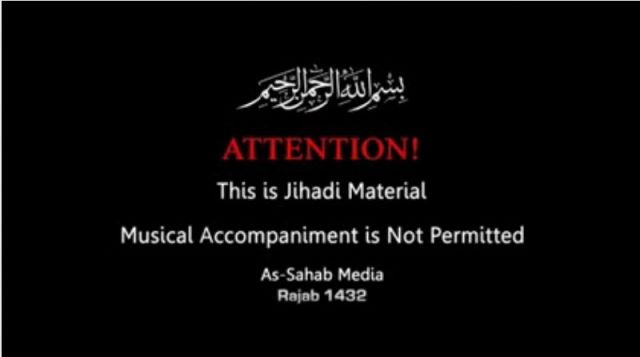
I’m grateful to JM Berger (@intelwire) and Chris Anzalone (@ibnsiqilli) for their encouragement and help with this post. JM provided the screengrab above, which shows a title card from a recent al-Zawahiri video — I suspect it may have been the one he mentioned here [text now mildly updated]:

Back in the day, when Adam Gadahn was just getting started as guru to Al Qaeda’s media operations, he released a couple of fairly slick videos designed to appeal to Western audiences by mimicking Western documentaries — up to and including the presence of a musical soundtrack.

It is therefore interesting to note that the latest release from As-Sahab (which Gadahn basically runs at this point) opens with a short disclaimer. “ATTENTION: We do not permit musical accompaniment with our productions.” One second later, a nasheed (religious song) fired up, but I guess that doesn’t count.

I’m guessing this is due to input from one of Gadahn’s Al Qaeda overseers. It’s interesting that these guys can rationalize away visits to strip clubs but they can’t handle a light orchestral score.

Chris tells me that Tehrik-i Taliban Pakistan has included similar notes in some of its videos. Indeed as JM put it in a tweet yesterday, “The odd thing is most of these guys would not be cool with music” — while as Chris noted, “Opposition to music with instruments, it should be said, isn’t unique to jihadis.”

So that’s the context: here’s the thing that interests me.

*

I can appreciate using the Old Master’s portrait of Christ that’s on the album cover to accompany a YouTube video of Bach’s B Minor Mass performed by Philippe Herreweghe (left), I can understand using a series of “nature scenes” for the Diego Fasolis performance (middle), I can even bite my lip and remain silent when someone lays a cute graphic of a wide-eyed young thing with a white rabbit (right) on top of Ton Koopman‘s version —

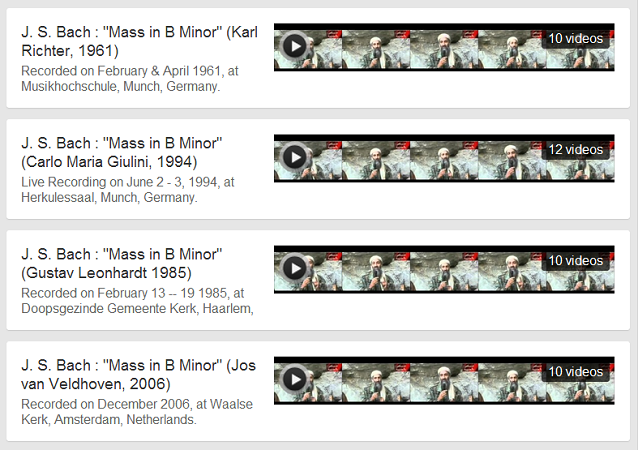
But my eyes simply bug out when I find someone has posted not one but four versions of Bach’s great Mass on YouTube, on not four but 42 separate videos, with bin Laden talking — silently, his lips moving — on each one.

Amazingly enough, that’s what someone calling themselves SOMALIAAFGHANISTAN has done.

*

Look, people, this is strange.

Lawrence Wright quotes Osama bin Laden [link, at p 167] as saying “Music is the flute of the devil”.

I was doing some research for this post on Google, and ran across this:

Fair enough, I thought, and went to Last.FM, where I found this artist featured:

Bullet for my bloody valentine.

I kid you not.

*

See, this all started because I was looking to play myself some Bach organ music and ran across a video of Marie-Claire Alain performing Bach’s BWV 767, which is pretty terrific — Alain is a great organist, it’s a remarkable work, etc etc — and found myself staring at this:

I mean, that’s not from the Bach part of my life, that’s from the part of my life that tracks jihadist utterances and theology…

*

As my friend Chris Anzalone, whose posts on jihadist graphics I always read with interest, pointed out to me, this particular video has an extensive explanation of its heraldic significance attached:

Coat of Arms Of The Famous Afridi Pashtun Afghan Pathan Tribe

Flag of the Afghan Tribe – The Afridi.

Made from historical Texts & references.

Main Circle/Islam Symbolism:

White circle: Unified, unbroken & Islam 4 stars: 4 sons of Qis/Kesh/Qais Abdur Rashid Crown: Representation of Qis/Kesh/Qais Abdur Rashid & his Bani Israel lineage which is from the Ancient Royal House of Israel Lion with Flag: The Lion of Judah/The Bravery of the Afghans & the emblem of many Afghan Kingdoms Olive Tree: Descent from the House of Israel/Bani Israel Black Background: The world in troment, pain & ignorance, showing the messianic dedication of Afghans that spread Islam through kings and Sufis throughout India.

Tribal Symbolism on Coat of Arms:

Babe Khyber/Fort: Defending the borders of Afghanistan for centuries and masters of siege warfare. They successfully held the mountain passess of Afghanistan against the counter attack of many Indian Armies. Bolt Rifle: One of the first among Afghans to master the art of local Rifle and small arms making. They were famous for their sniper marksmen skills with the 3 not 3 or .303. Camel Caravan: Afridis are skilled businessmen. AK 47: Every Afridi child is given one before passing into adulthood.
Red Background: The Traditional color of the Afridis.

Reference Material:

* The Pathans 55O B.C.-A.D. 1957 By Sir Olaf Caroe
* History of the Afghans by Bernhard Dorn
* History of the Afghans Original by Neamet Ullah (active 1613-30) in the court of the Mughal emperor Jahangir (1569-1627)
* Tareekh i Farishta
* History of the Afghans edition X by Fut’h Khan in 1718
* The Works of the Pashto Academy Peshawar University and The Pashto Dept. Islamia College Peshawar through countless publications, both online and offline, and may writers including Dr. Yusafzai, much of which you can find at Khyber.org
* History of Kohat -Gazetteer of the Kohat District
* History of Peshawar -Gazetteer of the Peshawar District
* Afghan Poetry: Selections from the poems of Khush Hal Khan Khattak., Biddulph, C.D., Saeed Book Bank, Peshawar, 1983 (reprint of 1890 ed.)
* A Grammer Of The Pukhto, Pushto: Or Language Of The Afghans, Raverty, H.G., London, 1860
* Poems from the Diwan of Khushâl Khân Khattak, MacKenzie, D.N, London, Allen & Unwin, 1965
* Notes on the Tarikh-e-Murassa, Plowden, Maj.
* Settlement Report of Bannu, Thorburn

This text, in turn, comes from a Wikipedi page on the Afridi Tribal Flag posted by a user named Afghan Historian. Who has an enviable library.

Sadly enough, Wikipedia notes “The factual accuracy of this description is disputed” — although it’s not clear by whom.

*

There are interesting references in the scholarly footnotes to the Afridi flag to “Qais Abdur Rashid & his Bani Israel lineage which is from the Ancient Royal House of Israel” and to “the messianic dedication of Afghans that spread Islam through kings and Sufis throughout India”…

The idea that the Afghans are descendants of the “lost tribes” of Israel is explored in the Jewish Virtual Library here. As to the Afghans’ “messianic dedication” — I’m not clear exactly what the word messianic means in this context, but it’s an interesting word choice in any case.

*

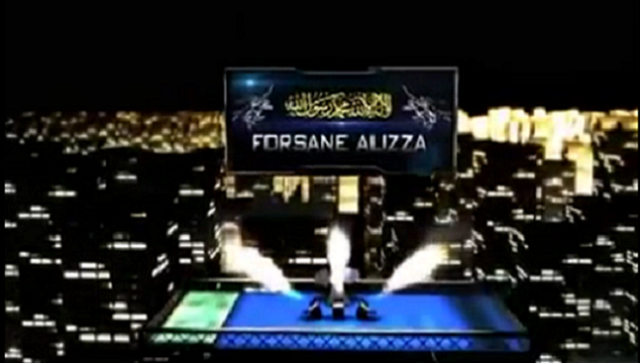
When I first looked up this image on TinEye, my image-search engine of choice, the only version it reported was from the site of Forsane Alizza, a now-disbanded group in France whose leader claims to preach only non-violence:

Je vous préviens dès maintenant que je n’ai ni armes, ni explosifs, ni drogues, ni même quoi que ce soit d’illégal. Si cela venait à arriver, soyez intelligent réfléchissez et souvenez vous que depuis sa création et jusqu’à la fin, Forsane Alizza use et n’usera, que de sa liberté d’expression et son droit à manifester contre des lois injustes et illégal au vu des droits de l’homme. D’ailleurs toutes nos actions sont non violentes et elles le resteront.

while the security police claim to have found weapons in his house.

The Forsane Alizza video, from which the snazzy image directly above was taken, shows members practicing martial arts and painball games…

*

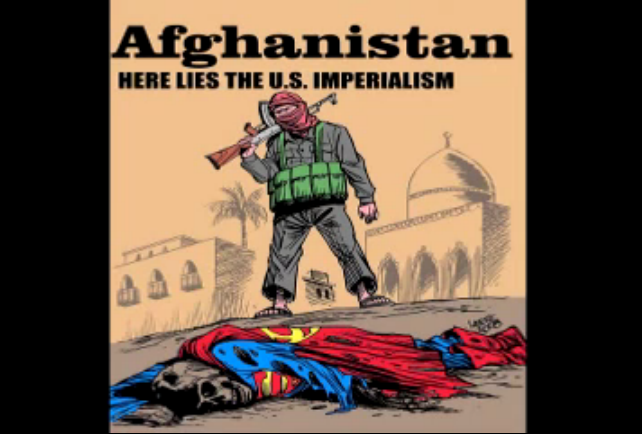
And how’s this for an illustration of Bach’s BWV 566, the C Major Toccata and Fugue — and the death of American pop culture?

To sum up: what’s all this about? Why pair Bach with bin Laden, the Afridi, the demise of superman and all the rest?

*

I don’t want to leave you with a bad taste in your mouth.

If you want to see what it’s like to hear Gustav Leonhardt conducting the Kyrie from the B Minor Mass juxtaposed with images of bin Laden, you’ll find that here. You may, of course, prefer the Herreweghe version, with another variant of his album cover with the face of Christ as the accompanying visual…

And for Marie-Claire Alain performing Bach, sans the Afridi, may I recommend this hour long recital, which I just happened upon myself thanks to this post?

Some unknown calculus

Thursday, March 1st, 2012

[ by Charles Cameron — thinking inside and outside the pack, Robert Wright, John Robb, Iran, outliers ]
.

1.

Robert Wright just closed his Atlantic piece on Why Bombing Iran Would Mean Invading Iran with an exchange from a couple of years back between Gen. James Cartwright, then Vice-Chairman of the Joint Chiefs, and Sen. Jack Reed:

Senator Reed: I presume that [a bombing campaign] would not be 100 percent effective in terms of knocking them out. It would probably delay them, but that if they’re persistent enough they could at some point succeed. Is that a fair judgment from your position?

General Cartwright: That’s a fair judgment.

Senator Reed: So that the only absolutely dispositive way to end any potential would be to physically occupy their country and to disestablish their nuclear facilities. Is that a fair, logical conclusion?

General Cartwright: Absent some other unknown calculus that would go on, it’s a fair conclusion.

2.

Look, I’m way outside my zone of focus here, but that phrase “some unknown calculus” intrigues me.

Maybe Robert Wright should read John Robb. Maybe that “unknown calculus” is in Robb’s post, Israel, Iran and the Poor Man’s Cruise Missile:

One of the Stratfor research “findings” (culled from the Wikileaks stockpile) is that Israel claimed its upcoming strike on Iran would be “catastrophic enough” to cause a regime change. This claim was made both to dissuade Iran from going forward with its program, physically eliminating their ability to move forward with the program, and persuade the US to act instead of Israel.

Running through all of the potential scenarios, only one emerges that makes sense.

A strike on Iranian oil facilities. A strike so devastating that it disrupts all of its oil production, currently at 4 million barrels a day.

How to do that? Drones.

Look, Robb’s piece came out yesterday, Wright’s piece came out today — and who knows how long the editorial process might have taken. So I don’t blame Wright.

3.

The point is, Robb doesn’t think with the pack. And that means he comes up with ideas the pack is blind to.

Outliers.

“I Call the Left Hemisphere the Berlusconi of the Brain”

Sunday, February 12th, 2012

The RSA video below is very, very good. It gave me several insights:

First, that two of our more negative trends in American society – the tendency to politicize all aspects of life, no matter how trivial and then, after bitterly polarizing them, subject activities to litigation that were never meant to be regulated in a free society – is a result of a Left hemisphere -dominant cultural “ratchet”.

The cognitive capacity to isolate, compartmentalize and analyze free of context is a biological-psychological driver behind the “cultural imperialism” of the domains of politics and law to subsume and dominate all other human activities; this is quite apart from the content of specific ideologies held by the advocates, which could easily aggravate or inhibit these tendencies. It would also help if the most ideological of our politicians and lobbyist-activists were not also themselves lawyers with a professional training in crafting tunnel-visioned micromanaging language.

Secondly, the thesis in this RSA video might help explain the mystery of Joseph Tainter’s The Collapse of Complex Societies– the stubborn rationalization of piling on ever greater degrees of complexity, despite empirical evidence of harm or decline mustered by advocates of social control that goes beyond protecting rice bowls or the horse-trading/bargaining. Much of the vast TSA security theater promoted by DHS, for example, represents a huge economic waste in terms of expense, spillover costs and opportunity costs while doing very little to increase security from terrorist attacks.

It becomes very difficult to secure agreement to reduce higher complexity levels to simpler structures or forms, once they are established. Instead, more complexity is usually added to route around the problem. In terms of the above example, the Obama administration is belatedly trying to undo years of post-9/11 nonsensical regs that deters legitimate business and scientific travelers from visiting the United States with various new tourism-friendly initiatives, but is avoiding the obvious solution of reducing the size and scope of DHS/TSA authority that has made air travel here a nightmare in the first place.  In fact, there are moves by the administration to expand TSA authority into all public spaces to habituate Americans to a greater degree of  (admittedly less sinister) scrutiny than East Germans once had from Stasi.

Check it out:


Switch to our mobile site